 July 2025
Ordinary Council
Business Paper
2:00 PM Thursday 17 July 2025
Council Chambers, 17 Burrawan Street, Port Macquarie
July 2025
Ordinary Council
Business Paper
2:00 PM Thursday 17 July 2025
Council Chambers, 17 Burrawan Street, Port Macquarie
 |

Our Vision
The most liveable, sustainable and innovative place in Australia
Community Mission
Enable and empower great service delivery, innovation and community connection
through efficient, effective and well-governed organisational operations.
Council’s Corporate Values
People, Service to our community, Excellence, Respectful and open communication, Working together as one. Please update the corporate values.
Councillors are reminded of the oath or affirmation which was taken by each of them.
Oath Of Councillor
I swear that I will undertake the duties of the office of Councillor in the best interests of the people of Port Macquarie-Hastings local government area and the Port Macquarie-Hastings Council and that I will faithfully and impartially carry out the functions, powers, authorities and discretions vested in me under the Local Government Act 1993 or any other Act to the best of my ability and judgment.
Affirmation Of Councillor
I solemnly and sincerely declare and affirm that I will undertake the duties of the office of Councillor in the best interests of the people of Port Macquarie-Hastings local government area and the Port Macquarie-Hastings Council and that I will faithfully and impartially carry out the functions, powers, authorities and discretions vested in me under the Local Government Act 1993 or any other Act to the best of my ability and judgment.
Councillors have the opportunity to declare any interests in items on the agenda and inform the Council and public if they will be leaving the Chambers during the debate and voting on the item.
Item Subject Page
01 Acknowledgement of Country........................................................................ 1
02 Remote Attendance at Meeting..................................................................... 1
03 Local Government Prayer.............................................................................. 1
04 Apologies........................................................................................................ 1
05 Confirmation of Minutes................................................................................. 1
06 Disclosures of Interest.................................................................................... 1
07 Mayoral Minute
08 Confidential Correspondence to Ordinary Council Meeting........................ 38
09 Items To Be Dealt With By Exception
10 Office of the Chief Executive Officer
10.01.... Mayoral Discretionary Fund Allocations - 5 June to 2 July 2025.. 40
10.02.... Recognition of Industry Awards..................................................... 42
10.03.... Delegates Report - Deputy Mayor Lauren Edwards - National General Assembly 2025............................................................................... 47
11 Business and Performance
11.01.... Disclosure of Interest Return - Designated Persons..................... 50
11.02.... Status Of Reports From Council Resolutions................................ 52
11.03.... Status of Council Policies............................................................... 63
11.04.... Delegation of Authority to the General Manager........................... 66
11.05.... Draft Code of Conduct................................................................... 71
11.06.... Investments and Loans - June 2025.............................................. 75
11.07.... Policy Review - Draft Reduction or Waiver of Council Fees and Charges Policy - Post Public Exhibition..................................................................... 86
11.08.... Policy Review - Debt Recovery Policy........................................... 97
11.09.... Policy Review - Hardship Policy.................................................. 101
11.10.... Report of the Audit, Risk and Improvement Committee Meeting Held 12 June 2025.............................................................................................. 106
11.11.... 12 Month Review Report - Pilot Training and Aircraft Noise - Fly Neighbourly Agreement.................................................................................... 110
11.12.... Contracts Awarded Under S377 Local Government Act............. 118
12 Community Infrastructure
12.01.... Petition - Council to Establish a Port Macquarie-Hastings Active Transport Advisory Committee..................................................................... 121
12.02.... Petition - Kendall Community Op Shop Parking.......................... 125
12.03.... Notice of Motion - Review of Ferry Operations............................ 130
13 Community Planning and Environment
13.01.... Policy Review - Works-in-Kind Agreement and Developer Works Deed Policy...................................................................................................... 132
13.02.... Policy Review - Planning Agreement Policy................................ 136
13.03.... Post Exhibition - Places to Play Plan........................................... 146
13.04.... Grant Funding Opportunities Quarterly Report............................ 151
13.05.... Community Grants 2024-2025..................................................... 155
13.06.... Scoping Proposal - Land within Yippin Creek Structure Plan..... 164
13.07.... Draft Lake Cathie Foreshore Reserve Master Plan Review....... 180
13.08.... Urban Growth Management Strategy Update............................. 185
13.09.... Biodiversity Committee - Draft Charter........................................ 193
13.10.... Climate Change and Resilience Committee - Draft Charter....... 201
13.11.... Lake Cathie Natural Resource Management Monthly Update Report 208
13.12.... Notice of Motion - Update on Homelessness in the Port Macquarie-Hastings Local Government Area............................................................... 214
13.13.... Notice of Motion - NSW Clubgrants............................................. 216
13.14.... Notice of Motion - Review of Public Swimming Pool Operations 220
14 Community Utilities
Nil
15 Late Items
16 Confidential Matters
Motion to move into Confidential Session.................................................. 222
16.01.... 2024.090 Port Macquarie Wastewater Treatment Plant Optimisation and Aerator Replacement Tender
16.02.... 2024.005.01 Design and Construction of Cowarra Water Treatment Plant Tender
Agenda
Item: 01
Subject: Acknowledgement of Country
"I acknowledge that we are gathered on Birpai Land. I pay respect to the Birpai Elders both past and present. I also extend that respect to all other Aboriginal and Torres Strait Islander people present."
Item: 02
Subject: Remote attendance at meeting
That Council accede to the request of Councillors to attend the meeting by remote means.
Subject: Local Government Prayer
A Minister from the Combined Churches of Port Macquarie will be invited to deliver the Local Government Prayer.
Subject: Apologies
Recommendation
That the apologies received be accepted.
Subject: Confirmation of Minutes
Recommendation
That the Minutes of the Ordinary Council Meeting held on 19 June 2025 be confirmed.
Subject: Disclosure of Interest
Recommendation
That Disclosures of Interest be presented
 Minutes
19 June 2025
Ordinary Council
PRESENT
Members:
Mayor Adam Roberts
Councillor Lauren Edwards
Councillor Mark Hornshaw
Councillor Lisa Intemann
Councillor Chris Kirkman
Councillor Nik Lipovac
Councillor Danielle Maltman
Councillor Rachel Sheppard
Councillor Hamish Tubman
Other Attendees:
Acting Chief Executive Officer (Robert Fish)
Director Business and Performance (Keith Hentschke)
Director Community, Planning and Environment (Melissa Watkins)
Acting Director Community Infrastructure (Blayne West)
Acting Director Community Utilities (Cameron Hawkins)
Group Manager Governance (Michael Ferguson)
Governance Officer (Tania Ellis)
The meeting opened at 2.02pm.
|
01 Acknowledgement of Country |
|
The Mayor opened the Meeting with an Acknowledgement of Country and welcomed all in attendance in the Chamber and viewing on line. |
|
02 Remote Attendance at Meeting |
|
Resolved: Roberts/Intemann That Council accede to the request of Councillor Sheppard to attend the meeting by remote means. carried: 9/0 For: Edwards, Hornshaw, Intemann, Kirkman, Lipovac, Maltman, Roberts, Sheppard and Tubman Against: Nil |
|
03 Local Government Prayer |
|
Captain Peter Gott from the Salvation Army delivered the Local Government Prayer. |
|
04 Apologies |
|
Nil. |
|
05 Confirmation of Minutes |
|
Resolved: Lipovac/Hornshaw That the Minutes of the Ordinary Council Meeting held on 15 May 2025 be confirmed. carried: 9/0 For: Edwards, Hornshaw, Intemann, Kirkman, Lipovac, Maltman, Roberts, Sheppard and Tubman Against: Nil |
|
06 Disclosures of Interest |
|
Councillor Lipovac declared a Non-Pecuniary - Less than Significant interest in Item 11.04 Draft Integrated Planning and Reporting Documents - Post Exhibition. The reason being is that both CRUZE FM and Radio 531 are mentioned in the Operational Plan of this agenda as a part of a wide range of media options recently used to run advertisements on behalf of Council. Although Councillor Lipovac is an employee of this business, the campaign expenditure was relatively minor, totalling $660. Councillor Lipovac intends to remain in the meeting, participate, and vote in the matter as this perceived conflict will not influence his decision making in the matter. Councillor Tubman declared a Pecuniary interest in Item 13.12 Scoping Proposal - LEP Housekeeping Amendments 2025. The reason being is that Councillor Tubman is in the process of purchasing Rural zoned land and this item includes a proposed amendment to Council’s LEP that relates to secondary dwellings in the rural zone. Councillor Tubman intends to leave the meeting, be out of sight and take no part in consideration of this item. Councillor Hornshaw declared a Non-Pecuniary - Less than Significant interest in Item 13.12 Scoping Proposal - LEP Housekeeping Amendments 2025. The reason being is that Councillor Hornshaw is the owner of, and resides on Rural zoned land. Cr Hornshaw noted that any future changes to the Local Environmental Plan provisions relating to the rural zones impact all owners of rural zoned land. Councillor Hornshaw intends to remain in the meeting, participate and vote in the matter as this perceived conflict will not influence his decision making in the matter. Councillor Maltman declared a Non-Pecuniary - Less than Significant interest in Item 13.13 Lake Cathie Natural Resource Management Monthly Update Report. The reason being that Councillor Maltman is a non-financial life member and former President of the community organisation Revive Lake Cathie Incorporated. Councillor Maltman intends to remain in the meeting, participate and vote in the matter as this perceived conflict will not influence her decision making in the matter. Councillor Lipovac declared a Non-Pecuniary - Less than Significant interest in Item 13.14 Friends of Camden Head Lookout (Pilot Station) update. The reason being that Jon Bailey who is listed as one of the volunteers seeking endorsement, ran on Councillor Lipovac’s Group Ticket at the Local Government Election September 2024. Councillor Lipovac intends to remain in the meeting, participate and vote in the matter as this perceived conflict will not influence his decision making in the matter. Acting Chief Executive Officer Robert Fish declared a Pecuniary interest in Item 12.01 Hastings River Flood Study Extension. The reason being is that Acting CEO Fish owns a property within the flood Planning area, and flood modelling impacts on the property may vary pending the outcome of the exhibition and adoption of the study. Director Fish intends to leave the meeting during consideration of this item. |
|
07.01 May 2025 Natural Disaster Flood Event |
|
Resolved: Roberts That Council: 1. Note its thanks, appreciation and contribution of the Port Macquarie-Hastings Council staff who worked tirelessly for our community during the escalation/management of the May 2025 natural disaster flood emergency and the recovery/clean-up operations. 2. Note its thanks, appreciation and contribution of the front line emergency agency responders, in particular the NSW State Emergency Service the combat agency for flooding events, and organisations who worked tirelessly during the May 2025 natural disaster flood event and to those organisations represented at the Emergency Operations Centre, including the NSW Police Force, NSW Ambulance Service, Fire and Rescue NSW, NSW Rural Fire Service, NSW State Emergency Service, NSW Marine Rescue, Surf Life Saving MNC Branch, Transport for NSW, NSW Maritime, NSW Reconstruction Authority, Department of Communities and Justice, Mid North Coast Local Health District, NSW Public Works, Essential Energy, Local Land Services, NSW Department of Primary Industries and Regional Development, Birpai Local Aboriginal Land Council, Telecommunications, Busways, the Resupply Planning Team, Kempsey Shire Council and Nambucca Valley Council. 3. Note its thanks and appreciation to our local community for coming together in this latest natural disaster flood event to assist those in need during the emergency and the recovery clean-up. 4. Note its thanks to the NSW Government and Australian Government for their immediate response and support in declaring a Natural Disaster and the subsequent deployment of resources and community support during and after the May 2025 weather event.
carried: 9/0 For: Edwards, Hornshaw, Intemann, Kirkman, Lipovac, Maltman, Roberts, Sheppard and Tubman Against: Nil |
|
08 Confidential Correspondence to Ordinary Council Meeting |
|
Nil |
|
09 Items to be Dealt With By Exception |
|
Resolved: Roberts/Intemann That Items 10.02, 11.01, 11.02, 11.07, 11.10, 11.12, 11.13, 11.14, 11.15, 11.16, 13.02, 13.03, 13.05, 13.07, 13.09, 13.11 and 13.16 be considered as a block resolution carried: 9/0 For: Edwards, Hornshaw, Intemann, Kirkman, Lipovac, Maltman, Roberts, Sheppard and Tubman Against: Nil Resolved: Intemann/Edwards That all recommendations listed in the block resolution be adopted by Council.
carried: 9/0 For: Edwards, Hornshaw, Intemann, Kirkman, Lipovac, Maltman, Roberts, Sheppard and Tubman Against: Nil |
|
10.02 Mayoral Discretionary Fund Allocations - 1 May to 4 June 2025 |
|
Resolved: Intemann/Edwards That Council note the Mayoral Discretionary Fund allocations for the period 1 May to 4 June 2025. |
|
11.01 Status Of Reports From Council Resolutions |
|
Resolved: Intemann/Edwards That Council note the information contained in the Status of Reports from Council Resolutions report. |
|
11.02 Monthly Budget Review - May 2025 |
|
Resolved: Intemann/Edwards That Council: 1. Adopt the adjustments in the May 2025 Adjustments section of the Monthly Budget Review – May 2025 report and associated attachment. 2. Amend the 2024-2025 Operational Plan to include all budget adjustments approved in this report. |
|
11.07 2023-2024 Dividend for Tax Equivalents - Water Fund and Sewer Fund |
|
Resolved: Intemann/Edwards That Council: 1. Endorse the recognition of tax-equivalent dividend payments totalling $449,000 for the 2023–2024 financial year, comprising: • $199,000 from the Water Fund; and • $250,000 from the Sewer Fund, as reported in the audited 2023–2024 Special Purpose Financial Statements. 2. Determine that the tax-equivalent dividends will be retained as restricted funds within their respective Water and Sewer Funds in the 2024–2025 financial year. 3. Acknowledge compliance with Section 409 of the Local Government Act 1993 and the NSW Government’s Guidelines for Council Dividend Payments for Water Supply or Sewerage Services in relation to tax-equivalent dividend payments. |
|
11.10 Audit, Risk and Improvement Committee Four-Year Strategic Work Plan and Four-Year Strategic Internal Audit Plan |
|
Resolved: Intemann/Edwards That Council: 1. Adopt the Audit Risk and Improvement Committee four-year Strategic Work Plan. 2. Adopt the Audit Risk and Improvement Committee four-year Strategic Internal Audit Plan. |
|
11.12 Draft Code of Meeting Practice |
|
Resolved: Intemann/Edwards That Council: 1. Pursuant to section 361(3) of the Local Government Act 1993, place on public exhibition the draft Code of Meeting Practice as attached as Attachment 1 for a period of not less than of 28 days. 2. Pursuant to section 361(4) of the Local Government Act 1993, accept submissions on the draft Code of Meeting Practice, for a period of not less than 42 days. 3. Note that a further report will be presented at a future meeting of Council, detailing the submissions received during the exhibition period. 4. Conduct a comprehensive review of its Code of Meeting Practice following the release of the updated Model Code of Meeting Practice by the Office of Local Government. |
|
11.13 Policy Review - Investment Policy |
|
Resolved: Intemann/Edwards That Council: 1. Endorse the Draft Investment Policy for the purpose of public exhibition. 2. Place the draft Investment Policy on public exhibition for a period of 28 days, in accordance with Council’s Community Engagement Strategy. 3. Receive a further report at the conclusion of the exhibition period, detailing any submissions received and recommending a final Investment Policy for adoption. |
|
11.14 Policy Review - Councillor Expenses and Facilities Policy |
|
Resolved: Intemann/Edwards That Council: 1. Pursuant to Section 253 of the Local Government Act 1993, place on public exhibition the draft Councillor Expenses and Facilities Policy for a period of not less than 28 days. 2. Note that a further report will be tabled at the August 2025 meeting of Council, detailing the submissions received from the public during the exhibition period. |
|
11.15 Policy Review - Mayoral Discretionary Fund Policy - Post Public Exhibition |
|
Resolved: Intemann/Edwards That Council: 1. Adopt the Mayoral Discretionary Fund Policy. 2. Thank those who made a submission and advise of Council’s determination in this matter. |
|
11.16 Policy Review - Pensioner Concession Rebates Policy |
|
Resolved: Intemann/Edwards That Council: 1. Endorse the Draft Pensioner Concession Rebates Policy for the purpose of public exhibition. 2. Place the draft Pensioner Concession Rebates Policy on public exhibition for a period of 28 days, in accordance with Council’s Community Engagement Strategy. 3. Receive a further report at the conclusion of the exhibition period, detailing any submissions received and recommending a final Pensioner Concession Rebates Policy for adoption. |
|
13.02 Draft Community Engagement Policy |
|
Resolved: Intemann/Edwards That Council: 1. Note the information contained within this report relating to the review of the Community Engagement Policy. 2. Endorse the updated Community Engagement Policy for public exhibition for a period of not less than 28 days. 3. Note that Council will receive a further report at future Ordinary Council meeting outlining community feedback received during the public exhibition period. |
|
13.03 Community Engagement Plan - Sports Field User Pay Model. |
|
Resolved: Intemann/Edwards That Council note the information contained in this report. |
|
13.05 Policy Review - Development Contributions Assessment Policy - Post Public Exhibition |
|
Resolved: Intemann/Edwards That Council: 1. Rescind the Development Contributions Assessment Policy upon commencement of the Port Macquarie-Hastings Local Infrastructure Contributions Plan 2025. 2. Adopt the Development Servicing Plan Administration Procedure (Attachment 4) to take effect on 1 July 2025. |
|
13.07 Policy Review - Volunteering |
|
Resolved: Intemann/Edwards That Council: 1. Note the information contained within this report regarding the review of the Volunteer Policy. 2. Endorse the revised draft Volunteer Policy for public exhibition for a period of not less than 28 days. 3. Note that a further report at a future Ordinary Council meeting outlining community feedback received during the public exhibition period. |
|
13.09 Policy Review - Beach Driving Policy - Post Public Exhibition |
|
Resolved: Intemann/Edwards That Council: 1. Note the submissions and feedback received relating to the review of the Beach Driving Policy during the public exhibition period. 2. Adopt the revised Beach Driving Policy. 3. Thank people who provided feedback during the review of the Beach Driving Policy and advise them of Council determination. |
|
13.11 Update on Site Specific Planning Proposal Requests Bi-Annual Report |
|
Resolved: Intemann/Edwards That Council: 1. Note the status of Site Specific Planning Proposal requests detailed in this report. 2. Receive a further update report in December 2025 regarding the progress of Site Specific Planning Proposal requests. |
|
13.16 Recommended Items from the May 2025 Meeting of the Port Macquarie-Hastings Sporting Fund |
|
Resolved: Intemann/Edwards That Council endorse the Port Macquarie-Hastings Sporting Fund Sub-Committee recommendations as follows: 1. Payment of $750.00 to Sienna Furney to compete at the Australian Little Athletics Championships between the 24 and 28 April 2025 in Adelaide. 2. Payment of $250.00 to Cameron McLean-Prosser to compete at the NSWCHS Championships Boys Football between the 2 and 4 June 2025 in Sydney. 3. Payment of $250.00 to Jack Wilson to compete at the Rugby Union State Championships between the 6 and 9 June 2025 in Maitland. 4. Payment of $750.00 to Tobias Toohey to compete at the 2025 Hockey National Championships between the 4 and 12 July 2025 in Perth. |
|
10.01 May 2025 Flood Event - Response, Immediate Relief and Recovery Overview |
|
Resolved: Roberts/Intemann That Council: 1. Note the information provided in this report regarding the management of the May 2025 flood event within the Port Macquarie-Hastings local government area and the ongoing recovery efforts. 2. Note the provisions included in Council’s Rates and Charges Hardship Assistance Policy for property owners who have had a house, facility or outbuilding determined to be destroyed or damaged by the responsible government agency as a result of a natural disaster. 3. Commencing 24 May 2025 until 30 June 2025, waive all waste disposal fees and charges at Waste Transfer Stations and the Cairncross Waste Management Facility for local government area residents and businesses disposing of flood-damaged waste, where verified by inspection at the point of entry by Council waste staff. 4. Note that flood-damaged waste from residential and business properties impacted by flooding has been collected from the kerbside and removed at no charge, as outlined in this report. 5. Waive the fees and charges associated with the use of Council’s vehicular ferry services until 30 June 2025 as outlined within this report. 6. Waive all rebuilding and reconstruction fees and charges for flood impacted properties that have been damaged or destroyed as determined by the responsible government agency, with the exception of State imposed statutory fees, related to: a) Development Applications b) Complying Development Certificates c) Construction Certificates d) Section 68 applications (including plumbing and drainage) e) Onsite Sewer Management System applications f) Section 138 Road Opening permits for properties damaged or destroyed as a result of the May 2025 flood event, where permissible under legislation. 7. Waive the additional fees and charges as detailed in this report, in relation to owners of properties and local businesses which have been damaged or destroyed during the flooding event as determined by the responsible government agency, including: a) Interest on rates and charges. b) Direct debit dishonour fees. c) Fees for food shop inspections. d) Fees for public health inspections. e) Animal impound and maintenance fees f) Fees to alter an existing sewerage management facility under section 68. g) Road Occupation fees under Section 138 for clean-up purposes. 8. Extend the above Rates and Charges provisions to non-residential property owners.
carried: 9/0 For: Edwards, Hornshaw, Intemann, Kirkman, Lipovac, Maltman, Roberts, Sheppard and Tubman Against: Nil |
Item 10.02 Mayoral Discretionary Fund Allocations - 1 May to 4 June 2025, has been addressed previously within the meeting.
Item 11.01 Status Of Reports From Council Resolutions, has been addressed previously within the meeting.
Item 11.02 Monthly Budget Review - May 2025, has been addressed previously within the meeting.
|
11.03 Investments and Loans - May 2025 |
|
Resolved: Intemann/Tubman That Council note the Investment and Loans report for May 2025.
carried: 9/0 For: Edwards, Hornshaw, Intemann, Kirkman, Lipovac, Maltman, Roberts, Sheppard and Tubman Against: Nil |
|
11.04 Draft Integrated Planning and Reporting Documents - Post Exhibition |
|
Councillor Lipovac declared a Non-Pecuniary - Less than Significant interest in this item, the reason being is that both CRUZE FM and Radio 531 are mentioned in the Operational Plan of this agenda as a part of a wide range of media options recently used to run advertisements on behalf of Council. Although Councillor Lipovac is an employee of this business, the campaign expenditure was relatively minor, totalling $660. Councillor Lipovac remained in the meeting, participated, and voted in the matter as this perceived conflict did not influence his decision making in the matter. |
|
Resolved: Roberts/Intemann That Council: 1. Note the submissions received by Council during the public exhibition period as contained in the draft Integrated Planning and Reporting “Our Community, Our Plan” Community Engagement Report (Attachment 1). 2. Note Council’s response to community feedback for each of the draft Integrated Planning and Reporting “Our Community, Our Plan” documents (Attachment 2). 3. Note the detailed amendments to the exhibited draft Integrated Planning and Reporting “Our Community, Our Plan” documents resulting from community feedback during the public exhibition period (Attachment 3) including the allocation of a portion of the available general rate yield to sustain service levels for parks and stormwater maintenance. 4. Note that use of the available rate yield for the purposes of sustaining service levels for parks and stormwater maintenance across the duration of the Long Term Financial Plan 2025-2035, includes utilisation of 20% of the available rate yield in 2025-2026 and a further 31% of the available rate yield in 2026-2027, resulting in an additional allocation of $0.9 million in the 2025-2026 budget and a further $1.4 million in 2026-2027. 5. Adopt the following Integrated Planning and Reporting “Our Community, Our Plan” documents: a) Community Strategic Plan Imagine2050 (Attachment 4) subject to an amendment to the Liveable and Economic themes to include Arts Mid North Coast as a .key collaborator’ b) Delivery Program 2025-2029 including the draft Operational Plan 2025-2026 (Attachment 5) subject to an amendment to the 2025-2026 Operational plan/budget to allocate funding for continued membership with Arts Mid north Coast, to be offset by an equivalent reduction in funding for the community grants program. c) Resourcing Strategy 2025-2035 (Attachment 6), comprising: i) Long Term Financial Plan 2025-2035 ii) Workforce Management Strategy 2025-2029 iii) Asset Management Strategy 2025-2035 6. In accordance with the NSW Office of Local Government Integrated Planning and Reporting Guidelines for Local Government in NSW September 2021, publish a copy of the adopted Integrated Planning and Reporting “Our Community, Our Plan” documents on Council’s website within 28 days of adoption. 7. Thank community members who provided feedback on the draft Integrated Planning and Reporting “Our Community, Our Plan” documents during the public exhibition period. 8. Thank those who made a submission in relation to the draft Integrated Planning and Reporting “Our Community, Our Plan” documents and advise them of Council’s determination of this matter carried: 8/1 For: Edwards, Intemann, Kirkman, Lipovac, Maltman, Roberts, Sheppard and Tubman Against: Hornshaw
|
|
11.05 Draft Asset Management Plans - Post Exhibition |
|
Resolved: Edwards/Intemann That Council: 1. Note the amendments to the draft Asset Management Plans during the public exhibition period. 2. Note the submission received during the public exhibition period, as contained in the Asset Management Plans Engagement Summary Report June 2025. 3. Thank and advise those who made a submission in relation to the Draft Asset Management Plans of Council’s determination on this matter. 4. Adopt the draft Asset Management Plans.
carried: 9/0 For: Edwards, Hornshaw, Intemann, Kirkman, Lipovac, Maltman, Roberts, Sheppard and Tubman Against: Nil |
11.06 Making of 2025-2026 Fees and Charges, Revenue Policy, and Rating Maps and Notation of Proposed Budget Adjustments |
|
A. Resolved: Roberts/Maltman
That Council: 1. Note the financial commentary related to the Draft 2025-2026 Budget and updated 2025-2035 Long-Term Financial Plan in support of the Draft Resourcing Strategy 2025-2035, Draft Delivery Program 2025-2029 and Draft Operational Plan 2025-2026 presented as a separate report on this agenda. 2. Note that the commentary referred to in point 1 and as determined by Council for agenda item 11.04, included the allocation of a portion of the available general rate yield to sustain service levels for parks and stormwater maintenance within the 2025-2026 financial year, with a further requirement in the 2026-2027 financial year to sustain these services. 3. Note that bringing point 2 into effect across the duration of the Long Term Financial Plan 2025-2035 as adopted by Council for agenda item 11.04, includes utilisation of 20% of the available rate yield in 2025-2026 and a further 31% of the available rate yield in 2026-2027, resulting in an additional allocation of $0.9 million in the 2025-2026 budget and a further $1.4 million in 2026-2027. 4. Note the amendments to the exhibited 2025-2026 Fees and Charges, 2025-2026 Revenue Policy and 2025-2026 Rating Maps. 5. Adopt the 2025-2026 Fees and Charges (including amendments to reflect statutory fees set by state and Federal Government agencies) and the 2025- 2026 Revenue Policy and the 2025-2026 Rating Maps as attached subject to the reinstatement of the concessional admission fees for the Port Macquarie public swimming pool of $4.70 and $4.30 for Kendall, Laurieton, Wauchope public swimming pools for holders of a Blue Pensioner Concession Card or Veteran Affairs Card only. 6. Make the 2025-2026 Rates, Special Rates and Charges as outlined in the attached 2025-2026 Revenue Policy, 2025-2026 Rating Maps and 2025-2026 Fees and Charges document. 7. Approve minor amendments to the draft documents to correct minor clarifications and typographical errors. 8. Set the interest rate on overdue rates and charges at 10.5% from 1 July 2025 to 30 June 2026 in accordance with the Office of Local Government determination 9. Amend the 2026-2026 Budget to include a reduction of the Community Grants program budget to fund the continued membership of Arts Mid North Coast for 2025-2026, as adopted in agenda item 11.04 - Draft Integrated Planning and Reporting Documents - Post Exhibition. carried: 8/1 For: Edwards, Intemann, Kirkman, Lipovac, Maltman, Roberts, Sheppard and Tubman Against: Hornshaw |
Item 11.07 2023-2024 Dividend for Tax Equivalents - Water Fund and Sewer Fund, has been addressed previously within the meeting.
|
11.08 Improvement Plan 2022-2026 - General Fund Operating Performance |
|
Resolved: Edwards/Tubman That Council note the progress update on the Improvement Plan 2022–2026, which outlines the continued implementation of initiatives to improve Council’s long-term financial sustainability and operational efficiency.
carried: 9/0 For: Edwards, Hornshaw, Intemann, Kirkman, Lipovac, Maltman, Roberts, Sheppard and Tubman Against: Nil |
|
11.09 Write Off Bad Debts - Sundry Debtors |
|
Resolved: Lipovac/Intemann That Council in accordance with its Debt Recovery Policy, approve the following Sundry Debtor amounts be written off as bad debts, as they are no longer considered recoverable. 1. Virgin Australia Airlines – $210,498.80. 2. JetGo Australia – $27,253.67
carried: 9/0 For: Edwards, Hornshaw, Intemann, Kirkman, Lipovac, Maltman, Roberts, Sheppard and Tubman Against: Nil |
Item 11.10 Audit, Risk and Improvement Committee Four-Year Strategic Work Plan and Four-Year Strategic Internal Audit Plan, has been addressed previously within the meeting.
Councillor Maltman left the meeting, the time being 03:43pm.
Councillor Hornshaw left the meeting, the time being 03:44pm.
Councillor Maltman returned to the meeting, the time being 03:45pm.
Councillor Hornshaw returned to the meeting, the time being 03:46pm.
|
11.11 Review of Disbanded Council Committees |
|
Resolved: Edwards/Intemann 1. Note the information provided in the report. 2. Endorse the principles and guidelines referenced in the report for the establishment of future committees by Council. 3. Request the Chief Executive Officer to develop a draft Port Macquarie-Hastings Council Establishment and Management of Committees Policy on the basis of the principles and guidelines referenced in the report for the establishment of Council committees for consideration by Council at the August 2025 meeting of Council. carried: 6/3 For: Edwards, Intemann, Lipovac, Roberts, Sheppard and Tubman Against: Hornshaw, Kirkman and Maltman
|
Item 11.12 Draft Code of Meeting Practice, has been addressed previously within the meeting.
Item 11.13 Policy Review - Investment Policy, has been addressed previously within the meeting.
Item 11.14 Policy Review - Councillor Expenses and Facilities Policy, has been addressed previously within the meeting.
Item 11.15 Policy Review - Mayoral Discretionary Fund Policy - Post Public Exhibition, has been addressed previously within the meeting.
Item 11.16 Policy Review - Pensioner Concession Rebates Policy, has been addressed previously within the meeting.
|
12.01 Hastings River Flood Study Extension |
|
Acting Chief Executive Officer Robert Fish declared a Pecuniary interest in this item, the reason being is that Acting CEO Fish owns a property within the flood Planning area, and flood modelling impacts on the property may vary pending the outcome of the exhibition and adoption of the study. Director Fish left the meeting during consideration of this item. Resolved: Intemann/Edwards That Council: 1. Note the deferral of the Hastings River Flood Study Extension report previously scheduled for adoption at the June 2025 Ordinary Council Meeting. 2. Receive a further report detailing the submissions received from the public exhibition period and resulting changes to the study.
carried: 9/0 For: Edwards, Hornshaw, Intemann, Kirkman, Lipovac, Maltman, Roberts, Sheppard and Tubman Against: Nil |
Councillor Tubman left the meeting, the time being 03:49pm.
Councillor Tubman returned to the meeting, the time being 03:50pm.
|
13.01 Draft Community Engagement Strategy |
|
Resolved: Sheppard/Intemann 1. Endorse the draft Community Engagement Strategy (Attachment 1) for the purpose of public exhibition. 2. Endorse the proposed Engagement Plan to support the public exhibition of the draft Strategy as included as Attachment 3 subject to the following: a) The inclusion of an additional key message on "How do you want Council to engage with you?" b) The inclusion of a specific question seeking community views on the use of committees as a means of consulting and collaborating on important planning, policy and strategic matters of Council. c) The preparation and inclusion in the exhibition material, of a Fact Sheet to assist with informing responses to the question identified in b), based on the information contained in Item 11.11 Review of Disbanded Council Committees from the June 2025 Ordinary Council meeting agenda. 3. Place the Community Engagement Strategy on public exhibition for a period of not less than 28 days. carried: 5/4 For: Edwards, Intemann, Lipovac, Sheppard and Tubman Against: Hornshaw, Kirkman, Maltman and Roberts
|
Item 13.02 Draft Community Engagement Policy, has been addressed previously within the meeting.
Item 13.03 Community Engagement Plan - Sports Field User Pay Model., has been addressed previously within the meeting.
|
13.04 Community Inclusion Plan and Cultural Plan Engagement |
|
Resolved: Edwards/Tubman That Council endorse the themes outlined in the report to be incorporated into the development of the new Cultural and Community Inclusion plans.
carried: 5/4 For: Edwards, Intemann, Lipovac, Sheppard and Tubman Against: Hornshaw, Kirkman, Maltman and Roberts |
Item 13.05 Policy Review - Development Contributions Assessment Policy - Post Public Exhibition, has been addressed previously within the meeting.
|
13.06 Post Exhibition Report - Port Macquarie-Hastings Local Infrastructure Contributions Plan 2025 |
|
Resolved: Edwards/Lipovac That Council: 1. Note the feedback received on the revised draft Port Macquarie-Hastings Local Infrastructure Contributions Plan 2025 during the exhibition period and outlined in the report. 2. Adopted the Port Macquarie-Hastings Local Infrastructure Contributions Plan 2025 as amended. 3. Repeal the relevant contributions plans and the provision of notice of repeal as per clause 215 of the Environmental Planning and Assessment Regulation 2021 effective upon commencement of the Port Macquarie-Hastings Local Infrastructure Contributions Plan 2025 which include: i. Port Macquarie-Hastings Administration Building Contributions Plan 2007. ii. Section 94 Administration Levy Contributions Plan 2005 iii. Port Macquarie-Hastings Contributions Plan 1993. iv. Hastings Section 94 Major Roads Contribution Plan 2006 v. Hastings Section 94 Open Space Contributions Plan 2006 vi. Port Macquarie-Hastings Council Open Space Contributions Plan vii. 2018 Hastings River Drive Section 94 Contribution Plan for Traffic Facility Works 2006 viii. Innes Peninsula Road Works s94 Contribution Plan, Port Macquarie-Hastings Council, ix. Kings Creek Contributions Plan Version 2.5. x. Laurieton Walkway Contributions Plan. xi. North Haven Neighbourhood Business Precinct Contributions Plan 2006. xii. The Bains Dairy Contributions Plan 2006. xiii. Port Macquarie-Hastings Community, Cultural and Emergency Services Development Contributions Plan 2005. xiv. Port Macquarie-Hastings Council s94A Levy Contributions Plan 2007. xv. S94 Local Roads Contributions Plan - Areas 13, 14 & 15 Port Macquarie-Hastings Council 2014. 4. Authorise the Director Community, Planning and Environment to make minor changes and alterations prior to publishing on Council website and Planning Portal. 5. Advise those community members who provided feedback on the draft Local Infrastructure Contributions Plan of Council’s determination.
carried: 9/0 For: Edwards, Hornshaw, Intemann, Kirkman, Lipovac, Maltman, Roberts, Sheppard and Tubman Against: Nil |
Item 13.07 Policy Review - Volunteering, has been addressed previously within the meeting.
|
13.08 Policy Review - Dogs in Public Open Spaces - Post Public Exhibition |
|
That Council: 1. Note the submissions and feedback received relating to the review of the revised Dogs in Public Open Space Policy during the public exhibition period. 2. Adopt the revised Dogs in Public Open Space Policy. 3. Thank people who provided feedback during the review of the revised Dogs in Public Open Space Policy and advise them of Council determination. 4. Request the Chief Executive Officer to develop a Fact Sheet to support the new Policy and to include behavioural expectations and penalties that apply in both Off Leash and On Leash settings. carried: 9/0 For: Edwards, Hornshaw, Intemann, Kirkman, Lipovac, Maltman, Roberts, Sheppard and Tubman Against: Nil |
Item 13.09 Policy Review - Beach Driving Policy - Post Public Exhibition, has been addressed previously within the meeting.
|
13.10 DA2024
- 749.1 2 Into 3 Lot Subdivision to Create 2 Industrial Lots and a Residue
Lot, Vegetation Removal and Associated Infrastructure at Lot 1 DP 729726 and
Lot 100 DP 1130726, No 178 Nancy Bird Walton Drive and Ocean Drive, Kew |
|
Resolved: Intemann/Roberts That Council determine DA2024 - 749.1 for a 2 into 3 lot Torrens title subdivision to create 2 industrial lots and a residue lot, vegetation removal, and associated infrastructure at Lot 1 DP 729726 and Lot 100 DP 1130726, No. 178 Nancy Bird Walton Drive, Kew and Ocean Drive, Kew, by granting consent subject to the recommended conditions as included in Attachment 1 to this report. carried: 9/0 For: Edwards, Hornshaw, Intemann, Kirkman, Lipovac, Maltman, Roberts, Sheppard and Tubman Against: Nil |
Item 13.11 Update on Site Specific Planning Proposal Requests Bi-Annual Report, has been addressed previously within the meeting.
|
13.12 Scoping Proposal - LEP Housekeeping Amendments 2025 |
|
Councillor Tubman declared a Pecuniary interest in this item, the reason being is that Councillor Tubman is in the process of purchasing Rural zoned land and this item includes a proposed amendment to Council’s LEP that relates to secondary dwellings in the rural zone. Councillor Tubman left the meeting, was out of sight and took no part in consideration of this item.
Councillor Hornshaw declared a Non-Pecuniary - Less than Significant interest in this item, the reason being is that Councillor Hornshaw is the owner of, and resides on Rural zoned land. Cr Hornshaw noted that any future changes to the Local Environmental Plan provisions relating to the rural zones impact all owners of rural zoned land. Councillor Hornshaw remained in the meeting, participated and voted in the matter as this perceived conflict did not influence his decision making in the matter.
Resolved: Hornshaw/Kirkman
That Council: 1. Endorse the Scoping Proposal (Attachment 1), to facilitate a pre-lodgement meeting with the Department of Planning, Housing and Industry subject to the following: a) The addition of an amendment to the proposed parameters under Matter 4 of the report relating to secondary dwellings (Clause 2.5) in the Scoping Proposal – LEP Housekeeping Amendments 2025, to consider: i. Increasing the maximum permissible distance of a secondary dwelling from the principal dwelling from 200 metres to 300 metres; ii. Increasing the maximum floor area of a secondary dwelling from 120m² or 50% of the principal dwelling, to 120m² or 80% of the principal dwelling, whichever is greater; b) The addition of a new Matter 18 - Dual Occupancy development to consider permitting dual occupancies (detached) in rural zones in the Scoping Proposal - LEP Housekeeping Amendments 2025 And request the Acting Chief Executive Officer include these alternative parameters and the additional matter within the scope of the review and assess their potential implications in terms of land use planning, infrastructure, and rural land management. c) That the assessment information referred to above be reported to Council prior to any lodgement with the Department. 2. Endorse the preparation of a Council-initiated Planning Proposal for LEP Housekeeping Amendments 2025 under section 3.33 of the Environmental Planning and Assessment Act 1979 on the basis of Item 1.
carried: 6/2 For: Hornshaw, Intemann, Kirkman, Lipovac, Maltman, and Roberts Against: Edwards and Sheppard
|
|
13.13 Lake Cathie Natural Resource Management Monthly Update Report |
|
Councillor Maltman declared a Non-Pecuniary - Less than Significant interest in this item, the reason being that Councillor Maltman is a non-financial life member and former President of the community organisation Revive Lake Cathie Incorporated. Councillor Maltman remained in the meeting, participated and voted in the matter as this perceived conflict did not influence her decision making in the matter.
Resolved: Maltman/Intemann That Council note the progress of natural resource management projects/initiatives within the Lake Cathie, Lake Innes and Cathie Creek Waterways and the progress of the Coastal Management Program.
carried: 9/0 For: Edwards, Hornshaw, Intemann, Kirkman, Lipovac, Maltman, Roberts, Sheppard and Tubman Against: Nil |
|
13.14 Friends of Camden Head Lookout (Pilot Station) update |
|
Councillor Lipovac declared a Non-Pecuniary - Less than Significant interest in this item , the reason being that Jon Bailey who is listed as one of the volunteers seeking endorsement, ran on Councillor Lipovac’s Group Ticket at the Local Government Election September 2024. Councillor Lipovac remained in the meeting, participated and voted in the matter as this perceived conflict did not influence his decision making in the matter. Motion Moved: Lipovac/Tubman That Council note the update on current activities of the Friends of Camden Head Lookout volunteer group.
Amendment Moved: Intemann/Edwards That Council: 1. Note the update on current activities of the Friends of Camden Head Lookout volunteer group. 2. Report this matter to the July 2025 Ordinary Council meeting, in addition to the regular bi-monthly report. lost: 2/7 For: Edwards and Intemann Against: Hornshaw, Kirkman, Lipovac, Maltman, Roberts, Sheppard and Tubman
The amendment on being put was lost.
Deputy Mayor Edwards left the meeting, the time being 04:49pm.
The motion on being put was carried.
|
|
Resolved: Lipovac/Tubman That Council note the update on current activities of the Friends of Camden Head Lookout volunteer group carried: 5/3 For: Hornshaw, Kirkman, Maltman, Roberts and Tubman Against: Intemann, Lipovac and Sheppard
|
Deputy Mayor Edwards returned to the meeting, the time being 04:51pm.
|
13.15 Notice of Motion - Sports Field Drainage |
|
Motion Moved: Roberts/Maltman That Council: 1. Note the correspondence received from the Local Member for Port Macquarie, Mr Robert Dwyer MP, regarding the Tuffins Lane Sporting Precinct. 2. Continue to engage with Mr Robert Dwyer MP on grant funding opportunities to progress the Environmental Impact Statement required to progress the Tuffins Lane sports fields drainage improvements. 3. Initiate a focussed review on sports fields drainage across the Local Government Area as part of the annual review of the Recreational Open Space Action Plan. Amendment Moved: Sheppard/Roberts
That Council: 1. Note the correspondence received from the Local Member for Port Macquarie, Mr Robert Dwyer MP, regarding the Tuffins Lane Sporting Precinct. 2. After a review conducted by Council’s Legal Counsel, remove the confidential restrictions previously resolved for Item 16.02 Potential Purchase of Land in Tuffins Lane, Port Macquarie at the October 2022 Ordinary Council Meeting, ensuring redaction of any Confidential information in accordance with Section 10A(2) of the Local Government Act 1993. 3. Provide a copy of the reviewed report, being Item 16.02 Potential Purchase of Land in Tuffins Lane, Port Macquarie at the October 2022 Ordinary Council Meeting, to State Members for Port Macquarie and Oxley, Federal Members for Lyne and Cowper and place a copy of the report on Council’s website for public access. 4. Initiate a focussed review of sports fields drainage across the Local Government Area as part of the Annual Review of the Recreational Open Space Action Plan.
Procedural Motion Resolved: Sheppard/Roberts That Council refer this matter to the confidential session of Council noting the confidential nature of a report that will be the subject of a motion/amendment moved with respect to this item. carried: 8/1 For: Edwards, Hornshaw, Intemann, Kirkman, Lipovac, Roberts, Sheppard and Tubman Against: Maltman
|
Item 13.16 Recommended Items from the May 2025 Meeting of the Port Macquarie-Hastings Sporting Fund, has been addressed previously within the meeting.
|
Confidential Session |
|
Resolved: Roberts/Lipovac 1. That pursuant to section 10A subsections 2 & 3 and 10B of the Local Government Act 1993 (as amended), the press and public be excluded from the proceedings of the Confidential Session of Council on the basis that items to be considered are of a confidential nature. 2. That Council move into Closed Session to receive and consider the following items: Item 16.01 Land Acquisition - 84 Bain Street Wauchope This item is considered confidential under Section 10A(2)(c) of the Local Government Act 1993, as it contains information that would, if disclosed, confer a commercial advantage on a person with whom the Council is conducting (or proposes to conduct) business. Item 16.02 Review into the Effectiveness of the Audit, Risk and Improvement Committee This item is classed CONFIDENTIAL under Section 10A(2)(d(iii)) of the Local Government Act 1993, which permits the Meeting to be closed to the public for business relating to commercial information of a confidential nature that would, if disclosed, reveal a trade secret. 3. That the resolutions made by Council in Confidential Session be made public as soon as practicable after the conclusion of the Confidential Session and such resolutions be recorded in the Minutes of the Council Meeting. carried: 9/0 For: Edwards, Hornshaw, Intemann, Kirkman, Lipovac, Maltman, Roberts, Sheppard and Tubman Against: Nil Resolved: Edwards/Roberts
That the Council meeting be closed to the public for the consideration of confidential items for the reason as listed in the reports. carried: 9/0 For: Edwards, Hornshaw, Intemann, Kirkman, Lipovac, Maltman, Roberts, Sheppard and Tubman Against: Nil |
Councillor Tubman left the meeting, the time being 05:04pm.
Councillor Maltman left the meeting, the time being 05:04pm.
Councillor Kirkman left the meeting, the time being 05:04pm.
Procedural Motion
Resolved: Roberts/Lipovac
That the Ordinary Council Meeting be adjourned.
carried: 6/0
For: Edwards, Hornshaw, Intemann, Lipovac, Roberts and Sheppard
Against: Nil
The meeting adjourned at 5.05pm
The meeting recommenced at 5.10pm
Councillor Tubman returned to the meeting, the time being 05:10pm.
Councillor Maltman returned to the meeting, the time being 05:10pm.
Councillor Kirkman returned to the meeting, the time being 05:10pm.
|
13.15 Notice of Motion - Sports Field Drainage |
|
Motion Moved: Roberts/Maltman That Council: 1. Note the correspondence received from the Local Member for Port Macquarie, Mr Robert Dwyer MP, regarding the Tuffins Lane Sporting Precinct. 2. Continue to engage with Mr Robert Dwyer MP on grant funding opportunities to progress the Environmental Impact Statement required to progress the Tuffins Lane sports fields drainage improvements. 3. Initiate a focussed review on sports fields drainage across the Local Government Area as part of the annual review of the Recreational Open Space Action Plan. Amendment Moved: Sheppard/Roberts
That Council: 1. Note the correspondence received from the Local Member for Port Macquarie, Mr Robert Dwyer MP, regarding the Tuffins Lane Sporting Precinct. 2. After a review conducted by Council’s Legal Counsel, remove the confidential restrictions previously resolved for Item 16.02 Potential Purchase of Land in Tuffins Lane, Port Macquarie at the October 2022 Ordinary Council Meeting, ensuring redaction of any Confidential information in accordance with Section 10A(2) of the Local Government Act 1993. 3. Provide a copy of the reviewed report, being Item 16.02 Potential Purchase of Land in Tuffins Lane, Port Macquarie at the October 2022 Ordinary Council Meeting, to State Members for Port Macquarie and Oxley, Federal Members for Lyne and Cowper and place a copy of the report on Council’s website for public access, prior to any further advocacy for funding in relation to Tuffins Lane. 4. Initiate a focussed review of sports fields drainage across the Local Government Area as part of the Annual Review of the Recreational Open Space Action Plan. carried: 9/0 For: Edwards, Hornshaw, Intemann, Kirkman, Lipovac, Maltman, Roberts, Sheppard and Tubman Against: Nil The amendment on being put was carried.
The amendment became the motion.
The motion on being put was carried. |
|
B. Resolved: Sheppard/Roberts
That Council: 1. Note the correspondence received from the Local Member for Port Macquarie, Mr Robert Dwyer MP, regarding the Tuffins Lane Sporting Precinct. 2. After a review conducted by Council’s Legal Counsel, remove the confidential restrictions previously resolved for Item 16.02 Potential Purchase of Land in Tuffins Lane, Port Macquarie at the October 2022 Ordinary Council Meeting, ensuring redaction of any Confidential information in accordance with Section 10A(2) of the Local Government Act 1993. 3. Provide a copy of the reviewed report, being Item 16.02 Potential Purchase of Land in Tuffins Lane, Port Macquarie at the October 2022 Ordinary Council Meeting, to State Members for Port Macquarie and Oxley, Federal Members for Lyne and Cowper and place a copy of the report on Council’s website for public access, prior to any further advocacy for funding in relation to Tuffins Lane. 4. Initiate a focussed review of sports fields drainage across the Local Government Area as part of the Annual Review of the Recreational Open Space Action Plan. carried: 9/0 For: Edwards, Hornshaw, Intemann, Kirkman, Lipovac, Maltman, Roberts, Sheppard and Tubman Against: Nil
|
|
16.01 Land Acquisition - 84 Bain Street Wauchope |
|
Resolved: Tubman/Lipovac That Council: 1. Note the information contained within this report, which provides details on the acquisition and settlement of the land. 2. Pursuant to section 59 of the Land Acquisition (Just Terms Compensation) Act 1991, pay the property owners conveyancing costs. 3. Pursuant to section 10 of the Roads Act 1993, dedicate the land as identified in this report as public road. carried: 9/0 For: Edwards, Hornshaw, Intemann, Kirkman, Lipovac, Maltman, Roberts, Sheppard and Tubman Against: Nil |
|
16.02 Review into the Effectiveness of the Audit, Risk and Improvement Committee |
|
Resolved: Intemann/Maltman That Council: 1. Note the information contained within the review of the effectiveness of the Audit, Risk and Improvement Committee. 2. Request that the Audit, Risk and Improvement Committee consider the findings within the review and include the actions listed in the Internal Audit Actions Register for implementation. 3. Maintain the confidentiality of the documents and consideration in respect of this item. carried: 9/0 For: Edwards, Hornshaw, Intemann, Kirkman, Lipovac, Maltman, Roberts, Sheppard and Tubman Against: Nil |
Resolved: Lipovac/Intemann
That the Council Meeting be re-opened to the public.
carried: 9/0
For: Edwards, Hornshaw, Intemann, Kirkman, Lipovac, Maltman, Roberts, Sheppard and Tubman
Against: Nil
The outcomes of the Confidential Session of the Ordinary Council meeting were read to the meeting by the Group Manager Governance.
|
The meeting closed at 5.35pm. |
.......................................................
Adam Roberts
Mayor
Agenda Ordinary Council 17/07/2025
Subject: CONFIDENTIAL CORRESPONDENCE TO ORDINARY COUNCIL MEETING
Presented by: Chief Executive Officer, Robert Fish
There are no confidential attachments to the reports for the Ordinary Council Meeting.
Agenda Office of the Chief Executive Officer
Subject: Mayoral Discretionary Fund Allocations - 5 June to 2 July 2025
Presented by: Office of the CEO, Robert Fish
That Council note the Mayoral Discretionary Fund allocations for the period 5 June to 2 July 2025.
Executive Summary
To advise of the Mayoral Discretionary Fund allocations for the period 5 June to 2 July 2025 inclusive.
Report
1. Background
As per the Mayoral Discretionary Fund Policy, a report is to be presented to each Council Meeting on the allocations from the Mayoral Discretionary Fund.
2. Discussion
The following allocation was made by the Mayor from the Mayoral Discretionary Fund during this reporting period - note this donation was made prior to 30 June 2025 in the 2024-2025 financial year:
|
Item |
Amount |
|
Donation of Glasshouse Vouchers to Winter Wonderland Black & White Cocktail Fundraiser on 28 June 2028 by Steve Brbich - entrant in Stars of the Hastings 2025 (raising funds for the Cancer Council of NSW) |
$200.00 |
|
Total allocation |
$200.00 |
3. Conclusion
This report is presented to Council as per Council’s adopted policy.
Key Considerations
4. Financial and Economic Implications
There are no economic implications in relation to this report.
The allocation made during this reporting period were funded from the Mayoral Discretionary Fund as included in the 2024-2025 Operational budget.
5. Legislative and Policy Implications
There are no legislative implications in relation to this report. The report is provided to Council as per the requirements of the Mayoral Discretionary Fund Policy.
6. Strategic Context and Implications
There are no strategic context implications in relation to this report.
7. Risk and Insurance Implications
There are no risk or insurance implications in relation to this report.
8. Engagement and Consultation
The donation made from the Discretionary Fund was approved by the Mayor and the Group Manager Governance.
9. Civic Leadership
The donation made from the Mayoral Discretionary Fund is in accordance with Council’s adopted policy.
Options
Council could elect to not adopt the recommendation outlined in the report.
|
Attachments Nil
|
Agenda Office of the Chief Executive Officer
Subject: Recognition of Industry Awards
Presented by: Office of the CEO, Robert Fish
That Council acknowledge and commend the contributions across the organisation that have led to recognition in industry awards through 2024-2025, as listed in this report.
Executive Summary
Port Macquarie Hastings Council has continued its strong commitment to excellence and in recognition of this ongoing work, Council was acknowledged with several prestigious awards and commendations in 2024-2025. These accolades are a reflection of our dedicated staff, organisational progression, innovative practices, and commitment to community wellbeing and excellence.
Report
1. Background
Industry awards provide an external benchmark and recognition of the value and impact of a commitment to excellence.
2. Discussion
Council has
received the following recognitions in the 2024-2025 financial year:
|
Industry and Award Category |
Award Recognition |
|
2024 Cemeteries and Crematoria Association of NSW - Award for Excellence |
Winner |
|
2024 Mumbrella Travel Marketing Awards - Ad Campaign of the Year · Awarded for PMHC ‘Where time does Wonders’ campaign - Breakthrough Destination of the Year |
Winner |
|
2024 LearnX Awards - Diamond Award - Best eLearning Design
Video |
Winner |
|
2024 National Local Government Customer Service Awards - National Innovation of the Year |
Highly Commended |
|
2024 Crown Lands NSW and ACT Community Achievement Awards - Crown Land Management Excellence Award |
Finalist |
|
2025 StateCover Mutual Awards - Wellbeing: Best Strategic and Integrated Approach · Awarded for excellence in keeping our people safe, well, and working. |
Winner |
|
2025 CivicRisk Mutual Excellence in Risk Management Awards - Risk Initiative Category |
Winner |
|
- People, Workplace and Wellbeing Award |
Highly Commended |
|
2025 IPWEA NSW & ACT Engineering Excellence Awards - Environment & Sustainability Category |
Highly Commended |
|
2025 LG Professional Awards - Rural Management Challenge |
Runners Up |
|
2025 LG Professional Awards - Innovative Leadership Award - Organisational Diversity and Inclusion
Award - Special Project Initiative (Between
50K-150K Population) Award - Asset and Infrastructure - Under $1.5
million Award - Asset and Infrastructure - Over $1.5
milion (Between 50K-150K Population) Award |
Finalist |
|
2025 Parks & Leisure Australia NSW/ACT Regional Awards of Excellence - Community-Based Initiative of the Year - Community Facility of the Year - Playspace (Over $500k) - Environmental Stewardship Award |
Commendation |
|
2025 Australian Institute of Landscape Architect Awards - Parks and Open Space · Kendall Recreation Reserve |
Finalist |
3. Conclusion
Council has received multiple awards and commendations across state-level industry bodies. These recognitions highlight the breadth of Council’s work and affirm our position as a leader in local government excellence, validating the success of strategic initiatives and the commitment of our workforce. Council’s acknowledgment of these achievements reinforces a culture of excellence.
Key Considerations
4. Financial and Economic Implications
Council was awarded $5,000 from StateCover Mutual for the award received, our workers compensation insurer. There are no other direct financial implications from the recognition. However, these awards may enhance Council’s employer branding and reputation, potentially improving access to future grant funding, partnerships and attraction of prospective staff during recruitment.
5. Legislative and Policy Implications
There are no legislative requirements associated with this report. Recognition aligns with Council’s strategic policies on organisational excellence and continuous improvement.
6. Strategic Context and Implications
There is no relevant strategic context and implications associated with the awards.
7. Risk and Insurance Implications
There are no identified risks associated with the awards.
8. Engagement and Consultation
Internal engagement was conducted with relevant teams to compile award submissions and verify achievements. External recognition was provided by independent industry bodies.
9. Civic Leadership
These achievements support priorities by acknowledging work in wellbeing, inclusion, infrastructure, and environmental initiatives - demonstrating strong, transparent governance and commitment to the community.
Options
Option 1: Accept the report and acknowledge the awards and commendations received.
Option 2: Request further information.
|
Attachments Nil
|
Agenda Office of the Chief Executive Officer
Subject: Delegates Report - Deputy Mayor Lauren Edwards - National General Assembly 2025
Presented by: Councillor Lauren Edwards
That Council note the information contained within the delegates report.
Report
As Deputy Mayor of Port Macquarie-Hastings Council, I attended the National General Assembly, hosted by the Australian Local Government Association (ALGA), to represent the Port Macquarie-Hastings Council and Community as the voting delegate.
Port Macquarie-Hastings Council put two motions up to the National General Assembly (NGA) 2025 that were accepted onto the agenda and were unanimously resolved in the block, or Section A, of the agenda on day one of voting. This is because the motions were consistent with current ALGA policy and position.
These motions were adopted by Council at its March 2025 Ordinary Council meeting and read:
1. This National General Assembly calls on the Australian Government to:
Support Local Governments in addressing the need for Climate Adaptation initiatives, through formula-based funding that is provided to all Councils.
2. This National General Assembly calls on the Australian Government to:
Ensure that any further Federal grant funding programs for enabling infrastructure that supports housing delivery apportions at least $500million each year for which only Local Governments are eligible.
The Theme of this year’s NGA was “National Priorities Need Local Solutions” and the event included voting sessions, presentations and forums – some with the opportunity to ask questions and also listening sessions on four areas: Emergency Management, Safer Roads, Housing and Community Infrastructure and Local Government Jobs and Skills. The listening sessions were run simultaneously, and I chose to attend the session on Housing and Community Infrastructure.
Day 1 was the Regional Forum, and delegates were welcomed by the ALGA President. On the morning of day 1, Bernard Salt AM - Founder and Executive Director of The Demographics Group, gave a very interesting presentation titled “State of the Regions” and revealed some important population trends and economic opportunities for the Regions of Australia. Key takeaways were that: the trend is that the Regions are set to experience the most growth in population over the next decade, that peak demand for aged care services will occur in the next 5-6 years so there is much need to see more key workers come to Regional Australia and finally, that the Regions should aim for at least a 25% increase in food production and up to 40% increase in food production to do much more than just ensure food security but to maximise economic opportunities and prosperity for the Regions and for Australia as a nation.
Day 1 also delivered a talk from the University of Canberra on Drought and Community Resilience with the key takeaway being that Drought needs to be included in Australia’s definition of a Natural Disaster and that Drought Hubs and Dry Time Talks are some good models and resources to search out.
Day 2 of the NGA featured a welcome and an address from the Governor General on the importance of education on civics and participation in our democracy. Also, on day 2, delegates heard from Mark Bouris AM and Dr Merriden Varrall who unpacked global economic forces shaping Australia’s local economies, including trends in trade, security, and investment. Mark Bouris AM, Australian Business Leader, Entrepreneur and Finance Expert, went into great technical detail on Inflation, GDP, Government Expenditure and the reserve bank function and methods. Dr Merriden Varrall covered some implications of unstable geopolitical environments for Local Government including financial sustainability, adapting to tech advancements, improving service delivery and streamlining operations and infrastructure development and maintenance. The key takeaway and common thread across all four areas were that supply chain disruptions including material costs increases and skills/labour supply shortages continue have great impact on the business of delivering in Local Government.
Delegates heard from a range of Federal Ministers across the Assembly including: The Honourable Kristy McBain MP, Senator the Hon Katy Gallagher, The Honourable Julian Hill MP, The Honourable Josh Wilson MP, The Honourable Darren Chester MP, Dr Anne Webster MP and the Honourable Kevin Hogan MP.
There was broad acknowledgement from Ministers that councils play a critical role in supporting their communities and that the role has expanded significantly, as has the financial pressure councils face and ALGA continued to call for urgent action, throughout the NGA event, to ensure the financial sustainability of councils.
Also on day 2, I attended the Coastal Councils morning tea event where I contributed that advocacy and calls for Federal Climate Adaptation Funding for Local Governments, should include a nationally consistent approach that is based on fair and equitable assessment and allocation. It was resolved that the Coastal Councils would seek to ensure that best use of ALGA, as a peak body, is made for advocacy purposes.
Jason Clarke, world leading consultant on issues of leadership and innovation, closed Day 1 of the NGA with an energising and practical presentation on how councils can take bold ideas and translate them into tangible, community-focused change and with many tips and tools including a great question to ask when problem solving alongside community members is about seeking to define first what the problem isn’t.
Day 3 featured the launch of ALGA’s exciting new research “Adapting Together: Local Government Leadership in a Changing Climate”. The report finds that Australia’s councils are expected to spend more than $2 billion over the next five years to futureproof their communities from the changing climate, resulting in up to $4.7 billion in avoided costs to communities. ALGA President Mayor Matt Burnett noted “Climate-resilient infrastructure is expensive and takes time to build, so we need sustainable funding from the Federal Government to implement long-term planning and adaptation
Now and into the future”. That is why “We are asking the Government for a new $400 million climate adaptation fund, distributed to all Australia’s councils each year, to deliver ongoing and sustainable place-based climate solutions” Mayor Burnett said.
Day 3 also featured the Concurrent Listening Session, and I attended the Housing and Community Infrastructure session. Panellists included: Novaplan, Citygreen, Civil Contractors Federation Australia, Department of Social Services and the Department of Infrastructure, Transport, Regional Development, Communications, Sport and the Arts. Delegates attending were reminded that Housing now sits within Department of Treasury and I raised a question on grant funding for enabling infrastructure and was able to quote how oversubscribed the Housing Support Program was and the enormous need that there is for further grant funding rounds.
Novaplan touched on just how common it is that Councils struggle to have good systems for managing Development Contributions including Voluntary Planning Agreements and Works in Kind Agreements too. Novaplan were a sponsor of the event.
Citygreen promoted the need for Green Infrastructure planning and implementation that focussed on the quality of the plantings to ensure survival and successful delivery of adequate urban shade within the built environment.
The final day involved a ministerial engagement forum with David Speers as MC. Many great questions were asked, and I was the very next at the microphone in the final session, with a question for Minister Gallagher, when time was called and so I just missed out. However, the Minister did answer some questions very well and was taking down notes on topics such as remunerations levels in Local Government and the need for pay that is commensurate with the responsibility, superannuation and maternity leave allowance.
The National General Assembly 2025 was and important and valuable forum to take part in and I highly recommend that Port Macquarie-Hastings Council aims to have a presence at each one in the future.
I end with a quote from the Mayor Russell Webb of Tamworth Regional Council, “if you’re not represented here, I think you’re doing yourself a disservice, but you’re doing your community a disservice, because you’re not being part of the organisation that’s actually going to help you find solutions for the challenges you face”.
Options
That the information contained within the delegates report be noted.
|
Attachments Nil
|
Agenda Business and Performance
Subject: Disclosure of Interest Return - Designated Persons
Presented by: Business and Performance, Keith Hentschke
That Council note the Disclosure of Interest Return for the following position:
Community Utilities - Director Community Utilities
Executive Summary
This report informs Council of the lodgement of a return disclosing the interests of designated persons which are required under Clause 4.21 of Council’s Code of Conduct.
The return for the abovementioned position will be tabled at this meeting.
Report
1. Background
Clause 4.21 of Council’s Code of Conduct requires Councillors and Designated Persons to prepare and submit written returns of interests. The following positions have been deemed a designated person under the Local Government Act:
• Director Community Utilities
Clause 4.23A to 4.23D of Council’s Code of Conduct require circumstances to be reported to Council where a staff member has failed to submit a return within the required timeframes following multiple reminders or if a return has been submitted with visibly incomplete information. I can confirm that no such instances have occurred regarding the subject returns.
2. Discussion
The disclosure returns will be held in the Disclosure Register in the Governance Section of Council and, as required by Section 6 of the Government Information (Public Access) Act 2009, they are available for public inspection by appointment or they are available on Council’s website noting residential addresses of staff may be redacted in accordance with the Local Government Act.
3. Conclusion
Clause 4.24 requires the General Manager (or Chief Executive Officer) to keep a Register of the Returns and Clause 4.25 requires the returns must be tabled at the first meeting of the Council after the last day the return is required to be lodged.
Key Considerations
4. Financial and Economic Implications
There are no financial or Economic Implications
5. Legislative and Policy Implications
Lodgement of a Return by a Designated Person is a requirement under Clause 4.21 of Council’s Code of Conduct.
6. Strategic Context and Implications
There are no Strategic Context and Implications
7. Risk and Insurance Implications
The failure of Councillors or Designated Persons to complete the returns as required under the Council’s Code of Conduct could increase the risk of fraud or conflicts of interest. The public declaration of a designated person’s interests provides oversight and informs the public of possible interests that that may exist in that designated persons work and personal environments.
8. Engagement and Consultation
• Group Manager Governance.
• Acting Chief Executive Officer.
9. Civic Leadership
There are no Civic Leadership implications
Options
Lodgement of a Return by a Designated Person is a requirement under Clause 4.21 of Council’s Code of Conduct.
|
Attachments Nil
|
Agenda Business and Performance
Subject: Status Of Reports From Council Resolutions
Presented by: Business and Performance, Keith Hentschke
That Council note the information contained in the Status of Reports from Council Resolutions report.
Discussion
|
JULY 2025 REPORTS |
||||||
|
Report |
Date and
Item |
Councillor Briefing |
Status |
Reporting Officer |
Due Date from Council resolution |
Previous Anticipated Date/s for Report |
|
Community Grants Program 2024-2025 |
15/08/2024 |
|
Receive a report to the July 2025 Council Meeting on outcomes of the 2024-2025 Grants Program |
DCPE |
Jul-25 |
|
|
Draft Places to Play Plans |
20/03/2025 |
|
A further report to council following public exhibition on submissions received. |
DCPE |
Jun-25 |
|
|
Draft Charter for a standing Biodiversity Committee |
15/05/2025 |
|
Draft charter to be presented to the July 2025 Ordinary Council Meeting |
DCPE |
Jul-25 |
|
|
Draft Charter for a standing Climate Change and Resilience Advisory Committee |
15/05/2025 |
|
Draft charter to be presented to the July 2025 Ordinary Council Meeting |
DCPE |
Jul-25 |
|
|
Delegation of Authority to the General Manager |
17/04/2025 |
|
Further report to be considered at the July 2025 |
DBP |
Jul-25 |
|
|
Port Macquarie Airport - Pilot Training and Aircraft Noise - Fly Neighbourly Agreement Trial 12 Month Review |
18/07/2024 |
|
A future report following the additional 12 month extension |
DBP |
Jul-25 |
|
|
AUGUST 2025 REPORTS |
||||||
|
Report |
Date and Item |
Councillor Briefing |
Status |
Reporting Officer |
Due Date from Council resolution |
Previous Anticipated Date/s for Report |
|
Customer Satisfaction Survey Action Plan |
17/04/2025 |
|
Communications team being fully deployed to support critical public safety efforts during recent severe weather events |
DBP |
Jul-25 |
|
|
Draft Recreation and Open Space Action Plan and Sporting Infrastructure Priorities |
18/04/2024 |
|
A report to Council following public exhibition |
DCPE |
Aug-25 |
|
|
Draft Domestic Violence Policy |
15/05/2025 |
|
Draft policy to be presented to the August 2025 Ordinary Council Meeting |
DCPE |
||
|
Draft Airport Master Plan |
17/04/2025 |
|
A report to Council following public exhibition |
DBP |
|
|
|
Flood Policy |
17/04/2025 |
|
A report to Council following public exhibition |
DCI |
Aug-25 |
|
|
Investigating a Sporting Venue Sponsorship Program |
17/04/2025 |
|
Receive a further report following feedback from Sports Council |
DCPE |
|
|
|
Review of Disbanded Council Committees |
19/06/2025 |
|
Develop draft Port Macquarie-Hastings Council Policy on the management and establishment of Council Committees |
DCPE |
Aug-25 |
|
|
Draft Code of Meeting Practice |
19/06/2025 |
|
A report to Council following public exhibition |
DBP |
|
|
|
AUGUST 2025 REPORTS |
|||||||
|
Report |
Date and
Item |
Councillor Briefing |
Status |
Reporting Officer |
Due Date from Council resolution |
Previous Anticipated Date/s for Report |
|
|
Policy Review - Councillor Expenses and Facilities Policy |
19/06/2025 |
|
A report to Council following public exhibition |
DBP |
|
|
|
|
Sovereign Hills Planning Agreement Assessment Report |
17/04/2025 |
|
The content of the submissions received on the Sovereign Hills VPA have been provided to the proponent. Council is currently waiting to receive a response from the proponent regarding what amendments they may be prepared to make in response to the submissions. |
DCPE |
|
Jun-25 |
|
|
T-22-10 Inlet Odour Management Works |
21/09/2023 |
|
Present a future report to Ordinary Council Meeting after contract awarded for Council's information |
DCU |
|
May-25 |
|
|
Workshop - Future IP&R and other Council reporting enhancements planned for 2025-2026 |
20/2/2025 |
Aug-25 |
Not yet scheduled |
DCPE |
|||
|
SEPTEMBER 2025 REPORTS |
|||||||
|
Report |
Date and Item |
Councillor Briefing |
Status |
Reporting Officer |
Due Date from Council resolution |
Previous Anticipated Date/s for Report |
|
|
Camden Haven River and Lakes System Flood Study 2025 |
17/04/2025 |
|
A report to Council following public exhibition |
DCI |
|||
|
Maria River Road Upgrade |
17/04/2025 |
|
Following CEO exercising the delegation under s.377 the outcomes be provided to a future council Meeting |
DCI |
|||
OCTOBER 2025 REPORTS |
||||||
|
Report |
Date and Item |
Councillor Briefing |
Status |
Reporting Officer |
Due Date from Council resolution |
Previous Anticipated Date/s for Report |
|
PP2024.10.1 - Planning Proposal Assessment Report Highway Services Site Oxley Highway, Sancrox. Applicant - Barr Planning Landowner Portcrox Pty Ltd |
15/05/2025 |
|
A report to Council following public exhibition |
DCPE |
|
|
NOVEMBER 2025 REPORTS |
||||||
|
Report |
Date and Item |
Councillor Briefing |
Status |
Reporting Officer |
Due Date from Council resolution |
Previous Anticipated Date/s for Report |
|
Budget Development Policy |
17/04/2025 |
Workshop yearly in November |
|
DBP |
|
|
|
FEBRUARY 2026 REPORTS |
||||||
|
Report |
Date and Item |
Councillor Briefing |
Status |
Reporting Officer |
Due Date from Council resolution |
Previous Anticipated Date/s for Report |
|
Classification as "Operational" Land - 52 John Oxley Drive, Port Macquarie - post exhibition. |
20/06/2018 |
|
To be incorporated in strategic property
portfolio review to be undertaken in 2022/2023 |
DCPE |
|
Feb-25 |
|
Statement of Business Ethics |
16/11/2023 |
|
Na |
GMP |
2026 |
|
DECEMBER 2026 REPORTS |
||||||
|
Report |
Date and Item |
Councillor Briefing |
Status |
Reporting Officer |
Due Date from Council resolution |
Previous Anticipated Date/s for Report |
|
Administering 2028 Local Government Election |
NA |
|
NA |
GMG |
NA |
NA |
|
JULY 2027 REPORTS |
||||||
|
Report |
Date and Item |
Councillor Briefing |
Status |
Reporting Officer |
Due Date from Council resolution |
Previous Anticipated Date/s for Report |
|
Councillor Numbers for 2028 Local Government Election |
NA |
|
NA |
GMG |
NA |
NA |
|
FUTURE REPORTS |
||||||
|
Report |
Date and Item |
Councillor Briefing |
Status |
Reporting Officer |
Due Date from Council resolution |
Previous Anticipated Date/s for Report |
|
Scoping Proposal - LEP Housekeeping Amendments 2025 |
19/06/2025 |
|
Assessment information be reported to Council prior to lodgement with the department |
DCPE |
|
|
|
Draft Community Engagement Policy |
19/06/2025 |
|
A report to Council following public exhibition |
DCPE |
|
|
|
Hastings River Flood Study Extension |
19/06/2025 |
|
A report to Council following public exhibition |
DCI |
|
|
|
Policy Review - Volunteering |
19/06/2025 |
|
A report to Council following public exhibition |
DCPE |
|
|
|
Draft Community Engagement Policy |
19/06/2025 |
|
A report to Council following public exhibition |
DCPE |
|
|
|
Policy Review - Pensioner Concession Rebates Policy |
19/06/2025 |
|
A report to Council following public exhibition |
DBP |
|
|
|
Policy Review - Investment Policy |
19/06/2025 |
|
A report to Council following public exhibition |
DBP |
|
|
|
FUTURE REPORTS |
||||||
|
Report |
Date and
Item |
Councillor Briefing |
Status |
Reporting Officer |
Due Date from Council resolution |
Previous Anticipated Date/s for Report |
|
Council owned lots at North Shore: Progress of Sale |
19/09/2018 |
|
Due diligence ongoing. Options for sale of land will be prepared for Council consideration as part of the broader property review due in May 2025 |
DBP |
Nov-23 |
|
|
Biodiversity and Land Acquisition for offsets update |
20/04/2023 |
|
There is not a single funding approach for these acquisitions as the approach will depend on the size and value of the land and the related project. Accordingly, no date has been provided for a future report at this stage as we have not identified land that we have been able to proceed with. |
DCPE |
||
|
Evaluation and Recommendation For Divestment of Council Land |
12/12/2024 |
|
A future progress report to the next available Ordinary Council Meeting on the Sale |
DBP |
||
|
NSW National Parks and Wildlife Services Land Revocation |
15/08/2024 |
|
Note that a further report will be presented to Council detailing the outcome of the compensation process discussions with NPWS and seeking a Council resolution to proceed with the transfers. |
DCI |
|
|
|
FUTURE REPORTS |
||||||
|
Report |
Date and
Item |
Councillor Briefing |
Status |
Reporting Officer |
Due Date from Council resolution |
Previous Anticipated Date/s for Report |
|
Letter of Offer - Batar Creek Road |
20/03/2025 |
|
A further report to council following public exhibition on submissions received. |
DCPE |
|
|
|
CYCLIC Reports |
Reporting Officer |
Reporting Cycle |
Month |
Altered |
Reason for Altered Date |
|
Mayoral Discretionary Fund Allocations |
CEO |
Monthly |
Every |
|
|
|
Monthly Budget Update |
DBP |
Monthly |
Every |
|
|
|
Investments |
DBP |
Monthly |
Every |
|
|
|
Recommendations by the Port Macquarie-Hastings Sporting Fund Sub-Committee |
DCPE |
Monthly |
Every (except Feb) |
|
No Applications Recommended this month |
|
Lake Cathie Natural Resource Management
update |
DCPE |
|
Every |
|
|
|
Recreation Action Plan – Status |
DCPE |
Annually |
Feb |
|
Review has changed due to the Recreation and Open Space Action Plan being adopted in August 2024 |
|
Annual Drinking Water and Recycled Water Reports |
DCU |
Annually |
Aug |
|
Proposed reviewed draft August 2025. |
|
Budget Development Policy 17/04/2025 |
DBP |
Annual Workshop |
Nov |
DBP |
|
|
Draft Community Strategic Plan (following Council Election) |
DBP |
4 Years |
March |
|
|
|
Contracts Awarded under Delegation by the Chief Executive Officer |
DBP |
Quarterly |
Feb, May, Aug, and Nov |
|
|
|
Development Activity and Assessment System Performance |
DCPE |
Quarterly |
Feb, May, Aug, and Nov |
|
|
|
CYCLIC Reports |
Reporting Officer |
Reporting Cycle |
Month |
Altered |
Reason for Altered Date |
|
Friends of Camden Head Lookout Bimonthly
report on progress of group, development and preliminary works and progress
toward the longer term of works |
DCPE |
Bimonthly |
Sep, Nov, Feb, April, Jun and Aug. |
|
|
|
Community Inclusion Plan - Update of Tasks, Measures and Actions |
DCPE |
Biannual |
Feb, Aug |
|
|
|
Glasshouse Strategic Plan Update |
DBP |
Biannual |
Feb, Aug |
|
|
|
Legal Fees - Update Report |
CEO |
Biannual |
Feb, Aug |
|
|
|
2022-2026 Delivery Program – Six Monthly Progress |
DBP |
Biannual |
Feb, Aug |
|
|
|
Hastings Youth Voice Review - Six Monthly Progress |
DCPE |
Biannual |
Apr, Oct |
|
|
|
Grant Application Biannual Report |
DCPE |
Biannual |
Feb, Aug |
|
|
|
Major Events Grants |
DCPE |
Biannual |
Sept, Apr |
|
|
|
Grant Funding Opportunities (for inclusion in the 2025-2026 Operational Plan) |
DCPE |
Quarterly |
July, Oct, Feb, Apr |
|
|
|
Operational Plan – Quarterly
Progress and |
DBP |
Quarterly |
May, Nov |
|
|
|
Quarterly Budget Review Statement |
DBP |
Quarterly |
Feb, May, Aug, Nov |
|
|
|
Chief Executive Officer's Performance Review |
CEO |
Annually |
Aug |
|
|
|
Mayoral and Councillor Fees (Setting of) |
CEO |
Annually |
May |
|
|
|
General Fund Operating Performance |
CEO |
Biannual |
Jun, Dec |
|
|
|
CYCLIC Reports |
Reporting Officer |
Reporting Cycle |
Month |
Altered |
Reason for Altered Date |
|
Update on Site Specific Planning Proposal Requests |
DCPE |
Biannual |
Jun, Dec |
|
|
|
Kooloonbung Creek Flying Fox Camp
Management Plan - Annual Update |
DCPE |
Annually |
Jun |
|
Now August 2025 waiting external consultant’s report |
|
Draft Delivery Program |
DBP |
Annually |
Jun |
|
|
|
Draft Resourcing Strategy (FP) |
DBP |
Annually |
Jun |
|
|
|
Community Strategic Plan (following
Council Election) |
DCPE |
4 Years |
Jun |
|
|
|
Draft Community Engagement Strategy (Following Council Election) |
DCPE |
4 Years |
Jun |
|
|
|
Council Policy - Status |
CEO |
Annually |
Jul |
|
|
|
UGMS - Annual Progress Report on Implementation
and Status of Actions |
DCPE |
Annually |
Jul |
|
|
|
Local Preference Policy Outcomes |
DBP |
Annually |
Aug |
|
|
|
Cultural Plan 2021 - 2025:
Implementation and evaluation of actions undertaken |
DCPE |
Annually |
Aug |
|
|
|
Living and Place Strategy, Affordable
Housing Plan update on actions |
DCPE |
Annually |
Aug |
|
|
|
Stormwater Strategic Action Plan |
DCI |
Annually |
Aug |
|
New Report |
|
Audit, Risk and improvement Committee Annual Report |
CEO |
Annually |
Sep |
|
|
|
Integrated Transport Plan Reporting |
DCI |
Annually |
Sep |
|
|
|
CYCLIC Reports |
Reporting Officer |
Reporting Cycle |
Month |
Altered |
Reason for Altered Date |
|
Annual Disclosure of Interest Returns |
CEO |
Annually |
Oct |
|
|
|
Professional Development of Councillors |
CEO |
Annually |
Oct |
|
|
|
Opportunity for Local Firms to do Business with Port Macquarie-Hastings Council |
DBP |
Annually |
Oct |
|
|
|
Draft Procurement Strategy |
DBP |
Annually |
Oct |
|
|
|
Councillor Attendance at Meetings |
DBP |
Annually |
Oct |
|
|
|
Council Meeting Dates |
CEO |
Annually |
Nov |
|
|
|
Legislative Compliance Register |
CEO |
Annually |
Nov |
|
|
|
Council’s Annual Report |
DBP |
Annually |
Nov |
|
|
|
Performance of Property Investment
Portfolio |
DBP |
Annually |
Nov |
|
|
|
Local Strategic Planning Statement -
Implementation of Actions |
DCPE |
Annually |
Nov |
|
|
|
Koala Recovery Strategy Annual Report |
DCPE |
Annually |
Nov |
|
|
|
Annual Financial Statements for the Year Ended 30 June 2023 |
DBP |
Annually |
Nov |
|
|
|
State of Our Region (Following Council Election) |
DBP |
4 Years |
Nov |
|
|
|
Code of Conduct Complaints Annual Report |
CEO |
Annually |
Dec |
|
|
|
Attachments Nil
|
Agenda Business and Performance
Subject: Status of Council Policies
Presented by: Business and Performance, Keith Hentschke
That Council note the information contained within this report.
Executive Summary
Council’s Policy Framework requires that a report be presented to Council on an annual basis outlining the status of all current Council Policies.
Council currently has 78 adopted Council Policies, which are published on Council’s website for public viewing.
An important component of public sector governance is establishing key policies and ensuring they are clear, available, regularly updated and monitored for compliance.
Council’s Policy Framework provides an open and transparent statement as to how Council will establish, amend and rescind Council Policy. In addition, the policy requires that a report be presented to Council on an annual basis outlining the status of all current Council Policies.
Report
1. Background
Council adopted a Policy Framework at its November 2024 Ordinary Councli meeting. This Policy Framework requires that a report be presented to Council on an annual basis outlining the status of all current Council Policies.
This report was noted by the Audit, Risk and Improvement Committee held 12 June 2025.
2. Discussion
A desktop review of the status of the seventy eight (78) Council adopted policies was conducted in July 2025. The results of this review are provided as an attachment to this report.
As at 1 July 2025, the status of the 78 adopted Council Policies is:
|
Status |
Number |
% |
|
Current |
57 |
73.1% |
|
Overdue |
21 |
26.9% |
Of the 21 Overdue policies, the status of these policies is outlined below:
|
Status |
Number |
% |
|
Not commenced |
3 |
14.3% |
|
Public consultation |
6 |
28.6% |
|
Submitted to Exec |
2 |
9.5% |
|
Submitted to Council |
2 |
9.5% |
|
Review initiated |
7 |
33.3% |
|
Deferred |
1 |
4.8% |
3. Conclusion
Staff will continue to review Council Policies on an ongoing basis, with the Group Manager Governance providing the processes and framework to support this process.
Key Considerations
4. Financial and Economic Implications
There are no financial or economic implications arising from this report.
5. Legislative and Policy Implications
Council adopted a Policy Framework at its November 2024 Ordinary Councli meeting. This Policy Framework requires that a report be presented to Council on an annual basis outlining the status of all current Council Policies. This report meets the requirement of reporting to Council.
6. Strategic Context and Implications
Policies are the mechanisms through which strategic goals are implemented. Strategic leadership requires consistent, values-based decisions. Policies provide the framework for those decisions, ensuring that actions taken by staff and leadership align with long-term objectives and community expectations.
7. Risk and Insurance Implications
Overdue or outdated policies pose significant risks to Council that may include legal, operational, financial, and reputational risks. Regular reporting of the status of policies assists in ensuring policies are maintained and reviewed on a regular basis.
8. Engagement and Consultation
No engagement or consultation has occurred.
9. Civic Leadership
Regular reporting of the status of Council policies enhances civic leadership through the regular review of policies and maintaining their currency with legislative and regulatory requirements. It also enhances Council’s governance and ethical framework through policies that facilitate integrity, transparency and accountability.
Options
This report is for information only.
|
Attachments 1.
|
Agenda Business and Performance
Subject: Delegation of Authority to the General Manager
Presented by: Business and Performance, Keith Hentschke
That Council:
1. Revoke all previous delegations of functions to the General Manager.
2. Delegate to the General Manager of Port Macquarie-Hastings Council the Functions in accordance with the Instrument of Delegation to the General Manager, attached to this report as Attachment 1.
3. Note that Council resolved at its April 2025 Ordinary Council meeting to appoint the Director Community, Planning and Environment to act as General Manager in any instance where an Acting General Manager has not otherwise been determined by Council while the General Manager is absent from work.
4. Delegate to any person acting as General Manager pursuant to this resolution all the functions, delegations, and sub-delegations given to the General Manager by the Council.
5. Pursuant to clause 213 of the Local Government (General) Regulation 2021, delegate to the General Manager the authority to approve the abandonment of debts up to the amount of $5,000.
6. Note that the role of General Manager applies to the position of Chief Executive Officer and all references to General Manager refer to the position of Chief Executive Officer.
Executive Summary
A Council may delegate to the General Manager any of its functions other than those functions specifically detailed in section 377 of the Local Government Act 1993 (the Act).
Section 380 of the Act requires that each Council must review its delegations during the first twelve (12) months of each term of office. Council last adopted the delegations to the General Manager at its July 2022 Ordinary Council meeting. The proposed delegations to the General Manager are attached to this report as Attachment 1.
It is noted that the General Manager’s Delegations of Authority were considered by Council at its April 2025 Ordinary Council meeting where it resolved to defer the matter to the July 2025 Ordinary Council meeting.
It is also noted that Council’s General Manager role is the position known as the Chief Executive Officer and all references to General Manager include the Chief Executive Officer.
Report
1. Background
The delegations to the General Manager were considered at the April 2025 Ordinary Council meeting where Council resolved:
That Council:
1. Note the information contained within the report.
2. Defer the review of the Delegations of Authority to the General Manager to allow councillors opportunity to convene and consider delegations in greater detail prior to a further report to be considered at the July 2025 Ordinary Meeting of Council.
3. Appoint the Director Community, Planning and Environment to act as Chief Executive Officer in any instance where an Acting Chief Executive Officer has not otherwise been determined by Council while the Chief Executive Officer is absent from work.
2. Discussion
Section 377 of the Local Government Act 1993 (the Act) enables Council to delegate the functions of Council to the General Manager. This section also specifies various functions such as making of a rate, fixing of a fee, borrowing of money, voting of money for expenditure and the acquisition or disposal of land or property that cannot be delegated and require a Council resolution to act on these functions.
The delegation of functions to the General Manager enables the organisation to meet the needs of residents and other stakeholders in an effective and efficient manner. It allows decisions that reflect Council's Policies, codes and other plans to be made at appropriate levels within the organisation. It also enables staff to be authorised to undertake functions under other legislation. This also has the added benefit of reducing the amount of administrative matters that must be considered by Council as staff have been delegated certain decision making capabilities.
Council currently delegates functions to the General Manager, by exception. This provides that all functions that can be delegated to the General Manager under the Act be delegated, excluding only those functions specifically identified and listed under section 377(1) of the Act as functions that cannot be delegated.
This is a far better approach with benefits being:
1. Increased efficiency - rather than having a lengthy and detailed list of functions that have been delegated to the General Manager, the delegations state what functions can’t be undertaken by the General Manager;
2. Reduce the risk of inadvertent noncompliance - there may be (in the future) a difference of opinion between the elected Council and the General Manager in relation to the interpretation of some delegations;
3. Increase the degree of completeness - a list of delegations containing all functions delegated to the General Manager may not be complete and is difficult to maintain. Case law indicates that if a delegation is not passed effectively from Council to the General Manager, any authority an officer may have (sub delegated from the General Manager) is not current; and
4. Future proofing - if Council undertakes additional functions following the instrument of delegation being adopted, an amendment through a Council resolution will have to be added to the instrument to ensure the General Manager is delegated the additional functions.
Section 378 of the Act states that the General Manager may in turn delegate all functions, except for the power of delegation where it provides:
(1) The general manager may delegate any of the functions of the general manager, other than this power of delegation.
(2) The general manager may sub-delegate a function delegated to the general manager by the council to any person or body (including another employee of the council).
This is undertaken through sub-delegations to Directors and staff. The General Manager practically does not delegate all the delegations of authority and in a number of cases limits the delegation when sub-delegated.
Organisational sub-delegations will be reviewed by Governance staff, the General Manager and Directors once the delegations to the General Manager are adopted by Council.
Acting General Manager
Section 351 of the Act relates to temporary appointments within the organisation and states:
If a position (including a senior staff position) within the organisation structure of the council is vacant or the holder of such a position is suspended from duty, sick or absent:
(a) the council, in the case of the general manager’s position, or
(b) the general manager, in the case of any other position,
may appoint a person to the position temporarily.
If the General Manager is absent for any unplanned reason and Council has not appointed someone to act in the role of General Manager, it has previously been resolved at the Council meeting of April 2025 that the Director Community, Planning and Environment shall act in the capacity of the General Manager. It is expected that all planned absences of the General Manager will be filled by Directors on a rotational/availability basis as appropriate and determined by the General Manager.
The recommendation contained in this report provides the temporary holder of this position with the appropriate delegations to perform the role.
Write off debts
Legal advice has previously stated that to provide the General Manager the authority to write off debts would need to be done through a separate delegation and not within the standard delegations. This has been added as a limitation to the Delegation of Authority Instrument.
The resolution relating to writing off debts is proposed to continue to be set at $5,000 to increase operational efficiency and reducing the need for a Council resolution for the writing off of debts up to $5,000.
Key Considerations
3. Financial and Economic Implications
There are no financial and economic Implications arising from this report other than noting that it is recommended that the General Manager be delegated the authority to write-off debts up to a maximum of $5,000.
4. Legislative and Policy Implications
Section 380 of the Act provides that each Council must review its delegations during the first 12 months of each term of office. Council last adopted the delegations to the General Manager at its July 2022 Ordinary Council meeting.
5. Strategic Context and Implications
There are no Strategic Context implications arising from this report
6. Risk and Insurance Implications
Delegations to the General Manager are essential for operational efficiency, but they also add the perceived loss of oversight by Council. It is however noted that the role of the General Manager is to conduct the day-to-day management of the Council in accordance with the strategic plans, programs, strategies and policies of the Council, and to implement, without undue delay, lawful decisions of the Council.
7. Engagement and Consultation
Engagement occurred with Council’s Executive Leadership Team as well as informal consultation with Councillors in preparing this report.
Following the deferral of the consideration of delegations to the General Manager at the April 2025 Ordinary Meeting, the Acting CEO wrote to Councillors advising that support was available to assist with review or further clarification as required, and that any identified amendments to delegations to be suggested should be received by June 2025 to enable reporting to the July 2025 Ordinary Council Meeting, which was later extended to 20 June 2025. No amendments were received from Councillors, accordingly as foreshadowed this report is returned to Councillors for consideration with the addition of specific consideration of the abandonment of debts up to $5,000 as outlined previously within this report.
8. Civic Leadership
Effective Council delegations can free up elected representatives for big-picture, strategic leadership, community visioning and policy setting—while entrusting the General Manager with day-to-day operations.
Options
• Council could choose to delegate/sub-delegate functions other than in the form proposed in Attachment 1.
• Council could resolve to maintain the limit of writing off of debts at $5,000 or some other value.
|
Attachments 1.
|
Agenda Business and Performance
Subject: Draft Code of Conduct
Presented by: Business and Performance, Keith Hentschke
That Council:
1. Pursuant to Section 440 of the Local Government Act 1993, adopt the draft Code of Conduct.
2. Pursuant to Section 440AA of the Local Government Act 1993, adopt the Procedures for the Administration of the Model Code of Conduct.
3. Conduct a comprehensive review of the Code of Conduct following the release of the updated Model Code of Conduct by the Office of Local Government.
Executive Summary
Following the 2024 Local Government elections, Council is required to review its adopted code of conduct and make adjustments as it considers appropriate within 12 months of that election in accordance with section 440(7) of the Local Government Act.
It is proposed that the:
· Draft Code of Conduct as attached as Attachment 1 be adopted pursuant to section 440 of the Local Government Act 1993.
· Procedures for the Administration of the Model Code of Conduct attached as Attachment 2 be adopted pursuant to section 440AA of the Local Government Act 1993.
The draft Code of Conduct and Procedures have not been recommended to be placed on public exhibition as there is no requirement to publicly exhibit, and the code and procedures are based on a model code as released by the Office of Local Government, including several previously adopted Council amendments.
It is further recommended that once the Office releases an updated model Code of Conduct as expected, Council conduct a comprehensive review of its Code of Conduct to include the requirements of any new Model Code of Conduct that may be prescribed by the Office and any other changes so proposed by Council.
Report
1. Background
A Council, under the Local Government Act 1993 must adopt a Code of Conduct that incorporates the provisions of the Model Code of Conduct as released by the Office of Local Government.
The Code of Conduct sets the minimum standards of conduct for Council officials. It is prescribed by regulation to assist Council officials to:
· Understand and comply with the standards of conduct that are expected of them
· Enable them to fulfil their statutory duty to act honestly and exercise a reasonable degree of care and diligence
· Act in a way that enhances public confidence in local government.
The current Code of Conduct was last adopted by Council in July 2022 with further amendments being adopted by Council in November 2024. The amendments in 2024 were as a result of a Notice of Motion being adopted that added several additional clauses to the Code relating to returns of interest. As the Code was amended at this time by the addition of these clauses, the substantive Code was not reviewed and is now appropriate to be reviewed and adopted in accordance with Council’s statutory requirements following the Local Government election in September 2024.
The draft Code of Conduct as attached in Attachment 1 is an unchanged version of the current Code of Conduct and is based on the model Code of Conduct.
2. Discussion
Council is required to adopt a Code of Conduct within 12 months of an ordinary Local Government election. The Office of Local Government (the Office) advised in late 2024 that it would be amending the Model Code of Conduct and issued a discussion paper for comment. Unfortunately, the Office has not completed this review and the current Model Code of Conduct remains in place. As Council must adopt a Code of Conduct within 12 months of the Local Government election, noting that significant changes are proposed by the Office, it is recommended that Council adopt its current Code of Conduct so as not to duplicate effort and resources when the updated model code is released. It is further recommended that once the Office releases an updated model Code of Conduct as expected, Council conduct a comprehensive review of its Code of Conduct to include the requirements of any new Model Code of Conduct that may be prescribed by the Office and any other changes so proposed by Council.
The draft Code of Conduct and Procedures have not been placed on public exhibition as there is no requirement to publicly exhibit and the code is based on a model code as released by the Office of Local Government, including several previously adopted Council amendments.
The draft Code of Conduct as attached as Attachment 1 is an unchanged version of the current Code of Conduct while the Procedures, as attached in Attachment 2, are the model procedures as released by the Office of Local Government.
3. Conclusion
It is proposed that the draft Code of Conduct (Attachment 1) be adopted with a comprehensive review of its Code of Conduct being conducted once the model Code of Conduct has been released by the Office to include the requirements of any new Model Code of Conduct that may be prescribed by the Office and any other changes so proposed by Council.
Key Considerations
4. Financial and Economic Implications
There are no financial or economic implications arising from this report.
5. Legislative and Policy Implications
Section 440(7) of the Local Government Act requires that a Council must, not later than 12 months after an ordinary election of councillors, adopt a Code of Conduct that incorporates the mandatory provisions of the model code prescribed by the regulations. The adopted code may also incorporate the non-mandatory provisions and other provisions.
6. Strategic Context and Implications
There are no strategic context implications arising from this report.
7. Risk and Insurance Implications
Should Council resolve not to adopt the draft Code of Conduct by September 2025, there is a high risk that Council will not meet its statutory obligations following an ordinary Local Government election. It is noted that Council’s risk appetite for regulatory and governance related risk is low and as such it is recommended that Council’s decision should aim to meet this appetite which would be to adopt the draft Code of Conduct and Procedures at this time.
8. Engagement and Consultation
The draft Code of Conduct and Procedures have not been placed on public exhibition as there is no requirement to publicly exhibit and the code is based on a model code as released by the Office of Local Government, including several previously adopted Council amendments.
9. Civic Leadership
The Code of Conduct sets the minimum standards of conduct for Council officials. It is prescribed by regulation to assist Council officials to:
· Understand and comply with the standards of conduct that are expected of them
· Enable them to fulfil their statutory duty to act honestly and exercise a reasonable degree of care and diligence
· Act in a way that enhances public confidence in local government.
Options
Council has a number of options in determining this matter. Council may resolve to:
· Adopt this draft Code of Conduct; or
· Adopt an amended draft Code of Conduct; or
· Adopt this draft Code of Conduct for exhibition for public comment for a further report to come to Council following the exhibition period, noting this will not meet the requirement to adopt the Code of Conduct within 12 months of the last ordinary Local Government election; or
· Place an amended draft Code of Conduct on exhibition for public comment for a further report to come to Council following the exhibition period, noting this will not meet the requirement to adopt the Code of Conduct within 12 months of the last ordinary Local Government election.
|
Attachments 1. 2.
|
Agenda Business and Performance
Subject: Investments and Loans - June 2025
Presented by: Business and Performance, Keith Hentschke
That Council note the Investment and Loans report for June 2025.
Executive Summary
This report provides an overview of Council's investment and loan portfolio performance as at 30 June 2025. All investments are compliant with legislative requirements under section 625 of the Local Government Act 1993, associated regulations, and Council’s adopted Investment Policy. Council’s strategy of capital preservation, alongside income maximisation has continued to deliver strong outcomes.
Key highlights:
· Council’s investment portfolio remained fully compliant with policy and legislative requirements.
· Year-to-date investment income exceeded budget expectations by $3,820,005.
· Portfolio return (3.53%) slightly lagged the benchmark (4.39%) due to legacy term deposits.
· Loans portfolio continues to benefit from low historic borrowing costs.
Report
1. Background
Clause 212 of the Local Government (General) Regulation 2021 mandates that the Responsible Accounting Officer provide a monthly investment report. This includes certification of compliance with relevant legislation, ministerial orders, and Council policy.
2. Discussion
Investment Portfolio
Attachment 1 - Port Macquarie-Hastings Council Investment Report provides a detailed summary of performance and movements in Council’s loan portfolio. Benchmarking undertaken by Council’s investment advisor confirms that Port Macquarie-Hastings Council continues to rank among the strongest performing councils in New South Wales in terms of long-term investment performance (over five years).
Council’s proactive and strategic approach to portfolio management, specifically, maintaining a slightly longer duration positioning, has proven effective in protecting interest income, particularly during periods of market volatility such as the COVID‑19 pandemic.
This strategy has delivered consistent benefits to Council in recent years, and there is confidence that maintaining a disciplined long-term approach will continue to enhance portfolio performance going forward.
Attachment 2 - Port Macquarie-Hastings Council Portfolio Valuation provides a valuation and detailed analysis of Council’s investment portfolio’s performance for June 2025.
Council’s investments primarily consist of:
· Externally restricted funds under the Local Government Act (e.g., Water and Sewer), which are designated for specific purposes and cannot be used for general operations.
· Internally restricted funds allocated for specific projects, to be expended based on the timing of future works and project delivery schedules.
A detailed breakdown of investments by external and internal restrictions as of 30 June 2025 is provided below.
|
|
Amount $ |
% of total |
|
Externally Restricted |
||
|
Water Fund |
164,085,718 |
37.08% |
|
Water Reserve |
97,152,975 |
21.95% |
|
Developer Contributions |
66,932,742 |
15.12% |
|
Sewer Fund |
55,634,172 |
12.57% |
|
Sewer Reserve |
29,275,078 |
6.62% |
|
Developer Contributions |
26,359,094 |
5.96% |
|
Waste Fund |
31,130,407 |
7.03% |
|
General Fund |
131,811,220 |
29.78% |
|
General Reserves |
44,544,475 |
10.07% |
|
Developer Contributions |
87,266,745 |
19.72% |
|
Total externally restricted |
382,661,516 |
86.47% |
|
Internally Restricted |
||
|
General Fund |
59,887,192 |
13.53% |
|
Total internally restricted |
59,887,192 |
13.53% |
|
Total investments |
442,548,709 |
100.00% |
Strategic Use of Internally Restricted Funds
The increase in internally restricted General Fund assets from the May 2025 position reflects Council’s continued use of a strategic borrowing timeline. In alignment with its financial strategy, Council has funded several priority programs through short-term internal reserve, avoiding the immediate need to borrow.
This approach enables Council to borrow only when necessary, minimising both the timing risk and cost of debt servicing, including interest and related expenses. The replenishment of these internal reserves through new borrowings taken in June 2025 ensures that restricted funds are restored, preserving financial flexibility for future program delivery.
This practice is consistent with prudent financial management and supports long-term sustainability by optimising cash flow timing while avoiding premature debt exposure.
New Borrowings – June 2025
Project Principal Amount ($)
North Brother Catchment – Flood Mitigation Measures 150,000
West Port (Buller Street) – Flood Mitigation Works 260,000
Gordon Street Upgrade (Local Roads Proactive Transport Program) 180,170
Lorne Road Upgrade 3,600,000
Ocean Drive Upgrade 41,500,000
Limeburners Creek Bridge – Piers Rehabilitation 200,000
Road Resealing Works 2,820,000
Thrumster WWTP Scheme 2,000,000
Total New Borrowings – June 2025 50,710,170
The 2025-2035 Resourcing Strategy, encompassing the Long-Term Financial Plan, projects that Water and Sewer investments - totalling $212 million (57% of total investments) - will be largely exhausted over the next 10 years to fund key infrastructure projects, including the Cowarra Water Treatment Plant, Thrumster Sewerage Treatment Plant, and the Kew Sewerage Treatment Plant Upgrade.
General Fund investments are substantially allocated for specific purposes with the following breakdown as of the end of the 2023-2024 financial year:
· Developer Contributions:
$87.3 million (23% of total investments) is restricted to funding growth-related infrastructure in accordance with adopted plans. These funds cannot be used for existing infrastructure or projects outside the approved plans.
· Unexpended Grants:
$34.3 million (9% of total investments) consists of grant funding received for specific purposes but not yet expended.
· Deposits and Bonds:
$7.9 million (2.1% of total investments) represents security bonds that will be returned to suppliers upon project completion.
· Working Capital:
$7.1 million (1.9% of total investments) is maintained as a reserve for urgent or emerging priorities. This amount is modest relative to the size of the organization but reflects sound financial management.
· Committed Works:
$3.8 million (1% of total investments) is allocated for committed works scheduled for delivery in 2024-2025 or future years.
· Plant Replacement:
$4.5 million (1% of total investments) is designated for vehicle and major plant replacements, funded through internal plant hire fees charged to projects.
· Employee Leave Entitlements:
$3.8 million (1% of total investments) is reserved for employee leave liabilities.
Details of investment movements during June 2025 are outlined below.
|
Activity |
Institution |
Rate |
Term |
Amount $ |
Funds Fossil Fuel |
|
|
Matured |
NAB |
5.31% |
1yr |
5,000,000 |
Yes |
|
|
Matured |
ICBC |
1.75% |
5yr |
2,000,000 |
Yes |
|
|
Matured |
Suncorp-ANZ |
5.29% |
1yr |
4,000,000 |
Yes |
|
|
Matured |
P&N |
5.33% |
1yr |
5,000,000 |
No |
|
|
Withdrawal |
Westpac |
4.35% |
On Demand |
0 |
Yes |
|
|
Total Matured |
|
|
16,000,000 |
|
|
|
|
Deposit |
Westpac |
4.35% |
On Demand |
104,006 |
Yes |
|
|
Invested |
Aust Unity |
4.29% |
1yr |
5,000,000 |
No |
|
|
Invested |
MyState |
4.10% |
2yr |
5,000,000 |
No |
|
|
Invested |
ING |
4.35% |
5yr |
5,000,000 |
Yes |
|
|
Invested |
Suncorp-ANZ |
4.37% |
9mths |
5,000,000 |
Yes |
|
|
Invested |
MyState |
4.10% |
2yr |
5,000,000 |
No |
|
|
Invested |
ING |
4.04% |
3yr |
5,000,000 |
Yes |
|
|
Invested |
ING |
4.34% |
5yr |
5,000,000 |
Yes |
|
|
Invested |
Suncorp-ANZ |
4.19% |
1yr |
5,000,000 |
Yes |
|
|
Invested |
SBI |
4.15% |
2yr |
5,000,000 |
No |
|
|
Invested |
ING |
4.03% |
3yr |
5,000,000 |
Yes |
|
|
Invested |
ING |
4.18% |
4yr |
5,000,000 |
Yes |
|
|
Invested |
NAB |
4.15% |
1yr |
5,000,000 |
Yes |
|
|
Invested |
Westpac |
4.03% |
2yr |
5,000,000 |
Yes |
|
|
Invested |
NAB |
4.00% |
3yr |
5,000,000 |
Yes |
|
|
Invested |
NAB |
4.10% |
4yr |
5,000,000 |
Yes |
|
|
Total New Investments |
|
|
|
75,104,006 |
|
|
|
Net Investment Movement being the difference in Principal invested at end of month & excluding Investment Earnings |
59,104,006 |
|
||||
Council’s decision to replenish internally restricted funds by borrowing in June 2025, as detailed in Strategic Use of Internally Restricted Funds above, aligns with its strategic cash flow management approach. By initially utilising internal reserves to fund key infrastructure programs throughout the financial year, Council avoided the need to draw down borrowings prematurely.
This approach deferred interest costs that would have otherwise been incurred had borrowings been accessed earlier. Once projects reached key milestones and funding was required to restore restricted balances, borrowings were drawn down and the resulting liquidity was prudently invested, primarily in term deposits exceeding one year.
While the interest rate differential between borrowings and investments may appear to suggest a net cost, the actual benefit lies in the significant interest savings accumulated throughout the year by not carrying loan balances unnecessarily. This strategy enhances Council’s financial flexibility and ensures optimal use of both internal and external funding sources, consistent with sound treasury management practices.
The movement in net investments during June reflects the restoration of internal reserves through new borrowings, rather than a change in financial strategy. This temporary increase in investment balances is a direct result of replenishing internally restricted funds before they are progressively applied to their intended capital and operational purposes.
The following graph shows total investments by type on a rolling 12-month basis.
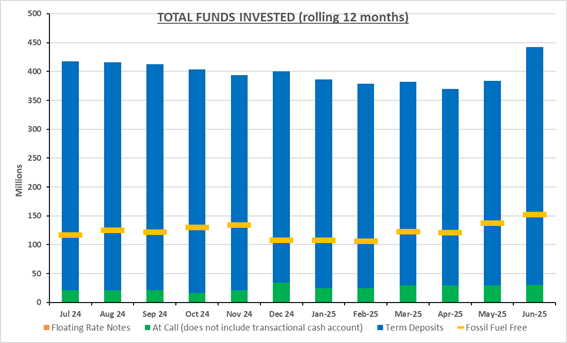
The maturity profile of investments (excluding the cash management account, which is on call) is shown below, demonstrating a balanced distribution of maturities over the next 3 to 5 years, in line with Council’s Investment Policy and the timing of future reserve funding requirements for key projects.
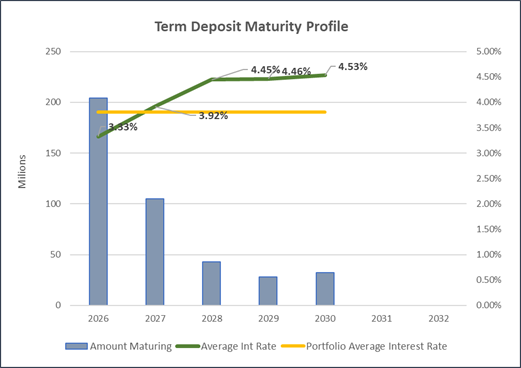
The average interest rate on maturities in 2024-2025 reflects the impact of longer-term investments made prior to the interest rate decline during the COVID-19 pandemic. The Movements in Investments table above highlights some investments with lower interest rates maturing in June 2025, which are largely being reinvested at higher rates.
This shift will help enhance Council’s performance in relation to key metrics such as the budget and the AusBond Bank Bill Index.
The following is a summary of Council’s exposure to financial institutions that fund fossil fuels.
|
Purchases since 01/07/2024 |
Purchases since 01/07/2024 |
Amount invested at 30/06/2025 |
Amount invested at 30/06/2025 |
|
|
Yes |
98,076,760 |
46% |
290,048,709 |
66% |
|
No |
116,000,000 |
54% |
152,500,000 |
34% |
|
|
214,076,760 |
|
442,548,709 |
|
Council has not resolved to divest from its current investment holdings with fossil fuel exposure, as doing so could adversely affect portfolio credit quality, ratings, and interest income forecasts. However, within ministerial and policy guidelines, Council will continue to prioritise newly issued fossil fuel-free investments where they align with Council’s risk and return objectives.
Over time, it remains Council’s intention to transition to a more balanced portfolio with reduced fossil fuel exposure, where it is financially prudent to do so.
In its investment decisions, Council seeks multiple quotes from a range of financial institutions across various rating levels. When a bank does not lend to the fossil fuel industry, offers the highest rate, and complies with Council's Policy risk limits, Council prioritises that bank in alignment with the Investment Policy.
The following table shows the interest returns as of 30 June 2025 and the portfolio performance against benchmark (bank bill Index).
|
Item |
Performance |
|
Interest for the Month ($) |
1,201,568 |
|
Interest YTD ($) |
14,542,794 |
|
% of Annual Budget Rec'd |
133% |
|
Portfolio Performance FYTD Actual (%) |
3.53% |
|
AusBond Bank Bill Index FYTD Actual (%) |
4.39% |
|
Performance Compared to Bank Bill Index (%) |
-0.86% |
Loan Portfolio
The following table presents the loan balances, repayments and monthly interest expense as of 30 June 2025 for the 2024-2025 financial year.
|
Fund |
Amount Borrowed |
Outstanding Balance |
Weighted Average Interest Rate |
Accrued Interest for Month |
Remaining Repayments FYTD |
|
General |
114,854,925 |
57,517,263 |
5.50% |
108,046 |
0 |
|
Waste |
1,500,000 |
174,074 |
3.44% |
732 |
0 |
|
Sewer |
2,000,000 |
2,000,000 |
5.70% |
3,123 |
0 |
|
Total |
118,354,925 |
59,691,337 |
|
111,901 |
0 |
The increase in the Outstanding Balance above, against that reported for May 2025 ($9,163,875) results from the approved borrowings undertaken in June 2025 (less $182,708 in principal payments in June 2025) as follows:
|
Description |
|
|
150,000 |
North Brother Catchment flood mitigation measures |
|
260,000 |
West Port (Buller Street) Flood mitigation works |
|
180,170 |
Gordon Street Upgrade (Part of Local Rds Proactive Transport Pgm) |
|
3,600,000 |
Lorne Road Upgrade |
|
41,500,000 |
Ocean Drive |
|
200,000 |
Limeburners Creek Bridge - Piers Rehabilitation |
|
2,820,000 |
Road Resealing Works |
|
2,000,000 |
Thrumster WWTP Scheme |
|
50,710,170 |
Total New Borrowings taken up in June 2025 |
The maturity profile of the loans portfolio is shown below, providing details of when outstanding loan balances will be paid down, including the average interest rate payable.
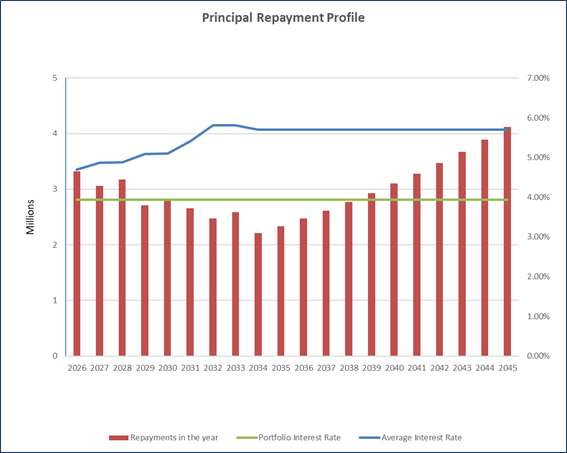
Summary - Net Position Investments and Loans
|
Interest Analysis for the Month |
Values $ |
|
Investment Interest Income |
1,201,568 |
|
Loan Interest Expense |
(111,901) |
|
Net Interest Income for the Month |
1,089,667 |
|
Investments Vs Borrowings |
|
|
Total Current Investment Balance |
442,548,709 |
|
Total Current Loan Balance |
(59,691,337) |
|
Net Position |
382,857,372 |
At current interest rates, Council can invest funds at around 4.3%. With a significant portion of the loan portfolio locked in at lower average rates, Council is benefiting from a positive net exposure to interest rates. However, this position may come under pressure in the future, as upcoming loans are expected to incur higher rates.
3. Conclusion
Council’s investment and loan portfolios are being managed prudently in line with legislative and policy requirements. Investment income is outperforming budget and strategic borrowings are helping minimise costs. Council remains well positioned to meet future funding needs.
Key Considerations
4. Financial and Economic Implications
Council's investment income is ahead of budget, with a total of $14.5 million earned year-to-date. Borrowing costs remain low, with interest expenses of $111,901 for June 2025. Council’s net interest position for the month was $1,089,667. Delayed borrowings and strategic fund timing have helped reduce reliance on internally restricted funds.
Domestic Economic Conditions
Australia’s monthly inflation eased faster than expected in May, with consumer prices rising +2.1% y/y (versus +2.3% expectations), which is near the bottom of the RBA’s target band. Core inflation also fell from +2.8% in April to +2.4% in May (its lowest rate since November 2021). Services inflation on the monthly indicator is running at +3.3% y/y, its lowest since May 2022.
Australia’s unemployment rate remained unchanged at 4.1% in May, for the fourth consecutive month. Despite a surprise fall in jobs (-2.5k in May versus +20k expectation), the unemployment rate was steady as the participation rate slightly eased to 67.0% (from 67.1%).
Q1 GDP rose just +0.2% q/q and +1.3% y/y, below consensus and the RBA’s forecast of +0.4% q/q.
Dwelling prices for May rose +0.5% m/m, further sustaining the turnaround seen since February. Price growth had slowed into April (ahead of the 3 May election), but the combination of election clarity and RBA interest rate cuts were likely the drivers behind the rise seen in May.
The monthly trade surplus was lower than expected with a surplus of $5.4bn for April vs. $6.0bn consensus.
Retail spending was up +1.1% in May, +1.5% in 3-month average terms and +6.8% over the past 12 months.
The Australian dollar rose around +1.77%, finishing the month at US65.50 cents (from US64.36 cents the previous month).
Global Economic Conditions
Global equity markets set all-time highs again, despite the escalating tensions in the Middle East throughout the month. The global tariff wars seem to have taken a backburner for now, whilst market expectations are for further rate cuts to be delivered by most global central banks.
Across equity markets, the US S&P 500 Index rose +4.96%, whilst the NASDAQ surged +6.57%. Europe’s main indices bucked the trend, with slight losses in France’s CAC (-1.11%), Germany’s DAX (-0.37%) and UK’s FTSE (-0.13%).
The US Federal Reserve kept rates unchanged at 4.25%–4.50% where it has been since December. The updated “dot plot” maintained expectations of two rate reductions later this year (though seven FOMC members now forecast no cuts at all, up from four in March) and have revised their 2026 outlook to only one 25bp rate cut.
The US unemployment rate held steady at 4.2%. US CPI report for May showed notably cooler inflation than expected, with both headline and core CPI rising just +0.1% m/m (consensus +0.2% and +0.3% respectively). Core CPI is up +1.7% in 3m annualised terms and +2.6% in 6m annualised terms.
The Bank of Canada kept rates on hold at 2.75% as fully expected, once again noting the uncertainty about the impact of tariffs on the economy. The Bank suggested a further rate cut could be required if the economy weakens and inflation remains contained.
The Bank of England kept the bank rate unchanged at 4.25%, with six members supporting the decision while three members voted for a 25bp rate cut. The UK unemployment rate rose 0.1% to 4.6%, in line with expectations. UK April GDP today was soft at -0.3% m/m vs a -0.1% consensus.
Euro area core CPI for May came in 0.1% lower than consensus at +2.3% y/y vs. +2.4% expected. The ECB cut rates by 25bp as expected to 2.00%, but the messaging was more hawkish, with President Lagarde positioning, “I think we are getting to the end of a monetary policy cycle”.
Both the Swiss National Bank and Norway’s Central Bank cut their rates by 25bp respectively in June.
China’s CPI data remained weak at -0.1% y/y (-0.2% expected) weighed by falling fuel and food prices even as broader inflation also remained subdued with the core measure at +0.6% y/y.
5. Legislative and Policy Implications
· Local Government Act 1993 (NSW)
· Local Government (General) Regulation 2021
· Ministerial Investment Order
· Council’s adopted Investment Policy
6. Strategic Context and Implications
This report aligns with the Integrated Planning and Reporting Framework (IP&R), supporting financial sustainability objectives outlined in the Long-Term Financial Plan and Resourcing Strategy (2025-2035).
7. Risk and Insurance Implications
Investment and borrowing decisions are managed within a comprehensive risk framework. Council maintains a diversified maturity profile and adheres to conservative credit exposure limits. Market volatility and rising interest rates are ongoing risks being actively monitored.
8. Engagement and Consultation
Council engages an independent investment advisor and routinely seeks market quotes across a diversified panel of institutions. Internal consultation includes finance, infrastructure, and strategic planning teams to align funding with project delivery.
9. Civic Leadership
Council is progressively aligning investments with ESG priorities. While current holdings include fossil fuel-exposed institutions, all new investments are assessed for ethical alignment where consistent with risk and return mandates
Options
This is an information report only.
|
Attachments 1. 2. 3.
|
Agenda Business and Performance
Subject: Policy Review - Draft Reduction or Waiver of Council Fees and Charges Policy - Post Public Exhibition
Presented by: Business and Performance, Keith Hentschke
That Council:
1. Adopt the draft Reduction or Waiver of Council Fees and Charges Policy.
2. Thank those who made a submission and advise of Council’s determination in this matter.
Executive Summary
The Reduction or Waiver of Council Fees and Charges Policy has been developed to ensure a consistent, transparent, and equitable framework for managing community requests for fee relief. The policy outlines clear eligibility criteria, decision-making authorities, and targeted provisions for declared disaster events.
The policy aligns with Council’s commitment to fairness, financial sustainability, and responsible governance.
Key objectives of the policy include:
· Clear eligibility criteria for applicants.
· Delegation of decision-making authority to the CEO for waivers up to $5,000.
· Transparency and accountability through structured assessment and recording procedures.
· Defined exclusions, such as non-Council-imposed statutory fees.
· Flexibility for community-focused hardship support aligned with Council’s Rates and Charges Hardship Policy.
Report
1. Background
Council regularly receives requests to waive fees for use of its facilities or operational services, particularly from not-for-profit organisations and during natural disasters. Historically, decisions have been made through informal or inconsistent processes.
A review of past practices identified the need for a formal policy to ensure fairness, transparency, and financial accountability in assessing such requests. In response, the Reduction or Waiver of Council Fees and Charges Policy has been developed to establish clear governance and reporting mechanisms.
Council, at its Ordinary Meeting held 17 April 2025 considered a report in relation to the development of a draft Budget Development Policy and subsequently resolved as follows:
That Council:
1. Endorse the draft Reduction or Waiver of Council Fees and Charges Policy for public exhibition of not less than 28 days.
2. Request a further report be presented to Council following the public consultation period to consider adoption of the final policy.
2. Discussion
The proposed policy aims to standardise and formalise the process for assessing requests for fee waivers. Key features include:
· Eligibility Criteria: Applications must be supported with evidence and fall within defined categories, such as not-for-profit organisations, charitable entities, or service failure by Council.
· Assessment and Decision-Making:
o The Chief Executive Officer (CEO) may approve waivers up to $5,000.
o Requests above $5,000 require a resolution of Council.
· Disaster Provisions:
o The CEO is empowered to approve fee waivers beyond policy thresholds during declared natural disasters.
o Eligible fees include waste disposal, lost documentation, and development applications for reconstruction.
· Governance and Reporting:
o Approved waivers will be recorded in a register and reported annually.
o The policy will be implemented by the Business and Performance Directorate under the oversight of the Chief Financial Officer.
This policy supports Council’s financial sustainability while providing targeted support for community recovery and resilience.
Disaster Provisions
In addition to the engagement and consultation process considered below, Council took the opportunity to review the Disaster Provisions of the draft Reduction or Waiver of Council Fees and Charges Policy following the May 2025 flood event.
Clause 7 of the draft Reduction or Waiver of Council Fees and Charges Policy provides a framework for emergency fee relief during declared disasters, allowing the Chief Executive Officer to:
• waive the application and assessment processes outlined in this Policy
• approve fee waivers and reductions exceeding the limits specified in this Policy to support disaster response and recovery efforts.
Specific Fees Subject to Waiver within the Disaster Provisions are as follows:
• Waste Disposal Fees:
o Waiver of waste disposal fees, or part thereof, for debris resulting from the disaster, including damaged household items, building materials, green waste, and spoiled food.
• Replacement of Lost or Damaged Council-Issued Documents:
o Waiver of fees for the reissuance of council permits, approvals, and other official documents lost or damaged due to the disaster.
• Development Application Fees:
o Donation of statutory fees for applications related to the repair or rebuilding of structures damaged during the disaster.
The Disaster Provisions apply for a duration of six months from the date a natural disaster is declared. Within this timeframe, Council may consider and approve extensions or amendments, particularly relating to post-event recovery costs, through a report to a regular monthly Ordinary Meeting of Council.
Although not formally enacted during the May 2025 flood event, senior leaders reviewed the policy against actions taken during the response and recovery phases. Reflections on application of the Policy were received suggesting that the Disaster Provisions clause is fit for purpose, with the following suggested refinements:
|
Area |
Policy Gap |
|
Disaster Provision effected classes |
Consider adding businesses to the Disaster Provisions section. |
|
Action Broaden the scope of Clause 7.1 as follows: 7.1 Eligibility Criteria Fee waivers and reductions under this section may be granted to support residents, businesses, landowners, and community organisations directly affected by a declared natural disaster. To be eligible: · The applicant must reside, operate, or own property within an area officially declared as a natural disaster zone by Council or relevant emergency authorities. · The applicant must provide proof of residence, property ownership, or business operation in the affected area, and demonstrate reasonable evidence of impact (e.g., photographs, insurance claims) from the disaster. Eligibility applies equally to individuals, community groups, and businesses adversely impacted by the event and seeking support for relevant Council-imposed fees and charges. |
|
|
Other Relevant Fee Types |
Ferry fares, public health inspection fees, animal impounding fees, food premises, and public health premises were waived but are not mentioned. Provide clarity in the policy about whether the EPA waste levy component is waived to provide transparency to the community if a fee is charged. |
|
Catch-all Provision for Unforeseen Fees |
Clause 7 lacks a general clause to authorise other fee waivers that arise unexpectedly. |
|
Action ·....... Broaden the scope of Clause 7.2, and include specific commentary to clarify treatment of the Waste Levy ·....... Add a sub clause under 7.2 to address the waiver of Unforeseen Fees 7.2 Fees Subject to Waiver The following Council-imposed fees may be waived to support residents, landowners, and businesses directly affected by a declared natural disaster: · Waste Disposal Fees o Waiver of waste disposal fees, or part thereof, for debris resulting from the disaster, including damaged household items, building materials, green waste, and spoiled food. o Note: The EPA Waste Levy is a statutory fee and will continue to be charged unless a specific exemption is granted by the NSW State Government. · Replacement of Lost or Damaged Council-Issued Documents o Waiver of fees for the reissuance of council permits, approvals, and other official documents lost or damaged due to the disaster. · Animal Impound and Maintenance Fees o Waiver of fees to support the return of displaced domestic and farm animals directly impacted by the disaster. · Ferry Service Fees o Waiver of fees to facilitate emergency access, relief logistics, and resident movement in affected areas. · Food Premises and Public Health Inspection Fees o Waiver of fees where directly impacted by the disaster. · Other Fees o Waiver of fees where the fee directly supports immediate disaster response or post-disaster community recovery efforts, as determined by the CEO. · Development Application Fees: o.. Donation of statutory fees (noting Council cannot waive statutory fees imposed by other tiers of government) for applications related to the repair or rebuilding of structures damaged during the disaster |
|
|
Statutory vs Non-Statutory Fees |
Clause 7.2 refers to “statutory fees” (e.g. DA fees) but doesn't distinguish between waivable vs non-waivable components. |
|
Action Add a clause 7.3 as follows: 7.3 Fee Waiver Exclusions Council cannot waive State-imposed statutory fees, including but not limited to: · Planning Reform Fees. · Long Service Levy. · Any other fees set by legislation or regulation that are outside the authority of Council to alter or waive. |
|
|
Hardship Alignment |
Clause 7 does not reference Council's Rates and Charges Hardship Policy or discretionary interest waivers. |
|
Action Add a clause 7.7 as follows: 7.7 Hardship In addition to the fee waivers outlined in this section, Council recognises that residents and businesses affected by declared natural disasters may experience financial hardship that extends beyond the scope of operational fees and charges. Where applicable, support may also be provided under Council’s Rates and Charges Hardship Assistance Policy, including but not limited to: · The ability to enter into extended payment arrangements for outstanding rates and charges. · The waiver of interest accrued on overdue rates and charges under Section 567 of the Local Government Act 1993. · The waiver of dishonour fees for failed direct debit payments associated with disaster-affected properties. Affected parties are encouraged to contact Council officers directly to discuss their individual circumstances. Council will work with applicants to determine the most appropriate form of assistance and reduce documentation burdens wherever possible. |
|
3. Conclusion
The Reduction or Waiver of Council Fees and Charges Policy provides a clear, equitable, and accountable framework for managing requests for fee relief. It ensures consistency, supports good governance, and introduces defined responsibilities and procedures.
It is recommended that Council approve the policy.
Key Considerations
4. Financial and Economic Implications
The Reduction or Waiver of Council Fees and Charges Policy provides a clear framework to assess and manage requests for financial relief, including during natural disasters. While the policy may result in foregone revenue through the approval of discretionary waivers, it also strengthens financial governance by ensuring such decisions are made transparently and equitably, with defined eligibility and approval thresholds.
The policy supports Council’s financial sustainability by:
·....... Introducing consistent and accountable decision-making at the staff level for requests under $5,000.
·....... Clarifying exclusions, such as statutory fees and security bonds, to protect Council from unintended financial exposure.
·....... Enabling a rapid response mechanism through Clause 7 during disaster events, which allows the CEO to authorise fee waivers aligned to recovery efforts, mitigating community hardship while maintaining control over costs.
The financial impact of waivers, particularly during natural disasters, is expected to be manageable, with all approved waivers recorded in a central register and reported in Council’s Annual Report. The Disaster Provisions are time-limited (six months) and subject to review or extension by Council, providing an additional safeguard over long-term cost implications.
The policy also reinforces that financial relief is not intended as a substitute for unsuccessful grant applications or to replace fees associated with Council-sponsored events. By maintaining a clear delineation between operational funding and waiver eligibility, the policy helps prevent double-dipping and ensures community contributions are fairly and transparently managed.
In summary, while some reductions in revenue are anticipated, the policy provides the necessary structure to manage and monitor these impacts without undermining Council’s broader financial and service delivery responsibilities.
5. Legislative and Policy Implications
The policy aligns with relevant legislation and guidelines, including:
· Local Government Act 1993
· Local Government (General) Regulation 2021
It also complements Council’s Providing Funding and Support to the Community Policy and upholds ESG (Environmental, Social, and Governance) principles by ensuring equitable access to services and support during emergencies
6. Strategic Context and Implications
The policy contributes to the strategic objectives of Council’s Community Strategic Plan and Delivery Program, particularly:
· Supporting community wellbeing and resilience.
· Promoting transparent and sustainable governance.
· Strengthening financial management practices.
7. Risk and Insurance Implications
The policy introduces several governance measures to reduce financial, reputational, and compliance risks:
· Defined eligibility criteria and documentation requirements.
· Clear delegation and Council decision thresholds.
· Reporting mechanisms including an internal register and inclusion in the Annual Report.
· Compliance with privacy and record management obligations.
Disaster relief provisions provide timely support while retaining financial control
8. Engagement and Consultation
External Consultation
In accordance with Council’s Community Engagement Policy, the draft Reduction or Waiver of Council Fees and Charges Policy was exhibited for 28 days, closing on 17 June 2025. At the time of writing this report, the Engagement Report had not been finalised. Notwithstanding, the following addresses submissions received through the process.
Submission 1
“I am in favour of this policy.
Though, this policy does not mention or address whether a fee waiver/reduction would also result in a BOND waiver or reduction.
For example, hiring the amphitheatre for a performance requires a $2000 bond, which is a large expense for a not for profit community organisation.
This policy should stipulate whether bond reduction or waiver is a part, it is not clear.”
While the concern regarding the cost of bonds is acknowledged, the Reduction or Waiver of Council Fees and Charges Policy is not intended to apply to security bonds. Bonds serve a specific purpose, to provide Council with financial protection in the event of damage or additional costs arising from the use of its facilities and are therefore not considered eligible for waiver or reduction under this policy.
Event organisers who require financial assistance are encouraged to seek support through Council’s established donations or sponsorship programs, which may assist with overall event delivery costs, including those associated with venue hire.
Submission 2
“Please consider the documentation required to prove eligibility for community groups.
Not all of them have non-for-profit status, but they also don’t have the funds to pay venue hire and application fees – which inhibits their ability to run great community programs.”
The Reduction or Waiver of Council Fees and Charges Policy establishes a discretionary framework that allows staff to assess and approve fee waiver requests under $5,000. This framework is underpinned by clear principles of equity, transparency, and accountability. These safeguards are essential to ensure that decisions involving the use of public funds are applied consistently and without bias, particularly where discretion is exercised at the staff level.
A key focus of the policy is capacity building, with priority given to groups that have not received other forms of Council support and have limited ability to generate their own income. This directly aligns with the intent of the community submission, recognising that some organisations face financial barriers that limit their ability to deliver otherwise valuable community programs.
At the same time, the policy recognises that not all organisations will meet its eligibility criteria, particularly informal or unregistered groups. In such cases, the policy encourages applicants to pursue support through Council’s sponsorship and donations programs. These programs may offer more flexible support pathways, especially for groups that are not formally constituted as not-for-profits or charities.
Internal consultation
As addressed above, specific consultation was undertaken with respect to the disaster provisions contained within the policy to review effectiveness out of the recent weather event.
In addition, broad consultation has been undertaken with:
· Executive Leadership Team
· Senior Leadership Team
· Manager Revenue Accounting
· Manager Financial Accounting
If approved, the policy will be implemented internally, with guidance material developed to assist applicants.
Overall, the policy strikes an appropriate balance between providing targeted support and maintaining the integrity of Council’s financial governance. While the concerns raised in the submissions are acknowledged, the policy’s documentation requirements are in place to ensure fairness and accountability in decision-making. Council’s broader community funding programs remain the most appropriate mechanism for assisting informal groups, and there is an opportunity to improve awareness of these options alongside the implementation of the policy.
9. Civic Leadership
By endorsing this policy, Council demonstrates a strong commitment to governance, community responsiveness, and equitable support—particularly in times of hardship. The policy balances financial responsibility with social support, aligning with Council’s ESG principles.
Options
1. Approve the Reduction or Waiver of Council Fees and Charges Policy (Recommended):
Provides a consistent framework and strengthens Council’s financial and community governance.
2. Request Amendments to the Policy Prior to Approval:
Council may seek changes to specific provisions before endorsing the policy.
3. Do Not Approve the Policy:
Existing practices, which lack structure and consistency, will remain in place.
|
Attachments 1. 2. 3.
|
Agenda Business and Performance
Subject: Policy Review - Debt Recovery Policy
Presented by: Business and Performance, Keith Hentschke
That Council:
1. Publicly exhibit the draft Debt Recovery Policy for a period of not less than 28 days.
2. Note that a further report will be tabled at the August 2025 meeting of Council, detailing the submissions received from the public during the exhibition period.
Executive Summary
The Debt Recovery Policy has undergone a comprehensive review to improve clarity, consistency, and alignment with legislative requirements and best practice standards. The revised policy introduces a more structured and detailed approach to debt recovery, including clearer definitions, expanded procedural guidance, and enhanced support for debtors experiencing financial hardship.
The Policy provides for an early intervention strategy that supports manageable debt recovery by enabling debtors to address their obligations proactively before they become unmanageable.
The Debt Recovery Policy was endorsed by the Executive Team at the June 2025 Executive Strategic Meeting for consideration by Council.
Report
1. Background
Council adopted the current Debt Recovery Policy in May 2023. The policy outlines the framework for recovering outstanding debts including rates, water charges, and sundry debtor accounts. A review has been undertaken in line with the scheduled policy review cycle and to ensure alignment with legislative changes and best practice.
The revised policy introduces a more structured and detailed approach to debt recovery, including clearer definitions, expanded procedural guidance, and enhanced support for debtors experiencing financial hardship.
2. Discussion
The Debt Recovery Policy has been reviewed with the following amendments:
Structural and Policy Framework Enhancements
The 2025 Draft Debt Recovery Policy is significantly restructured with a formal table of contents and clearly defined sections. New sections such as Third Party Reporting, Support Services, and Review of Decisions reflect a professionalised and user-centred approach to policy design.
The 2023 version, while functional, lacked standardised headings and a customer-facing policy structure.
Procedural Clarifications and Threshold Adjustments
Debt Recovery Threshold: Lowered from $1,100 to $500 to enable earlier intervention.
Legal Action Process: Clearly defined steps from reminders to enforcement orders and land sale procedures.
Payment Arrangements and Compliance Monitoring
The 2025 draft policy mandates:
· Rates and Water arrears must be cleared by 30 June of the financial year.
· Sundry debts must be cleared within 6 months (or 12 months in exceptional cases).
· Defaults on arrangements may trigger reinstated recovery without further notice.
These changes ensure stronger revenue recovery discipline and reduce compounding arrears.
Hardship Consideration and Support
There is a notable shift toward empathetic debt management:
· Stronger integration with Council’s Hardship Policy.
· Inclusion of external support services.
· Formal review process for decisions adds procedural fairness.
Governance, Privacy, and Definitions
This draft includes:
· Alignment with the Privacy and Personal Information Protection Act 1998 (NSW).
· Comprehensive Definitions section standardising interpretation.
· Clarified roles of officers and external agencies in the recovery process.
3. Conclusion
The revised Debt Recovery Policy reflects Council’s commitment to fair, transparent, and effective debt recovery practices. It is recommended that the draft policy be placed on public exhibition for community feedback.
Key Considerations
4. Financial and Economic Implications
The updated 2025 Debt Recovery Policy introduces several measures that strengthen Council’s financial sustainability while balancing social responsibility.
· The lower recovery threshold ($500) enables earlier engagement with debtors, potentially increasing administrative costs in the short term. However, this is expected to substantially reduce the volume of aged debts and future write-offs, especially for low-value but high-frequency accounts.
· Payment arrangement timeframes (e.g., requiring rates and water arrears to be resolved by 30 June) create clearer financial expectations and improve forecasting of cash inflows.
· The Policy’s strengthened approach to non-compliance and repeat defaults supports disciplined revenue recovery and avoids chronic arrears accumulation.
· Early intervention strategies, such as issuing reminder notices within 10 business days of default and offering structured payment arrangements, are designed to engage debtors before debts escalate. This approach improves the likelihood of recovery, minimises the legal costs associated with prolonged enforcement, and reduces the emotional and financial burden on debtors—thereby supporting long-term economic resilience within the community.
· Maintaining the non-write-off policy for land-secured debts ensures Council retains its financial leverage over secured recoveries, preserving ratepayer equity.
ESG factors include ethical treatment of debtors and transparency in recovery processes
5. Legislative and Policy Implications
· Complies with the Local Government Act 1993 (NSW) and associated regulations.
· Aligns with Council’s Hardship Policy and Code of Conduct.
· This is a revised policy.
6. Strategic Context and Implications
This policy aligns with the Integrated Planning and Reporting Framework (IP&R), particularly the Lead Strategy for Financial Sustainability and Governance.
7. Risk and Insurance Implications
Should this policy not be adopted the risks include reputational impacts and financial loss due to unrecovered debts.
This can be mitigated through earlier intervention, structured recovery processes, and legal cost recovery.
8. Engagement and Consultation
• Chief Executive Officer.
• Director Business and Performance.
• Director Community Infrastructure.
• Director Community, Planning and Environment.
• Director Infrastructure Utilities.
• Executive Lead Finance and Commercial Operations
• Chief Financial Officer.
This policy has also been reviewed by the Debt Recovery Specialist and Team Leaders of Rates and Water.
It has also been reviewed by Council’s external Debt Recovery Agent.
It is proposed that the draft policy be put on public exhibition for 28 days to allow for feedback from the public
9. Civic Leadership
This policy supports Council’s civic leadership responsibilities by ensuring ethical, transparent, and accountable debt recovery practices.
Options
Council may endorse the draft Debt Recovery Policy for public exhibition and receive a further report following the exhibition period, which is in line with the recommendation to this report.
Council may request further amendments before public exhibition.
Council may retain the existing Debt Recovery Policy without amendment
|
Attachments 1. 2.
|
Agenda Business and Performance
Subject: Policy Review - Hardship Policy
Presented by: Business and Performance, Keith Hentschke
That Council:
1. Publicly exhibit the draft Hardship Policy for a period of not less than 28 days.
2. Note that a further report will be tabled at the September 2025 Ordinary Council meeting, detailing the submissions received from the public during the exhibition period.
3. Publicly exhibit Council’s intention to rescind the Payment of Late Rate Instalment Due to Death of Ratepayers Spouse Policy for a period of not less than 28 days.
Executive Summary
The last formal review of Council’s Rates and Charges Hardship Assistance Policy was undertaken in 2020. Since then, both the economic landscape and community expectations have evolved significantly. A comprehensive review has been conducted to ensure the policy remains relevant, equitable, and aligned with current legislative requirements and best practice principles.
The revised Draft Hardship Policy (2025) introduces a more contemporary, compassionate, and inclusive approach to supporting ratepayers experiencing genuine financial hardship. It also incorporates provisions previously covered under the Payment of Late Rate Instalment Due to Death of Ratepayer’s Spouse Policy, which is now recommended for rescission.
The Hardship Policy was endorsed by the Executive Team at the June 2025 Executive Strategic Meeting for consideration by Council.
The rescission of the Payment of Late Rate Instalment Due to Death of Ratepayer’s Spouse Policy was also endorsed by the Executive Team at the June 2025 Executive Strategic Meeting.
Report
1. Background
Council adopted the current Hardship Policy in April 2020. The policy has provided a framework for supporting ratepayers in financial distress, including during natural disasters and the COVID-19 pandemic. A review was initiated to modernise the policy and improve its accessibility and effectiveness.
2. Discussion
The 2025 Draft Hardship Policy introduces several key enhancements that reflect Council’s commitment to fairness, transparency, and community support.
· Structural and Presentation Improvements
· The policy now features a formal table of contents and clearly defined sections, improving readability and usability. Language has been refined to meet plain English standards, making the document more accessible to ratepayers and staff alike.
· Expanded and Inclusive Eligibility Criteria
· Eligibility has been broadened from the previous focus on concession card holders to an evidence-based approach. This allows any residential ratepayer experiencing genuine financial hardship to apply, including spouses and account holders who share financial responsibility.
· Broader Definition of Hardship
The policy now acknowledges a wider range of contributing factors to financial hardship, including loss of income, illness, domestic violence, natural disasters, family breakdown, and bereavement. This ensures the policy is responsive to the complex realities faced by ratepayers.
· Formalised Assessment and Appeals Process
· Applications will be reviewed by a multidisciplinary panel comprising the Debt Recovery Specialist, Manager Revenue Accounting, and a Group Manager. This replaces the previous single-officer assessment model. A formal appeals process has also been introduced, allowing applicants to request a review of decisions, with outcomes provided in writing by the Chief Financial Officer.
· Expanded Assistance Options
· In addition to flexible payment arrangements and interest waivers, the policy includes provisions for natural disaster relief and bereavement support. For example, interest on overdue accounts will be automatically suspended for three months following a declared natural disaster, and discretion may be exercised in cases of missed payments due to the death of a spouse.
· Enhanced Application Process
· The application process has been redesigned to be more structured and supportive. The updated form includes sections for personal details, financial statements, repayment proposals, and declarations. Applicants are encouraged to provide documentation such as bank statements, income details, and letters from financial or medical professionals. Flexibility is built into the process, including the option for applicants to attend interviews to explain their circumstances.
· Connection to External Support Services
· The policy now includes contact details for external support services such as Legal Aid, Lifeline, and financial counselling organisations, reflecting Council’s commitment to holistic community support.
· Integration of Previous Policies
· The provisions of the “Payment of Late Rate Instalment Due to Death of Ratepayer’s Spouse Policy” have been incorporated into the new hardship policy, streamlining Council’s policy framework and ensuring all relevant support measures are housed within a single, comprehensive document.
· Updated Hardship Application Form
· As part of the broader policy review, Council has also undertaken a significant update of the Hardship Application Form to improve accessibility, clarity, and alignment with the revised policy. The previous form was primarily designed around pensioner eligibility and focused heavily on Centrelink verification and concession entitlements. In contrast, the new draft application form adopts a more inclusive and user-friendly approach, reflecting the expanded definition of hardship in the 2025 Policy.
These enhancements are intended to reduce barriers to access, streamline the assessment process, and ensure that all applicants are treated with fairness, dignity, and respect.
3. Conclusion
The revised Hardship Policy reflects Council’s commitment to fairness, empathy, and responsible governance. It is recommended for public exhibition to gather community feedback prior to adoption.
Key Considerations
4. Financial and Economic Implications
The revised policy maintains Council’s financial sustainability by continuing to require full repayment of rates and charges over time, while offering flexibility in payment arrangements and interest relief. The introduction of a formal assessment panel and clearer eligibility criteria is expected to improve administrative efficiency and reduce the risk of inconsistent decisions. While there may be a short-term impact on cash flow due to deferred payments or waived interest, this is balanced by improved community trust and support for vulnerable ratepayers.
5. Legislative and Policy Implications
· Complies with the Local Government Act 1993 and Local Government (General) Regulation 2021.
· Aligns with the Office of Local Government Debt Management and Hardship Guidelines (2018).
· This is a revised policy.
· ESG factors: Promotes social equity and responsible governance.
6. Strategic Context and Implications
Supports Council’s strategic goals under the Integrated Planning and Reporting framework, particularly in financial sustainability and community wellbeing.
7. Risk and Insurance Implications
Financial risk mitigated through structured repayment plans.
Legal and reputational risks reduced by transparent and fair processes.
8. Engagement and Consultation
• Chief Executive Officer.
• Director Business and Performance.
• Director Community Infrastructure.
• Director Community, Planning and Environment.
• Director Infrastructure Utilities.
• Chief Financial Officer
This policy has also been reviewed by Council’s Legal Counsel, the Hardship Specialist and Team Leaders of Rates and Water.
It is proposed that the draft Hardship policy be put on public exhibition for 28 days to allow for feedback from the public.
9. Civic Leadership
The revised policy enhances Council’s leadership in social responsibility and community support, aligning with ESG principles.
Options
Council may endorse the draft Hardship Policy for public exhibition and receive a further report following the exhibition period, which is in line with the recommendation to this report.
Council may request further amendments before public exhibition.
Council may retain the existing Hardship Policy without amendment.
Council may resolve not to rescind the Payment of Late Rate Instalment Due to Death of Ratepayers Spouse Policy, which would require amendment to the draft Hardship Policy as presented.
|
Attachments 1. 2. 3. 4. |
Agenda Business and Performance
Subject: Report of the Audit, Risk and Improvement Committee Meeting Held 12 June 2025
Presented by: Business and Performance, Keith Hentschke
That Council note the report of the Audit, Risk and Improvement Committee held 12 June 2025.
Executive Summary
In accordance with the Risk Management and Internal Audit for Local Government in NSW Guidelines, Council’s Audit, Risk and Improvement Committee is required to report to Council following each ordinary meeting on the items considered and outcomes of the meeting.
It is noted that due to the sensitive nature of some items considered at this meeting, some details may be excluded from this report.
Report
1. Background
Councils are required to have an Audit, Risk and Improvement Committee as required by the Local Government Act. This Committee meets on a quarterly basis and considers items as relevant under section 428A of the Local Government Act.
2. Discussion
In accordance with the Risk Management and Internal Audit for Local Government in NSW Guidelines, Council’s Audit, Risk and Improvement Committee is required to report to Council following each ordinary meeting on the items considered and outcomes of the meeting.
It is noted that due to the sensitive nature of some items considered at this meeting, some details may be excluded from this report.
Council’s Audit, Risk and Improvement Committee met on 12 June 2025 commencing at 12 noon. The meeting was conducted in-person in Council’s Burrawan Street, Port Macquarie offices and attended by Chairperson Stephen Coates, Independent Members Mel Jacobs (attended remotely) and Kerry Phillips and non-voting member Councillor Rachel Sheppard (also attended remotely). The meeting was also attended by Council’s Acting Chief Executive Officer, Robert Fish and Director Business and Performance, Keith Hentschke together with other support staff including Governance, Legal and Internal Audit staff. A representative of the Audit Office of NSW was also present for the duration of the meeting.
There were 19 items considered outside of housekeeping items such as previous minutes and disclosures of interest.
This Audit, Risk and Improvement Committee meeting replaced the usual item of discussing emerging risks with an update being provided by the Acting Chief Executive Officer. The main items as discussed by the Acting Chief Executive Officer included:
· The progress of the Integrated Planning and Reporting process and annual budget
· The status of damage and recovery from the May 2025 flooding event in the local government area
· Progress of major projects being undertaken by Council
The Committee noted a report from the Group Manager Project Delivery on the status of major projects currently underway by Council. These projects include:
· Ocean Drive Duplication
· Maria River Road
· Thrumster Wastewater Scheme
· Port Macquarie Bulk Water Treatment Plant at Cowarra (Cowarra Water Supply Scheme)
· Kew/Kendall Wastewater Scheme Diversion to Camden Haven
Council’s Legal Counsel provided reports that provided an update on legal and compliance matters and also a separate report that detailed a specific legal matter Council is currently engaged in.
The Committee was provided a report on Council’s Airport Master Plan that is currently on public exhibition by the Group Manager Commercial Business Units and the Airport Business Manager. It was noted that the exhibition period has been extended to 42 days due to the May 2025 flooding event.
A Cybersecurity report was provided to the Committee by the Chief Information Officer. This report was well received and outlines Council’s current preparedness and future plans to protect Council from Cybersecurity threats. An ongoing cyclic information report continues to be requested for future Committee meetings. Other items mentioned to the Committee by the Chief Information Officer included the cloud migration project, AI (artificial intelligence) and data analytics. The Committee has requested a report on Council’s AI strategy and uses to come to a future meeting of the Committee.
Council’s Executive Manager Strategy and the Strategic Landuse Planning Manager presented an update to the Committee on Council’s Infrastructure Contributions Plan and Rollover of Existing Funds. The Committee noted the information provided to them. This was also followed by an update on the transformation project for Developer Contributions with a presentation by Change Management Lead and Change Project Specialist. The Committee noted the presentation, particularly that there will be an internal audit on Developer Contributions commencing shortly.
Council’s Chief Financial Officer and Financial and Statutory Accounting Manager attended to address several reports including:
· Council’s 2024-2025 Quarterly Budget Review Statement and Operational Plan Status Report as at 31 March 2025
· Changes to the Local Government Code of Accounting Practice and Financial Reporting and Financial Statement Timetable
· Making of 2025-2026 Fees and Charges, Revenue Policy, and Rating Maps and Notation of Proposed Budget Adjustments
It was requested that the timing of ARIC meetings allows for documents such as the Quarterly Budget Review Statement and Operational Plan Status Report to be considered by ARIC prior to consideration by Council. The Committee agreed that out-of-session meetings could occur in the interim to ensure that this can occur. It was also noted that the Auditor General’s report will be presented to ARIC at the September 2025 ARIC meeting and that regular reporting of the General Fund Improvement Plan and Unfunded Budget Register will be scheduled for ARIC. A representative of the Audit Office attended the meeting and discussed the progress of the audit for year ending 30 June 2025.
The Financial and Statutory Accounting Manager, in her former role as Internal Auditor, presented a report on the outcomes of the Internal Audit Report, Procurement - Panel contracts/Standing Offers/Supply Arrangement Compliance. An action plan will be provided by the December 2025 ARIC meeting as to how the recommendations are to be addressed. The Committee also noted the Quarterly Internal Audit Report.
The Group Manager Governance presented a number of reports to the Committee including:
· Major Non-Compliance Exceptions Report - this is a cyclic report that includes any major instances where Council needed to report a non-compliance with licence requirements to an external agency. It was noted that no such reports were required in this reporting period.
· Business Continuity Plans - this was a progress report on the review of Business Continuity Plans with final plans coming to the ARIC in September 2025 for consideration.
· Status of Council Policies - this is a cyclic report that indicates a register of Council policies and their status.
· Risk Management Transformation Project Update and Risk Registers - this item provided a status update to the Committee of this transformation project together with updated risk registers for the Committee’s review. The Committee suggested that additional work should be undertaken on the registers and provided to the September 2025 ARIC meeting for further consideration.
· Draft 2024-2025 Attestation Statement - the Committee considered the draft attestation statement required by Council to complete for inclusion into the Annual Report. The Committee endorsed the content of the draft attestation statement for inclusion in the Annual Report to be presented to Council in November 2025.
· Draft Ethical Framework - the Committee considered a draft ethical framework and requested that this be presented to the September 2025 for further consideration.
Items of General Business included:
· Development of an action table to capture actions from current and previous minutes that will be considered at each ARIC meeting.
· A request that Council’s Strategy Hierarchy be presented at the September 2025 Committee meeting.
The next meeting will be held on 3 September 2025.
Key Considerations
3. Financial and Economic Implications
There are no financial and economic implications in relation to this report.
4. Legislative and Policy Implications
Councils are required to have an Audit, Risk and Improvement Committee by the Local Government Act. This Committee meets on a quarterly basis and considers items as relevant under section 428A of the Local Government Act.
In accordance with the Risk Management and Internal Audit for Local Government in NSW Guidelines, Council’s Audit, Risk and Improvement Committee is required to report to Council following each ordinary meeting on the items considered and outcomes of the meeting.
It is noted that due to the sensitive nature of some items considered at this meeting, some details may be excluded from this report.
5. Strategic Context and Implications
There are no Strategic Context implications in relation to this report.
6. Risk and Insurance Implications
Failure to provide this report to Council as required risks Council not complying with its requirements under the Risk Management and Internal Audit for Local Government in NSW Guidelines. This report however is for information only so there are minimal risks associated with this report.
7. Engagement and Consultation
No engagement was required or has occurred regarding this report.
8. Civic Leadership
These quarterly reports provide details of items considered by the ARIC on a quarterly basis. This transparently advises the community the items being considered even though not all details can be made public through this report due to the sensitivity of some of the information.
Options
This report is for notation only.
|
Attachments Nil
|
Agenda Business and Performance
Subject: 12 Month Review Report - Pilot Training and Aircraft Noise - Fly Neighbourly Agreement
Presented by: Business and Performance, Keith Hentschke
That Council:
1. Note
the information provided in this 12 Month Review report -
Port Macquarie Airport - Pilot Training and Aircraft Noise - Fly Neighbourly
Agreement.
2. Endorse the extension of the Fly Neighbourly Agreement for a four-year period (May 2025 to April 2029) as an effective method of managing circuit movements at the Airport to minimise impact on the local community.
3. Receive a further report on the Fly Neighbourly Agreement in July 2029.
Executive Summary
The Port Macquarie Airport - Pilot Training and Aircraft Noise - Fly Neighbourly Agreement (the ‘Fly Neighbourly Agreement’ or ‘FNA’) provides guidance and controls for managing the impact of noise from aircraft operations on Airport neighbours and the wider Port Macquarie community. The FNA commits General Aviation operators at the Airport to reducing the impact of their operations on the surrounding community, while maintaining the safe operation of aircraft. This report provides an annual FNA update for the period from May 2024 to April 2025.
There has been a 25% increase in aircraft training movements during the current reporting period, and only two noise complaints were received, compared with three complaints during the previous 12 months. These figures demonstrate the strong, ongoing commitment by Airport staff and local operators to deliver on the key intent of the FNA, balancing Airport noise impacts and the aviation operational needs.
The FNA has been very successful in managing noise issues at the airport, and staff recommend the FNA now be extended for a further four years, with an updated report and recommendations submitted to Council in July 2029. If significant noise issues were to arise within this period, staff could provide an update to Council as required.
Report
1. Background
At
the Ordinary Council Meeting held on 18 July 2024, Council considered a
12-month report on the Port Macquarie Airport - Pilot Training and Aircraft
Noise - Fly Neighbourly Agreement, and resolved as follows:
|
That Council: 1. Note the information provided in this Port Macquarie Airport - Pilot Training and Aircraft Noise - Fly Neighbourly Agreement Trial - 12 Month Review report; 2. Endorse the extension of the Fly Neighbourly Agreement for a further 12 months as a useful method of managing circuit movements at the Airport to minimise impact on the local community, with a further report presented at the Ordinary Council Meeting to be held in July 2025. |
2. Discussion
The FNA was originally adopted by Council in May 2022 as a 12-month trial to May 2023. The trial was later extended by Council to May 2024, and again further extended to May 2025. This report provides a 12-month review report on the FNA, from May 2024 to April 2025.
The report includes aircraft movement data, noise and other impact factors, noise complaint details, and other circuit and noise management information to support the staff recommendation to extend the FNA for four years.
Aircraft movements
Aircraft circuit movement data within this report is provided by Avdata, a third-party service provider. The circuit movement data from May 2024 to April 2025 is compared to the prior 12 months, from May 2023 to April 2024.
The definition of a circuit movement comprises the following:
· Touch and Go - A trainee pilot on circuit training landing on the runway and immediately taking off again.
· Stop and Go - A trainee pilot on circuit training landing and stopping on the runway and taking off again.
· Missed Approach - A trainee pilot following the airport go around procedures for a hypothetical missed approach to the runway (an essential part of training); and
· Practice Approach - A trainee pilot practicing their approach to the runway and then re-joining the circuit without landing.
Each one of the above counts as two circuit movements. As shown in Figure 1 below, during the reporting period, a total 34,866 circuit movements were flown, a 25% increase in circuit movement activity compared to the 27,794 movements during the May 2023 to April 2024 period.
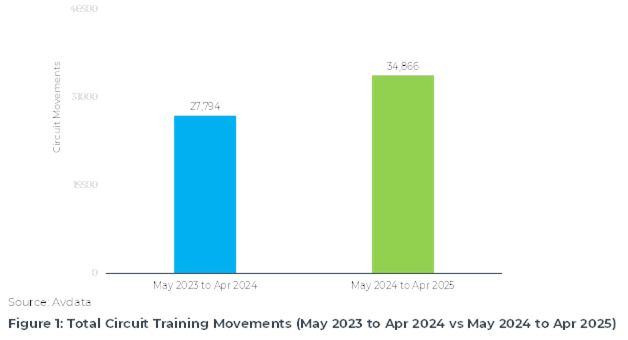
Three flying schools currently operate at the airport. Figure 2 illustrates monthly aircraft activity at the airport, with the latest for circuit activity data generally exceeding the activity in the previous period (only April was lower, most likely weather related).
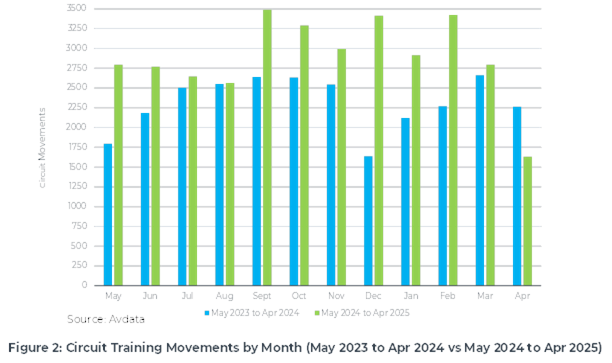
Operating hours
The range of operating hours for aircraft is a significant factor for noise complaints. There are times and days where aircraft movements are more likely to trigger noise complaints i.e. Saturday evenings, Sundays and on Public Holidays.
The data confirms a small increase in the number of circuit movements after 6pm on Saturdays, with 20 circuits during the May 2024 to April 2025 period compared to six circuits during the prior 12 months.
There was an increase in circuits conducted on Sundays with 1,945 from May 2024 to April 2025, compared to 622 from May 2023 to April 2024.
There were 42 training movements on public holidays from May 2024 to April 2025, an increase from the zero movements reported on public holidays in the prior year.
Noise complaints
From May 2024 to April 2025, two complaints concerning circuits on a public holiday were received directly by the Airport.
During the reporting period, airport staff liaise with operators to reduce noise impacts, foster collaboration and encourage compliance with this voluntary agreement. The results have been positive, however, ongoing engagement is undertaken with local operators and flying schools to reinforce the intent of the FNA and to ensure the key undertakings are being delivered.
Fly Neighbourly Agreement - detailed comments on key undertakings
See Attachment 1 for full details of the Fly Neighbourly Agreement. The following comments relate to the FNA key undertakings:
Hours of operation
One of the key measures of the FNA is the reduction in agreed Circuit Training Hours of Operation, being 7:00am to 10:00pm in summer (9:00pm in winter) Mondays to Fridays; 8:00am to 6:00pm on Saturdays; and no continuous circuit training to be done on Sundays and Public Holidays.
Figure 3 below highlights that 85% of circuit movements occur Monday to Friday.
Circuit training performed on a Sunday has historically been the trigger for noise complaints received by Council. The Agreement allows operators and students to undertake catch up training on Sundays between 8:00am and 4:00pm resulting from lost time on other days due to weather, airspace, technical or other disruptions.
During the current reporting period nearly 80% of Sunday circuits occurred between 8:00am and 4:00pm, with no complaints received for activity outside these times.
In terms of public holiday activity, there were 42 training movements with two noise complaints received.
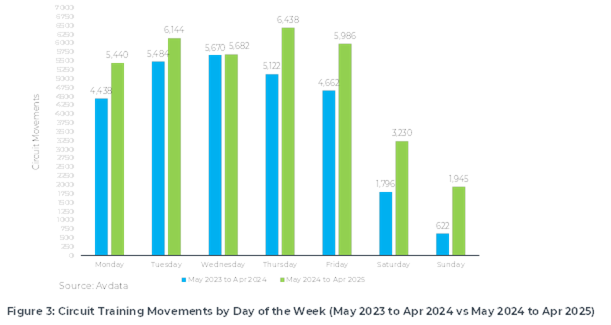
Figure 4 below illustrates the share of circuit activity per hour from 6:00am to midnight. For the current reporting period, circuit training after 6pm represents about 6% of total circuit movements compared with 5% of total movements during the 2023-2024 comparison period.
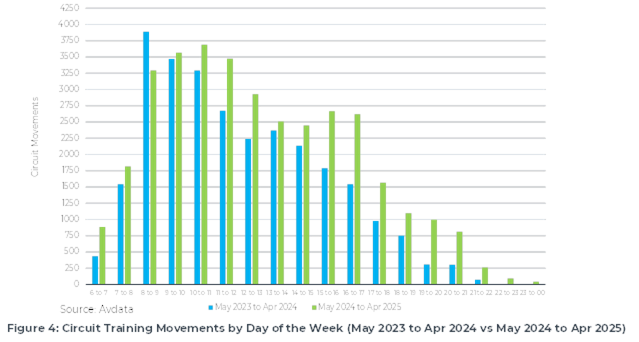
Continuous circuit training - light aircraft
The FNA allows light recreational aircraft to operate early mornings, between 6:00am and 7:00 am Monday to Friday. This time is allocated for aircraft operated by the non-commercial flying schools e.g. Hastings Flying Club.
From May 2024 to April 2025, 885 circuits were reported between 6:00am and 7:00am, compared to 434 during the same period in 2023-2024. While circuits at this time have doubled, no noise complaints were received.
Catching up lost time
Some students unable to attend training during the week will request catch-up training on weekends, including on Sundays. Circuit training performed on Sundays has traditionally been the trigger for noise complaints received by Council.
While the number of Sunday circuit training has increased in the current reporting period, no noise complaints were received for Sunday.
Number of aircraft operating at same time
No issues to report.
Runway take-off direction
‘Runway 03’ means taking off towards the Hastings River, and turning inland to the west, then looping anti clockwise around towards the south. When wind and traffic conditions permit, this is the preferred runway direction (illustrated in yellow in Figure 5 below) as aircraft are flying over less populated areas.
The other option is ‘Runway 21’, shown in red below.
Runway 03 usage is facilitated by the parallel taxiway development completed in March 2023, which allows light aircraft to taxi down to the southern runway end to take off towards the north. The 2024-2025 reporting period saw 47% of circuit movements utilise Runway 03 direction. This is a slight decrease from 2023-2024, where 53% of circuits used Runway 03.
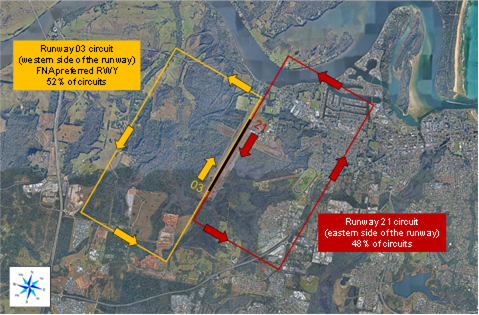
Figure 5: Preferred circuit direction (in yellow)
Turning direction after take-off
No issues to report.
Precautionary Search and Landing
No issues to report.
Aircraft ground operations e.g. repairs
No issues to report.
Minimising low level flight over built-up areas
The
FNA requires aircraft operators to be mindful of altitude when setting
operating procedures, including when to turn cross wind after take-off, and
performing precautionary search and landing, to low level flying over built up
areas.
To help monitor altitude and respond to enquiries or complaints, Council has
installed Automatic Dependent Surveillance-Broadcast (ADS-B) recording
equipment at the Airport that records flight paths and altitude for aircraft
with an activated transponder.
No complaints were received regarding aircraft altitude during the reporting period.
3. Summary
In summary, the FNA has proved effective for aircraft circuit and noise impact management, with key points being:
· Circuit movements have increased by 25% (back to pre-COVID levels).
· Noise complaints have reduced from three to two complaints received - both regarding circuits on a public holiday. No noise complaints were received regarding Saturday or Sunday circuit activity.
· Good general adherence to the key undertakings and operating conditions set out in the FNA by the flying schools operating at the airport.
· Circuit activity has increased on public holidays (42 flights) compared with zero in the prior year.
· A slight rise in circuit training being conducted after 6pm, to 6% of total activity (although still well below pre FNA levels of 19%).
· Broadly similar usage of Runway 03 direction for the reporting period 47% vs 53% for the previous period .
The FNA has been very successful in managing noise issues at the airport for the last 3 years, and staff recommend the FNA now be extended for four years, with an updated report and any recommendations submitted to Council in July 2029. If significant noise issues were to arise within this period, staff could provide an interim update to Council as required.
Key Considerations
4. Financial and Economic Implications
There are no financial and economic implications in relation to this report.
5. Legislative and Policy Implications
There are no legislative and policy implications in relation to this report.
6. Strategic Context and Implications
Not applicable.
7. Risk and Insurance Implications
Not applicable.
8. Engagement and Consultation
In conjunction with the implementation of the FNA, an aircraft noise complaint register has been established to monitor and respond to complaints received from local residents. Over the 12-month reporting period, two complaints were received:
|
Date Received |
Date complaint |
Issue |
|
28 April 2025 |
18 April 2025 |
Circuit activity on public holiday (Good Friday) |
|
28 April 2025 |
25 April 2025 |
Circuit activity on public holiday (Anzac Day) |
In response to each incident, Airport management took the following actions:
· The operating organisation was identified.
· The operating organisation received correspondence providing details of the incident, requesting a formal response regarding the background to the incident and proposed procedures to ensure future compliance with the FNA.
· Once the response was received a face-to-face meeting took place to reiterate the importance of FNA compliance.
· Communication was sent to the complainant acknowledging the breach of the FNA and outlining the process undertaken with the breaching organisation.
1.
9. Civic Leadership
Not applicable.
Options
· Adopt the recommendations as tabled in the report (staff recommendation).
· Adopt the recommendations as tabled in the report with amendments.
· Note the report and not continue with Port Macquarie Airport - Pilot Training and Aircraft Noise - Fly Neighbourly Agreement.
|
Attachments 1.
|
Agenda Business and Performance
Subject: Contracts Awarded Under S377 Local Government Act
Presented by: Business and Performance, Keith Hentschke
That Council note the contracts awarded under s377 of the Local Government Act 1993 for the period 1 April 2025 to 30 June 2025.
Executive Summary
Attached is an extract of the GIPA Contracts Register published on the website of Council detailing contracts awarded by the Chief Executive Officer under section 377 Local Government Act 1993 in the period 1 April 2025 to 30 June 2025.
Report
Discussion
Under s377 of the Local Government Act 1993 (Act), a Council may by resolution delegate to the general manager or any other person specific functions. This includes the function to accept tenders as set out in s178(a) of the Local Government (General) Regulation 2021 (Regulation) and in accordance with s377(1) of the Act.
Delegated Authority
Under delegated authority the Chief Executive Officer may accept tenders, with the following exceptions that should be referred to Council:
· the limitation legislated in s377(1)(i) of the Act being the acceptance of tenders required under the Act to be invited by the Council (E.G., the acceptance of tenders to provide services currently provided by members of staff of the council)
· a recommendation made under s178(1)(b), s178(3) or s178(4) of the Regulation (e.g. a recommendation to decline tenders and enter into negotiations)
· any tender for a service or project where cost exceeds the adopted budget limit for that service or project, and
· any tender for a service or project which is not in an approved operational plan.
The procurement delegate and/or the Chief Executive Officer will retain discretion to refer to Council for decision any procurement outcome:
· which otherwise falls within the Chief Executive Officer’s delegated authority
· which has materially deviated from the approved procurement and evaluation plan
· that has a significant level of public interest in the service
· that is contentious in nature, or
· for any other reason described in the evaluation & recommendation report.
A report is tabled on a quarterly basis detailing contracts that have been awarded by the Chief Executive Officer under s377 of the Act.
Options
This report is provided for information. Council can resolve to request further information.
|
Attachments 1.
|
Agenda Community Infrastructure
Subject: Petition - Council to Establish a Port Macquarie-Hastings Active Transport Advisory Committee
Presented by: Community Infrastructure, Blayne West
That Council:
1. Note the petition lodged by Derek Archer and Felicity Forth on behalf of Better By Bicycle Port Macquarie
2. Respond to the organiser of the petition with Council’s position in respect of this matter.
Executive Summary
A petition containing 380 signatures has been received by Council from Derek Archer and Felicity Forth on behalf of Better by Bicycle Port Macquarie asking Council to “establish a Port Macquarie Hastings Active Transport Advisory Committee (PMH ATAC).”
In accordance with Council’s “Petitions Policy”, petitions lodged with Council containing 250 signatures or more will be included in the agenda of the next available Ordinary Council Meeting where the agenda has not already been determined with a recommendation for notation.
Whilst Council acknowledges the concerns and growing interest in active transport and the desire of the Better By Bicycle community group, it is recommended that Council progress with implementation of the actions identified in the Integrated Transport Plan (August 2024) and Walking and Cycling Plan (May 2025) which were recently engaged on with the community and stakeholders, in lieu of establishing an Active Transport Advisory Committee, as funding permits.
Report
1. Background
Council has prioritised active transport through strategic planning and infrastructure investment. The adopted Integrated Transport Plan (August 2024) and Walking and Cycling Plan (May 2025) were developed in partnership with Transport for NSW and shaped by extensive community feedback, including over 500 survey responses and multiple engagement sessions.
These documents provide a comprehensive framework for active transport planning, implementation, and monitoring across the Port Macquarie - Hastings Local Government Area (LGA).
2. Discussion
Council is committed to improving active transport and multi-modal transport options. These improvement and prioritised actions are identified in both the Walking and Cycling Plan and Integrated Transport Plan.
The petition introduction states:
“The advent of e-bikes is leading to an ever increasing number of cyclists on our streets. However, currently the Port Macquarie roads are not safe for cyclists. There are limited bike lanes and access to shared paths. The potential for increased conflict between differing shared path users is increasing as the number of cyclists on our roads and shared paths increase. We see the Draft Walking and Cycling Review as a great first step to start to address these issues, however, more needs to be done so this issue is tackled in a holistic manner.
Establishing a PMHC Active Transport Advisory Committee (PMHC ATAC) will ensure we meet this challenge by creating a network of cycle lanes and shared pathways and ensuring that future development is cycle-friendly. It will help Council meet the challenge of making our LGA more walkable and cycle-friendly in the most efficient and community supported manner.”
Council acknowledges the concerns and growing interest in active transport and has worked to address these concerns through the recently adopted plans.
The Walking and Cycling Plan outlines six strategic focus areas, including safe access to schools, multi-modal integration, and liveable neighbourhoods. It also includes a prioritisation matrix for infrastructure delivery across the LGA, and annual monitoring indicators.
The Integrated Transport Plan leads and implements the Walking and Cycling Plan by embedding active transport within a broader multi-modal framework, setting clear community targets for mode shift, and aligning with state and regional strategies.
It is considered that establishing a new advisory committee on this topic at this time would:
· Duplicate existing strategic mechanisms already endorsed by Council.
· May introduce inconsistencies with the strategic intent of Council-endorsed plans, developed through considered community engagement.
A copy of the petition is attached for Council’s information.
An alternative option to the one discussed above is to defer this decision until the adoption of the Council Establishment and Management of Committees Policy is completed and endorsed by Council. This policy will provide additional guidance for decision making purposes.
3. Conclusion
Council has demonstrated a strong commitment to active transport through the adoption of the Integrated Transport Plan and the Walking and Cycling Plan. The endorsed plans provide a clear, community considered and endorsed roadmap for future action.
Establishing a new advisory committee at this time is not recommended, as it would depart from Council’s adopted strategic direction and established community engagement outcomes.
Key Considerations
4. Financial and Economic Implications
No direct financial implications arise from noting the petition. However, establishing a new committee would require resourcing, staff time, and budget allocations not currently planned for.
5. Legislative and Policy Implications
The matter complies with the requirements of Council’s Petitions Policy.
The referenced and recently adopted Integrated Transport Plan and Walking and Cycling Plan are consistent with NSW Government strategies including the Future Transport Strategy and Active Transport Strategy.
6. Strategic Context and Implications
As noted in the discussion above, the Council’s adopted Integrated Transport Plan and the supporting Walking and Cycling Plan define the Council’s strategic framework for active transport planning, implementation, and monitoring.
7. Risk and Insurance Implications
Establishing a committee outside the scope of adopted strategies may create reputational risk and reduce public confidence in Council’s planning and engagement processes.
It may also lead to fragmented decision-making and misalignment with funded priorities.
8. Engagement and Consultation
Extensive engagement was undertaken during the development of both the Integrated Transport Plan and the Walking and Cycling Plan, including surveys, drop-in sessions, and online platforms. The Walking and Cycling Plan received 546 responses, with 97% indicating they would walk or cycle more if improvements were made.
9. Civic Leadership
Council has demonstrated leadership in active transport planning through evidence-based strategies and inclusive community engagement. Continuing to implement the adopted plans reinforces Council’s commitment to transparency, sustainability, and community wellbeing.
Options
Council has the option to:
· Note the request, take no action at this stage and continue to implement recently adopted plans.
· Defer the decision regarding the establishment of Active Transport Advisory Committee until the Council Establishment and Management of Committees Policy and the Community Engagement Strategy are finalised.
· Request additional information regarding establishing a committee.
|
Attachments 1.
|
Agenda Community Infrastructure
Subject: Petition - Kendall Community Op Shop Parking
Presented by: Community, Planning and Environment, Melissa Watkins
That Council:
1. Note the petition received by the Kendall Community Op Shop, requesting Council to construct additional parking adjacent to the Kendall Community Op Shop
2. Determine that formal investigation into car park expansion at this location not commence until progression of the Parking Precinct Plan Project for Kendall occurs, which will plan for car parking needs within the broader area
3. Respond to the organiser of the petition with the outcome of Council’s consideration in the matter
Executive Summary
A petition has been received by Council from the Kendall Community Op Shop, containing 1,064 signatures, requesting Council to construct additional parking adjacent to the Kendall Community Op Shop (Attachment 1).
In accordance with Council’s “Petitions Policy”, petitions lodged with Council containing 250 signatures or more will be included in the agenda of the next available Ordinary Council Meeting where the agenda has not already been determined with a recommendation for notation.
Report
1. Background
The Kendall Community Op Shop is situated at 1A Comboyne Street, Kendall, NSW 2439. The property is owned by Port Macquarie-Hastings Council and is classified as Operational Land. Established in 1995, the Kendall Community Op Shop was initially created to raise funds for the construction of the Kendall Swimming Pool, which opened in 2004. Following the pool's completion, the Op Shop focused on expanding its facilities, and since 2009, it has been channelling profits back into the community through a structured grants program.
Parking and the area surrounding the Op Shop were addressed in the 2017 Kendall Main Street Master Plan, which at the time identified a requirement for 11 parking spaces for the town centre area of Kendall. In response to recent feedback in 2024 regarding insufficient parking, Council also undertook a series of parking surveys to better understand current demand. Surveys were completed on 27 May (10:45am and 12:00pm), 6 June (11:00am), 11 July (9:30am and 11:45am), and 1 August (10:30am).
From the data gathered during the traffic counts, parking was determined to be sufficient, with an average of 30% of parking in the precinct utilised. Additional surveys may occur to expand upon this data and may also look at surrounding area on street parking given footpath linkages to the Op Shop.
It is noted as part of the Skate Space and Reserve upgrades 2024, the parking directly across the street was also formalised, increasing the precinct capacity.
2. Discussion
The petition submitted by the Kendall Community Op Shop seeks Council support to expand car parking at their current location on Comboyne Street, Kendall. The request is underpinned by community interest demonstrated by the collection of 1,064 petition signatures and a 24-day customer tally showing 3,820 shop visitors.
Council acknowledges the long-standing role of the Kendall Community Op Shop as an active contributor to the local area, both through its historical origins supporting the establishment of the Kendall Pool and through its ongoing grant program, which has delivered over $2 million in community funding since 2009.
While the Op Shop continues to provide valued community outcomes, Council’s strategic approach to parking; endorsed through the 2023 Parking Management Plan (Attachment 2) prioritises precinct-based assessment and management of parking needs, applied consistently across the Local Government Area. The current Parking Precinct Plan Project, which is developing a standardised assessment framework, is being piloted in the Port Macquarie Town Centre and will be used to guide future prioritisation of high-demand precinct planning such as Lake Road industrial precinct, Wauchope, North Haven and Laurieton. Other emerging town centres were identified for potential planning needs for parking based on localised considerations, such as Kendall, however will be of lower priority to progress given lower demand and need for detailed planning.
Although current utilisation of current car parking is low (approximately 30% occupancy), the site’s broader community use and strategic location within Kendall may warrant future planning consideration. As such, Council may consider opportunities for car park expansion as part of long-term precinct planning, aligned with the Kendall Master Plan and Parking Management Plan (Attachment 2) objectives. Any such consideration should also assess land use compatibility, traffic safety, amenity impacts, and potential funding implications.
At this time, it is recommended that formal investigation into car park expansion at the site not proceed until progression of the Parking Precinct Plan Project for Kendall occurs, which will plan for car parking needs within the broader area.
3. Conclusion
The long-standing contributions of the Kendall Community Op Shop to the local community are acknowledged, including its role in funding significant community initiatives and supporting social cohesion. While the value of this contribution is recognised, Council’s response must also be guided by adopted strategic frameworks, including the Parking Management Plan (Attachment 2) and the Parking Precinct Plan Project. These frameworks ensure decisions are made in a consistent, evidence-based manner that balances local needs with broader environmental, social, and financial considerations across the region.
Key Considerations
4. Financial and Economic Implications
Should Council resolve to consider this request in the future, funding would be required to undertake preliminary site investigations, concept design, community consultation, detailed design and construction. Initial estimates for planning and design works are anticipated to range between $40,000 - $60,000 depending on the level of detail required. Construction costs would be subject to the outcome of the planning process and site constraints, including final design, stormwater, and access considerations.
There is currently no budget allocation for this project within the 2025–2026 Operational Plan or Long-Term Financial Plan.
5. Legislative and Policy Implications
The request to expand car parking adjacent to the Kendall Community Op Shop involves several legislative and policy considerations.
The site is located on Council-owned operational land. Any potential development or change of use would be subject to the provisions of the Environmental Planning and Assessment Act 1979 and may require development consent under the Port Macquarie-Hastings Local Environmental Plan and compliance with the Development Control Plan, including should any temporary arrangements be contemplated.
Environmental and social considerations include:
· Environmental: Any expansion of car parking may require vegetation clearing, drainage management, and assessment of stormwater impacts.
· Social: Wider consideration of the endorsed 2023 Parking Management Plan and priority implementation across the LGA.
Compliance with relevant planning instruments, consultation requirements, and environmental legislation would be necessary.
6. Strategic Context and Implications
The Parking Management Plan (PMP) 2023 (Attachment 2) is Council’s endorsed framework for managing parking across the Port Macquarie-Hastings region. It provides a strategic, LGA-wide approach to meeting current and future parking needs, balancing demand with broader transport, environmental, and place-making objectives. The Plan aims to improve parking efficiency, reduce congestion, support economic and population growth, and guide tailored actions in identified high-demand precincts.
This PMP supports the Community Strategic Plan Imagine 2050, Local Strategic Planning Statement 2040, Urban Growth Management Strategy 2017, draft Regional Integrated Transport Strategy and the Development Control Plan 2013.
Specific actions and local place-based parking plans have been identified for key focus areas such as Port Macquarie Town Centre and surrounds, the Lake Road industrial precinct, Wauchope, North Haven, and Laurieton. As emerging town centres develop including Kendall, associated precinct plans and asset management plans will be developed with localised considerations.
7. Risk and Insurance Implications
The community’s desire for improved parking infrastructure is acknowledged. Funding projects outside the scope or sequence of adopted strategies may compromise the integrity of Council’s strategic planning framework. Doing so risks fragmented decision-making, misalignment with endorsed priorities and budget allocations, and may reduce public confidence in Council’s commitment to transparent, consistent, and evidence-based planning and engagement processes.
8. Engagement and Consultation
No community consultation has been undertaken at this stage by Council however it is noted that the petition (Attachment 1) has obviously garnered support from the community.
Internal Communication has taken place with the follow:
· Group Manager - Liveable Communities
· Acting Group Manager - Community Infrastructure Planning and Design
· Acting Director - Community Infrastructure
9. Civic Leadership
Council recognises the significant and enduring contribution of the Kendall Community Op Shop to the local area, particularly its role in supporting key community infrastructure and ongoing social initiatives.
In demonstrating civic leadership, Council must carefully balance this community contribution with the responsibility to plan and invest in a way that is consistent, transparent, and strategically sound. Guided by the adopted Parking Management Plan and the forthcoming Parking Precinct Plan framework, Council is committed to making decisions that reflect both local priorities and the long-term interests of the broader Port Macquarie-Hastings region.
Options
Council has the following options:
1. Note the petition and determine that a formal investigation into parking in the Kendall Precinct not commence until progression of the Parking Precinct Plan Project for Kendall occurs, which will plan for car parking needs within the broader area (noting other priority locations that will progress prior to Kendall)
2. Consider a formal response of support and request further information on the potential for a formal investigation into parking in the Kendall Precinct to be undertaken out of sequence of the Parking Precinct Plan Project.
3. Request further information.
This report recommends option 1.
|
Attachments 1. 2.
|
Agenda Community Infrastructure
Item: 12.03
Subject: Notice of Motion - Review of Ferry Operations
Councillor Lauren Edwards has given notice of the intention to move the following motion:
Request the Chief Executive Officer to deliver a Councillor Workshop on Ferry Operations by October 2025 to inform future decisions on ferry fee structures, payment systems, and service efficiencies.
Comments by Councillor Edwards
It has been approximately 2.5 years since a Council resolution on Ferry Operations and each year since we have received community submissions regarding the ferries to the Integrated Planning and Reporting documents. In February 2023, Council resolved on an approach that involved seeking to progressively reduce operating loss of ferry operations and it will be beneficial for Councillors to have the opportunity for a highly focussed look at ferry operations.
Comments by Chief Executive Officer
In accordance with February 2023 resolution, Council has reviewed fees and charges on an annual basis seeking to progressively reduce the operating loss of ferry operations. This commenced in 2023-2024 via the 2023-2024 fees and charges as part of the Integrated Planning and Reporting suite of documents.
A Councillor workshop can be coordinated in accordance with the recommendation of the Notice of Motion to discuss ferry fee structure, payment systems and service efficiencies.
Resourcing Implications
Conducting a workshop will require resourcing allocation to coordinate the requested information. Outcomes of the workshop may require further staff resources to complete.
Financial Implications
Conducting a workshop will have no financial implications. Outcomes of the workshop may require further financial resources to complete.
Policy Implications
There are no Policy implications resulting from this Notice of Motion.
|
Attachments 1.
|
Agenda Community Planning and Environment
Subject: Policy Review - Works-in-Kind Agreement and Developer Works Deed Policy
Presented by: Community, Planning and Environment, Melissa Watkins
That Council:
1. Endorse for public exhibition, the draft Works-in-Kind Agreement and Developer Works Deed Policy, for a period of not less than 28 days.
2. Note that a further report will be tabled at a meeting of Council, detailing any submissions received from the public during the exhibition period.
Executive Summary
The purpose of this report is to summarise and present the draft Works-in-Kind Agreement and Developer Works Deed Policy to Council for consideration and to recommend that the draft document be endorsed for public exhibition.
The Works-in-Kind Agreement Policy (Attachment 4) is due for review. It was adopted by Council at the Ordinary Council Meeting on 23 August 2004 and took effect on that date. At the time, this policy served to inform and educate the community about the process and requirements for entering into a Works-in-Kind Agreement (WIKA).
The Developer Works Deed (DWD) process has been employed by Council to expedite the delivery of water and sewer infrastructure works when developers are better positioned to deliver these works than Council. While the DWD is similar to the WIKA, it specifically addresses water and sewer infrastructure. Currently, there is no DWD policy in place; therefore, it is recommended that the WIKA policy also encompass DWD in order to manage risks and provide clarity.
Report
1. Background
The Works-in-Kind Agreement Policy was adopted by Council at the Ordinary Council Meeting 23 August 2004 and came into effect on that date.
This Policy indicates that it is to be reviewed on an ‘as needs’ basis and as part of Council’s routine Policy review process.
The timing of this review is following the adoption of the Port Macquarie-Hastings Local Infrastructure Contributions Plan at the 19 June 2025 ordinary Council Meeting.
2. Discussion
The draft Works-in-Kind Agreement and Developer Works Deed (DWD) Policy (draft Policy) (Attachment 1) aims to improve efficiencies and provide consistency in the components of entering into an agreement or deed between Council and a developer to deliver infrastructure such as local roads, water, sewer, stormwater, active transport links, recreation facilities and other community facilities, identified in Council’s Local Infrastructure Contribution Plan (LICP) or Development Servicing Plan (DSP), in lieu of payment of section 7.11 development contributions or section 64 developer charges, required as part of their developments where that is in Council’s and the Community’s interest.
The purpose of this draft Policy is to outline Council’s requirements for developers who offer to enter into a WIKA or DWD to deliver public infrastructure as part of their developments.
This draft Policy applies to a developer seeking to undertake any of the works included in Council’s LICP or DSP, as full or partial satisfaction of payment of a condition of development consent or section 306 notice of requirements.
The Environmental Planning and Assessment Act 1979 (the Act) allows Council to accept the provision of a material public benefit instead of a monetary contribution. A WIKA or DWD is used as a mechanism to deliver a material public benefit.
WIKAs can be entered into after a development consent has been granted, that imposes section 7.11 contributions. There is no provision of the Act that permits WIKAs to be entered into to satisfy the section 7.12 levy.
DWDs are entered into after development consent has been granted, and a section 306 notice of requirements has been issued, imposing works and / or developer charges.
The content of this draft Policy provides details on the process of entering a WIKA or DWD, as well as including draft templates for a WIKA and DWD (Attachments 3 and 4).
The intent of the draft Policy (Attachment 1) is that it will ultimately replace the adopted policy (Attachment 4).
3. Conclusion
The draft Policy would replace the existing adopted policy to provide a transparent policy with improved clarity. It provides an improved process on Council’s requirements to enter into a WIKA or DWD to enable a developer to deliver public infrastructure identified in the LICP or DSP in lieu of development contributions or developer charges required as part of their development.
Key Considerations
4. Financial and Economic Implications
The draft Policy will enable the offset of the value of works for identified infrastructure within the LICP or DSP, against section 7.11 development contributions and section 64 developer charges.
Entering a WIKA or DWD may enable the delivery of identified infrastructure within the schedule of works within the LICP and DSP more efficiently or prior to Council’s anticipated timeframe. This must be in Council’s and the Community’s best interest.
The offset of section 7.11 contributions or s64 charges, does not impact on Council’s financial position. The contributions or charges from the approved development, would have been collected as part of the LICP or DSP, had the infrastructure not been constructed. These contributions would then be used to fund Council’s delivery of the infrastructure without the WIKA or DWD and offsets.
5. Legislative and Policy Implications
If ultimately adopted, this draft Policy will be an adopted Policy of Council.
6. Strategic Context and Implications
The draft Policy will update the principles and requirements to enter into a WIKA or DWD, for not only Council but developers and the community more broadly.
7. Risk and Insurance Implications
As the offset does not impact Council’s financial position, the risk is low.
The draft Policy requires the developer to take out and keep current insurance to reduce any risk of providing the infrastructure, as well as injury to workers or the public.
The developer will also be required to provide security to cover the developer’s obligations under the WIKA or DWD. This security for the works is in the provision of a bond that is 130% of the agreed value of each of the works in the WIKA or DWD.
8. Engagement and Consultation
Community Engagement
It is recommended that this Policy be placed on public exhibition for not less than 28 days.
Internal Consultation
Internal consultation was undertaken with the Community Utilities Section.
9. Civic Leadership
A critical aspect of public sector governance is the establishment of key policies that are clear, accessible, regularly updated, and monitored for compliance. This approach helps manage risks and provides guidance to Council staff in fulfilling the needs of both the Council and the community.
The draft WIKA and DWD policy aim to manage risks for the Council while offering clarity to developers and the community regarding the effective delivery of infrastructure in Development Servicing Plans (DSPs) and Local Infrastructure Contributions Plans (LICPs), especially in relation to future development.
Options
Council has the options to:
1. Endorse the draft Works-in-Kind Agreement and Developer Works Deed Policy for exhibition; or
2. Request or make further amendments to this Policy, noting this may delay exhibition; or
3. Not adopt the recommendation and resolve in some other fashion.
This report recommends endorsement of the draft Policy for the purposes of public exhibition as per option 1 above.
|
Attachments 1. 2. 3. 4.
|
Agenda Community Planning and Environment
Subject: Policy Review - Planning Agreement Policy
Presented by: Community, Planning and Environment, Melissa Watkins
That Council:
1. Endorse the revised draft Planning Agreement Policy for public exhibition for a period of not less than 28 days.
2. Note that a further report will be tabled at a further meeting of Council following the public exhibition period, detailing any submissions received from the public during the exhibition period.
Executive Summary
An important component of public sector governance is establishing key policies and ensuring they are clear, available, regularly updated and monitored for compliance.
The Planning Agreements Policy (Attachment 3) with the Planning Agreement Template (Attachment 2) were adopted by Council at the Ordinary Council Meeting held on 18 July 2024 and became effective on that date. This Policy replaced the previous Planning Agreements Policy adopted by Council at the Ordinary Meeting held on 19 June 2006.
The Planning Agreements Policy has been reviewed in accordance with clause 29(a) being within 12 months of any general election of Council and to amend minor grammatical errors. The draft Policy has been updated in Council’s standard policy template.
This report recommends that the draft Policy (Attachment 1) be endorsed by Council for public exhibition.
Report
1. Background
At the Ordinary Council meeting held on 18 July 2024 (Item 13.01) Council resolved as follows:
That Council:
1. Adopt the amended Planning Agreements Policy with the recommended changes.
2. Delegate authority to the Director Community, Planning and Environment to make any minor amendments to any numerical, typographical, interpretation and formatting errors, if required, in preparation for the commencement of the amended Planning Agreements Policy.
3. Advise the local planning and development industry of the commencement of the amended Planning Agreements Policy and publish the new Policy on Council’s website.
2. Discussion
The NSW planning framework enables councils to enter into agreements with developers to provide public benefits in conjunction with a development application or planning proposal. The agreements are voluntary, and the public benefits can be in the form of a monetary contribution, the dedication of land or the provision of material public benefits directly. Planning Agreements must be in Council’s and the community’s best interest.
This Policy sets out Council’s policy position relating to planning agreements for land within the Port Macquarie-Hastings Local Government Area, in accordance with the provisions of the Environmental Planning and Assessment Act and Regulation.
The content of this Policy cannot be inconsistent with the planning legislation and the DPHI’s practice notes for preparing planning agreements including:
A planning agreement is a voluntary agreement between a planning authority and a developer, who has:
1.
· sought a change to an environmental planning instrument; or
· made or proposes to make a development application or application for a complying development certificate; under which the developer is required to:
· dedicate land free of cost.
· pay a monetary contribution.
· provide any other material benefit; or
· provide any combination of the above.
The Planning Agreement Policy adopted by Council on 18 July 2024, complies with the Environmental Planning and Assessment Act 1979, Environmental Planning and Assessment Regulation 2021, and the Department of Planning, Housing and Industry’s Practice Note. This Policy includes details of the planning agreement process to provide transparency and clarity on the process for both Council and the developer.
The Planning Agreements Policy has been reviewed in accordance with clause 29(a) being within 12 months of any general election of Council and to amend minor grammatical errors.
The table below summaries the proposed changes and differences between the existing Policy and draft Policy:
· within the whole draft Policy, VPA or VPAs has changed to planning agreement or planning agreements;
· part of the draft Policy has been renumbered;
|
Clause Titles |
Current Policy |
Draft Policy |
|
1 Introduction |
|
No changes. |
|
2 Definitions |
|
Definitions moved towards end of Policy, to become clause 27. Numbering of clauses adjusted. |
|
2 Purpose |
· Paragraph 5 - The Practice Note is the guiding document used in the preparation of this Policy, however this Policy has also been prepared with regard to the draft Local Planning Agreements Practice Note – December 2023.
|
· Paragraph 5 - Change highlighted wording as follows: Planning Agreements Practice Note – May 2025. · Wording changed - VPA or VPAs has changed to planning agreement or planning agreements |
|
3 Statutory Framework |
· Paragraph 3 - Section 7.4(1) of the Act sets out the circumstances under which a VPA may be entered into. The Act states that a Planning Agreement may be made between a planning authority (or two or more planning authorities) and a person (the developer): |
· Paragraph 3 - add additional wording: Section 7.4(1) of the Act sets out the circumstances under which a VPA may be entered into. The Act states that a Planning Agreement is a voluntary agreement and may be made between a planning authority (or two or more planning authorities) and a person (the developer): · Wording changed - VPA or VPAs has changed to planning agreement or planning agreements. |
|
4 Objectives of VPAs |
· Paragraph 3 - a. Meeting the current and future demands created by the development for new or improved public infrastructure, amenities or services. b. Meeting specific planning objectives of Council by providing public benefits identified in an adopted contributions plan or that achieve a Net Public Benefit. c. Compensating for the loss of or damage to a public amenity, service, resource or asset resulting from a development through replacement, substitution, repair or regeneration of amenities, services or assets. d. Rectifying a deficiency in existing Public Facilities in the LGA. e. Providing for future and recurrent funding for public infrastructure, amenities and services with sustainable funding. |
· Paragraph 3 - add two points: f. Conservation and enhancement of the natural environment. g. Minimise any environmental impacts. · Wording changed - VPA or VPAs has changed to planning agreement or planning agreements.
|
|
5 Mandatory Requirements of a VPA |
|
· Wording changed - VPA or VPAs has changed to planning agreement or planning agreements. |
|
6 Principles / Responsibilities |
· Paragraph 3 - The principles are consistent with Part 2.1 of the Practice Note. |
· Paragraph 3 - delete wording - Part 2.1 · Wording changed - VPA or VPAs has changed to planning agreement or planning agreements. |
|
7 Acceptability Test |
|
· Wording changed - VPA or VPAs has changed to planning agreement or planning agreements. |
|
8 Types and Forms of Public Benefits |
|
· Wording changed - VPA or VPAs has changed to planning agreement or planning agreements. |
|
9 Standard VPA Template |
|
· Wording changed - VPA or VPAs has changed to planning agreement or planning agreements. |
|
10 Explanatory Notes |
|
· Wording changed - VPA or VPAs has changed to planning agreement or planning agreements. |
|
11 Planning Agreement Register |
|
· Wording changed - VPA or VPAs has changed to planning agreement or planning agreements. |
|
12 Process |
|
· Wording changed - VPA or VPAs has changed to planning agreement or planning agreements. |
|
13 Offsets |
|
No changes. |
|
14 Valuation Methodology |
|
· Wording changed - VPA or VPAs has changed to planning agreement or planning agreements. |
|
15 Recurrent Charges |
|
· Wording changed - VPA or VPAs has changed to planning agreement or planning agreements. |
|
16 Application of Section 7.11 and 7.12 of the EP&A Act |
|
· Wording changed - VPA or VPAs has changed to planning agreement or planning agreements. |
|
17 Implementation Requirements |
|
· Wording changed - VPA or VPAs has changed to planning agreement or planning agreements. |
|
18 Probity |
|
· Wording changed - VPA or VPAs has changed to planning agreement or planning agreements. |
|
19 Council’s Costs |
|
· Wording changed - VPA or VPAs has changed to planning agreement or planning agreements. |
|
20 Operation and Monitoring VPAs |
|
· Wording changed - VPA or VPAs has changed to planning agreement or planning agreements. |
|
21 Modification and Discharge of Obligations |
|
· Wording changed - VPA or VPAs has changed to planning agreement or planning agreements. |
|
22 Assignment, Novation and Dealings by the Developer |
|
· Wording changed - VPA or VPAs has changed to planning agreement or planning agreements. |
|
23 Provision of Security under a VPA |
|
· Wording changed - VPA or VPAs has changed to planning agreement or planning agreements. |
|
24 Registration of VPAs |
|
· Wording changed - VPA or VPAs has changed to planning agreement or planning agreements. |
|
25 Dispute Resolution and Enforcement |
|
· Wording changed - VPA or VPAs has changed to planning agreement or planning agreements. |
|
26 Disclaimer |
|
Definitions moved towards end of Policy, to become clause 28. Numbering of clauses adjusted. |
|
27 Periodical Updates |
|
Definitions moved towards end of Policy, to become clause 29. Numbering of clauses adjusted. |
|
28 Implementation |
|
Definitions moved towards end of Policy, to become clause 30. Numbering of clauses adjusted. |
|
29 References and Related Documents |
· Third dot point - Change of wording: Planning agreements – Practice note – February 2021 published by Department of Planning, Housing and Industry · Fourth dot point - deletion Draft for Exhibition – Local Planning Agreements Practice Note |
· Third dot point - Change of wording: May 2025 published by Department of Planning, Housing and Industry · Fourth dot point - deletion
|
|
27 Definitions |
Definition: Practice Note means the document titled ‘Planning agreements – Practice note – February 2021 and the draft Practice Note on Planning Agreements published by the NSW Department of Planning, Housing and Industry and Environment. VPA means a voluntary planning agreement between a Developer and a planning authority for the provision of public benefits referred to in section 7.4 of the Act. |
· Wording changed - VPA or VPAs has changed to planning agreement or planning agreements. New definition added: Planning Agreement means a voluntary planning agreement between a Developer and a planning authority for the provision of public benefits referred to in section 7.4 of the Act. Planning agreements maybe referred to as planning agreements in other documentation. Definitions amend: February 2021 May 2025’ and the draft Practice Note on Planning Agreements published by the NSW Department of Planning, Housing and Industry and Environment.
VPAs is the abbreviation other documents may utilise to refer to a voluntary planning agreement between a Developer and a planning authority for the provision of public benefits referred to in section 7.4 of the Act. |
|
28 Disclaimer |
|
· Wording changed - VPA or VPAs has changed to planning agreement or planning agreements. |
|
29 Periodical Updates |
· Paragraph 2 - Point ‘c’ when the Department of Planning, Housing and Infrastructure (or equivalent) initiates any changes to the relevant legislation or guidelines that affect VPAs to enable incorporation into this Policy.
|
· Paragraph 2 - Point ‘c’ - Change of wording: Industry · Wording changed - VPA or VPAs has changed to planning agreement or planning agreements. |
|
30 Implementation |
· Change of approval date upon adoption of draft policy. · Planning Agreements Policy 2024 to be superseded. |
· Change of approval date upon adoption of draft policy. · Planning Agreements Policy 2024 to be superseded. |
|
31 Responsible Officer |
|
New clause |
|
Appendices |
|
No changes. |
If adopted, the existing Policy will be replaced by the draft Policy.
The current adopted Policy is included here as Attachment 3 and the proposed draft Policy is included here as Attachment 1.
3. Conclusion
The Planning Agreements Policy has been reviewed in accordance with clause 29(a) being within 12 months of any general election of Council and to amend minor errors. The draft Policy has been updated in Council’s standard policy template.
Key Considerations
4. Financial and Economic Implications
The provisions within planning agreements are to be wholly related to the proposed development and are to meet the demands created by that development for new or augmented public infrastructure, amenities and services. The planning agreement shall clearly detail and justify these costs.
Planning agreements should not be used as a means of general revenue raising or to overcome revenue shortfalls or deliver infrastructure that is not related to the development.
The new Policy will continue to provide clear and concise details on negotiating and entering planning agreements, with positive financial and economic implications, through the orderly coordination of infrastructure to serve the development, in accordance with the current legislative framework.
5. Legislative and Policy Implications
The draft Policy proposes minor changes that will become new policy subject to Council’s decision on the matters raised in this report. The proposed changes will comply with clause 29(a) of the Policy, which requires review within 12 months of an election of Council. The draft Policy will also amend several minor grammatical errors.
6. Strategic Context and Implications
The draft Policy review is consistent with clause 29(a) of the Policy, which requires review within 12 months of an election of Council.
7. Risk and Insurance Implications
The draft Policy will still require the developer to take out and keep current insurance to reduce any risk of providing the infrastructure, as well as injury to workers or the public.
The developer will also be required to provide security to cover the developer’s obligations under the draft Policy. This security for the works is in the provision of a bond that is 130% of the agreed value of each of the works in the draft Policy.
8. Engagement and Consultation
Community Engagement
It is recommended that this draft Policy be placed on public exhibition for not less than 28 days.
Internal Consultation
The following internal stakeholders will be engaged during the public exhibition period:
· Business Performance.
· Community, Infrastructure, Planning and Design.
· Development Assessment Team.
· Development Engineering Team.
· Utilities, Planning and Design.
9. Civic Leadership
A critical aspect of public sector governance is the establishment of key policies that are clear, accessible, regularly updated, and monitored for compliance. This approach helps manage risks and provides guidance to Council staff in fulfilling the needs of both the Council and the community.
The draft Policy continues to manage risks for the Council while offering clarity to developers and the community regarding the effective delivery of infrastructure in the planning agreements, especially in relation to future development.
Options
Council has the options to:
1. Endorse the draft Planning Agreements Policy for exhibition; or
2. Request or make further amendments to this Policy, noting this may delay exhibition; or
3. Not endorse the recommendation and resolve in some other manner.
This report recommends Option 1. Endorsement of the draft Policy for the purposes of public exhibition.
|
Attachments 1. 2. 3.
|
Agenda Community Planning and Environment
Subject: Post Exhibition - Places to Play Plan
Presented by: Community, Planning and Environment, Melissa Watkins
That Council:
1. Adopt the Places to Play Plan which includes the following new sub plans
a) Skate Spaces Plan
b) Outdoor Fitness Equipment Plan
c) Outdoor Courts Plan
d) Off-Leash areas and Designated Dog Parks Plan
e) Watercraft Access and Fishing Areas Plan
f) Community Gardens Plan
2. Note the information contained within the Places to Play Plan Community Engagement Report - May 2025.
3. Thank submitters and advise them of the outcome of Council’s consideration.
4. Note that Places to Play Plan, Sport Field Facilities Plan will be reported to Council for consideration in 2025-2026.
Executive Summary
The Places to Play Plan was identified as an immediate priority, strategic planning project, in Council’s Recreation and Open Space Action Plan 2024-2029.
The Places to Play Plan is a comprehensive strategy composed of various smaller plans and reviews combined, forming a unified and all-encompassing approach. This report recommends the adoption of the Places to Play Plan (Attachment 1) with the publishing of additional sub plans.
· Skate Spaces Plan
· Outdoor Fitness Equipment Plan
· Outdoor Courts Plan
· Off-leash Areas and Designated Dog Parks Plan
· Watercraft Access and Fishing Areas Plan
· Community Gardens Plan
Report
1. Background
At the Ordinary Council meeting held on 20 March 2025 (item 11.05), Council resolved as follows:
That Council:
1. Place the latest draft sub plans of the Places to Play Plan, namely the:
· Watercraft Access and Fishing Areas Plan and
· Community Gardens Plan
in conjunction with the following previously adopted draft sub plans:
· Skate Spaces Plan
· Outdoor Fitness Equipment Plan
· Outdoor Courts Plan
· Off-leash Areas and Designated Dog Parks Plan
on public exhibition for a period of not less than 28 days.
2. Note that a further report will be tabled at a future meeting of Council, detailing the submissions received from the public during the exhibition period of all six draft sub plans as follows:
· Skate Spaces Plan
· Outdoor Fitness Equipment Plan
· Outdoor Courts Plan
· Off-leash Areas and Designated Dog Parks Plan
· Watercraft Access and Fishing Areas Plan
· Community Gardens Plan
This report provides information on the public exhibition on the above-mentioned sub plans of the Places to Play Plan.
2. Discussion
The Places to Play Plan serves as a key tool for effectively guiding the development, implementation and sustainable management of spaces and places throughout our region.
A place to play is a designated area that facilitates different forms of play, both structured and unstructured. The Places to Play Plan encompasses:
· Play Spaces
· Outdoor Courts
· Sport Field Facilities
· Indoor and Aquatic Facilities
· Skate Spaces
· Outdoor Fitness Equipment
· Water Access and Fishing Areas
· Off-leash Areas and Designated Dog Parks
· Community Gardens
· Bike Spaces
· Youth Spaces
The Places to Play Plan is included as Attachment 1.
Places to Play Plan - Public Exhibition
At the Ordinary Council Meeting held on 20 March 2025, Council resolved to place the draft Places to Play Plan with the following sub plans, on public exhibition.
· Skate Spaces Plan
· Outdoor Fitness Equipment Plan
· Outdoor Courts Plan
· Off-leash Areas and Designated Dog Parks Plan
· Watercraft Access and Fishing Areas Plan
· Community Gardens Plan
The plan was subsequently placed on public exhibition from Monday 7 April 2025 to Monday 12 May 2025. The public exhibition period is now complete with the outcomes of the exhibition process discussed below. There is an Engagement Summary Report provided for this exhibition included here as Attachment 2.
These six plans were placed on public exhibition for 35 days (from 7 April to 12 May 2025), with the aim of informing the community and seeking feedback that will help protect, enhance and maximise the use of existing public spaces and expand in line with community needs.
The engagement process included four pop ups and extensive communication via several channels, including direct communication with more than 60 clubs, groups and current users of public spaces. This yielded 24 Have Your Say surveys, two submissions and six email submissions. Valuable user and ‘on the ground’ feedback was also recorded at the various pop-up sessions (see Appendix of Attachment 2).
Detailed information can be found under Results Summary/Conclusion, however, key themes from all forms of community engagement included:
· Strong support for an ocean pool (although not part of this engagement exercise)
· High demand for off leash dog parks, particularly in Lake Cathie, Bonny Hills and Port Macquarie
· Calls for outdoor sports to be addressed in the plan
· Calls for transparency on user fees, funding models and maintenance cost comparisons between sporting fields and other open spaces
· Upgrade requests for local parks and skate spaces at Crestwood Park, Rainbow Beach Reserve and Bonny Hills Skate Park
· Suggestions for more diverse, age-inclusive and evenly distributed play and fitness equipment
· Praise for Council’s support of community gardens, particularly “The Lost Plot” and the Lake Cathie Community Garden
· Calls for investment in multi-use venues
· General advocacy for greater equity across the LGA, better co-ordination in growth areas and Council decision making aligning with long-term plans such as this.
The detailed responses to all submissions can be found in Attachment 2.
Minor amendments have been made to the Play Spaces Plan; a summary of the amendments made in response to community feedback is below.
· Minor changes to the Key Findings in the Skate Space section, specifically for the Town Beach Skate Space. Recommendations made to improve user safety and spectator experience.
· Additional boat ramp proposal added for North Shore - Council to investigate the feasibility of a boat ramp.
· Noted that further assessment of the site's suitability for proposed Dog Off Leash area at John Downs Park. Council will continue to progress the planning and concept design of the proposed dog park but will undertake a further round of Have Your Say community engagement on the proposed design before any final decision is made on the site.
3. Conclusion
The Plans received strong community interest from community groups, sporting organisations and local stakeholders, with submissions reflecting a high level of interest in inclusive, accessible and future-focused recreational spaces.
Key Considerations
4. Financial and Economic Implications
Projects identified in the Plan will be investigated for delivery from 2025-2026 onward and are subject to priority review and budget endorsement through subsequent Operational Plan development, they will also be identified in the 10-year Works Program.
5. Legislative and Policy Implications
There are no legislative or policy implications related to this report.
6. Strategic Context and Implications
The Places to Play Plan Asset Management data will determine 10 years works program for play.
The adoption of the Places to Play Plan will be followed by a review of the Recreation Action Plan 2025-2030 priority projects.
7. Risk and Insurance Implications
There are no risk and insurance implications related to this report.
8. Engagement and Consultation
Details of the external consultation is detailed in Attachment 2.
Ongoing Internal Consultation has occurred with:
· Group Manager Liveable Communities
· Manager Spaces and Places
· Recreation and Open Space Planner
· Parks and Open Space Coordinator
· Education Coordinator
· Facilities Coordinator
· Recreation and Community Initiatives Coordinator
· Recreation and Community Strategy Coordinator
· Asset Officer
· Community Engagement Officer
· Parks Technical Officer
· Future Landscape Architect
· Future Asset Planner
9. Civic Leadership
The Places to Play Plan demonstrates Council’s civic leadership through proactive, transparent, and evidence-based planning that supports the health, wellbeing and inclusion of the community. By adopting a strategic and coordinated approach to public recreation spaces, Council is reinforcing its commitment to shaping a more connected, equitable and liveable region.
Options
Council can opt to:
1. Adopt the Places to Play Plan as presented, which includes minor changes based on feedback provided during the exhibition period, as outlined in this report; or
2. Request modifications be made to the Places to Play Plan.
This report recommends option 1.
|
Attachments 1. 2.
|
Subject: Grant Funding Opportunities Quarterly Report
Presented by: Community, Planning and Environment, Melissa Watkins
That Council note the Grant Funding Opportunities Quarterly Report on relevant grant opportunities for the three months 1 April 2025 to 30 June 2025.
Executive Summary
Grants from State and Federal Government support the delivery of a range of Council services and infrastructure for our community. This report provides an update on relevant grant funding opportunities for the period 1 April 2025 to 30 June 2025.
That Council request the Chief Executive Officer to consider for inclusion in the 2025-2026 Operational Plan the development of a cyclic quarterly report on relevant Grant Funding opportunities, for which the NSW Local Government sector is eligible to apply for, that have become available within the quarter and detail which were, and which were not applied for including the reason/s for either.
In the three month period from 1 April to 30 June 2025 there were:
· 29 relevant grant funding opportunities.
· 12 Council applications for grants totalling over $1.67million.
· 9 grant opportunities are still being reviewed (including previous periods)
· 8 funding opportunities have been reviewed and will not proceed.
Report
1. Background
This is the first quarterly reporting on Council’s grant funding opportunities. This report is quarterly in accordance with the resolution at Item 10.19 in the 20 February 2025 Ordinary Council meeting as follows:
That Council request the Chief Executive Officer to consider for inclusion in the 2025-2026 Operational Plan the development of a cyclic quarterly report on relevant Grant Funding opportunities, for which the NSW Local Government sector is eligible to apply for, that have become available within the quarter and detail which were, and which were not applied for including the reason/s for either.
2. Discussion
Grant opportunities follow a process to assess funding opportunities and determine if they are strategically aligned, priorities for Council, the impact they may have on other priorities execution and the impact of the Council contribution implications to budget and expenses. This process is ultimately approved by the Executive prior to committing resources to an application. See below Figure 1 for an overview of the process.
Figure 1. Grants Process - assessing funding opportunities
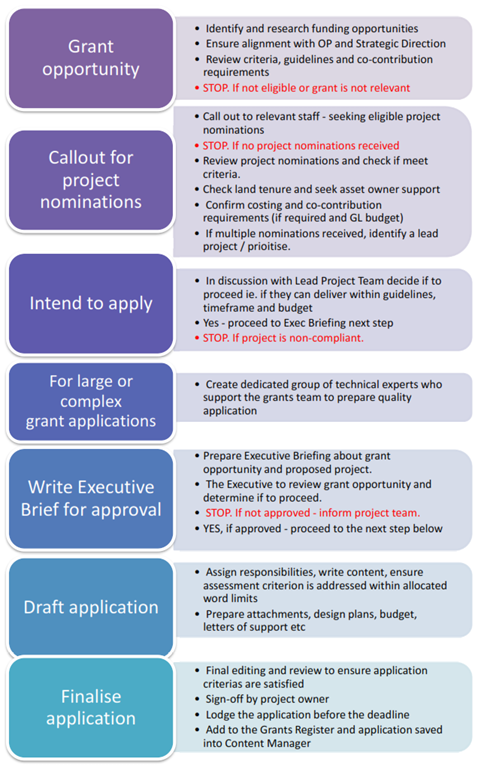
Activity over the last three-months
During the reporting period staff have evaluated 28 relevant funding opportunities, with the outcome as follows:
· 8 grant opportunities not proceeding.
· 9 grant opportunities still under review (including the previous period)
· 12 grant opportunities with applications written and submitted.
The Council Grant Opportunities Quarterly Register (Attachment 1) details all the relevant grant opportunities under review for Council for the last three months of the 2024-2025 financial year. The register provides details of projects, programs and infrastructure considered, and a brief description of the criteria applications must meet for eligibility. The register includes the status of Grant opportunities in the April 2025 to June 2025 period, in the following categories:
1. Grant Opportunities Under Review
2. Grant Opportunities Not Proceeding
3. Grant Applications Submitted
3. Conclusion
There are a range of grant opportunities available from Australian and NSW Government funding bodies.
Council’s operational plan delivery, funding and capacity is assessed at the time a funding opportunity is presented. This assessment informs the decision to proceed to prepare and submit an application.
Key Considerations
4. Financial and Economic Implications
The direct economic implications are the staff resources utilised to actively seek and review funding opportunities, prepare and manage grant applications and report on them.
It should be noted that if Council is successful in receiving grants, there is often a requirement for Council to provide matched funding. The financial impact of this is assessed prior to application.
Grants from various sources are an important source of funding for a wide variety of Council activities and supporting the delivery of services and infrastructure for our community. Many grant funded projects result in the use of local suppliers and contractors, which contributes significantly to local economic activity.
There are no financial and economic implications specifically in relation to this report other than the time and operational staff resources to produce this new report.
5. Legislative and Policy Implications
There are no legislative requirements associated with this report.
6. Strategic Context and Implications
It is noted that the grant opportunities are assessed according to timing of grants announced and received by the grant’s subscription, and that project implementation and delivery can have implications on Council staff resources, budgets and priorities and is assessed prior to submission of an application.
The Operational Plan alignment must be demonstrated before an application is submitted.
7. Risk and Insurance Implications
There are no identified risks specifically associated with this report.
8. Engagement and Consultation
Internal engagement is conducted with relevant teams across Council to compile the grants register which is the basis of this report.
9. Civic Leadership
Grants from the Australian and NSW Governments are an important source of funding for a wide variety of Council activities and supporting the delivery of services and infrastructure for our community.
Options
This report is for information only.
|
Attachments 1.
|
Agenda Community Planning and Environment
Subject: Community Grants 2024-2025
Presented by: Community, Planning and Environment, Melissa Watkins
That Council note the report on Community Grants awarded for 2024-2025.
Executive Summary
Council’s 2024-25 Community Grants Program was adopted at the 15 August 2024 Council Meeting. The Program has a total budget of $200,000 for the 2024–2025 financial year, delivered in accordance with Council’s Policy on Providing Funding and Support to the Community.
At the Ordinary Meeting of Council on 15 August 2024 (Item 11.05), Council resolved:
That Council:
1. Adopt the proposed funding criteria for the 2024-2025 Community Grants Program.
2. Receive a report to the July 2025 Council meeting on the outcomes of the 2024-2025 Community Grants program.
This report responds to this resolution.
Report
1. Background
Council allocates up to $200,000 annually through the Community Grants Program to support local not-for-profit organisations in delivering community development programs and events. The program gives priority to community-led initiatives that align with the objectives of Council’s Community Inclusion Plan, Disability Plan, and Cultural Plan.
For the 2024–25 financial year, a total of $164,683 was awarded to 39 local charities and not-for-profit organisations through two funding rounds (September 2024 and February 2025) and the ongoing Micro Grants Program.
All applications were subject to eligibility and completeness checks, and were assessed by an independent Assessment Panel, in accordance with the program’s funding guidelines.
The Community Grants Program remains dedicated to fostering inclusive, accessible, and culturally rich community initiatives across the Port Macquarie Hastings.
2. Discussion
The guidelines provided funding for projects and activities that:
· Celebrate creativity and heritage through arts and cultural initiatives
· Enhance learning and skills through educational programs
· Bring people together through local community events
· Address disadvantage to promote equity and inclusion.
The Community Grants Program was launched on Council’s website in August 2024 and included supporting information such as Funding Guidelines, grant writing tips and examples of previously funded projects. When each funding round was opened Council promoted these through:
· Social media posts (Round 1: 2 & 20 September, Round 2: 14, 17, 24, 25 February & 12 March)
· Radio advertising through the Southern Cross Austereo network
· Community Grants information sessions
· Direct mail to community organisations (including youth, seniors, disability, First Nations, and welfare sectors)
· Mail-out to previous grant applicants, Council-Community Action Teams and Progress Associations
· Presentations at interagency meetings
· Advertising in multiple e-Newsletters, including Have Your Say, iCreate, Environment Matters, and Artwalk newsletters
Council received a total of 75 Community Grant applications for 2024–25, with 45 applications submitted in Round 1 and 30 in Round 2. Of these, 20 applications were successful in Round 1, and 11 in Round 2. In addition, 8 micro grants were awarded, bringing the total number of successful Community Grants applications to 39 for the year.
The Community Grants Program continues to be a positive tool in supporting local initiatives that create real and lasting impact. The program enables the delivery of projects that foster inclusion, celebrate culture, support youth and wellbeing and build stronger connections within and across our communities.
The grants program goes far beyond funding individual events - they help Council deliver more than we could alone, particularly in the areas of access and inclusion, First Nations engagement and cultural activation. Whether it is supporting art therapy for people with a disability, cultural camps for Aboriginal boys, or youth-led music gigs, the program brings people together and supports grassroots leadership.
Many of the grant-funded projects have also enriched Council-led initiatives, including participation in ArtWalk, Youth Week and the Seniors Festival, helping to expand their reach, relevance, and community ownership.
From villages to town centres, creative spaces to community halls, the program empowers local groups to respond to local needs, test ideas, and spark change. It is helping to shape a more inclusive, connected and vibrant Port Macquarie-Hastings.
Applicants were requested to submit grants applications across three categories: Community Projects, Creative Community and Community Celebrations, while micro grants were awarded to specific areas of need. Below are the successful applications for Rounds 1 and 2 across these categories and for micro grants:
Round 1 - Community Projects (Round 1 total: $105,119)
|
Target Area |
Project |
Grant Amount |
|
Disability |
Creating a Safe Haven A 12-week art therapy program linking disability needs with suicide support services through a 12-week recovery-oriented program and major artwork for the Safe Haven premises at the hospital. |
$2,400 |
|
Mental health |
Front Line Listeners Mental Health First Aid training for volunteers of the Self Seen Men’s Program. |
$3,000 |
|
Domestic violence |
Pathways to Healing Trauma, culture and life skills recovery workshops for women and children residing in Liberty’s refuge and crisis accommodation. |
$10,000 |
|
Youth, creative industries |
Creative Sparks Career development workshops on earning a living in the creative industry, held at CSU and PCYC for 13–25-year-olds during Youth Week. |
$10,000 |
|
At-risk youth |
Rise & Shine Breakfast Club Funding for Term 1 2025 to maintain an existing free breakfast for disadvantaged students at Hastings Secondary College Westport and Port Macquarie campuses. |
$5,000 |
|
First Nations, villages, youth, careers |
Camden Haven Cultural Camps Cultural immersion camps bring Elders and Aboriginal boys together. Imparting skills and knowledge to youth to give career opportunities in cultural tourism. |
$10,000 |
|
|
TOTAL |
$40,400 |
Round 1 - Creative Community (Round 1 total: $105,119)
|
Target Area |
Project |
Grant Amount |
|
Creative industries |
Hastings Art Trail The arts trail engages local artists to exhibit their work in open studios across Port Macquarie, Wauchope, and outlying villages. Bringing residents and visitors to these areas ending in a feature showcase at Artwalk 2025. |
$13,769 |
|
Youth, creative industries, careers |
Cage the Night This program of 10 free, youth-led community events provides safe, supportive, and paid performance opportunities for emerging young musicians. Featuring events during Youth Week and Artwalk, it helps young creatives build confidence and gain real-world experience in the live music industry |
$15,000 |
|
Creative industries |
One Act Play Festival This event that has run for over 10 years, brings together theatre groups from NSW, QLD, and Victoria on the June long weekend. An important competition that connects our local theatre community with diverse performances and playwrights. |
$5,000 |
|
LGBTQIA+, Youth |
Queer Screen Film Festival In its 3rd year Queer Screen Film Festival in Port Macquarie celebrates LGBTQIA+ stories. A low-ticket price event showing 7 films from Mardi Gras as part of a regional roadshow, speakers, performances, and a local photography showcase. A partner event between CSU, Queer Screen Australia, Cheers Queers, Out Loud & Proud, and Headspace. |
$5,000 |
|
Creative industries |
Hastings Valley Open Art Prize An all-age and ability artist competition and exhibition at Port Macquarie Bowling Club in April 2025. |
$1,000 |
|
|
TOTAL |
$39,769 |
Round 1 - Community Celebrations (Round 1 total: $105,119)
|
Target Area |
Project |
Grant Amount |
|
Connected communities |
Splashfests Free family friendly events at Port Macquarie, Kendall, Laurieton and Wauchope pools on Australia Day. Music, BBQ, prizes, and water play. |
$8,950 |
|
Seniors, connected communities |
Seniors Day at the Vineyard As part of the NSW Seniors Festival program, seniors are invited to Douglas Vale for a day of local performances, vineyard tours, and a community picnic. |
$2,000 |
|
Villages, families, placemaking, connected communities |
Christmas in Lorne A free Christmas event at the Lorne Recreation Centre on 21 December, featuring a visit from Santa on a fire truck, food, and a performance by a local band. |
$2,000 |
|
Villages, families, placemaking, connected communities |
Christmas in Byabarra A fee village Christmas at the Byabarra Hall and Recreation Reserve on 14 December. Volunteer club catered meal, kids’ games, social sport games, visit from Santa and a movie. |
$2,000 |
|
Villages, families, placemaking, connected communities |
Christmas in Beechwood A free village Christmas event at Byabarra Hall and Recreation Reserve on 14 December, featuring a catered meal by the volunteer club, kids' games, social sports, a visit from Santa, and a movie. |
$2,000 |
|
Villages, families, placemaking, connected communities |
Christmas for Bunyah LALC A free Christmas event to be held at Wildnets on 11 December bringing Wauchope Aboriginal families together through this event hosted by their Elders and Bunyah Local Aboriginal Land Council. |
$2,000 |
|
Villages, families, placemaking, connected communities |
Christmas in Pappinbarra A free, family-focused Christmas event at Hollisdale Hall for the Pappinbarra community, featuring Santa, live music, and lunch. |
$2,000 |
|
Villages, families, placemaking, connected communities |
Christmas in Bonny Hills Carols on the grass at Rainbow Beach Reserve brings residents together to enjoy carols, local bands, and performances beachside. |
$2,000 |
|
Volunteers, placemaking |
A Decade of Bloom Mrs Yorks Garden A free community event on 15 February 2025 that celebrates the 10-year achievements of volunteer group Friends of Mrs Yorks Garden. Guest from Gardening Australia, historical and indigenous activities, dance, music, weaving, bush tucker, art, garden tours and practice workshops. |
$2,000 |
|
|
TOTAL |
$24,950 |
Round 2 - Community Projects (Round 2 total: $47,426)
|
Target Area |
Application |
Offer |
|
First Nations |
Strong Spirit Men’s Program The Aboriginal Men’s Cultural & Social Support Program (June–December 2025) is a community initiative in the Port Macquarie-Hastings region that fosters cultural reconnection, wellbeing, and leadership among Aboriginal men through workshops, mentoring, and on-country experiences. |
$7,200 |
|
Place based Heritage |
Tacking Point Lighthouse Signs This project will replace outdated signage at the Lighthouse with accessible, informative panels that enhance the visitor experience and share the site's cultural, historical, and environmental significance for both locals and tourists. |
$9,142 |
|
Volunteer Support |
The Acoustic Vineyard Douglas Vale Historic Homestead & Vineyard is seeking funding for sound equipment to enhance its free monthly live music program. |
$4,000 |
|
|
TOTAL |
$20,342 |
Round 2 - Creative Community (Round 2 total: $47,426)
|
Target Area |
Application |
Offer |
|
Heritage |
Bringing Our History to Life An interactive projection experience for Artwalk 2025 that will illuminate St Agnes’ Church with historic images, audio, and artefacts, creatively sharing Port Macquarie’s heritage. |
$2,000 |
|
Social Connection |
Kendall Music Exchange A free, monthly all-ages event at the community hall that fosters social connection and inclusion through music, open mic performances, and shared meals, offering a safe, alcohol-free night out for the Kendall community. |
$4,184 |
|
Arts & Culture |
Church Light Display As part of ArtWalk, St Thomas Anglican Church will host free 30-minute light shows transforming Church Hill into a vibrant cultural gathering with projections, music, food trucks, and local artists. |
$2,000 |
|
|
TOTAL |
$8,184 |
Round 2 - Community Celebrations (Round 2 total: $47,426)
|
Target Area |
Application |
Offer |
|
First Nations |
NAIDOC Week Two free NAIDOC Week events - an Opening Ceremony at Town Green & Family Fun Day at Westport Park—celebrating culture, community, and connection through Aboriginal performances, activities, and displays. |
$4,000 |
|
Community Events |
New Years Eve Fireworks The 2025 Port Macquarie New Year’s Eve Fireworks will feature two family-friendly displays along the CBD foreshore. |
$7,000 |
|
First Nations Environment |
Reconnecting with Nature - Cultural Intelligence A free Reconciliation Week initiative by Landcare to build cultural knowledge of volunteers and the wider community by engaging a cultural teacher to share Aboriginal stories, language, and food through interactive sessions. |
$3,900 |
|
Social Connection |
Christmas Carols at the Beach A free Christmas event at Rainbow Beach Reserve that brings together local communities for a joyful evening of music, connection, and celebration featuring choirs, school groups, and Santa. |
$2,000 |
|
Disability - Social Connection |
Memories in Melodies A free weekly music therapy program starting 3 June 2025 at the Salvation Army Hall, supporting people with dementia, Parkinson’s, and other cognitive conditions. |
$2,000 |
|
|
TOTAL |
$18,900 |
Micro grants - (2025-26 total: $12,138)
|
Target Area |
Project |
Grant Amount |
|
Intergenerational |
Seen & Heard 2.0 This 8-week program bridges the generation gap by bringing together teenagers and seniors for storytelling, games, digital, and outdoor activities across various locations. A partnership with Griffith University will produce a scholarly paper on the program's outcomes. |
$2,000 |
|
Multicultural |
Diwali Festival A multicultural festival on 2 November on Town Green. Includes food, dance, music and fireworks showcasing diverse cultures of the Port Macquarie Hastings and celebrating Indian Festival of Lights. |
$2,000 |
|
STEM, youth, careers |
Hastings Robotics Team Team uniforms for students excelling in Science, Technology, Engineering, and Maths, representing the Port Macquarie Hastings region in an interstate robotics competition. |
$2,000 |
|
Volunteers |
Lost Plot Spring Fair Hire of disability toilet for the Community Garden’s Spring Fair. |
$755 |
|
Social Connection |
Pappinbarra Valley Bush Dance A free community event at the Hollisdale Hall, a much-loved evening that brings locals together for music, dancing, and shared meals. |
$2,000 |
|
Homelessness |
Our Place The Shade & Shelter project will enhance the Our Place Homelessness Hub with shaded outdoor seating, creating a safer, more accessible, and calming space for visitors, including those with mobility aids or experiencing stress. |
$1,312 |
|
Heritage Activation |
Museum After Dark Portable stage lights to enhance night-time exhibitions, improving safety, accessibility, and visitor experience and participating in creative cultural events including Artwalk 2025. |
$1,571 |
|
Health & Wellbeing |
Parkinson’s Day The Port Macquarie Parkinson’s Support Group seeks funding for a World Parkinson’s Day event at the library, offering expert talks, resources, and connection to support people with Parkinson’s, their carers, and families. |
$500 |
|
|
TOTAL |
$12,138 |
3. Conclusion
Community grants play a vital role in strengthening social cohesion, empowering local groups and delivering meaningful outcomes across the Port Macquarie-Hastings region. The program continues to support a diverse range of initiatives - from grassroots arts and cultural activities to programs promoting wellbeing, inclusion, and environmental stewardship.
Feedback from recipients and measurable project outcomes demonstrate that the grants foster innovation, build community capacity, and create lasting local impact.
Continued investment in the Community Grants Program is not only cost-effective, but essential in enabling community-led solutions that enrich our region and reflect the values of connection, diversity, and resilience.
Key Considerations
4. Financial and Economic Implications
There are no financial and economic implications to this report other than the details provided in respect of the grants awarded.
5. Legislative and Policy Implications
There are no legislative implications associated with this report.
6. Strategic Context and Implications
Community grants are a key mechanism through which Council delivers on its strategic objectives for community wellbeing, inclusion, and resilience. Aligned with the Port Macquarie-Hastings Community Strategic Plan, the grants program enables direct investment in local community groups, empowering organisations, volunteer groups, and individuals to lead initiatives that reflect local needs and aspirations.
In an environment where cost-of-living pressures, social isolation, and changing demographics impact community wellbeing, targeted grant funding ensures resources reach those best placed to make a difference. Community Grants support Council’s role as an enabler - strengthening partnerships, enhancing social infrastructure, and encouraging innovation at the grassroots level.
By funding projects that align with strategic priorities, the grants program delivers measurable outcomes and fosters a more connected, creative, and resilient region. This strategic investment not only leverages local knowledge and passion but also maximises impact by building capacity within the community to deliver sustainable benefits over time.
7. Risk and Insurance Implications
There are no identified risks specifically associated with this report.
8. Engagement and Consultation
There was no internal engagement required for the generation of this report.
9. Civic Leadership
Community grants are a powerful tool for fostering civic leadership by empowering individuals and organisations to take initiative, drive positive change, and contribute to the wellbeing of their communities. By supporting local projects that reflect shared values and address identified needs, community grants help cultivate a culture of active citizenship and collaboration.
The Community Grants program encourages emerging leaders, builds the capacity of grassroots organisations, and strengthen the connection between Council and the community. Through transparent and inclusive grant-making, Council demonstrates responsive governance and a commitment to enabling community-driven solutions, key hallmarks of effective civic leadership.
Options
This report is provided for information only.
|
Attachments Nil
|
Agenda Community Planning and Environment
Subject: Scoping Proposal - Land within Yippin Creek Structure Plan
Presented by: Community, Planning and Environment, Melissa Watkins
That Council:
1. Endorse the Scoping Proposal (Attachment 1), to facilitate a pre-lodgement meeting with the Department of Planning, Housing and Industry.
2. Endorse the preparation of a Council-initiated Planning Proposal for the land within the Yippin Creek Structure Plan under section 3.33 of the Environmental Planning and Assessment Act 1979.
Executive Summary
Council is progressing a Council-initiated Scoping Proposal to rezone land identified in the Yippin Creek Structure Plan adopted by Council at the 15 March 2017 Ordinary Council meeting. The Scoping Proposal outlines the necessary investigations, infrastructure coordination and planning process, required to prepare a formal Planning Proposal for Gateway determination under the Environmental Planning and Assessment Act 1979 (the Act).
The Yippin Creek Structure Plan area forms part of Wauchope’s designated urban expansion area under the North Coast Regional Plan 2041 and Council’s Urban Growth Management Strategy 2011-2031. The Structure Plan was adopted by Council in March 2017, following extensive consultation and technical analysis and provides the basis for this rezoning. It aims to accommodate approximately 1,050 dwellings and a future population of around 2,300 residents through a balanced approach to housing supply, infrastructure delivery and environmental conservation.
The 175-hectare precinct currently comprises a mix of rural holdings, cleared grazing land and ecological corridors. While the precinct presents a logical expansion for urban development, it is also affected by significant environmental and physical constraints, including high ecological value vegetation, flood-prone land, bushfire risk, and subsoil limitations for stormwater infiltration. These constraints necessitate a careful and staged approach to land use planning.
The precinct is currently not serviced, requiring major upgrades to water, sewer, drainage and road networks. A new 450mm trunk water main is proposed from Rosewood Reservoir, while three sewer catchments will be supported by new pump stations and rising mains. Stormwater detention will be designed to address runoff risks associated with clay soils and altered hydrology. Beechwood Road and Oxley Highway intersections will need to be upgraded to support access, and new pedestrian and cycle links will improve local connectivity. These works will be sequenced in line with development staging and partly funded through Council’s Development Servicing Plan, Local Infrastructure Contribution Plan and voluntary planning agreements.
The rezoning will apply a revised suite of zones, in accordance with the Standard Instrument, to implement the Structure Plan, including R1 General Residential, C2 Environmental Conservation, C4 Environmental Living, RE1 Public Recreation and retained RU1 Primary Production. A Locality-specific Development Control Plan will be developed to accompany the rezoning to guide subdivision layout, urban design, environmental buffers and public open space provision. Detailed built form and infrastructure controls will respond to the precinct’s unique context and constraints.
A comprehensive gap analysis has been completed to confirm the technical studies required to support the Planning Proposal. While several key studies, such as biodiversity, transport, contamination, and cultural heritage, have been completed, further work is required to update flood and bushfire assessments, confirm servicing strategies, and finalise the zoning and subdivision layout. This information will underpin the Planning Proposal and inform the statutory Local Environmental Plan mapping suite.
Engagement with landowners will be a priority, particularly in relation to servicing coordination and subdivision intentions. Broader community consultation will occur as part of the statutory public exhibition period, and Council will continue to liaise with State agencies to resolve any technical or policy matters ahead of a Gateway submission to the Department of Planning, Housing and Industry.
The Yippin Creek precinct offers a strategically endorsed opportunity for urban expansion in Wauchope. The rezoning process, as outlined in the Scoping Proposal, will ensure development occurs in a coordinated, environmentally responsible, and infrastructure-led manner. Following the scoping proposal process Council will be required to progress the required investigations to prepare a comprehensive Planning Proposal. It should be noted that the comprehensive studies and the stages beyond the Scoping Proposal are not presently funded in the 2025-2026 budget.
Report
1. Background
The Yippin Creek Structure Plan area (the precinct) has been consistently identified as a logical extension of Wauchope’s urban footprint, underpinned by both regional and local planning strategies. In anticipation of future population growth, Council prepared the Yippin Creek Structure Plan in 2017 to provide a coordinated framework for the future rezoning and development of the precinct.
The Structure Plan was developed over a two-year period through a rigorous process of technical assessment, interagency collaboration, and community consultation. It was formally adopted at the Ordinary Council Meeting held on 15 March 2017.
The Structure Plan identifies approximately 175 hectares of land on Wauchope’s western edge for low-density residential development, public open space, infrastructure corridors, and environmental conservation. The area is recognised in the North Coast Regional Plan 2041 (Regional Plan), the Urban Growth Management Strategy 2011-2031 (UGMS) and the Local Strategic Planning Statement 2040 as a growth area aligned with long-term urban planning and infrastructure delivery.
The Structure Plan establishes a strategic framework to accommodate approximately 1,050 new dwellings, housing an estimated 2,300 residents. It promotes a place-based planning approach and embeds key principles in the Structure Plan including protecting significant ecological values, managing hazard risks (such as flooding and bushfire), and delivering infrastructure in a coordinated and financially sustainable manner.
Since the Structure Plan’s adoption, Council has undertaken several technical studies to refine its understanding of site constraints and servicing requirements. These include biodiversity assessments, Aboriginal heritage due diligence, land contamination testing, transport modelling, flooding and preliminary bushfire analysis.
2. Discussion
The Scoping Proposal represents the next phase in implementing the Structure Plan. It defines the scope of additional technical studies, statutory planning work, and engagement activities required to support a Council-initiated Planning Proposal.
Site-specific and Environmental Considerations
The precinct is currently zoned part RU1 Primary Production and part R1 General Residential under the Port Macquarie-Hastings Local Environmental Plan 2011 (LEP). The precinct and its surrounds exhibit several key features, opportunities, and constraints that must be further investigated as part of the Planning Proposal process to confirm the precinct’s suitability for rezoning and development. These considerations include:
|
Existing and Surrounding Land Uses |
The precinct comprises rural grazing land, detached dwellings, home businesses, rural activities and patches of remnant vegetation. It is bounded by new and existing residential areas to the east and south, and bushland to the north and west, creating a transitional edge that presents both urban and rural interface challenges and opportunities for buffer treatments. |
|
Topography and Contamination |
The precinct features undulating terrain and low-lying areas with poor-draining clay soils, which constrain stormwater management. Council will require integrated Water Sensitive Urban Design (WSUD) solutions and detention basins tailored to local catchment conditions. The land contamination assessment found the precinct suitable for residential use with no remediation required, subject to standard construction-phase protocols. |
|
Ecology and Biodiversity Offsets |
The ecological assessments have confirmed the presence of high ecological value (HEV) vegetation, threatened species habitat, and an Endangered Ecological Community (Subtropical Coastal Floodplain Forest). The biodiversity studies have recommended development avoidance in key areas and proposed offset strategies. |
|
Flood Prone Land |
Flood modelling indicates that while most of the precinct is elevated, portions near Yippin Creek are flood-affected in 1% Annual Exceedance Probability (AEP) and Probable Maximum Flood (PMF) events. Flood risk limits developable land, restricts access during major flood events, and highlights the need for updated stormwater and flood impact assessments to inform zoning boundaries and emergency access planning. |
|
Bushfire Hazard |
The precinct is bushfire-prone due to adjacent unmanaged vegetation. A preliminary assessment supports future development, provided Asset Protection Zones, dual access roads, and appropriate water infrastructure are incorporated. A refined bushfire assessment will be required to confirm compliance with the Planning for Bush Fire Protection 2019 guidelines. |
|
Vehicle Access and Connectivity |
Vehicle access to the Precinct is proposed via Beechwood Road to the north and the Oxley Highway to the south. Yippin Creek Road and Glenview Drive will be upgraded to provide direct access to the internal road network. Several key intersection upgrades have been identified to support future traffic volumes, including: · Beechwood Road / Glenview Drive: upgrade to a roundabout to accommodate increased through traffic and turning movements, · Beechwood Road / Yippin Creek Road: upgrade to a roundabout to improve safety and capacity, · Oxley Highway / Beechwood Road / Allan Road: signalisation and left-in/left-out restrictions at Allan Road to reduce conflict and improve capacity, · Oxley Highway / Yippin Creek Access: no further upgrades required beyond those proposed under the approved MHE development. These upgrades are not solely attributable to the Precinct but will be partially funded through development contributions, coordinated under Council’s Contributions Plan and infrastructure servicing framework. Council is currently upgrading Beechwood Road between Waugh Street and Glenview Drive (Stage 6) including replacing the existing timber bridge (named Steels Bridge) at Yippin Creek. Planning is now well progressed for the upgrading of Beechwood Road including the replacement of Steels Bridge. A transport study by Bitzios Consulting (2020) confirms that, although the current network is functional, upgrades including new roundabouts, restricted turning movements, and improved active transport links are necessary. |
|
Heritage and Cultural Landscape |
A due diligence assessment determined that the Yippin Creek precinct has low to moderate potential for Aboriginal cultural heritage. No Aboriginal objects or sites were identified, and further assessment is not required unless new evidence emerges during future planning or development stages. There are no known European heritage items within the precinct. However, the existing semi-rural character of the area will require sensitive treatment in future urban design, particularly in relation to visual impacts and the integration of public open space. |
|
Infrastructure and Servicing Capacity |
Water supply is a critical constraint, with a new pipeline required from Rosewood. Sewer capacity is available, but delivery will require new pump stations and staging. Electricity and NBN can be extended from adjacent developments. A coordinated servicing strategy will be essential to align infrastructure delivery with land release sequencing. |
|
Fragmented Land Ownership |
The central and north-eastern areas of the precinct are fragmented, complicating stormwater drainage and infrastructure staging. A coordinated approach, including landowner agreements and shared infrastructure corridors, will be necessary to facilitate equitable and functional development across multiple parcels. |
The Scoping Proposal seeks to rezone approximately 135 hectares of land (from the 175 hectares precinct area) to enable the development of a new low-density residential neighbourhood. The proposed zone map is based on the Structure Plan and has been informed by site constraints, servicing capacity, and strategic growth directions under the Regional Plan and the UGMS (refer to Attachment 2).
The Scoping Proposal put forward, strictly aligns with the original precinct boundary as endorsed by Council in 2017. No expansion beyond this footprint is proposed. This approach ensures a clear alignment with regional planning policy and avoids inappropriate land use conflicts or environmental impacts in areas not earmarked for growth.
Indicative Land Use Breakdown
The proposed land use distribution within the precinct reflects a balanced approach to housing supply, environmental conservation, and infrastructure delivery. Table 1 shows the approximate breakdown.
Table 1 - Indicative Precinct Land Use Breakdown
|
Land Use |
Area |
% |
Description |
|
Residential |
83 ha |
54% |
Low Density Dwellings |
|
Open Space |
1 ha |
1% |
Neighbourhood Park |
|
Conservation |
41 ha |
24% |
Riparian buffers, corridors and ecological conservation areas |
|
Infrastructure |
10 ha |
7% |
New local roads, detention basins, and utility corridors |
|
SUB-TOTAL |
135 ha |
- |
- |
|
Rural - no change |
25 ha |
14% |
Retained areas and buffers. |
|
SUB-TOTAL |
160 ha |
100% |
- |
|
The Oxley Club - no change |
15 ha |
- |
Manufactured Home Estate which is subject to an existing development consent. |
|
TOTAL |
175 ha |
- |
- |
Residential land will comprise approximately 83 hectares (54%) of the precinct, excluding the adjoining 15-hectare Oxley Club estate. Open space (1 ha) and conservation areas (41 ha) account for 1% and 24% respectively, with the latter preserving ecological corridors and HEV vegetation. Infrastructure, including roads and stormwater management, is approximately 10 hectares (7%). A further 25 hectares (14%) will remain zoned rural.
Proposed Zones
The Scoping Proposal introduces a revised zoning framework to support the transition from rural land to urban residential and conservation uses, aligned with the Structure Plan. Key zoning changes include:
1. R1 General Residential (Pink)
Located in the central, west and southern portions of the precinct, this zone facilitates low-density housing. It is strategically placed adjacent to existing residential areas to the east and south for efficient infrastructure delivery. Smaller pockets of R1 are also located in the north-west and south-west.
2. C2 Environmental Conservation (Orange)
Concentrated along the western boundary and riparian corridors, particularly in the north-west and south-west of the precinct. This zoning preserves HEV vegetation and some flood-prone areas to the north.
3. C4 Environmental Living (Peach)
Located in the southern edge of the precinct, this zone allows for limited, low-impact residential development integrated with natural features and biodiversity values.
4. RE1 Public Recreation (Bright Green)
A small area centrally located within the western portion of the precinct, adjacent to R1 and C2 zones. This area provides for a neighbourhood park and contributes to walkable green corridors.
5. RU1 Primary Production (Light Beige)
Positioned in the north-east portion of the precinct, retained to accommodate existing rural uses and as a protection area for identified HEV vegetation.
Indicative Dwelling Yield
The proposal estimates an indicative yield of 1,050 dwellings, accommodating around 2,300 residents, subject to detailed subdivision design. This includes 323 manufactured dwellings already approved in the southern part of the precinct, with additional lower-density yields dispersed throughout i.e. 727 new dwellings are proposed in the balance area.
New Locality-specific Development Control Plan (DCP)
A Locality-specific DCP will be critical to implementing the Structure Plan by providing detailed, site-specific development controls that the LEP alone cannot deliver for the precinct. It will address environmental constraints, fragmented land ownership, and urban-rural interfaces through tailored guidance on subdivision layout, built form, landscaping, and infrastructure coordination.
The Locality-specific DCP will promote walkable, connected neighbourhoods with active transport links, diverse housing, and accessible public open space. Incorporating principles like Healthy Streets and Crime Prevention Through Environmental Design (CPTED), it will support safe, inclusive, and sustainable communities.
To be incorporated into Part D of Council’s Development Control Plan 2013, the Locality-specific DCP will include sections on the precinct’s objectives, site context, character, zoning, urban design, public domain, access, environmental management, infrastructure, and staging. It will provide a clear and consistent framework for assessing future development in the precinct.
Essential Services Infrastructure
Currently, the precinct is not serviced, however, it is strategically located near existing water, sewer, electricity, and telecommunications networks. A coordinated infrastructure delivery approach will be essential to facilitate development and manage demand as the area urbanises.
Access, Traffic and Transport
A detailed Transport Study by Bitzios Consulting in 2020 supports the precinct’s rezoning, forecasting over 1,050 dwellings and peak-hour traffic volumes of 793 (AM) and 872 (PM) trips at full build-out. The proposed internal road network includes distributor, collector, and local roads designed for efficient traffic distribution, active transport, and emergency access.
External access will be via Beechwood Road and the Oxley Highway, supported by intersection upgrades at Glenview Drive, Yippin Creek Road, and Allan Road. Beechwood Road is currently undergoing staged upgrades and planning is well progressed for these works including the replacement of Steels Bridge.
Active transport will be improved through shared paths, cycle lanes, and enhanced pedestrian connectivity, including a key link over Yippin Creek to Duncan Street. Public transport planning will be considered in later stages with Transport for NSW.
Transport infrastructure delivery will be staged and funded via Section 7.11 contributions and voluntary planning agreements (VPAs), aligned with traffic growth and development sequencing.
Public Open Space and Conservation Areas
The precinct prioritises public open space and environmental conservation to enhance liveability, recreation, and biodiversity protection. The Structure Plan identifies a green network comprising a 5,000m² neighbourhood park, riparian corridors, and ecological buffers. While the originally proposed park site at 92-98 Yippin Creek Road was withdrawn, an alternative location in the northeast of Lot 2 DP 1036844 has been identified for its accessibility and integration with stormwater infrastructure.
Riparian corridors along Yippin Creek will provide passive open space, walking trails, and Water Sensitive Urban Design (WSUD) features, forming a connected green infrastructure network. Overall, the Structure Plan includes 1 hectare of active open space and 41 hectares of conservation land.
A Public Open Space and Recreation Strategy will accompany the Planning Proposal to confirm the park’s location, design standards, funding (via Section 7.11 and PAs), and options for dual-use stormwater-recreation areas.
Studies and Supporting Documentation Required
To progress the Planning Proposal and rezone land in accordance with the Structure Plan, several key studies must still be completed or updated. While some can be prepared in-house by Council staff, others will require external technical input to address more complex or specialist matters. These are not deficiencies, but standard next steps to meet Gateway determination requirements. The gap analysis in the Scoping Proposal identifies what was undertaken in earlier phases and what remains outstanding (refer to Attachment 1). These include:
Prepared by Council
|
1. Planning Proposal Report: Strategic Planning team |
Required to demonstrate strategic justification and consistency with State and local planning frameworks. |
|
2. Updated Zone Map: Strategic Planning team + GIS team |
Needed to reflect final land uses and align with the Structure Plan ‘Vision.’ |
|
3. Indicative Subdivision Layout: Strategic Planning team + GIS team |
Provides spatial detail to test dwelling yields, infrastructure staging, and road layout. |
|
4. Locality-specific DCP: Strategic Planning team |
Translates the Structure Plan into detailed built form, open space, and infrastructure controls. |
|
5. Staging and Delivery Plan: Strategic Planning team + GIS team |
Aligns infrastructure delivery with land release timing and forecast dwelling take-up. Supports the coordination of servicing and development sequencing. |
|
6. Infrastructure Funding Strategy (s7.11 / VPAs): Strategic Planning team, Infrastructure team + Utilities team |
Establishes the contributions framework to fund infrastructure delivery, including potential amendments to existing s7.11 / s7.12 plans or the preparation of VPAs. |
|
7. Electricity and Telecommunications Servicing Assessment: Strategic Planning team + GIS team |
Validates the feasibility of extending power and telecommunications infrastructure to the precinct, including service availability, upgrade requirements, and delivery timing. |
|
8. LEP Amendment Mapping Suite: GIS team |
A full LEP Amendment Mapping Suite will be produced, covering proposed zoning, minimum lot size, building heights, floor space ratios etc. |
Prepared by external specialists
|
9. Updated Flood Impact Assessment:
|
Ensures zoning and development avoids flood-prone areas and complies with updated flood modelling. This assessment must be informed by current hydraulic modelling standards and statutory flood planning requirements. |
|
10. Updated Bushfire Hazard Assessment:
|
Assesses bushfire risk and defines Asset Protection Zones in accordance with Planning for Bush Fire Protection 2019. This report must be prepared by a certified practitioner. |
|
11. Ecologically Sustainable Development (ESD) Strategy:
|
Outlines how sustainability principles will be embedded in the precinct design, including energy efficiency, water conservation, and urban resilience measures. This requires multi-disciplinary expertise. |
|
12. Stormwater and WSUD Management Plan:
|
Identifies stormwater detention areas, manages runoff, protects water quality, and addresses site-specific constraints such as clay soils and topography. The plan must incorporate best practice WSUD principles and integrated catchment modelling. |
|
13. Social Infrastructure Needs Assessment:
|
Identifies future demand for schools, health services, libraries, and community facilities based on projected population growth. Requires specialist input in demographic modelling and service benchmarking. |
|
14. Public Open Space and Recreation Strategy:
|
Confirms the location, design standards, and delivery mechanisms to deliver the neighbourhood park and recreation areas. |
|
15. Development Feasibility Assessment:
|
Tests the financial viability of future subdivision and development and assesses the capacity of the precinct to fund infrastructure contributions. Requires detailed economic modelling and scenario testing. |
|
16. Urban Design Study:
|
Supports the preparation of a subdivision layout, public domain strategy, and built form controls. Informs the Locality-specific DCP and ensures consistency with the Structure Plan. |
Consultation and Engagement
A clear and transparent consultation process will underpin the Planning Proposal, process ensuring that landowners, the broader community, and State agencies are engaged at key stages. The strategy will aim to build trust, clarify the planning process, and ensure local knowledge and concerns are meaningfully considered.
Given that land ownership and expectations may have changed since the Structure Plan was endorsed in 2017, Council will undertake proactive engagement with landowners. This will involve direct correspondence, targeted briefings, and one-on-one meetings (if required).
The purpose of this engagement will be to:
· confirm landowner interest or concerns regarding zoning, dwelling yields, infrastructure staging, and development potential,
· clarify the Planning Proposal process and anticipated LEP amendment timeline,
· seek input on local matters, such as public open space locations, road alignments, and site-specific development considerations.
This stage will help ensure that the Planning Proposal reflects current landowner positions and addresses any unresolved issues from the original Structure Plan process.
Broader community consultation will occur during the formal public exhibition period of the Planning Proposal, in accordance with the Environmental Planning and Assessment Act 1979 (the EP&A Act). The exhibition will provide the community with an opportunity to review the full proposal and associated technical studies. This will include:
· public notification on Council’s website,
· access to the full Planning Proposal documentation and supporting technical studies,
· drop-in sessions or Q&A events to explain the proposed changes,
· a formal submission process, allowing residents and stakeholders to express views, identify issues, or support elements of the proposal.
Feedback received during this phase will be reviewed and may result in amendments to the proposal prior to finalisation.
In parallel with community consultation, Council will continue to liaise with relevant State agencies to resolve technical issues and ensure consistency with agency policies and infrastructure requirements. This process will support the integration of agency feedback into the final Planning Proposal and facilitate a smoother path to Gateway determination.
Timing and Delivery of the Planning Proposal
Table 2 provides an indicative program outlining the expected timing and key milestones associated with finalising the required technical studies, preparing the Planning Proposal, and progressing through the LEP plan-making process. This timeline assumes adequate resourcing, sufficient budget, timely agency input, and resolution of key technical matters identified through this scoping stage.
Table 2 - Indicative Delivery Program
|
Milestone |
Timeframe |
|
Pre-lodgement Meeting with Department |
Q3 2025 |
|
Engage consultants and complete required studies |
Q4 2025 |
|
Prepare draft Planning Proposal, LEP maps and DCP content |
Q1/Q2 2026 |
|
Report to Council to endorse Planning Proposal |
Q3 2026 |
|
Submit Planning Proposal to Department for Gateway determination |
Q3 2026 |
|
Gateway determination received |
Q4 2026 |
|
Public exhibition, agency referrals, landowner engagement |
Q4 2026 |
|
Consideration of submissions and finalisation report |
Q1 2027 |
|
Council adoption and submission to Minister to finalise LEP |
Q2 2027 |
|
LEP Amendment gazettal and DCP adoption |
Q2/Q3 2027 |
3. Conclusion
The Scoping Proposal provides a clear and strategically aligned pathway for progressing the rezoning and future urban development of a key growth precinct on the western edge of Wauchope. As outlined throughout this report, the Yippin Creek Structure Plan is grounded in strong strategic merit, consistent with the North Coast Regional Plan 2041, Council’s Urban Growth Management Strategy 2011–2031, and the Port Macquarie-Hastings Local Strategic Planning Statement 2040. It delivers on State and local planning objectives to accommodate population growth through sustainable, infrastructure-ready, and environmentally responsible urban expansion.
The Yippin Creek Structure Plan was adopted by Council in March 2017. The progression of the planning process was identified in 2020 as being contingent upon the completion of the Beechwood Road upgrade to ensure flood evacuation and access of emergency services in a flood event. Until Council had confidence that this project would proceed, the Planning Proposal process could not continue. Now with confidence that critical infrastructure has been funded and is being delivered by Council, the Planning Proposal process can commence with the Scoping Proposal outlined in this report.
Comprehensive technical assessments have been undertaken to inform the Structure Plan and this Scoping Proposal. These confirm that, while the Precinct contains areas of environmental sensitivity and servicing complexity, it also presents a viable opportunity to deliver over 1,000 new dwellings supported by a robust framework of public open space, transport connections, conservation outcomes, and infrastructure delivery. Site-specific challenges, such as fragmented ownership, bushfire risk, stormwater constraints, and ecological values, can be appropriately managed through further investigations, targeted design responses, and implementation of best practice planning and infrastructure strategies.
The Scoping Proposal defines the extent of the Precinct to be rezoned, sets out a clear land use and zoning framework, and identifies the scope of work required to prepare a Council-initiated Planning Proposal. Key land use components include approximately 83 hectares of residential development, 41 hectares of environmental conservation land, and dedicated areas for public open space and infrastructure. These land use allocations have been determined based on updated technical evidence, refined policy alignment, and practical infrastructure servicing constraints.
To progress to Gateway Determination, Council will complete a range of outstanding technical studies as identified in the gap analysis. These include updates to hazard assessments, detailed infrastructure servicing strategies, social infrastructure planning, and financial and economic feasibility studies. A Locality-specific Development Control Plan will also be prepared to translate the Structure Plan’s vision into tailored built form, subdivision, and infrastructure delivery provisions. This will ensure that future development is responsive to the unique character and constraints of the precinct and aligned with Council’s broader urban design and public domain objectives.
Importantly, Council remains committed to a transparent and inclusive planning process. The next phase will include targeted landowner engagement, formal community consultation, and ongoing collaboration with State agencies to ensure the Planning Proposal reflects the views of stakeholders and complies with all statutory requirements. The intent is to maintain strategic integrity while ensuring flexibility to respond to new information and evolving conditions as the Planning Proposal progresses.
In conclusion, the Scoping Proposal establishes a solid foundation for managing Wauchope’s urban growth in a planned, sustainable, and coordinated manner. It provides the necessary evidence and strategic justification to support the preparation of a Planning Proposal that will deliver much-needed housing, protect environmental assets, and guide long-term infrastructure investment. Subject to the completion of identified studies and agency engagement, Council will prepare and submit a Planning Proposal for Gateway Determination in accordance with section 3.33 of the Environmental Planning and Assessment Act 1979.
Key Considerations
4. Financial and Economic Implications
Preparation of the Planning Proposal will require both internal resourcing and external specialist input to complete the technical studies, mapping, and documentation identified in the Scoping Proposal.
Where feasible, Council teams will lead workstreams (e.g. GIS mapping, infrastructure coordination), however external consultants will be engaged to deliver specialist assessments such as flood modelling, bushfire risk, ESD, WSUD, and development feasibility. Currently the external studies are unfunded and not budgeted for in 2025-2026 with the table below outlining the indicative costs of these studies.
Estimated Indicative costs for each study are:
|
$30,000 – $50,000 |
||
|
· Updated Bushfire Hazard Assessment |
$12,000 – $20,000 |
|
|
· Ecologically Sustainable Development Strategy |
$20,000 – $35,000 |
|
|
· Stormwater and WSUD Management Plan |
$30,000 – $60,000 |
|
|
· Social Infrastructure Needs Assessment |
$15,000 – $30,000 |
|
|
· Public Open Space and Recreation Strategy |
$15,000 – $25,000 |
|
|
· Development Feasibility Assessment |
$25,000 – $40,000 |
|
|
· Urban Design Study |
$25,000 – $45,000 |
|
|
Total Estimated Range: |
$172,000 – $305,000 (ex. GST) |
|
|
Total Estimate + 10% Contingency |
$189,200 – $335,500 (ex GST) |
|
Longer term, the successful rezoning of the precinct is expected to enable the delivery of over 1,000 new dwellings and generate indirect economic benefits through construction activity and local service demand.
Infrastructure funding to support development will be secured through a combination of Section 7.11 contributions, VPAs, State infrastructure programs (such as the Regional Precincts and Partnerships Program, Regional Housing Strategic Planning Fund, State Voluntary Planning Agreements (SVPA) Funding Program, Infrastructure Grants: Community Infrastructure Program etc.) and State improvement programs (such as Open Streets Program, Streets as Shared Spaces Program, Places to Love Program etc.), to be outlined in the Infrastructure Funding Strategy. The Development Feasibility Assessment and Staging Plan will ensure the financial viability and orderly rollout of infrastructure is appropriately aligned with development uptake.
5. Legislative and Policy Implications
The Scoping Proposal represents the first step in the formal LEP plan-making process as set out in the Department’s LEP Plan-Making Guideline, including the requirement to engage in pre-lodgement consultation with the Department. This Scoping Proposal is intended to inform the preparation of a Planning Proposal under Section 3.33 of the Act, to be submitted to the Department for Gateway determination under Section 3.34 of the Act.
The proposed rezoning will require an amendment to the LEP, supported by associated mapping and a new Locality-specific DCP. These instruments will ensure future development aligns with the adopted Structure Plan, relevant State and regional planning policies, and Council’s Integrated Planning and Reporting (IP&R) framework.
The proposed changes are consistent with the strategic planning framework including the Regional Plan and the UGMS. Additionally, the Scoping Proposal does not introduce new policies but implements an existing Council-endorsed Structure Plan through statutory mechanisms.
From an Environmental, Social and Corporate Governance (ESG) perspective, the Planning Proposal will promote environmental protection through C2 zoning and WSUD principles, supports social equity via public open space and diverse housing, and ensures transparency in planning and infrastructure funding. It demonstrates Council’s commitment to sustainable, infrastructure-led growth that balances development with long-term environmental and community outcomes.
6. Strategic Context and Implications
Planning Proposals are assessed in accordance with the strategic planning framework of NSW which includes both State and local legislative requirements, strategies and planning controls.
This strategic planning framework establishes the vision for NSW into the future with alignment between planning priorities identified at a state, regional or district level with finer-grained placed-based planning at the local level.
The framework sets out the principles and outcomes for meeting the needs of communities and the environment now and plans for the needs of the future. It enables communities to assess the broader implications and consequences of identifying locations for growth and change.
Alignment across state and local strategic planning sets up a streamlined process for amending LEPs by having planning matters resolved early and setting a clear sequence, and greater confidence for all parties, for how communities will grow and change over time.
7. Risk and Insurance Implications
The key risks associated with proceeding to the Planning Proposal stage relate to planning uncertainty, infrastructure delivery, stakeholder expectations, and legal compliance.
· Planning risk - there is a moderate risk that the Planning Proposal may not proceed to Gateway determination if the required strategic justification or supporting studies are not undertaken. This will be mitigated by ensuring the proposal aligns with adopted regional and local planning strategies, securing sufficient budget, seeking Council’s internal team comments on the Scope of Works and draft reports and by completing all identified technical studies,
· Infrastructure risk - delays or gaps in infrastructure planning, funding, or delivery may affect development feasibility and staging. To reduce this risk, Council will prepare a Staging and Infrastructure Funding Strategy and coordinate early with service agencies and Council’s Utilities team,
· Stakeholder risk - divergent landowner expectations, particularly regarding dwelling yields or infrastructure costs, may lead to reputational or political pressure. Proactive engagement and transparent communication, as outlined in the consultation strategy, will mitigate this risk,
· Legal and Policy Compliance risk - there is a low risk of legal or procedural challenge if the Planning Proposal process does not fully comply with the Act or if community consultation is inadequate. This risk is minimised by following statutory procedures, including public exhibition and agency consultation, and documenting all decisions and inputs,
· Insurance risk - there are no direct insurance implications at this stage, as the work relates to statutory planning processes.
8. Engagement and Consultation
A comprehensive engagement strategy will be implemented to ensure landowners, community members, and key stakeholders are informed and actively involved throughout the Planning Proposal process.
· Landowner engagement - Council will re-engage with landowners within and adjacent to the precinct to confirm their positions on zoning changes, development potential, and infrastructure staging. This will include written correspondence, targeted briefings, and one-on-one meetings, where appropriate,
· Community consultation - formal public consultation will occur during the statutory exhibition of the Planning Proposal in accordance with the Act. The exhibition will include online access to documentation, drop-in information sessions, and a formal submission process to capture community feedback,
· Agency consultation - Council will continue to liaise with relevant State agencies to address technical matters and ensure consistency with policy and infrastructure delivery requirements.
9. Civic Leadership
The progression of the Planning Proposal demonstrates Council’s commitment to responsible civic leadership by delivering long-term, sustainable urban growth outcomes aligned with ESG principles.
The proposal prioritises environmental protection through the application of C2 Environmental Conservation zoning, integration of WSUD, and identification of riparian buffers and ecological corridors. These measures ensure that biodiversity, water quality, and flood resilience are embedded in the planning framework.
The precinct’s design promotes social inclusion by enabling a diverse housing mix, walkable neighbourhoods, and equitable access to public open space. A Social Infrastructure Needs Assessment will ensure service provision is aligned with future population needs.
Council is demonstrating transparent governance through a staged, evidence-based planning process that includes landowner engagement, public consultation, and inter-agency coordination. The integration of feasibility analysis, infrastructure funding strategies, and tailored planning controls into the statutory framework reflects a clear and accountable approach to growth management.
|
Attachments 1. 2.
|
Agenda Community Planning and Environment
Subject: Draft Lake Cathie Foreshore Reserve Master Plan Review
Presented by: Community, Planning and Environment, Melissa Watkins
That Council:
1. Endorse the Draft Lake Cathie Foreshore Reserve Master Plan Review for public exhibition for a period of not less than 28 days.
2. Note that a further report will be tabled at a future meeting of Council, detailing the submissions received from the public during the exhibition period.
Executive Summary
The review of the Lake Cathie Foreshore Master Plan project is identified as a short-term priority in the Recreation and Open Space Action Plan 2024-2029. This project is part of Councils Delivery Program, Principal Activity 2.1.1 Spaces and Places; to investigate and plan for future strategic recreational facilities.
This report details changes to the Plan and recommends adoption of the draft Plan for the purpose of public exhibition.
Report
1. Background
The Lake Cathie Foreshore Master Plan, adopted in 2018 (Attachment 1) is due for review. The Plan as adopted was overembellished and there are aspects that Council cannot deliver. Accordingly the Master Plan requires updating and this needs to be undertaken so as to provide the community with transparency into the projects and realistic outcomes for the foreshore reserve. The draft revised Master Plan involved pre-engagement as detailed (Attachment 3) with the Lake Cathie community prior to this draft being reported to Council.
2. Discussion
The draft Lake Cathie Foreshore Master Plan Review (LCFMR) (Attachment 2) considers the 2018 Lake Cathie Foreshore Master Plan, assesses the existing conditions and reflects on the latest community and stakeholder aspirations. This process informs the revised Master Plan, with a new set of proposed prioritised projects, to be realised in stages over the coming years and decades in line with Council’s IP&R framework.
This Master Plan review expands along the reserves and linking connecting pathways along this town’s foreshore. With Lake Cathie Reserve at the northern extent as the most popular area, followed by Aqua Reserve across the bridge and Jonathan Dickson Reserve some distance away at the Southern extent. Lake Cathie Foreshore environment includes a variety of natural formations, including an ICOL, tidal and surf beaches and steep rock and sand escarpments. Littoral Rainforests bookend this study area at the North and South reaches to ensure the park’s continued development and to optimise use, the creation of a Master Plan is essential. This plan will serve as a strategic framework for the management and enhancement of the town’s foreshore reserves, addressing community needs and recreational opportunities. By implementing a Master Plan, Council can guarantee that the park remains well-maintained and effectively managed, catering to the diverse needs of residents and visitors alike.
The development of the Master Plan involves a thorough assessment of the existing facilities and amenities along the foreshore. Engaging with the local community will be crucial to gather insights and aspirations, ensuring that the plan reflects their needs.
The various passive and active reserves within the Lake Cathie Foreshore precinct are to be linked via a coastal walk to form a continuous coastal recreational corridor.
The sensitivities and opportunities presented by the Birpai culture in this rich coastal environment are also considered in upgrade proposals.
3. Conclusion
The vision for the Lake Cathie Foreshore will encompass improvements such as upgraded pathways and facilities, enhanced landscaping, and additional car parking spaces. This approach aims to foster physical activity, social interaction, and overall accessibility among users.
With thoughtful planning and active community participation, the Lake Cathie foreshore can continue to flourish as a welcoming hub for a variety of recreational activities, providing an inviting environment for all who visit.
Key Considerations
4. Financial and Economic Implications
No funding is currently available for the delivery of the Master Plan. Future projects will be identified for delivery from 2026-2027 onward and are subject to priority review and budget endorsement through subsequent Operational Plan development, they will be identified in the 10-year Works Program and the Recreation and Open Space Action Plan.
The planning and delivery of Lake Cathie Foreshore Master Plan is expected to provide a positive economic impact for the Port Macquarie Hastings community by contributing to the area being a great place to live and recreate.
5. Legislative and Policy Implications
The draft revised Lake Cathie Foreshore Master Plan identifies several areas of improvement to the reserve. These improvements will undergo prioritisation and will be identified in the 10-year Works Program and the Recreation and Open Space Action Plan.
6. Strategic Context and Implications
The revision of the Lake Cathie Foreshore Master Plan project is identified as a short-term priority in the Recreation and Open Space Action Plan 2024-2029.This project is part of Councils Delivery Program, Principal Activity 2.1.1 Spaces and Places; to investigate and plan for future strategic recreational facilities.
7. Risk and Insurance Implications
Potential risks associated with the Draft Lake Cathie Foreshore Reserve Masterplan include potential community resistance to and expectations for the delivery of the proposed projects. These risks are reduced by the following:
- Undertaking pre-engagement with the community to develop draft Master Plan (completed).
- Undertaking a planned public consultation period of the draft Master Plan.
- Seeking feedback from the community regarding the prioritisation of project and preferred order of implementation.
- Revising the draft Master Plan with consideration of feedback received from the community during the public exhibition period.
8. Engagement and Consultation
External Pre-Consultation (completed)
To support this project, staff conducted two feedback community sessions to gain valuable feedback for input in drafting the Plan.
Over the two sessions held at the Lake Cathie Community Centre, 35 people attended and provided feedback. The first of these sessions was with the Lake Cathie Progress association/ Revive Lake Cathie members and the second was open to the public and advertised via the Council’s social media, website and posters placed in key areas of the locality.
There are a broad variety of concerns and aspirations regarding this prime recreational space for this community. Broader planning issues were raised as well as asset specific and maintenance requests. Some of these are broader issues cannot be resolved solely within this Master Plan, such as coastal and traffic planning and management. In this report these issues are identified as needing completion of other studies or projects prior to proposing certain upgrades that have not yet been completed at this time.
More detailed analysis of the community feedback received to date is included in the Lake Cathie Foreshore Master Plan Engagement Report (Attachment 3).
Overall, the community consultation meetings served as a platform to gather input, discuss ideas, and evolve the draft Master Plan into a base reference by which to develop the foreshore into recreational spaces that reflect the local community.
Ongoing Internal Consultation has occurred with.
· Group Manager Liveable Communities
· Manager Spaces and Places
· Recreation and Community Initiatives Coordinator
· Recreation and Community Strategy Coordinator
· Recreation and Open Space Planner
· Tree Management and Open Space Planner
· Facilities Coordinator
· Asset Officer
· Parks and Open Space Coordinator
· Future Asset Officer
· Community Engagement Officer
· Coast and Estuary Coordinator
Council has undertaken pre-engagement at the Involve level of the IAP2 Spectrum to inform the development of the draft Master Plan. This early engagement sought to understand community values, aspirations and site-specific concerns, and the feedback gathered has directly shaped the preparation of the draft plan now being sought to be placed on public exhibition.
Proposed Public Exhibition
The public exhibition phase will be delivered at the Consult level, providing the community with clear and accessible information about the draft Master Plan and inviting formal submissions and feedback. Engagement activities will be guided by the principles outlined in Council’s Draft Community Engagement Strategy, with a focus on inclusiveness, transparency and accessibility. A variety of communication channels will be used—including Have Your Say online tools, hard copy displays in accessible locations, and targeted notifications—to ensure community members have a fair opportunity to review the plan and provide input. Feedback will be considered in finalising the plan, and outcomes will be reported back to the community to demonstrate how their input was considered.
The Engagement Plan for this stage for consultation is provided here as Attachment 4.
9. Civic Leadership
The revision of the Lake Cathie Foreshore Master Plan is essential for future planning and decision making for the reserve. To ensure the parks continued development and to optimise use, the creation of a Master Plan is essential.
Options
Council has the option to not adopt the draft Lake Cathie Foreshore Master Plan Review for exhibition and may request the draft Plan be amended further prior to being placed on exhibition. This report recommends adoption of the draft Plan to seek community feedback.
|
Attachments 1. 2. 3. 4. |
Agenda Community Planning and Environment
Subject: Urban Growth Management Strategy Update
Presented by: Community, Planning and Environment, Melissa Watkins
That Council:
1. Note the progress of actions from Council’s Urban Growth Management Strategy as detailed within this report.
2. Note the information and associated timeframes contained within this report, in relation to the proposed continued progression of actions as detailed within Council’s Urban Growth Management Strategy.
Executive Summary
The Urban Growth Management Strategy 2017-2036 (UGMS) provides a framework for urban planning in the Port Macquarie-Hastings Local Government Area (LGA), with a focus on key actions in the 5-year period from 2018-2019 to 2022-2023. The UGMS was adopted by Council in June 2018 and endorsed by the former NSW Department of Planning in November 2018.
The purpose of this report is to provide a status update on the progress of the implementation of the actions as detailed within the UGMS. This report also recommends re-evaluation of some actions based on current identified opportunities, constraints, and priorities.
Report
1. Background
Council at its meeting on 18 July 2024, considered a report on the status of the actions within the Urban Growth Management Strategy Update (Item 13.03) and resolved as follows:
“That Council:
1. Note the progress of actions from Council’s Urban Growth Management Strategy as detailed within this report.
2. Note the information and associated timeframes contained within this report, in relation to the proposed continued progression of actions as detailed within Council’s Urban Growth Management Strategy”.
2. Discussion
This report is intended to provide an annual update and demonstrate how Council has proceeded to action UGMS priorities.
Actions – Status Summary
The UGMS contains 33 Actions for delivery, indicatively over the life of the plan to 2036. The Actions relate to Housing, Economic Development and Making It Happen (i.e. the delivery of essential planning and services) to cater for forecast population growth in the Port Macquarie-Hastings region.
A summary of the actions, their current status and the proposed delivery in 2025-2026 are provided in the table below.
Note: Year 1 of the Strategy is 2018-2019. As stated in the UGMS, the timeframes shown are “indicative only and will be confirmed in Council’s annual operational plans.”
|
Housing Actions |
|
UGMS Housing Actions have now been superseded by the Living and Place Strategy which are updated in a separate report. |
|
Economic Development Actions |
||||
|
Action |
UGMS Year |
Status at July 2025 |
Proposed 2025-2026 Delivery |
|
|
12 |
Review LEP and DCP provisions for the Port Macquarie CBD |
3-4 |
City Heart Master Plan Project planning and scoping identified in the 2024/2025 and 2025/26 Operational Plan and will include consideration of planning controls in the Port Macquarie CBD. |
Stakeholder meetings have been held in June and the consultant is drafting a master plan, which will be presented to Council at a future date. |
|
13 |
Council led precinct planning for the proposed Health and Education Precinct |
1-3 |
Alternative access to the Health and Education Precinct to be investigated. Modelling information gathered and concept design for alternative solutions commenced. |
Review existing planning controls and make recommendations to Council. A Planning Proposal was lodged on 23 May 2025 for part of the HEP. |
|
14 |
Develop a new Destination Management Plan (DMP) for the Port Macquarie-Hastings |
1-2 |
Completed Report on progress of implementation presented to Council in June 2024. |
|
|
15 |
Planning for the development of a Business Park at the Port Macquarie Airport |
1 |
Completed |
|
|
16 |
Planning for the ‘gateway sites’ at the intersection of the Pacific and Oxley Highways in Port Macquarie |
1-2 |
Finalise Fernbank Creek and Sancrox Structure Plan. |
The draft water and sewer servicing and transport reports have been received from the consultants and are being reviewed. |
|
17 |
Investigate the capacity of land at the intersections of Ocean Drive with Houston Mitchell Drive for light industrial use and at the intersection of Ocean Drive with Bonny View Drive for light industrial development or for use as a school |
1-2 |
Planning proposal has been submitted to the Department of Planning for a gateway determination. Once a Gateway determination is received Council staff will progress planning proposal. |
Complete, LEP amendment (map only) was made on 17 April 2025. |
|
18 |
Investigate options for future service industrial land in the Camden Haven |
5 |
Further consideration of item will be undertaken as part of the UGMS and LSPS review process. |
Further consideration of item will be undertaken as part of the UGMS and LSPS review process. |
|
19 |
Review planning controls for rural and environmental areas in relation to recreation, agri-business and nature-based tourism |
3-4 |
Completed |
|
|
Making it Happen Actions |
||||
|
Action |
UGMS Year |
Status at July 2025 |
Proposed 2025-2026 Delivery |
|
|
20 |
Council will review population statistics and growth forecasts annually |
1-5 |
Ongoing |
Ongoing. |
|
21 |
Collaboration with the NSW government to prepare a Regional City Action Plan (RCAP) for Port Macquarie |
1-2 |
Completed |
|
|
22 |
Commence UGMS review to coincide with the next review of the North Coast Regional Plan |
4-5 |
Continue with review of LSPS and UGMS as per OP item. |
Continue with review of LSPS and UGMS. The next NCRP review is scheduled for 2027 and that is also the deadline for the LSPS. |
|
23 |
Review Major Roads Contributions Plan |
1-2 |
Progress and finalise Draft Contributions Plan. |
Completed - The Local Infrastructure Contributions Plan was adopted at the Ordinary Council Meeting held on 19 June 2025. |
|
24 |
Review Open Space Contributions Plan |
5 |
Progress and finalise Draft Contributions Plan. |
Completed - The Local Infrastructure Contributions Plan was adopted at the Ordinary Council Meeting held on 19 June 2025. |
|
25 |
Review the Water and Sewer Development Servicing Plans (DSP) |
2-3 |
Draft DSP is expected to be reported to Council’s July meeting. |
Completed - The DSP was adopted at the Ordinary Council Meeting held on 20 February 2025. |
|
26 |
Preparation of a Regional Integrated Transport Strategy |
1-2 |
Completed |
|
|
27 |
Preparation of an Integrated Water Cycle Management Strategy (IWCMS) for the Port Macquarie-Hastings |
1-2 |
Completed |
|
|
28 |
Complete Biodiversity Strategy and implement key actions |
1-5 |
In relation to the implementation of key actions from the Biodiversity Strategy, Council will in 24/25: · Investigate need for management plans for specific fauna species of concern. Outcome of investigation reported to Executive team. · Implement Flying Fox Camp Management Plan Flying Fox Camp Management Plan reviewed. · Progress towards identifying and acquiring land for biodiversity offsets - Procedure developed for land identification and acquisition. · Council’s Koala Plans of Management – Council sites monitored and education · Koala Plan of Management compliance capital maintenance undertaken Number of Koala Plan of Management compliance actions completed. · Development of Biodiversity Management Strategy - New strategy developed and presented to Council. |
The Biodiversity Strategy has been subsumed into the Environment and Sustainability Strategy, which was adopted at the Ordinary Council Meeting held on 20 March 2025. · The Flying Fox Camp Management Plan has ongoing review. An updated plan will be presented to the Ordinary Council Meeting to be held in August. · A Draft procedure to identify and acquire land for biodiversity offsets will be presented to Exec for review. · The Koala Action Plan was adopted at the Ordinary Council Meeting held in February 2024, and addresses the monitoring, education and maintenance relating to Koala Plans of Management. |
|
29 |
Complete strategies in relation to koala populations and implement key actions |
1-5 |
Key actions in relation to koala and their populations committed to in the 2024/2025 include: · Council’s Koala Plans of Management – Council sites monitored and education, percentage of Koala Management Plans sites monitored · Educational resources developed and implemented · Koala Plan of Management compliance capital maintenance undertaken · Number of Koala Plans of Management compliance actions completed. |
The Koala Action Plan was adopted at the Ordinary Council Meeting held in February 2024. The monitoring and education of Council sites, and resources has been delivered. Compliance actions relating to Koala Plans of Management are ongoing under the Koala Action Plan. |
|
30 |
Develop Community Plans and Local Strategic Planning Statement (LSPS) in consultation with key communities |
1-5 |
LSPS review process to continue as OP item. |
LSPS review process to continue. |
|
31 |
Review the Port Macquarie-Hastings Heritage inventory |
1-2 |
Review of the heritage inventory was not included the 2024/2025 Operational Plan. |
Review of the heritage inventory was not included the 2025/2026 Operational Plan. |
|
32 |
Complete a review of the Port Macquarie-Hastings Development Control Plan |
1-2 |
Further DCP review is to be undertaken in accordance with the DCP review program. |
Further DCP review is to be undertaken in accordance with the DCP review program which focuses on the residential controls in the 2025/26 FY |
|
33 |
Preparation of a Coastal Management Program (CMP) |
2-3 |
Finalisation of Stage 2 projects Commencement of Stages 3 and 4, including CMP options analysis and drafting of CMP for Council consideration and community engagement. |
Council’s Coastal Management Program is nearing completion, with Stages 3 and 4 starting in Q1 2025/26. These will outline detailed actions and business cases, supported by extensive community consultation. Once certified by the Minister for Local Government, the CMP will guide coastal management for the next 10 years. |
As shown in the table above, there are a range of land use planning actions related to economic development, infrastructure and service delivery that have been completed and are proposed for implementation in 2025-2026.
The delivery of these actions will generally be coordinated by Council’s Strategy Group, with input from other sections of Council.
The following section of this report provides further detail in relation to some key projects from the above table.
a. UGMS Review
The UGMS is reviewed on a five yearly basis. As such, it was required to be reviewed in 2022-2023. The review of the UGMS was delayed due to the review and subsequent finalisation of the North Coast Regional Plan 2041. A review has commenced on the strategic planning framework, including the UGMS.
A Planning and Land Use Discussion Paper was presented to the Ordinary Council Meeting of 20 June 2024, to commence the conversation with the community and industry regarding the review of Council’s two main land use planning documents, the LSPS and the UGMS.
A post-exhibition report and summary of submissions received during the public exhibition period was presented to the Ordinary Council Meeting of 20 February 2025. Council resolved to proceed with a review of the consolidation of the LSPS and UGMS and align the document with the Community Strategic Plan and Living and Place Strategy Local Housing Delivery Plan priorities.
The review will align the LSPS and UGMS with current relevant Council strategies, plans and policies. The review will also consider any new documentation or updates to relevant NSW Government strategies, plans and policies, such as the new North Coast Regional Plan 2041, highlights many issues, challenges, and opportunities across the LGA.
b. Living and Place Strategy
The Living and Place Strategy has replaced the housing section of the UGMS and was adopted by Council on 15 August 2024, supported by the Local Housing Delivery Plan and Affordable Housing Plan.
c. Contributions Planning
Council’s Contributions Planning Team have continued with the management of the existing contributions system over the 2024-2025 period, particularly development assessment and voluntary planning agreement (VPA) implementation. This work will continue throughout the 2025-2026 period.
At the Ordinary Council Meeting held on 19 June 2025, the Local Infrastructure Contributions Plan was adopted.
3. Conclusion
A further update on the progress of the actions within Council’s Urban Growth Management Strategy will be reported to Council in July 2026.
Key Considerations
4. Financial and Economic Implications
The implementation of Council’s strategic planning framework, including the UGMS, is intended to inform the sustainable cultural, economic, environmental, and social management of Council’s strategic planning activities and are included in the adopted Operational Plan and budget for 2024-2025 and 2025-2026.
5. Legislative and Policy Implications
The UGMS was adopted by Council in June 2018 and endorsed by the NSW Department of Planning on 2 November 2018. The continued implementation of the UGMS would ensure that Council continues delivery of work in accordance with the current applicable strategic planning framework.
6. Strategic Context and Implications
The UGMS provides a framework for urban planning in the Port Macquarie-Hastings Local Government Area, within Council’s strategic framework.
The UGMS recommends 33 actions to be delivered relating to Housing, Economic development and Making it Happen, to cater for the forecast population growth in the Port Macquarie-Hastings region.
7. Risk and Insurance Implications
The risks to the natural and built environment associated with any of the actions within the UGMS are assessed and considered as part of the work associated with the actions being addressed.
8. Engagement and Consultation
Community engagement and internal consultation has been undertaken in relation specific projects on a case by case basis. Consultation with the NSW Government is also undertaken on an as needs basis in relation to specific projects.
The Strategic Land Use Planning Framework review and implementation will include a program of community and stakeholder consultation and workshop.
9. Civic Leadership
From an Environmental, Social, and Corporate Governance perspective, the UGMS actions aim to support housing delivery, protection of ecological values, more efficient infrastructure planning, and better alignment of land use with strategic outcomes, to cater for forecast population growth in the Port Macquarie-Hastings Local Government Area.
Options
A significant program of strategic and land use planning is proposed in 2025-2026 to deliver a variety of actions in accordance with the UGMS. Some of these actions are required to implement Council’s legislative responsibilities. Others are necessary to plan for coordinated housing, economic development and forecast population growth.
This report outlines the current status of these tasks and proposed delivery methodology and timeframes in order to ensure the practical and efficient achievement of tasks associated with the UGMS.
The update on the UGMS actions is for information only.
|
Attachments Nil
|
Agenda Community Planning and Environment
Subject: Biodiversity Committee - Draft Charter
Presented by: Community, Planning and Environment, Melissa Watkins
That Council:
1. Note the information provided in this Report
2. Note the draft Charter for a potential Biodiversity Committee per Council resolution of 15 May 2025.
3. Defer consideration of the establishment of a new standing Biodiversity Committee until:
- a draft Policy for the Establishment of Committees is considered by Council at the August 2025 Ordinary Meeting, and
- the draft Community Engagement Policy and draft Community Engagement Strategy are adopted by Council
Executive Summary
This report presents the draft Charter for a standing Biodiversity Committee and the exploration of alternative approaches to the proposed committee, as requested by Council in response to a community petition and subsequent Council resolution from the May 2025 Ordinary Meeting of Council.
This report considers the principles and guidelines provided in the Review of Disbanded Council Committees report that was presented to and endorsed by Council at the June 2025 Ordinary Meeting, as well as the recommendation within that report that a draft Council Establishment and Management of Committees Policy (Policy) be developed. This report also contemplates the need for the consideration of community feedback gathered during the current public exhibition of the draft Community Engagement Strategy (Strategy), which includes a specific question on the use of committees for consultation on key planning, policy, and strategic matters as requested by Council.
Adopting a structured, policy-driven approach to committee formation will enhance governance, align with strategic objectives, ensure meaningful community engagement, and assist in developing better outcomes for our community.
Report
1. Background
Provided below is an outline of recent resolutions (or similar) that relate to this Report.
At the Ordinary Meeting of Council in May 2025 (Item11.02) Council resolved as follows:
That Council:
1. Note the petition lodged by Les Mitchell on behalf of members of the community,
2. Request the acting Chief Executive Officer to present a draft Charter for a standing Biodiversity Committee to be presented to the July 2025 Ordinary Meeting of Council, noting that the accompanying Report may also include commentary about alternative formats or objectives of a Biodiversity Committee, and
3. Respond to the organiser of the petition with Council’s position in respect of this matter.
At the Ordinary Meeting of Council in
June 2025 (Item 11.11) and following a workshop with Councillors in March 2025,
a desktop review of discontinued committees was presented, and a subsequent
report titled Review of Disbanded Council Committees was considered where
Council subsequently resolved as follows:
That Council:
1. Note the information provided in the Report,
2. Endorse the principles and guidelines referenced in the Report for the establishment of future committees by Council, and
3. Request the acting Chief Executive Officer to develop a draft Port Macquarie-Hastings Council Establishment and Management of Committees Policy on the basis of the principles and guidelines referenced in the Report for the establishment of Council committees for consideration at the August 2025 meeting of Council.
In addition, at the Ordinary Meeting
of Council in June 2025 (Item 13.01), Council resolved as follows:
That Council:
1. Endorse the draft Community Engagement Strategy for the purpose of public exhibition,
2. Endorse the proposed Engagement Plan to support the public exhibition of the draft Strategy as included as Attachment 3 subject to the following:
a) The inclusion of an additional key message on "How do you want Council to engage with you?"
b) The inclusion of a specific question seeking community views on the use of committees as a means of consulting and collaborating on important planning, policy and strategic matters of Council.
c) The preparation and inclusion in the exhibition material, of a Fact Sheet to assist with informing responses to the question identified in b), based on the information contained in Item 11.11 Review of Disbanded Council Committees from the June 2025 Ordinary Council meeting agenda.
3. Place the Community Engagement Strategy on public exhibition for a period of not less than 28 days.
That Council:
1. Note the information contained within this report relating to the review of the Community Engagement Policy.
2. Endorse the updated Community Engagement Policy for public exhibition for a period of not less than 28 days.
3. Note that Council will receive a further report at future Ordinary Council meeting outlining community feedback received during the public exhibition period.
2. Discussion
Council is committed to fostering a culture of meaningful community engagement to deliver more sustainable, inclusive, effective and efficient outcomes for the community, including around the topic of biodiversity. Biodiversity is identified in Council’s Environmental Sustainability Strategy (March 2025) as an area in need of action within our Local Government Area (LGA) and projects identified to address related issues will require consultation with our community.
Provided below are potential avenues to ensure the associated actions from the Environmental Sustainability Strategy, and other works, are fit for purpose and consider community interest and expertise.
Potential Committees:
A standing committee could be established to provide oversight, advice, decision making support and/or to channel community engagement and sentiment in relation to biodiversity initiatives and actions and be guided by the Committee Charter.
A Draft Committee Charter has been prepared and is provided at Attachment 1.
Alternative Approaches:
Option 1:
Rather than Standing Committees, Special/Advisory Committees that are stood up in response to a specific need and for a specific period of time may provide for more streamlined and focused meetings and outputs. The development of the Environmental Sustainability Strategy’s Biodiversity Action Plan provides an example of when such a committee would be activated with members drawn from a pool of experts.
This is the preferred type of committee, were committees to be established.
Option 2:
Rather than any form of committee being established, and given that we have a Community Strategic Plan, Delivery Program, Operational Plan and other supporting strategic documents such as the recently endorsed Environmental Sustainability Strategy that guide Council actions through supporting action plans that are to be developed (e.g., Biodiversity Action Plan) as well as those already in effect (e.g., Koala Action Plan), Council could instead rely on our ever improving and expanding community engagement activities to seek relevant input when undertaking our work. This is consistent with the International Association of Public Participation (IAP2) best practice framework and the draft Community Engagement Strategy.
This would occur via the following means:
· Council Meetings
· Council Website
· Engagement with community groups
· Focus groups and workshops
· Drop in / pop up sessions
· Information and education initiatives such as newsletters and briefings
· Public exhibition and submissions
· Have Your Say Platform - surveys / questionnaires / polls / submissions
Defer decision:
The establishment of Standing Committees and the adoption of a Committee Charter prior to adoption of the Policy (Council Establishment and Management of Committees Policy) or Strategy (Community Engagement Strategy) is not recommended.
Instead, Council could defer a decision until the abovementioned Policy and Strategy are formalised before deciding on any potential committees or alternatives covered by this Report.
3. Conclusion
There are a number of options available to Council to consider with options provided later in this report which are listed in order of staff preference, and which take into consideration the factors outlined under “Key Considerations” below. Irrespective of the options provided, the principal recommendation is that a decision be deferred until the Policy and Strategy are finalised.
Key Considerations
4. Financial and Economic Implications
Establishing or reinstating committees has financial implications, including internal staff resourcing, administration, stakeholder coordination, meeting facilitation (especially after-hours) and reporting. Future committees should be considered within the framework of existing budgets or require allocation of new funding. Any committee formed must clearly identify the funding source for operations. Where external expertise or extensive engagement is required, additional funding may be necessary.
5. Legislative and Policy Implications
This report aligns with requirements of the Local Government Act 1993 (NSW), particularly regarding transparency, community participation, and sound governance. The proposed Policy for the establishment of committees would form a new Council policy and ensure consistency with statutory committees such as the Audit, Risk and Improvement Committee. Consideration has been given to the Integrated Planning and Reporting (IP&R) Framework and the Office of Local Government’s Community Engagement Strategy Guidelines (2021).
6. Strategic Context and Implications
This report aligns with Council’s recently adopted Community Strategic Plan and supports the following key community outcomes:
· Leadership and Governance: Enhancing Council’s responsiveness, transparency, and accountability through clear committee structures and engagement mechanisms.
· Community: Promoting meaningful and inclusive community participation by ensuring committees provide diverse and representative voices.
· Infrastructure and Planning: Enabling evidence-based decision-making and community-focused development through structured advisory input.
The draft Strategy (currently on public exhibition) and related initiatives directly support the objectives of the IP&R Framework, providing a cohesive approach to governance and community collaboration.
7. Risk and Insurance Implications.
There is minimal insurance implications related to committee operation beyond standard public liability where members attend Council-facilitated meetings.
Key risks include:
· Governance Risk: Poorly defined committee roles or unclear delegations could lead to inefficiencies or legal exposure.
· Reputational Risk: Inadequate community representation or transparency could affect Council’s public trust.
· Resource Risk: Insufficient staff capacity to support numerous committees may impact service delivery.
These risks can be mitigated through the adoption of a structured Policy.
8. Engagement and Consultation
Engagement undertaken to date about the establishment of committees includes a Councillor Workshop (March 2025), previous reports and resolutions (February and December 2024), and review by the Review of Discontinued Committees Working Group.
9. Civic Leadership
Establishing well-structured and purpose-driven committees reflects strong civic leadership by ensuring community voices are heard and by promoting governance that is transparent, accountable, and aligned with strategic priorities. It supports ESG principles by fostering inclusive participation, social equity, and trust in Council’s decision-making processes.
Options
Council has the following options, provided in order of staff preference:
Option 1:
Council could determine to note the draft Charter and defer any decision regarding the establishment of a Biodiversity Committee until the Council Establishment and Management of Committees Policy and the Community Engagement Strategy are finalised.
Option 2:
Council could determine that any biodiversity initiatives such as, but not limited to, the development of action plans and similar relevant initiatives under the Environmental Sustainability Strategy follow best practice community engagement actions to ensure the community, including relevant experts, are afforded the opportunity to provide input into those action plans and initiatives, instead of via committees. Such community engagement actions must consider the following:
· Council Meetings
· Council Website
· Engagement with community groups
· Focus groups and workshops
· Drop in / pop up sessions
· Information and education initiatives such as newsletters and briefings
· Public exhibition and submissions
· Have Your Say Platform - surveys / questionnaires / polls / submissions
Option 3:
Council could resolve to establish a Special/Advisory Biodiversity Committee and request that a draft Charter be provided to the August 2025 Ordinary Meeting of Council if this option is endorsed.
Option 4:
Council could also resolve to establish a Standing Biodiversity Committee per the attached Draft Committee Charter.
Option 5:
Alternatively, Council could resolve to take no further action in relation to this topic.
This report recommends option 1.
|
Attachments 1. |
Agenda Community Planning and Environment
Subject: Climate Change and Resilience Committee - Draft Charter
Presented by: Community, Planning and Environment, Melissa Watkins
That Council:
1. Note the information provided in this Report,
2. Note the draft Charter for a potential Climate Change and Resilience Committee per Council resolution of 15 May 2025.
3. Defer consideration of the establishment of a new standing Climate Change and Resilience Committee until:
- the draft Policy for the Establishment of Committees is considered by Council at the August 2025 Ordinary Meeting, and
- the draft Community Engagement Policy and draft Community Engagement Strategy are adopted by Council
Executive Summary
This report presents the draft Charter for a standing Climate Change and Resilience Advisory Committee and the exploration of alternative approaches to the proposed committee, in response to a community petition and subsequent Council resolution from the May 2025 Ordinary Meeting of Council.
This report considers the principles and guidelines provided in the Review of Disbanded Council Committees Report that was presented to Council at the June 2025 Ordinary Meeting, as well as the recommendation within that report that a draft Council Establishment and Management of Committees Policy (Policy) be developed. This report also contemplates the need for the consideration of community feedback gathered during the current public exhibition of the draft Community Engagement Strategy (Strategy), which includes a specific question on the use of committees for consultation on key planning, policy, and strategic matters as requested by Council.
While the draft Charter has been prepared in accordance with the associated resolution, it is recommended that Council defer establishment of a new standing committee until the abovementioned policies and Strategy are progressed further and alternative approaches to committees are explored that align with the draft Community Engagement Strategy and which reflects the International Association of Public Participation (IAP2) best practice framework. This approach focuses on project specific engagement actions that are short term and includes focus groups, workshops, surveys, and digital platforms, ensuring inclusive and transparent involvement.
Adopting a structured, policy-driven approach to committee formation will enhance governance, align with strategic objectives, ensure meaningful community engagement, and assist in developing better outcomes for our community.
Report
1. Background
Provided below is an outline of recent resolutions (or similar) that relate to this report.
At the Ordinary Meeting of Council in
May 2025 (Item11.03) Council resolved as follows:
That Council:
1. Note the petition lodged by Lynda McNeill on behalf of members of the community,
2. Request the acting Chief Executive Officer to present a draft Charter for a standing Climate Change and Resilience Advisory Committee to be presented to the July 2025 Ordinary Meeting of Council, noting that the accompanying Report may also include commentary about alternative formats or objectives of a Climate Change and Resilience Advisory Committee, and
3. Respond to the organiser of the petition with Council’s position in respect of this matter.
At the Ordinary Meeting of Council in June 2025 (Item 11.11)
and following a workshop with Councillors in March 2025, a desktop review of
discontinued committees was presented, and a subsequent report titled Review of
Disbanded Council Committees, provided where Council resolved as follows:
That Council:
1. Note the information provided in the Report,
2. Endorse the principles and guidelines referenced in the Report for the establishment of future committees by Council, and
3. Request the acting Chief Executive Officer to develop a draft Port Macquarie-Hastings Council Establishment and Management of Committees Policy on the basis of the principles and guidelines referenced in the Report for the establishment of Council committees for consideration at the August 2025 meeting of Council.
In addition, at the Ordinary Meeting of Council in June 2025
(Item 13.01), Council resolved as follows:
That Council:
1. Endorse the draft Community Engagement Strategy for the purpose of public exhibition,
2. Endorse the proposed Engagement Plan to support the public exhibition of the draft Strategy as included as Attachment 3 subject to the following:
a) The inclusion of an additional key message on "How do you want Council to engage with you?"
b) The inclusion of a specific question seeking community views on the use of committees as a means of consulting and collaborating on important planning, policy and strategic matters of Council.
c) The preparation and inclusion in the exhibition material, of a Fact Sheet to assist with informing responses to the question identified in b), based on the information contained in Item 11.11 Review of Disbanded Council Committees from the June 2025 Ordinary Council meeting agenda.
3. Place the Community Engagement Strategy on public exhibition for a period of not less than 28 days.
At the same meeting of Council in June 2025 Council also considered a report on the draft Community Engagement Policy (Item 13.02) and resolved as follows:
That Council:
1. Note the information contained within this report relating to the review of the Community Engagement Policy.
2. Endorse the updated Community Engagement Policy for public exhibition for a period of not less than 28 days.
3. Note that Council will receive a further report at future Ordinary Council meeting outlining community feedback received during the public exhibition period.
Accordingly, Council has now undertaken considerable work on community engagement and the review of committee structures, including the establishment and dissolution of committees, as well as their roles and functions. The June report, titled “Review of Disbanded Council Committees,” outlines this work in detail, including the types of committees used within local government and the objectives for establishing such committees. Given this context, it is considered appropriate to review the outcomes of this work, including the draft policies and strategy currently on public exhibition, before deciding on the formation of a new committee.
2. Discussion
Council is committed to fostering a culture of meaningful community engagement to deliver more sustainable, inclusive, effective and efficient outcomes for the community, including around the topic of our changing climate. Both climate change adaptation and resilience are identified in Council’s Environmental Sustainability Strategy (March 2025) as areas in need of action within our Local Government Area (LGA) and projects identified to address these issues will require consultation with our community.
Provided below are potential avenues to ensure the associated actions from the Environmental Sustainability Strategy, and other works, are fit for purpose and consider community interest and expertise.
Potential Committees:
A standing committee could be established to provide oversight, advice, decision making support and/or to channel community engagement and sentiment in relation to climate change initiatives and actions and be guided by the Committee Charter.
A draft Committee Charter has been prepared and is provided at Attachment 1.
Alternative Approaches:
Option 1:
Rather than a standing committee, Special/Advisory Committees that are stood up in response to a specific need and for a specific period of time may provide for more streamlined and focused meetings and outputs. The development of the Environmental Sustainability Strategy’s Sustainability Action Plan provides an example of when such a committee would be activated with members drawn from a pool of experts.
This is the preferred type of committee, were committees to be established.
Option 2:
Rather than any form of committee being established, and given that we have a Community Strategic Plan, Delivery Program, Operational Plan and other supporting strategic documents such as the recently endorsed Environmental Sustainability Strategy that guide Council actions through supporting action plans that are to be developed (e.g. Sustainability Action Plan) as well as those already in effect, Council could instead rely on our ever improving and expanding community engagement activities to seek relevant input when undertaking our work. This is consistent with the International Association of Public Participation (IAP2) best practice framework and the draft Community Engagement Strategy.
This would occur via the following means:
· Council Meetings
· Council Website
· Engagement with community groups
· Focus groups and workshops
· Drop in / pop up sessions
· Information and education initiatives such as newsletters and briefings
· Public exhibition and submissions
· Have Your Say Platform - surveys / questionnaires / polls / submissions
Defer decision:
The establishment of a Standing Committees and the adoption of a Committee Charter prior to adoption of the Policy (Council Establishment and Management of Committees Policy) or Strategy (Community Engagement Strategy) is not recommended.
Instead, Council could defer a decision until the abovementioned Policy and Strategy are formalised before deciding on any potential committees or alternatives covered by this Report.
3. Conclusion
There are several options available to Council to consider with options provided later in this report which are listed in order of staff preference, and which take into consideration the factors outlined under “Key Considerations” below. Irrespective of the options provided, the principal recommendation is that a decision be deferred until the Policy and Strategy are finalised.
Key Considerations
4. Financial and Economic Implications
Establishing or reinstating committees has financial implications, including internal staff resourcing, administration, stakeholder coordination, meeting facilitation (especially after-hours) and reporting. Future committees should be considered within the framework of existing budgets or require allocation of new funding. Any committee formed must clearly identify the funding source for operations. Where external expertise or extensive engagement is required, additional funding may be necessary.
5. Legislative and Policy Implications
This report aligns with requirements under the Local Government Act 1993 (NSW), particularly regarding transparency, community participation, and sound governance. The proposed Policy for the establishment of committees would form a new Council policy and ensure consistency with statutory committees such as the Audit, Risk and Improvement Committee. Consideration has been given to the Integrated Planning and Reporting (IP&R) Framework and the Office of Local Government’s Community Engagement Strategy Guidelines (2021).
6. Strategic Context and Implications
This report aligns with Council’s draft Community Strategic Plan as exhibited and supports the following key community outcomes:
· Leadership and Governance: Enhancing Council’s responsiveness, transparency, and accountability through clear committee structures and engagement mechanisms.
· Community: Promoting meaningful and inclusive community participation by ensuring committees provide diverse and representative voices.
· Infrastructure and Planning: Enabling evidence-based decision-making and community-focused development through structured advisory input.
The draft Strategy (currently on public exhibition) and related initiatives directly support the objectives of the IP&R Framework, providing a cohesive approach to governance and community collaboration.
7. Risk and Insurance Implications
There is minimal insurance implications related to committee operation beyond standard public liability where members attend Council-facilitated meetings.
Key risks include:
· Governance Risk: Poorly defined committee roles or unclear delegations could lead to inefficiencies or legal exposure.
· Reputational Risk: Inadequate community representation or transparency could affect Council’s public trust.
· Resource Risk: Insufficient staff capacity to support numerous committees may impact service delivery.
These risks can be mitigated through the adoption of a structured Policy.
8. Engagement and Consultation
Engagement undertaken to date about the establishment of committees includes a Councillor Workshop (March 2025), previous reports and resolutions (February and December 2024), and review by the Review of Discontinued Committees Working Group.
9. Civic Leadership
Establishing well-structured and purpose-driven committees reflects strong civic leadership by ensuring community voices are heard and by promoting governance that is transparent, accountable, and aligned with strategic priorities. It supports ESG principles by fostering inclusive participation, social equity, and trust in Council’s decision-making processes.
Options
Council has the following options, provided in order of staff preference:
Option 1:
Council could determine to note the draft Charter and defer any decision regarding the establishment of a Climate Change and Resilience Advisory Committee until the Council Establishment and Management of Committees Policy, and the Community Engagement Strategy are finalised.
Option 2:
Council could determine that any initiatives such as, but not limited to, the development of action plans and similar relevant initiatives under the Environmental Sustainability Strategy follow best practice community engagement actions to ensure the community, including relevant experts, are afforded the opportunity to provide input into those action plans and initiatives, instead of via committees. Such community engagement actions must consider the following:
· Council Meetings
· Council Website
· Engagement with community groups
· Focus groups and workshops
· Drop in / pop up sessions
· Information and education initiatives such as newsletters and briefings
· Public exhibition and submissions
· Have Your Say Platform - surveys / questionnaires / polls / submissions
Option 3:
Council could resolve to establish a Special/Advisory Climate Change and Resilience Advisory Committee and request a draft Charter be provided to the August 2025 Ordinary Meeting of Council if this option is endorsed.
Option 4:
Council could also resolve to establish a Standing Climate Change and Resilience Advisory Committee per the attached Draft Committee Charter.
Option 5:
That Council resolves to take no further action in relation to this topic.
This report
recommends option 1.
|
Attachments 1.
|
Subject: Lake Cathie Natural Resource Management Monthly Update Report
Presented by: Community, Planning and Environment, Melissa Watkins
That Council note the progress of natural resource management projects/initiatives within the Lake Cathie, Lake Innes and Cathie Creek Waterways and the progress of the Coastal Management Program.
Executive Summary
Council is currently involved in several projects relating to the management of the Lake Cathie/Lake Innes/Cathie Creek waterway (referred herein as Lake Cathie) and surrounds.
This report provides an update on the Lake Cathie waterway natural resource management projects/initiatives and the progression of the Coastal Management Program (CMP) that have occurred since the previous report was presented to the June 2025 Ordinary Council Meeting.
Works currently being undertaken and outlined in this report include:
a. Water Quality Improvement Strategy
b. Review of the Lake Cathie Entrance Management Strategy
c. Stages 3 & 4 of the CMP
d. Development of the CMP
e. Other Projects
Report
1. Discussion
a. Water Quality Improvement Strategy
Rhelm is developing Water Quality Improvement Strategies for the Hastings River Estuary, Camden Haven River Estuary, and Lake Cathie/Bonny Hills catchments. These strategies aim to identify current and future water quality impacts and recommend targeted management actions. Rhelm has finalised their data and literature review which is currently under staff review with an Interim Progress Summary Report due in the coming weeks. Project completion is expected in September 2025.
b. Review of the Lake Cathie Entrance Management Strategy
Royal Haskoning DHV (RHDHV) are continuing their work on the Entrance Management Strategy (EMS) for the Lake Cathie System, using recent investigations and current guidelines to develop short, medium, and long-term entrance management options. RHDHV are currently undertaking further modelling scenarios of the system to guide the development of the management options in addition to finalising their machine learning-based monitoring dashboard to inform decision making around entrance management. The dashboard uses Council’s weather gauges to create a localised model. The overall project is expected to finish by mid/late-2025.
c. Stage 3 and 4 CMP
Council has secured $196,667 from the NSW Coastal and Estuary Grant Program to complete Stages 3 and 4 of the CMP. These stages involve options analysis, business case development, and drafting the CMP, including extensive community engagement. Also being undertaken is development of a Planning Proposal to establish a Coastal Vulnerability Area (CVA) map in the Resilience Hazards SEPP to ensure future development considers coastal hazards. A tender to identify a consultant to undertake these works ran from 29 May to 19 June 2025. Three responses were received. The evaluation team were reviewing the responses at the time this report was created. The project is expected to commence in July.
Note, there have been some delays in the last three months of the 2024-2025 Financial Year affecting some components of the CMP outputs, including the May 2025 flood event, which have been outlined in Operational Plan commentary for the Integrated Planning and Reporting Q4 update.
d. Development of the CMP
The development of CMPs is prescriptive and includes five stages.
• Stage 1: Identify the scope of a CMP,
• Stage 2: Determine risks, vulnerabilities and opportunities,
• Stage 3: Identify and evaluate options,
• Stage 4: Prepare, exhibit, finalise, certify and adopt the CMP, and
• Stage 5: Implement, monitor, evaluate and report.
Stage 2 is underway across four geographic chapters, involving detailed studies to assess risks and inform later stages. This stage is the most time-intensive but critical for quality outcomes. The Water Quality Strategy and Lake Cathie EMS are the final Stage 2 projects, both due in the second half of 2025. Stages 3 and 4 are progressing in parallel to expedite finalisation.
 Table 1: Indicative
CMP Timeframe
Table 1: Indicative
CMP Timeframe
e. Other Projects
Lake Cathie Water Quality Buoy
Council, in partnership with NSW National Parks and Wildlife Services (NPWS), NSW Department of Primary Industries and Regional Development, Fisheries (DPIRD Fisheries) and Department of Climate Change, Energy, Environment & Water (DCCEEW), have engaged Manly Hydraulics Laboratory (MHL) to install and maintain a long-term water quality monitoring station in Lake Innes. This project builds off the excellent pilot project that was initiated by Revive Lake Cathie in partnership with Southern Cross University.
The existing buoy had reached the end of its serviceable life, and this cross-agency partnership aims to deliver a long-term robust solution to water quality monitoring in Lake Innes. The new station will be capable of providing autonomous, continuous and quality controlled water quality data that can be integrated into a web-based platform and made available to Council and the public in near real-time. Staff from MHL and Council undertook an inspection of the proposed location on 26 June to gather background information to assist with the development and installation of the station. The monitoring station is expected to be deployed in August.
Invasive Weed Management
Recent weed control includes work on approximately 1 hectare of weed control along the bushland off Tallong Drive. A range of species were controlled including Yellow bells (Tecoma stans), Sicklethorn (Asparagus falcatus), Devil’s fig (Solanum torvum) and Groundsel bush (Baccharis halimifolia).
Emergency Erosion Works
· Lake Cathie Reserve
Bluecoast Consulting Engineers are finalising a concept design for a
medium-term sandbag structure to stabilise erosion-affected areas of Lake
Cathie Reserve, damaged by storms in January and May flooding. If cost
assessments are favourable, construction will proceed promptly. Temporary rock
bags have been installed to limit further erosion. Council staff will look to
backfill the area behind the rock bags in the coming weeks using sand sourced
from the adjacent berm at the lake entrance.
· Illaroo Road
Council has acquired 96 additional 4-tonne rock bags, supplementing the 120
already stored at Koala Street depot. These provide flexible protection for
coastal and estuarine assets. In 2023, rock bags and sand were installed along
Illaroo Road’s southern end to protect stormwater infrastructure. While
recent swells removed most nourished sand, the upper dune profile remains
intact.
Environmental approvals are being finalised to extend rock bag protection, with installation to be coordinated by the Infrastructure Delivery team. Bluecoast Consulting Engineers have been engaged to develop a detailed design using rock bags to protect the most vulnerable areas along Illaroo Road. These rock bags would provide short to medium term protection to the area while the CMP is being developed. Staff are consulting with the DCCEEW on the most appropriate planning pathway to conduct the works. On ground works will be undertaken as soon as possible following this assessment.
Riverbank Restoration Works
Stage
1 – Hastings River Hybrid Shorelines
Rock-It Science has begun designing the restoration of a 200m foreshore section
at North Shore, incorporating a prototype oyster reef hybrid fillet as part of
a University of Melbourne ARC research project. Final design is underway with
input from stakeholders. A Development Application will follow and on ground
works are expected to commence in 2026.
Limeburner’s
Creek
The DPIRD is funding repairs to a failing 180m rock revetment wall upstream of
Shoreline Drive Bridge on the North Shore to reduce erosion and improve water
quality for oyster growers. Design is complete and approvals and license
processes are in progress. Construction is expected to commence in July.
North
Haven Foreshore
The DPIRD is also restoring Riverview Reserve’s foreshore at North Haven.
Realm, engaged for detailed design, has completed the Review of Environmental
Factors and are currently finalising the detail design. The design integrates
living shoreline elements and public access. The final design is expected to be
completed by mid-2025. Construction of the works is subject to funding
confirmation.
Little
Rawdon Island – Bank Stabilisation & Mangrove Offsets
Council is supporting Infrastructure Delivery in identifying a 500m²
mangrove offset site for the Beach-to-Beach project. A site on Little Rawdon
Island was selected. NSW Soil Conservation Services is preparing detailed
designs and cost estimates, due by July 2025.
Sea Country
Council continues to collaborate with Birpai elders, LALCs, and the DPIRD to develop a Sea Country Action Plan for inclusion in the CMP.
This report is provided for information purposes only
Key Considerations
2. Financial and Economic Implications
There are no direct financial or economic implications arising from this report. All project funding allocations and expenditures remain within adopted budgets. An updated financial status for current natural resource management and CMP-related projects is provided below for reference and transparency.
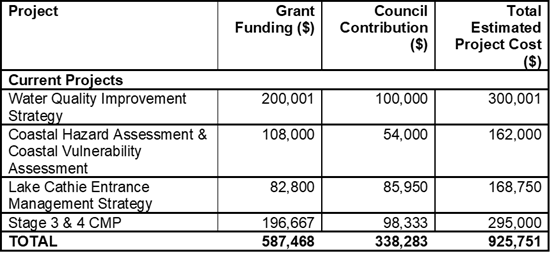
3. Legislative and Policy Implications
There are no new or immediate legislative or policy implications resulting from this update. All actions outlined are in accordance with existing state and local planning instruments, including alignment with the NSW Coastal Management Framework and associated guidelines.
4. Strategic Context and Implications
The projects and initiatives outlined in this report align with Council's adopted strategies and objectives for sustainable natural resource management. They support long-term coastal and estuarine resilience, ecosystem health, and informed planning in line with Council’s Strategic Planning objectives.
5. Risk and Insurance Implications
There are no new or elevated risk or insurance concerns raised by this report. Risk assessments have been incorporated into individual project designs and planning phases, particularly in relation to coastal hazards and infrastructure vulnerability.
6. Engagement and Consultation
There are no new engagement or consultation activities proposed as part of this report. Existing projects continue to incorporate stakeholder engagement in accordance with funding requirements and best practice community involvement standards.
7. Civic Leadership
This report demonstrates Council’s ongoing commitment to responsible environmental stewardship and transparent project delivery. The initiatives presented contribute to evidence-based decision-making and uphold community expectations for sustainable coastal and waterway management.
Options
This report is provided for information purposes only.
|
Attachments Nil
|
Agenda Community Planning and Environment
Item: 13.12
Subject: Notice of Motion - Update on Homelessness in the Port Macquarie-Hastings Local Government Area
Councillor Lauren Edwards has given notice of the intention to move the following motion:
That Council request the Chief Executive Officer to provide an update to the September 2025 Ordinary Council Meeting on Homelessness in the Port Macquarie-Hastings Local Government Area including, but not limited to the following:
1. Current number of people experiencing homelessness in the Port Macquarie-Hastings LGA
2. Current levels of Social Housing provision
3. Current levels of Affordable Housing
4. Short-term Rental Accommodation Statistics
5. Actions, including advocacy, that Port Macquarie-Hastings Council has taken to address homelessness since November 2022
6. Actions, including advocacy, that Port Macquarie-Hastings Council has taken to increase affordable housing and housing affordability since November 2022
Comments by Councillor Edwards
It has been some time, almost 3 years, since Council received the very important and informative report on the issue of homelessness in our Local Government Area including possible solutions that Council may be able to facilitate. The report provided good data and a snapshot of what was known at the time and I feel that it is important that we seek an update to understand what the situation is now so that Councillors can decide what next steps, including whether further advocacy, might be needed.
Comments by Chief Executive Officer
Council recognises the importance of monitoring homelessness and housing issues within the Port Macquarie-Hastings LGA, however much of the detailed data requested; such as current homelessness figures, social and affordable housing statistics, and short-term rental information is not collected, verified or held directly by Council, some relevant information is publicly available through state government and other agency websites.
Council would also be aware that a separate report has also already been requested by Council to come back to Council at the August Ordinary Council meeting with an update on the implementation of the actions in the Living and Place Strategy (Affordable Housing Plan and Local Housing Delivery Plan) which was adopted by Council in March 2025 (Item 13.04). In this regard Council resolved as follows:
That Council:
1. Note the progress of actions identified in Council’s Affordable Housing Plan and Local Housing Delivery Plan as detailed within this report.
2. Note the information and associated timeframes contained within this report, in relation to the proposed continued progression of actions as detailed within Council’s Affordable Housing Plan and Local Housing Delivery Plan.
3. Receive an update on the implementation of the actions identified within Council’s Affordable Housing Plan and Local Housing Delivery Plan in August 2025 and annually thereafter.
Resourcing Implications
Preparation of this report will require additional resource commitment from the Strategic Planning team. This work can be accommodated within current staff resources, although some reprioritisation of other tasks may be necessary.
Financial Implications
There are no direct financial implications associated with preparing this update report.
Policy Implications
No immediate policy changes are anticipated from this report.
|
Attachments Nil
|
Agenda Community Planning and Environment
Item: 13.13
Subject: Notice of Motion - NSW Clubgrants
Councillor Nik Lipovac has given notice of the intention to move the following motion:
That Council:
1. Actively pursue current and future NSW Clubgrants Category 3 Infrastructure Grants where such funding will deliver improved community and/or sporting infrastructure on Council-owned or managed land, and where Council is the most appropriate applicant to ensure delivery of the project.
2. Request the Chief Executive Officer to provide a report to the November 2025 Ordinary meeting of Council outlining a clear framework or policy position that:
a. Provides criteria for when Council should consider applying directly for Clubgrants or other community infrastructure grants;
b. Outlines mechanisms to manage or mitigate any actual or perceived conflicts of interest in doing so;
c. Ensures Council continues to support and not compete with community organisations wherever appropriate.
3. Continue to support local sporting and community groups applying for Clubgrants funding by providing landowner consent, letters of support, and technical assistance, as is current practice.
Comments by Councillor
Nil
Comments by Chief Executive Officer
In relation to Council applying for NSW ClubGRANTS Category 3 Infrastructure Grants, Council has not pursued these grants in recent years. This approach has been guided by two key considerations:
1. Avoiding Competition with Community Groups – Council maintains a consistent position of not competing with local community and sporting organisations for these limited funds, recognising that these organisations are the primary intended beneficiaries of the program.
2. Conflict of Interest – Given Council’s role as the authorising/referral body for liquor licences and consent authority for related approvals, applying for the same grants could give rise to perceived or actual conflicts of interest.
Council continues to play a vital supporting role for local clubs and community groups seeking ClubGRANTS funding by providing:
· Letters of support to strengthen applications.
· Landowner consent where works are proposed on Council-owned land; and
· Technical advice and project information as appropriate.
Under this collaborative arrangement, community organisations apply for and manage the grants while Council, as asset owner, works alongside them to ensure successful project delivery. Council remains committed to supporting initiatives that benefit the community and welcomes opportunities to assist eligible groups throughout the grant process.
In respect of item 1 of the recommendation it should be noted that the available grant details are as follows:
Clubgrants Category 3
Infrastructure Grants: Community infrastructure
Key information:
· Status: Open
· Grant amount: From $50,000 to $250,000
· Application opened: 1 July 2025
· Application closes: 21 July 2025
· Councils must match any funding request 50:50
This grant can be applied to funds the cost of construction, alteration, renovation, completion and fit-out of buildings and community infrastructure to deliver outcomes for disadvantaged NSW communities including regional, remote and drought-affected areas.
Infrastructure Grants: Sport and Recreation
Key information:
· Status: Open
· Grant amount: $50,000 to $300,000
· Application opened: 1 July 2025
· Application closes: 21 July 2025 (Next round opens 24 November 2025)
· Councils must match any funding request 50:50
Funding to support sport and recreation infrastructure such as sports centres, playgrounds and swimming pools.
Infrastructure Grants: Arts and Culture
Key Information:
· Status: Open
· Grant amount: $50,000 to $200,000
· Application opened: 1 July 2025
· Application closes: 21 July 2025
· Councils must match any funding request 50:50
Funding to support the cost of construction, alteration, renovation, completion and fit-out of buildings and community infrastructure to deliver outcomes for disadvantaged NSW communities including regional, remote and drought-affected areas, Must support arts and culture infrastructure such as music (e.g. concert hall), performing arts (e.g. arts centre, rehearsal studio), etc.
Infrastructure Grants: Disaster Readiness
Key Information:
Applies to assisting with infrastructure disaster readiness such as evacuation centres, capital equipment or a multipurpose community facility for example.
· Status: Open
· Grant amount: $50,000 to $200,000
· Application opened: 1 July 2025
· Application closes: 21 July 2025
· Councils must match any funding request 50:50
Funding to support the cost of construction, alteration, renovation, completion and fit-out of buildings and community infrastructure, e.g. fit out of evacuation centre, multi-purpose community hall, etc.
Given the criteria of the grants as outlined above, Council would need to make any application by 21 July 2025 and identify the matching funding for any project identified. Based on the date of determination of this matter being 17 July 2025, this would result is a very limited timeframe for staff to identify a suitable ‘shovel ready’ project and funding and put together an application for submission by 21 July 2025.
Resourcing Implications
Preparation of the requested report and development of a framework or policy will require input from relevant Council teams, including Grants, Liveable Communities and Community Infrastructure. This work can be managed within existing resources but may require prioritisation alongside other business-as-usual activities.
Financial Implications
There are no immediate financial implications associated with the preparation of a report or development of the framework other than staff time, however it should be noted that each of the relevant Clubgrant categories identified above do require Council to match any funding request 50:50 and this funding would be required to be identified before an application can be made.
Further, any successful Clubgrant may result in capital investment and operational costs if grant applications are successful, which would be subject to future Council budget considerations and approvals.
Policy Implications
The development of a clear framework or policy position will formalise Council’s approach to applying for community infrastructure grants, including criteria for eligibility, conflict of interest management, and partnership principles. This may lead to the creation of a new Council policy or amendment of existing policies related to grants management and community partnerships.
|
Attachments Nil |
Agenda Community Planning and Environment
Item: 13.14
Subject: Notice of Motion - Review of Public Swimming Pool Operations
Councillor Lauren Edwards has given notice of the intention to move the following motion:
That Council request the Chief Executive Officer to provide a Public Swimming Pool Operations Councillor briefing by the end of October 2025 including, but not limited to, the current contract, pool program offerings and pricing structure.
Comments by Councillor Edwards
Council received several submissions from community to the Integrated Planning and Reporting documents regarding Public Swimming Pool operations. I believe that Councillors should have the opportunity to take a closer look at this service area, to ask questions and to better understand the background, current status and any potential opportunities for future improvements.
Comments by Chief Executive Officer
A Councillor briefing session can be arranged to provide a detailed overview of the current service model, contract arrangements, performance metrics, and potential areas for improvement. This should support informed decision-making and ensure alignment with community expectations and long-term service planning.
It should be noted that the current management contract remains in place until 30 June 2027, with a mutual option to extend until 30 June 2029. Any future considerations will need to consider the terms of this agreement, operational performance, and broader service delivery objectives.
Resourcing Implications
A Councillor briefing session can be scheduled within existing staff capacity. Preparation of briefing materials and participation in the session will require input from relevant internal staff. Any additional work arising from the briefing, such as service reviews or options analysis, would require further scoping and may impact current work program priorities.
Financial Implications
There are no immediate financial implications associated with holding a Councillor briefing. However, any future decisions regarding changes to service delivery, capital investment, or contractual arrangements may have budgetary implications and would require detailed financial analysis and Council consideration at the appropriate time.
Policy Implications
There are no direct policy implications at this stage. Should the review process identify the need for changes to the existing service model or management arrangements, Council policies relating to procurement, service delivery, and asset management may require review or amendment.
|
Attachments Nil
|
Agenda
|
Recommendation 1. That pursuant to Section 10A Subsections 2 & 3 and 10B of the Local Government Act 1993 (as amended), the press and public be excluded from the proceedings of the Council in Confidential Committee of the Whole on the basis that the items to be considered are of a confidential nature. 2. That Council move into Confidential Committee of the Whole to receive and consider the following items: Item 16.01 2024.090 Port Macquarie Wastewater Treatment Plant Optimisation and Aerator Replacement Tender This item is considered confidential under Section 10A(2)(c) of the Local Government Act 1993, as it contains information that would, if disclosed, confer a commercial advantage on a person with whom the Council is conducting (or proposes to conduct) business. Item 16.02 2024.005.01 Design and Construction of Cowarra Water Treatment Plant Tender This item is considered confidential under Section 10A(2)(c) of the Local Government Act 1993, as it contains information that would, if disclosed, confer a commercial advantage on a person with whom the Council is conducting (or proposes to conduct) business. 3. That the resolutions made by Council in Confidential Session be made public as soon as practicable after the conclusion of the Confidential Session and such resolutions be recorded in the Minutes of the Council Meeting.
|


