 September 2025
Ordinary Council
Business Paper
2:00 PM Thursday 18 September 2025
Council Chambers, 17 Burrawan Street, Port Macquarie
September 2025
Ordinary Council
Business Paper
2:00 PM Thursday 18 September 2025
Council Chambers, 17 Burrawan Street, Port Macquarie
 |

Our Vision
The most liveable, sustainable and innovative place in Australia
Community Mission
Enable and empower great service delivery, innovation and community connection
through efficient, effective and well-governed organisational operations.
Council’s Corporate Values
People, Service to our community, Excellence, Respectful and open communication, Working together as one. Please update the corporate values.
Councillors are reminded of the oath or affirmation which was taken by each of them.
Oath Of Councillor
I swear that I will undertake the duties of the office of Councillor in the best interests of the people of Port Macquarie-Hastings local government area and the Port Macquarie-Hastings Council and that I will faithfully and impartially carry out the functions, powers, authorities and discretions vested in me under the Local Government Act 1993 or any other Act to the best of my ability and judgment.
Affirmation Of Councillor
I solemnly and sincerely declare and affirm that I will undertake the duties of the office of Councillor in the best interests of the people of Port Macquarie-Hastings local government area and the Port Macquarie-Hastings Council and that I will faithfully and impartially carry out the functions, powers, authorities and discretions vested in me under the Local Government Act 1993 or any other Act to the best of my ability and judgment.
Councillors have the opportunity to declare any interests in items on the agenda and inform the Council and public if they will be leaving the Chambers during the debate and voting on the item.
Item Subject Page
01 Acknowledgement of Country........................................................................ 1
02 Remote Attendance at Meeting..................................................................... 1
03 Local Government Prayer.............................................................................. 1
04 Apologies........................................................................................................ 1
05 Confirmation of Minutes................................................................................. 1
06 Disclosures of Interest.................................................................................... 1
07 Mayoral Minute
07.01.... Mayoral Minute - Funding for Tuffins Lane EIS and Associated Studies 33
08 Confidential Correspondence to Ordinary Council Meeting........................ 36
09 Items To Be Dealt With By Exception
10 Office of the Chief Executive Officer
10.01.... Mayoral Discretionary Fund Allocations - 7 August to 3 September 2025........................................................................................................ 38
11 Business and Performance
11.01.... Status Of Reports From Council Resolutions................................ 40
11.02.... Monthly Budget Review - August 2025.......................................... 51
11.03.... Investment Performance - August 2025........................................ 55
11.04.... Draft Annual Financial Statements for the year ended 30 June 2025 64
11.05.... 2025-2026 Financial Assistance Grants........................................ 70
11.06.... Council Loan Funding - August 2025........................................... 74
11.07.... Policy Review - Debt Recovery Policy........................................... 79
11.08.... Policy Review - Hardship Policy.................................................... 82
11.09.... Report of the Audit, Risk and Improvement Committee Meeting Held 3 September 2025............................................................................. 85
12 Community Infrastructure
12.01.... Integrated Transport Plan - Annual Update................................... 91
12.02.... Implementation of the 2025 Authorisation and Delegation Instrument from Transport for NSW......................................................................... 98
13 Community Planning and Environment
13.01.... City Heart Strategy and Master Plan........................................... 104
13.02.... Homelessness in the Port Macquarie-Hastings Local Government Area 114
13.03.... Planning Proposal - LEP Housekeeping Amendments 2025...... 129
13.04.... Draft Community Inclusion Plan and Disability Inclusion Action Plan 2025-2029...................................................................................................... 147
13.05.... Draft Community Engagement Policy - Post Public Exhibition... 154
13.06.... Draft Community Engagement Strategy - Post Public Exhibition 159
13.07.... Draft Domestic, Family and Sexual Violence Policy.................... 166
13.08.... Draft Cultural Plan 2025 - 2029................................................... 172
13.09.... Lake Cathie Natural Resource Management Monthly Update Report 178
13.10.... ArtWalk Report and Future Strategy............................................ 184
13.11.... Recommended Items from the July 2025 Meeting of the Port Macquarie-Hastings Sporting Fund................................................................ 197
14 Community Utilities
Nil
15 Notices of Motion
15.01.... Notice of Motion - Annual Reports Special Schedule.................. 199
15.02.... Notice of Motion - Proposed Local Government NSW Annual Conference Motion - Biodiversity and Conservation SEPP 2021................... 201
15.03.... Notice of Motion - Proposed Local Government NSW Annual Conference Motion - Constitutional Referendums.......................................... 203
15.04.... Notice of Motion - Proposed Local Government NSW Annual Conference Motion - Determine Method of Electing Mayor............................ 205
15.05.... Notice of Motion - Proposed Local Government NSW Annual Conference Motion - Environmental Monitoring, Planning and Decision Making 207
15.06.... Notice of Motion - Proposed Local Government NSW Annual Conference Motion - Funding to Support Monitoring and Enforcement of Development Consent Conditions...................................................................... 209
15.07.... Notice of Motion - Proposed Local Government NSW Annual Conference Motion - Stormwater Management Services............................... 211
15.08.... Notice of Motion - Southern Breakwall Upgrade Project............. 213
16 Confidential Matters
Motion to move into Confidential Session.................................................. 215
16.01.... Land Acquisition - 24 Beechwood Road Wauchope
16.02.... Land Acquisition - Corner Lake Road and Ocean Drive Port Macquarie
16.03.... Approval to Negotiate Settlement - Port Macquarie-Hastings Council v Willis
Agenda
Item: 01
Subject: Acknowledgement of Country
"I acknowledge that we are gathered on Birpai Land. I pay respect to the Birpai Elders both past and present. I also extend that respect to all other Aboriginal and Torres Strait Islander people present."
Item: 02
Subject: Remote attendance at meeting
That Council accede to the request of Councillors to attend the meeting by remote means.
Subject: Local Government Prayer
A Minister from the Combined Churches of Port Macquarie will be invited to deliver the Local Government Prayer.
Subject: Apologies
Recommendation
That the apologies received be accepted.
Subject: Confirmation of Minutes
Recommendation
That the Minutes of the Ordinary Council Meeting held on 21 August 2025 be confirmed.
Subject: Disclosure of Interest
Recommendation
That Disclosures of Interest be presented
 Minutes
21 August 2025
Ordinary Council
PRESENT
Members:
Mayor Adam Roberts
Councillor Lauren Edwards
Councillor Mark Hornshaw
Councillor Lisa Intemann
Councillor Chris Kirkman
Councillor Nik Lipovac
Councillor Danielle Maltman
Councillor Rachel Sheppard
Councillor Hamish Tubman
Other Attendees:
Acting Chief Executive Officer (Robert Fish)
Director Business and Performance (Keith Hentschke)
Director Community, Planning and Environment (Melissa Watkins)
Acting Director Community Infrastructure (Blayne West)
Director Community Utilities (Narelle D’Amico)
Group Manager Governance (Michael Ferguson)
Governance Officer (Tania Ellis)
The meeting opened at 2.01pm.
|
01 Acknowledgement of Country |
|
The Mayor opened the Meeting with an Acknowledgement of Country and welcomed all in attendance in the Chamber and viewing on line. |
|
02 Remote Attendance at Meeting |
|
Resolved: Intemann/Tubman That Council accede to the request of Councillor Edwards to attend the meeting by remote means. carried: 9/0 For: Edwards, Hornshaw, Intemann, Kirkman, Lipovac, Maltman, Roberts, Sheppard and Tubman Against: Nil |
|
03 Local Government Prayer |
|
Pastor Terri Thomson from the Divergent Church delivered the Local Government Prayer. |
|
04 Apologies |
|
Nil |
|
05 Confirmation of Minutes |
|
Resolved: Roberts/Maltman That the Minutes of the Ordinary Council Meeting held on 17 July 2025 be confirmed. carried: 9/0 For: Edwards, Hornshaw, Intemann, Kirkman, Lipovac, Maltman, Roberts, Sheppard and Tubman Against: Nil |
|
06 Disclosures of Interest |
|
Councillor Tubman declared a Pecuniary interest in Item 11.13 Draft Airport Master Plan - Post Public Exhibition. The reason being is that Councillor Tubman owns a property and resides in the area that is affected by aircraft noise relating to the Port Macquarie Airport. Councillor Tubman intends to leave the meeting, be out of sight and take no part in consideration of this item. Councillor Tubman declared a Pecuniary interest in Item 13.05 Sovereign Hills Planning Agreement - Post Exhibition Report Applicant: Lewis Developments Pty LTD as Trustee for the Lewis Developments Trust Landowner: PM Land Pty Ltd. The reason being is that a member of his immediate family is employed by Lewis Land Group. Councillor Tubman intends to leave the meeting, be out of sight and take no part in consideration of this item. Councillor Maltman declared a Non-Pecuniary - Less than Significant interest in Item 13.10 - Lake Cathie Natural Resource Management Monthly Update Report. The reason being that Councillor Maltman is a non-financial life member and former President of the community organisation Revive Lake Cathie Incorporated. Councillor Maltman intends to remain in the meeting, participate and vote in the matter as this perceived conflict will not influence her decision making in the matter. |
|
07 Mayoral Minutes |
|
Nil. |
|
08 Confidential Correspondence to Ordinary Council Meeting |
|
Resolved: Sheppard/Kirkman That Council determine that the attachments to Item Number 11.14 be considered as confidential, in accordance with section 11(3) of the Local Government Act. carried: 9/0 For: Edwards, Hornshaw, Intemann, Kirkman, Lipovac, Maltman, Roberts, Sheppard and Tubman Against: Nil |
Councillor Edwards experienced temporary remote access technical issues that prevented her from voting for the next item.
|
09 Items to be Dealt With By Exception |
|
Resolved: Lipovac/Kirkman That Items 10.02, 11.01, 11.02, 11.07, 11.08, 11.09, 11.10, 11.11, 11.14, 12.01, 13.11, 13.14 and 13.15 be considered as a block resolution carried: 8/0 For: Hornshaw, Intemann, Kirkman, Lipovac, Maltman, Roberts, Sheppard and Tubman Against: Nil
Councillor Edwards’ temporary remote access technical issues were resolved at this time. Resolved: Intemann/Hornshaw That all recommendations listed in the block resolution be adopted by Council. carried: 9/0 For: Edwards, Hornshaw, Intemann, Kirkman, Lipovac, Maltman, Roberts, Sheppard and Tubman Against: Nil |
|
10.02 Mayoral Discretionary Fund Allocations - 3 July to 6 August 2025 |
|
Resolved: Intemann/Hornshaw That Council note the Mayoral Discretionary Fund allocations for the period 3 July to 6 August 2025. |
|
11.01 Status Of Reports From Council Resolutions |
|
Resolved: Intemann/Hornshaw That Council note the information contained in the Status of Reports from Council Resolutions report. |
|
11.02 Draft Code of Meeting Practice - Post Public Exhibition |
|
Resolved: Intemann/Hornshaw That Council: 1. Adopt the draft Code of Meeting Practice. 2. Formally thank those who made submissions and advise them of Council’s decision on this matter. |
|
11.07 Monthly Budget Review - July 2025 |
|
Resolved: Intemann/Hornshaw That Council: 1. Adopt the adjustments in the July 2025 Adjustments section of the Monthly Budget Review – July 2025 report and associated attachment. 2. Amend the 2025-2026 Operational Plan to include all budget adjustments approved in this report. |
|
11.08 Council Loan Funding - July 2025 |
|
Resolved: Intemann/Hornshaw That Council note the Loan Funding report for July 2025. |
|
11.09 Investment Performance - July 2025 |
|
Resolved: Intemann/Hornshaw That Council note the Investment Performance report for July 2025. |
|
11.10 Policy Review - Investment Policy |
|
Resolved: Intemann/Hornshaw That Council: 1. Note the outcomes of the public exhibition period for the draft Investment Policy. 2. Adopt the Investment Policy. |
|
11.11 Policy Review - Pensioner Concession Rebates Policy |
|
Resolved: Intemann/Hornshaw That Council: 1. Note the outcomes of the public exhibition for the Draft Pensioner Concession Rebates Policy. 2. Adopt the Pensioner Concession Rebates Policy. |
|
11.14 Legal Fees |
|
Resolved: Intemann/Hornshaw That Council note the information in the Legal Fees Report. |
|
12.01 Voluntary House Raising - Post Exhibition |
|
Resolved: Intemann/Hornshaw That Council: 1. Note the submissions and feedback received relating to the Voluntary House Raising Scheme during the public exhibition period. 2. Thank people who provided feedback and submissions during the public exhibition period and advise them of Council determination. 3. Receive a further report on the feasibility of participating in the Voluntary House Raising Scheme after undertaking further investigation through a technical assessment, financial feasibility study, and alignment with updated Flood Risk Management Plans. |
|
13.11 Kooloonbung Creek Flying-fox Camp Management Plan - Annual Update |
|
Resolved: Intemann/Hornshaw That Council: 1. Note this Report as the annual report in regard to the Kooloonbung Creek Flying-fox Camp Management Plan. 2. Note that a review of the Kooloonbung Creek Flying-fox Camp Management Plan has been completed and is presented in the attached Review and Recommendations Report by WolfPeak. 3. Note that the Review and Recommendations Report by WolfPeak recommended continuation of existing management actions (with refinement) which were included where appropriate into the endorsed Delivery Program 2025-2029 and Operational Plan 2025-2026. |
|
13.14 Investigating a Sporting Venue Sponsorship Program |
|
Resolved: Intemann/Hornshaw That Council: 1. Note the information contained in the report. 2. Receive a further report with a draft Sporting Venue Sponsorship Policy at the November 2025 Ordinary Council meeting. |
|
13.15 Draft Revised Recreation and Open Space Action Plan 2025-2030 and Sporting Infrastructure Priorities |
|
Resolved: Intemann/Hornshaw That Council: 1. Publicly exhibit the revised draft Recreation and Open Space Action Plan for a period of not less than 28 days. 2. Note that a further report will be tabled at a future meeting of Council, detailing the submissions received from the public during the exhibition period. 3. Endorse the prioritisation of Sporting Infrastructure Projects that Council will continue to seek funding for as follows: a) Port Macquarie Aquatic Centre b) Regional Stadium - Master Plan and staged upgrades c) Wayne Richards Park Stage 3&4 d) Rainbow Beach Sporting Fields - Stage 2 e) Thrumster Sporting Fields - Stage 2 f) Tuffins Lane Drainage – Environmental and development approvals g) Hastings Regional Sporting Complex |
|
Suspension of Standing Orders |
|
Resolved: Sheppard/Lipovac That Standing Orders be suspended to allow items 13.03, 13.05 and 13.16 to be brought forward and considered next. carried: 9/0 For: Edwards, Hornshaw, Intemann, Kirkman, Lipovac, Maltman, Roberts, Sheppard and Tubman Against: Nil |
|
13.03 PP2024-13.1 - Planning Proposal Assessment Report - Ocean Drive Lake Cathie Applicant
- Hopkins Consultants |
|
Motion: Moved: Hornshaw/Maltman That Council:
Amendment Moved: Sheppard/Edwards That Council: 1. Endorse the draft Planning Proposal, to enable rezoning of part of the land from R1 General Residential to C3 Environmental Management, R3 Medium Density Residential (as per attachment 2) and associated amendments to the minimum lot size, height of building and floor space ratio maps (as per attachment 1), prepared under Section 3.33 of the Environmental Planning and Assessment Act 1979. 2. Forward the draft Planning Proposal to the NSW Department of Planning, Housing and Infrastructure for a Gateway Determination under Section 3.34 of the Environmental Planning and Assessment Act 1979, and request that the Gateway Determination authorise Council to be the local plan-making authority. 3. Delegate authority to the Director Community, Planning and Environment to make any minor updates to the Planning Proposal prior to seeking a Gateway Determination, and/or as a result of the issue of Gateway Determination. 4. Receive a report following the public exhibition period on any submissions received. 5. Notify the proponent of Council’s decision. lost: 3/6 For: Edwards, Lipovac and Sheppard Against: Hornshaw, Intemann, Kirkman, Maltman, Roberts and Tubman
The amendment on being put was lost.
Motion Moved: Hornshaw/Maltman That Council: 1. Endorse the draft Planning Proposal, to enable rezoning of part of the land from R1 General Residential to C3 Environmental Management, R3 Medium Density Residential and associated amendments to the minimum lot size, height of building and floor space ratio maps, as per the proponents proposal in respect of the proposed 5m C3 zone, prepared under Section 3.33 of the Environmental Planning and Assessment Act 1979. 2. Forward the draft Planning Proposal to the NSW Department of Planning, Housing and Infrastructure for a Gateway Determination under Section 3.34 of the Environmental Planning and Assessment Act 1979, and request that the Gateway Determination authorise Council to be the local plan-making authority. 3. Delegate authority to the Director Community, Planning and Environment to make any minor updates to the Planning Proposal prior to seeking a Gateway Determination, and/or as a result of the issue of Gateway Determination. 4. Receive a report following the public exhibition period on any submissions received. 5. Notify the proponent of Council’s decision.
The motion on being put was carried.
|
|
That Council: 1. Endorse the draft Planning Proposal, to enable rezoning of part of the land from R1 General Residential to C3 Environmental Management, R3 Medium Density Residential and associated amendments to the minimum lot size, height of building and floor space ratio maps, as per the proponents proposal in respect of the proposed 5m C3 zone, prepared under Section 3.33 of the Environmental Planning and Assessment Act 1979.
carried: 7/2 For: Hornshaw, Intemann, Kirkman, Lipovac, Maltman, Roberts and Tubman Against: Edwards and Sheppard |
|
13.05 Sovereign
Hills Planning Agreement - Post Exhibition Report |
|
Councillor Hamish Tubman declared a Pecuniary, Significant interest in this item. The reason being that a member of his immediate family is employed by Lewis Land Group. Councillor Tubman took no part in the consideration or voting, left the meeting and was out of site for consideration of this matter. Resolved: Intemann/Sheppard That Council: 1. Delegate to the Acting Chief Executive Officer to enter into and execute the Sovereign Hills Planning Agreement as amended (Attachment 1). 2. Take all reasonable steps to repeal the following Planning Agreements which have been replaced by the Sovereign Hills Planning Agreement: a. The Sovereign Hills Estate Voluntary Planning Agreement b. The Area 13 Environmental Land Management Voluntary Planning Agreement c. The Area 13 Environmental Land Management Voluntary Planning Agreement for Lot 71 in Deposited Plan 1061516 d. The Sovereign Hills Estate Highway Works Voluntary Planning Agreement 3. Note the Post Exhibition Engagement Summary Report which provides details of the submissions and the number of persons who accessed the public exhibition material on Council’s Have Your Say page. 4. Thank all persons who lodged a submission and notify them of Council’s decision. carried: 8/0 For: Edwards, Hornshaw, Intemann, Kirkman, Lipovac, Maltman, Roberts, and Sheppard Against: Nil |
|
13.16 Petition - Dog Park in Lake Cathie |
|
Resolved: Lipovac/Intemann That Council: 1. Note the petition received by Ms Kerrie Angel-Starr, requesting Council to provide a divided, fenced dog park in Lake Cathie. 2. Respond to the organiser of the petition with the outcome of Council’s consideration in the matter. carried: 9/0 For: Edwards, Hornshaw, Intemann, Kirkman, Lipovac, Maltman, Roberts, Sheppard and Tubman Against: Nil |
|
10.01 2025 Local Government NSW Annual Conference |
|
Resolved: Edwards/Tubman
That Council:
1. Approve the attendance of the following at the 2025 Local Government NSW Annual Conference to be held in Penrith from 23 to 25 November 2025: · Mayor Adam Roberts · Councillor Lauren Edwards · Councillor Nik Lipovac · Councillor Mark Hornshaw 2. Determine that Mayor Roberts and Councillors Edwards, Lipovac and Hornshaw be Council’s voting delegates on motions and the Board elections at the Conference. 3. Should a Councillor withdraw their attendance a further report will be brought to the next available Ordinary Council meeting to determine if an alternative Councillor should attend. carried: 9/0 For: Edwards, Hornshaw, Intemann, Kirkman, Lipovac, Maltman, Roberts, Sheppard and Tubman Against: Nil |
Item 10.02 Mayoral Discretionary Fund Allocations - 3 July to 6 August 2025, has been addressed previously within the meeting.
Item 11.01 Status Of Reports From Council Resolutions, has been addressed previously within the meeting.
Item 11.02 Draft Code of Meeting Practice - Post Public Exhibition, has been addressed previously within the meeting.
|
11.03 Policy Review - Councillor and Staff Interaction Policy |
|
Resolved: Edwards/Intemann That Council adopt the draft Councillor and Staff Interaction Policy as attached to this report as Attachment 1, subject to inclusion of the following note in the policy: “Councillors and staff are not prevented from both being in attendance at council engagements, community meetings or other events as a result of this policy. The requirements of this policy apply in these settings, as in all others”. carried: 9/0 For: Edwards, Hornshaw, Intemann, Kirkman, Lipovac, Maltman, Roberts, Sheppard and Tubman Against: Nil |
|
11.04 Policy Review - Councillor Expenses and Facilities Policy - Post Public Exhibition |
|
Motion Moved: Edwards/Intemann
That Council: 1. Adopt the draft Councillor Expenses and Facilities Policy, subject to the following Changes (a) Amend the professional development allocation to reflect $12,000 per Councillor, per term available at the commencement of the term, rather than annual Councillor allocation of $3,000 expiring annually. (b) Insertion of a footnote that “The Professional Development allocation does not include group training sessions for all Councillors or attendance at the annual Local Government NSW Conference or the Australian Local Government Association National General Assembly”. 2. Request advice on options to fund the shortfall in the current allocation for the 2025-2026 financial year in order to meet the requirements of point 1(a) as part of the next quarterly budget review. 3. Formally thank those who made submissions and advise them of Council’s decision on this matter.
Councillor Sheppard left the meeting, the time being 03:29pm. Councillor Hornshaw left the meeting, the time being 03:31pm. Councillor Sheppard returned to the meeting, the time being 03:32pm.
Amendment
Moved: Intemann/Roberts
That Council: 1. Adopt the draft Councillor Expenses and Facilities Policy. 2. Request a report to the October 2025 Ordinary Council meeting advising on methods by which to implement the proposal contained in Councillor Edwards’ moved motion. 3. Formally thank those who made submissions and advise them of Council’s decision on this matter. lost: 3/5 For: Intemann, Kirkman and Roberts Against: Edwards, Lipovac, Maltman, Sheppard and Tubman
The amendment on being put was lost.
Councillor Hornshaw returned to the meeting, the time being 03:34pm.
The motion on being put was carried.
|
|
Resolved: Edwards/Intemann That Council: 1. Adopt the draft Councillor Expenses and Facilities Policy, subject to the following Changes (a) Amend the professional development allocation to reflect $12,000 per Councillor, per term available at the commencement of the term, rather than annual Councillor allocation of $3,000 expiring annually. (b) Insertion of a footnote that “The Professional Development allocation does not include group training sessions for all Councillors or attendance at the annual Local Government NSW Conference or the Australian Local Government Association National General Assembly”. 2. Request advice on options to fund the shortfall in the current allocation for the 2025-2026 financial year in order to meet the requirements of point 1(a) as part of the next quarterly budget review. 3. Formally thank those who made submissions and advise them of Council’s decision on this matter. carried: 6/3 For: Edwards, Hornshaw, Lipovac, Maltman, Sheppard and Tubman Against: Intemann, Kirkman and Roberts |
Councillor Maltman left the meeting, the time being 03:39pm.
Councillor Maltman returned to the meeting, the time being 03:42pm.
|
11.05 2022-2026 Delivery Program Six Month Progress Report as at 30 June 2025 |
|
Resolved: Intemann/Roberts That Council: 1. Note the progress report against the 2022-2026 Delivery Program as at 30 June 2025 2. Promote the key activities in each of the community priority areas as listed within the report. carried: 7/2 For: Intemann, Kirkman, Lipovac, Maltman, Roberts, Sheppard and Tubman Against: Edwards and Hornshaw |
Councillor Kirkman left the meeting, the time being 03:54pm.
Councillor Kirkman returned to the meeting, the time being 03:57pm.
|
11.06 2024-2025 Carry Forward Projects and Operational Plan Full Year Status Report as at 30 June 2025 |
|
Resolved: Edwards/Tubman That Council: 1. Note the 2024-2025 Operational Plan Full Year Status Report as at 30 June 2025. 2. Adopt the 2024-2025 carry forward projects outlined in this report for inclusion in the 2025-2026 budget. 3. Amend the 2025-2026 Operational Plan to include all approved carry forward projects that do not currently have an associated action, by adding them as individual action items.
carried: 9/0 For: Edwards, Hornshaw, Intemann, Kirkman, Lipovac, Maltman, Roberts, Sheppard and Tubman Against: Nil |
Item 11.07 Monthly Budget Review - July 2025, has been addressed previously within the meeting.
Item 11.08 Council Loan Funding - July 2025, has been addressed previously within the meeting.
Item 11.09 Investment Performance - July 2025, has been addressed previously within the meeting.
Item 11.10 Policy Review - Investment Policy, has been addressed previously within the meeting.
Item 11.11 Policy Review - Pensioner Concession Rebates Policy, has been addressed previously within the meeting.
|
11.12 Glasshouse Biannual Report and Update on Glasshouse Plan 2024-2025 Actions |
|
Resolved: Hornshaw/Lipovac That Council note the information provided in the Glasshouse Biannual Report and Update on Glasshouse Plan 2024-2025 Actions report (Attachment 1 and Attachment 2). carried: 9/0 For: Edwards, Hornshaw, Intemann, Kirkman, Lipovac, Maltman, Roberts, Sheppard and Tubman Against: Nil |
|
11.13 Draft Airport Master Plan - Post Public Exhibition |
|
Councillor Hamish Tubman declared a Pecuniary interest in this item. The reason being is that Councillor Tubman owns a property and resides in the area that is affected by aircraft noise relating to the Port Macquarie Airport. Councillor Tubman left the meeting, was out of sight and took no part in consideration of this item.
Resolved: Edwards/Intemann That Council: 1. Note the information contained within the Port Macquarie Airport Community Engagement Report 2. Thank submitters for their contribution to the Community Engagement Report. 3. Note the amendments to the Draft Airport Master Plan resulting from Community comment received during public exhibition. 4. Adopt the Draft Airport Master Plan.
carried: 8/0 For: Edwards, Hornshaw, Intemann, Kirkman, Lipovac, Maltman, Roberts, Sheppard Against: Nil |
Item 11.14 Legal Fees, has been addressed previously within the meeting.
Item 12.01 Voluntary House Raising - Post Exhibition, has been addressed previously within the meeting.
|
12.02 Policy Review - Flood Policy |
|
Resolved: Sheppard/Intemann
That Council: 1. Note the executive decision to delay the resolved public exhibition of the draft Flood Policy from June 2025 to enable further review of the draft Flood Policy in parallel with the current review of the Hastings River Flood Study Extension project. 2. Endorse further review of the draft Flood Policy in parallel with the current review of the Hastings River Flood Study Extension project. 3. Receive a revised version of the Draft Flood Policy for a consideration of commencement of public exhibition. 4. Receive quarterly updates on the progress of the Hastings River Flood Study Extension, Flood Risk Management Study, and Flood Risk Management Plan, with reporting to continue until the adoption of the Flood Risk Management Study and Flood Risk Management Plan.
carried: 9/0 For: Edwards, Hornshaw, Intemann, Kirkman, Lipovac, Maltman, Roberts, Sheppard and Tubman Against: Nil |
|
13.01 Grant Applications Biannual Report |
|
Resolved: Maltman/Tubman That Council note the Grant Applications Biannual Report, providing an update on grants that Council has applied for and/or obtained, for the 2024-2025 financial year. carried: 9/0 For: Edwards, Hornshaw, Intemann, Kirkman, Lipovac, Maltman, Roberts, Sheppard and Tubman Against: Nil |
|
13.02 Living and Place Strategy, Affordable Housing Plan & Local Housing Delivery Plan - Update on Actions |
|
Resolved: Edwards/Intemann That Council: 1. Note the progress of actions identified in Council’s Living and Place Strategy, Affordable Housing Plan and Local Housing Delivery Plan as detailed within this report. 2. Note the information and associated timeframes contained within this report, in relation to the proposed continued progression of actions as detailed within Council’s Living and Place Strategy Affordable Housing Plan and Local Housing Delivery Plan. 3. Note that a further update on the implementation of the actions identified within Council’s Affordable Housing Plan and Local Housing Delivery Plan is to be provided to Council in August annually. carried: 9/0 For: Edwards, Hornshaw, Intemann, Kirkman, Lipovac, Maltman, Roberts, Sheppard and Tubman Against: Nil |
13.03 PP2024-13.1 - Planning Proposal Assessment Report - Ocean Drive Lake Cathie Applicant - Hopkins Consultants Landowner - Jojeni Investments, has been addressed previously within the meeting.
|
13.04 Ocean
Club Resort Planning Agreement Assessment Report |
|
Resolved: Intemann/Roberts That Council: 1. Endorse the draft Ocean Club Resort Planning Agreement for public exhibition for a period of not less than 28 days. 2. Receive a further report following the public exhibition period on any submissions received. carried: 9/0 For: Edwards, Hornshaw, Intemann, Kirkman, Lipovac, Maltman, Roberts, Sheppard and Tubman Against: Nil |
Item 13.05 Sovereign Hills Planning Agreement -
Post Exhibition Report
Applicant: Lewis Developments Pty LTD as Trustee for the Lewis Developments
Trust
Landowner: PM Land Pty Ltd, has been addressed previously within the meeting.
|
13.06 Development Activity and Assessment System Performance |
|
Resolved: Edwards/Intemann
That Council: 1. Note the Development Activity and Assessment System Performance report for the fourth quarter of 2024-2025. 2. Request the Chief Executive Officer include data on Development Applications and Complying Development Certificates approved for Secondary Dwellings in future Development Activity and Assessment System Performance cyclic reports. carried: 9/0 For: Edwards, Hornshaw, Intemann, Kirkman, Lipovac, Maltman, Roberts, Sheppard and Tubman Against: Nil |
|
13.07 Community Inclusion Report Card 2024-2025 |
|
Resolved: Edwards/Intemann That Council note the Community Inclusion Report Card 2024-2025. carried: 9/0 For: Edwards, Hornshaw, Intemann, Kirkman, Lipovac, Maltman, Roberts, Sheppard and Tubman Against: Nil |
Procedural Motion
Resolved: Hornshaw/Maltman
That the Ordinary Council Meeting be adjourned.
carried: 7/2
For: Edwards, Hornshaw, Kirkman, Maltman, Roberts, Sheppard and Tubman
Against: Intemann and Lipovac
The meeting adjourned at 4.35pm
The meeting recommenced at 4.43pm
|
13.08 Cultural Plan Report Card |
|
Resolved: Lipovac/Sheppard That Council note the Cultural Plan Report Card 2024-2025.
carried: 9/0 For: Edwards, Hornshaw, Intemann, Kirkman, Lipovac, Maltman, Roberts, Sheppard and Tubman Against: Nil |
|
13.09 Draft Establishment and Management of Committees Policy |
|
Resolved: Edwards/Sheppard That Council: 1. Place on public exhibition the draft Establishment and Management of Committees Policy for a period of not less than 28 days. 2. Note that a further report will be tabled at the October 2025 meeting of Council, detailing the submissions received from the public during the exhibition period. carried: 9/0 For: Edwards, Hornshaw, Intemann, Kirkman, Lipovac, Maltman, Roberts, Sheppard and Tubman Against: Nil |
|
13.10 Lake Cathie Natural Resource Management Monthly Update Report |
|
Councillor Danielle Maltman declared a Non-Pecuniary - Less than Significant interest in this item. The reason being that Councillor Maltman is a non-financial life member and former President of the community organisation Revive Lake Cathie Incorporated. Councillor Maltman remained in the meeting, participated and voted in the matter as this perceived conflict did not influence her decision making in the matter.
Resolved: Maltman/Lipovac That Council note the progress of natural resource management projects/initiatives within the Lake Cathie, Lake Innes and Cathie Creek Waterways and the progress of the Coastal Management Program.
carried: 9/0 For: Edwards, Hornshaw, Intemann, Kirkman, Lipovac, Maltman, Roberts, Sheppard and Tubman Against: Nil |
Item 13.11 Kooloonbung Creek Flying-fox Camp Management Plan - Annual Update, has been addressed previously within the meeting.
|
13.12 Friends of Camden Head Lookout (Pilot Station) update |
|
Resolved: Lipovac/Intemann That Council: 1. Note the update on current activities of the Friends of Camden Head Lookout volunteer group. 2. Request the acting Chief Executive Officer to provide a briefing to Councillors to the matters raised in this report by the end of November 2025. carried: 8/1 For: Edwards, Hornshaw, Intemann, Kirkman, Maltman, Roberts, Sheppard and Tubman Against: Lipovac |
|
13.13 Policy Review - Volunteering |
|
Resolved: Intemann/Sheppard That Council: 1. Note the outcomes of the public exhibition of the draft Volunteer Policy. 2. Adopt the revised Volunteer Policy. 3. Thank those people who made a submission and advise them of Council’s determination. carried: 9/0 For: Edwards, Hornshaw, Intemann, Kirkman, Lipovac, Maltman, Roberts, Sheppard and Tubman Against: Nil |
Item 13.14 Investigating a Sporting Venue Sponsorship Program, has been addressed previously within the meeting.
Item 13.15 Draft Revised Recreation and Open Space Action Plan 2025-2030 and Sporting Infrastructure Priorities, has been addressed previously within the meeting.
Item 13.16 Petition - Dog Park in Lake Cathie, has been addressed previously within the meeting.
Councillor Lipovac left the meeting, the time being 05:11pm.
|
13.17 Notice of Motion - Koala Corridors - Pacific Highway |
|
Resolved: Edwards/Intemann That Council write to the NSW Minister for Climate Change, Minister for Energy, Minister for the Environment, and Minister for Heritage, the Hon. Penny Sharpe, MLC, and the NSW Koala Strategy Team, seeking a commitment to and funding for TfNSW to undertake the following: 1. Maintenance of the two existing fauna underpasses along the Pacific Highway at Karrikee Creek and Sancrox. 2. A monitoring and reporting program to assess the effectiveness of these underpasses. 3. A strategic evaluation/study of options to improve fauna connectivity across the Pacific Highway, to inform future direction, whether that be a land bridge or a range of other options for the protection of koalas
carried: 8/0 For: Edwards, Hornshaw, Intemann, Kirkman, Maltman, Roberts, Sheppard and Tubman Against: Nil |
Councillor Lipovac returned to the meeting, the time being 05:15pm.
|
13.18 Notice of Motion - Compliance and Enforcement Education |
|
Resolved: Edwards/Intemann That Council request the Chief Executive Officer to provide a report to the November 2025 Ordinary Meeting of Council on potential alternative community education initiatives, deterrents, or Council responses to suspected or alleged unauthorised or illegal activities in line with Council’s adopted Compliance and Enforcement Policy. carried: 9/0 For: Edwards, Hornshaw, Intemann, Kirkman, Lipovac, Maltman, Roberts, Sheppard and Tubman Against: Nil |
|
Confidential Session |
|
Resolved: Intemann/Hornshaw 1. That pursuant to section 10A subsections 2 & 3 and 10B of the Local Government Act 1993 (as amended), the press and public be excluded from the proceedings of the Confidential Session of Council on the basis that items to be considered are of a confidential nature. 2. That Council move into Closed Session to receive and consider the following items: Item 16.01 Land Acquisition - 79 Beechwood Road Yippin Creek This item is considered confidential under Section 10A(2)(d(ii)) of the Local Government Act 1993, as it contains commercial information of a confidential nature that would, if disclosed, confer a commercial advantage on a competitor of the Council. Item 16.02 Land Acquisition - 88 Beechwood Road Yippin Creek This item is considered confidential under Section 10A(2)(d(ii)) of the Local Government Act 1993, as it contains commercial information of a confidential nature that would, if disclosed, confer a commercial advantage on a competitor of the Council. Item 16.03 T2025.124 Coastal Management Program Stages 3 & 4 and Coastal Vulnerability Area Planning Proposal This item is considered confidential under Section 10A(2)(d(i)) of the Local Government Act 1993, as it contains commercial information of a confidential nature that would, if disclosed, prejudice the commercial position of the person who supplied it. That the resolutions made by Council in Confidential Session be made public as soon as practicable after the conclusion of the Confidential Session and such resolutions be recorded in the Minutes of the Council Meeting. carried: 9/0 For: Edwards, Hornshaw, Intemann, Kirkman, Lipovac, Maltman, Roberts, Sheppard and Tubman Against: Nil Resolved: Tubman/Kirkman That the Council meeting be closed to the public for the consideration of confidential items for the reason as listed in the reports.
carried: 9/0 For: Edwards, Hornshaw, Intemann, Kirkman, Lipovac, Maltman, Roberts, Sheppard and Tubman Against: Nil |
|
16.01 Land Acquisition - 79 Beechwood Road Yippin Creek |
|
Resolved: Intemann/Tubman That Council: 1. Proceed with the part land acquisition of 469.6 sqm of land being part of existing Lot 31 DP 1192366, known as 79 Beechwood Road Yippin Creek, more particularly described in the plan of acquisition as Lot 311 DP 1314410. 2. Pay compensation to the owners of Lot 31 DP 1192366, in accordance with the Land Acquisition (Just Terms Compensation) Act 1991 as set out in Attachment 3. 3. Pay the landowners valuation, property and conveyancing costs. 4. Pursuant to Section 10 of the Roads Act 1993, dedicate Lot 311 DP 1314410 as public road. 5. Maintain the confidentiality of the documents and consideration in respect of the Land Acquisition - 79 Beechwood Road Yippin Creek.
carried: 9/0 For: Edwards, Hornshaw, Intemann, Kirkman, Lipovac, Maltman, Roberts, Sheppard and Tubman Against: Nil |
|
16.02 Land Acquisition - 88 Beechwood Road Yippin Creek |
|
Resolved: Tubman/Kirkman That Council 1. Proceed with the part land acquisition of 2,513 sqm of land being part of existing Lots 103 and 104 DP 1135493, known as 88 Beechwood Road Yippin Creek, more particularly described in the plan of acquisition as Lots 1 and 2 DP 1314411. 2. Pay compensation to the owners of the Lots 103 and 104 DP 1135493, in accordance with the Land Acquisition (Just Terms Compensation) Act 1991 as set out in Attachment 3. 3. Pay the landowners valuation, property and conveyancing costs. 4. Pursuant to Section 10 of the Roads Act 1993, dedicate Lots 1 and 2 DP 1314411 as public road. 5. Maintain the confidentiality of the documents and consideration in respect of the Land Acquisition - 88 Beechwood Road Yippin Creek. carried: 9/0 For: Edwards, Hornshaw, Intemann, Kirkman, Lipovac, Maltman, Roberts, Sheppard and Tubman Against: Nil |
|
16.03 T2025.124 Coastal Management Program Stages 3 & 4 and Coastal Vulnerability Area Planning Proposal |
|
Resolved: Lipovac/Maltman That Council: 1. Decline to accept, in accordance with Clause 178(1) of the Local Government (General) Regulation 2021, any tenders submitted for 2025.124 Coastal Management Program Stages 3 & 4 and Coastal Vulnerability Area Planning Proposal, and enter into negotiations with any person (whether or not the person was a tenderer) with a view to entering into contracts in relation to the subject matter of the contract. 2. Decline to invite, in accordance with Clause 178(4)(a) and (b) of the Local Government (General) Regulation 2021, fresh tenders since the evaluation panel considers that the market has not significantly changed and inviting fresh tenders will likely not achieve a satisfactory result. 3. Note that the Acting Chief Executive Officer, under existing delegation to the General Manager, may accept a tender for 2025.124 Coastal Management Program Stages 3 & 4 and Coastal Vulnerability Area Planning Proposal following successful negotiations, and present a further report to a future meeting of Council after contract awarded for Council’s information. 4. Maintain the confidentiality of the documents and consideration in respect of Request for Tender 2025.124 Coastal Management Program Stages 3 & 4 and Coastal Vulnerability Area Planning Proposal.
carried: 9/0 For: Edwards, Hornshaw, Intemann, Kirkman, Lipovac, Maltman, Roberts, Sheppard and Tubman Against: Nil |
Resolved: Maltman/Tubman
That the Council Meeting be re-opened to the public.
carried: 9/0
For: Edwards, Hornshaw, Intemann, Kirkman, Lipovac, Maltman, Roberts, Sheppard and Tubman
Against: Nil
The outcomes of the Confidential Session of the Ordinary Council meeting were read to the meeting by the Group Manager Governance.
|
The meeting closed at 5.35pm. |
.......................................................
Adam Roberts
Mayor
Agenda Mayoral Minutes
Subject: Mayoral Minute - Mayoral Minute - Funding For Tuffins Lane EIS And Associated Studies
Mayor, Adam Roberts
1. That Council note that at the Ordinary Council Meeting on 21 August 2025 Council resolved as follows:
“That Council:
1. Publicly exhibit the revised draft Recreation and Open Space Action Plan for a period of not less than 28 days.
2. Note that a further report will be tabled at a future meeting of Council, detailing the submissions received from the public during the exhibition period.
3. Endorse the prioritisation of Sporting Infrastructure Projects that Council will continue to seek funding for as follows:
a) Port Macquarie Aquatic Centre
b) Regional Stadium - Master Plan and staged upgrades
c) Wayne Richards Park Stage 3&4
d) Rainbow Beach Sporting Fields - Stage 2
e) Thrumster Sporting Fields - Stage 2
f) Tuffins Lane Drainage – Environmental and development approvals
g) Hastings Regional Sporting Complex”
which specifically endorsed prioritisation of Tuffins Lane Drainage - Environmental and development approvals as a project that Council will continue to seek funding for.
2. Request the Chief Executive Officer provide a report by the November 2025 Ordinary Council Meeting on options to fund preparation of the Environmental Impact Statement and development approvals for the Tuffins Lane Drainage Project.
Comments by Mayor Roberts
The Tuffins Lane Sporting Precinct is well utilised year round for a number of sports within the Port Macquarie-Hastings. The Precinct also hosts the annual Senior State Touch Football tournament, generating in excess of $8 million in economic benefit for the local economy annually.
At the August 2025 Ordinary Meeting, Council resolved its prioritised sporting infrastructure projects. Included within the prioritised list was Tuffins Lane Drainage - Environmental and development approvals. The project aims to improve drainage performance, reduce field downtime, and minimise surface ponding during typical storm events.
Following the completion of design work for drainage improvements in 2024-2025, this is the next stage of the project. A progress report on the project to improve drainage provisions at the site was provided to the April 2025 Ordinary Meeting of Council, which highlighted this next step and outlined an anticipated cost of $500,000. Once this step is complete, the works are construction ready pending construction funding.
Among other sporting infrastructure priorities, advocacy with the NSW Government has occurred seeking funding for the location. Without the necessary approvals for the works, the likelihood of obtaining funding support is much lower. Progression of this stage is therefore important in ensuring construction readiness. It is noted that similar project development and/or approval works have occurred, or are well progressed, for other identified priority sporting infrastructure projects in the August 2025 resolution.
The motion proposes to request the Acting CEO provide a report on options to fund preparation of the Environmental Impact Statement and development approvals for the field drainage project. On receipt of that report, Council may then further consider the next steps of the project.
Comments by Chief Executive Officer
A report can be prepared in accordance with the proposed motion should Council resolve to request this. It is noted that funding for the proposed purpose is not currently identified within the Long Term Financial Plan. It is also noted that external (grant) funding for the purposes of sporting and recreational infrastructure planning and approval is rare and therefore unlikely to be received. Accordingly, to progress the next steps Council funding is likely to be needed for at least a large portion of the estimated $500,000 cost.
Resourcing Implications
Should Council resolve in accordance with the motion there is a minor resourcing implication to consider options and develop the requested report on funding options to come back to Council.
Financial Implications
The motion requests a report to a subsequent meeting of Council on options to fund preparation of the Environmental Impact Statement and development approvals for the Tuffins Lane Drainage Project.
Policy Implications
There are no policy implications arising from this motion.
|
Attachments Nil
|
Agenda Ordinary Council 18/09/2025
Subject: CONFIDENTIAL CORRESPONDENCE TO ORDINARY COUNCIL MEETING
Presented by: Chief Executive Officer, Robert Fish
There are no confidential attachments to the reports for the Ordinary Council Meeting.
Agenda Office of the Chief Executive Officer
Subject: Mayoral Discretionary Fund Allocations - 7 August to 3 September 2025
Presented by: Office of the CEO, Robert Fish
That Council note the Mayoral Discretionary Fund allocations for the period 7 August to 3 September 2025.
Executive Summary
To advise of the Mayoral Discretionary Fund allocations for the period 7 August to 3 September 2025 inclusive.
Report
1. Background
As per the Mayoral Discretionary Fund Policy, a report is to be presented to each Council Meeting on the allocations from the Mayoral Discretionary Fund.
2. Discussion
The following allocations were made by the Mayor from the Mayoral Discretionary Fund during this reporting period:
|
Item |
Amount |
|
Donation of Glasshouse Vouchers to the United Hospital Auxiliary of NSW Inc Wauchope Hospital Volunteers Fundraising Luncheon on 9 September 2025 |
$200.00 |
|
Donation of Glasshouse Vouchers to the Wauchope Thunder Junior Rugby Union Club Fundraising Raffle being drawn on 5 September 2025 |
$200.00 |
|
Total allocation |
$400.00 |
3. Conclusion
This report is presented to Council as per Council’s adopted policy.
Key Considerations
4. Financial and Economic Implications
There are no economic implications in relation to this report.
The allocations made during this reporting period were funded from the Mayoral Discretionary Fund as included in the 2025-2026 Operational budget.
5. Legislative and Policy Implications
There are no legislative implications in relation to this report. The report is provided to Council as per the requirements of the Mayoral Discretionary Fund Policy.
6. Strategic Context and Implications
There are no strategic context implications in relation to this report.
7. Risk and Insurance Implications
There are no risk or insurance implications in relation to this report.
8. Engagement and Consultation
The donation made from the Mayoral Discretionary Fund was approved by the Mayor and the Group Manager Governance.
9. Civic Leadership
The donation made from the Mayoral Discretionary Fund is in accordance with Council’s adopted policy.
Options
Council could elect to not adopt the recommendation outlined in the report.
|
Attachments Nil
|
Agenda Business and Performance
Subject: Status Of Reports From Council Resolutions
Presented by: Business and Performance, Keith Hentschke
That Council note the information contained in the Status of Reports from Council Resolutions report.
Discussion
|
SEPTEMBER 2025 REPORTS |
||||||
|
Report |
Date and Item |
Councillor Briefing |
Status |
Reporting Officer |
Due Date from Council resolution |
Previous Anticipated Date/s for Report |
|
NOM - Review of Ferry Operations |
17/07/2025 |
Workshop prior to October 25 Ferry fee structures, payment systems and service efficiencies |
Workshop to be held 11/09/25 |
DCI |
|
|
|
Draft Domestic Violence Policy |
15/05/2025 |
|
Draft policy to be presented to the August 2025 Ordinary Council Meeting |
DCPE |
|
|
|
Debt Recovery Policy |
17/07/2025 Item 11.08 |
|
A report to Council following public exhibition |
DBP |
|
|
|
Hardship Policy |
17/07/2025 Item 11.09 |
|
A report to Council following public exhibition |
DBP |
|
|
|
Scoping Proposal - LEP Housekeeping Amendments 2025 |
19/06/2025 |
|
Assessment information be reported to Council prior to lodgement with the department |
DCPE |
|
|
|
Update on Homelessness in the Port Macquarie-Hastings LGA |
17/04/2025 |
|
A future report to council by Sept-25 |
DCPE |
|
|
OCTOBER 2025 REPORTS |
||||||
|
Report |
Date and Item |
Councillor Briefing |
Status |
Reporting Officer |
Due Date from Council resolution |
Previous Anticipated Date/s for Report |
|
Establishment and Management of Committees Policy |
21/08/2025 |
|
A report to Council following public exhibition |
|
|
|
|
OCTOBER 2025 REPORTS |
||||||
|
Report |
Date and Item |
Councillor Briefing |
Status |
Reporting Officer |
Due Date from Council resolution |
Previous Anticipated Date/s for Report |
|
Communications Policy |
17/04/2025 Item 10.15 |
|
Revised Communication's Policy be presented to Council July 2025 |
DCPE |
Jul-25 |
Delayed: Communications team being fully deployed to support critical public safety efforts during recent severe weather event |
|
Review of Public Swimming Pool Operations |
17/07/2025 Item 13.14 |
Briefing on Swimming Pool Operations by end of October |
|
DCPE |
|
|
|
NOM - NSW Clubgrants |
17/07/2025 Item 13.13 |
Briefing on Clubgrants prior to the report in November |
|
DCPE |
|
|
|
Works in Kind Agreement and Developer Works Deed |
17/07/2025 Item 13.01 |
|
A report to Council following public exhibition |
DCPE |
|
|
|
Planning Agreement Policy |
17/07/2025 Item 13.02 |
|
A report to Council following public exhibition |
DCPE |
|
|
|
PP2024.10.1 - Planning Proposal Assessment Report Highway Services Site Oxley Highway, Sancrox. Applicant - Barr Planning Landowner Portcrox Pty Ltd |
15/05/2025 |
|
A report to Council following public exhibition |
DCPE |
|
|
NOVEMBER 2025 REPORTS |
||||||
|
Report |
Date and Item |
Councillor Briefing |
Status |
Reporting Officer |
Due Date from Council resolution |
Previous Anticipated Date/s for Report |
|
Biodiversity Committee Charter
|
17/07/2025 Item 13.09 |
|
Deferred until 1. Draft Policy Establishment of Committees, 2. Draft Community Engagement Policy 3. Draft Community Engagement Strategy are adopted by Council |
DCPE |
|
|
|
NOVEMBER 2025 REPORTS |
||||||
|
Report |
Date and
Item |
Councillor Briefing |
Status |
Reporting Officer |
Due Date from Council resolution |
Previous Anticipated Date/s for Report |
|
Climate Change and Resilience Committee Charter
|
17/07/2025 Item 13.10 |
|
Deferred until 1. Draft Policy Establishment of Committees, 2. Draft Community Engagement Policy 3. Draft Community Engagement Strategy are adopted by Council |
DCPE |
|
|
|
Compliance and Enforcement Education |
21/08/2025 Item 13.18 |
|
A report to Council on community education initiatives |
DCPE |
Nov-25 |
|
|
Sporting Venue Sponsorship Policy |
21/08/2025 Item 13.14 |
|
A report to council with a draft Sporting Venue Sponsorship Policy |
DCPE |
Nov-25 |
|
|
NOM - NSW Clubgrants |
17/07/2025 |
|
A report to council outlining framework or policy |
DCPE |
Nov-25 |
|
|
Lake Cathie Foreshore Reserve Master Plan Review |
17/07/2025 Item 13.07 |
|
A report to Council following Public Exhibition |
DCPE |
Nov-25 |
|
|
Budget Development Policy |
17/04/2025 |
Workshop yearly in November |
|
DBP |
|
|
|
Recreation and Open Space Action Plan and Sporting Infrastructure Priorities |
21/08/2025 Item 13.15 |
|
A report to Council following Public Exhibition |
DCPE |
Nov-25 |
|
|
Friends of Camden Head lookout (Pilot Station) |
21/08/2025 Item 13.12 |
Briefing to be provided to Councillors before end November 2025 |
|
|
|
|
|
|
||||||
|
Report |
Date and Item |
Councillor Briefing |
Status |
Reporting Officer |
Due Date from Council resolution |
Previous Anticipated Date/s for Report |
|
Classification as "Operational" Land - 52 John Oxley Drive, Port Macquarie - post exhibition. |
20/06/2018 |
|
To be incorporated in strategic property
portfolio review to be undertaken in 2022/2023 |
DCPE |
|
Feb-25 |
|
MARCH 2026 REPORTS |
||||||
|
Statement of Business Ethics |
16/11/2023 |
|
Na |
GMP |
2026 |
|
|
Places to Play Plan Sport Field Facilities Plan |
17/07/2025 |
|
A future report to Council - 2025-2026 |
DCPE |
Mar-26 |
|
DECEMBER 2026 REPORTS |
||||||
|
Report |
Date and Item |
Councillor Briefing |
Status |
Reporting Officer |
Due Date from Council resolution |
Previous Anticipated Date/s for Report |
|
Administering 2028 Local Government Election |
NA |
|
NA |
GMG |
NA |
NA |
|
JULY 2027 REPORTS |
||||||
|
Report |
Date and Item |
Councillor Briefing |
Status |
Reporting Officer |
Due Date from Council resolution |
Previous Anticipated Date/s for Report |
|
Councillor Numbers for 2028 Local Government Election |
NA |
|
NA |
GMG |
NA |
NA |
|
FUTURE REPORTS |
||||||
|
Report |
Date and Item |
Councillor Briefing |
Status |
Reporting Officer |
Due Date from Council resolution |
Previous Anticipated Date/s for Report |
|
T2025.124 Coastal Management Program |
21/08/2025 |
|
A report to Council after contract awarded |
DCPE |
|
|
|
Ocean Club Resort Planning Agreement Assessment Report |
21/08/2025 |
|
A report to Council following public exhibition |
DCPE |
|
|
|
Flood Policy |
21/08/2025 |
|
Receive a revised version of the Draft Flood Policy for consideration of commencement of public exhibition |
DCI |
|
|
|
PP2024-13.1 Planning Proposal Assement Report Ocean Drive Lake Cathie |
21/08/2025 |
|
A report to Council following public exhibition |
DCPE |
|
|
|
House Raising Scheme |
21/08/2025 |
|
Provide a future report in alignment with Flood Risk Management Plans |
DCPI |
|
|
|
Biodiversity and Land Acquisition for offsets update |
20/04/2023 |
|
There is not a single funding approach for these acquisitions as the approach will depend on the size and value of the land and the related project. Accordingly, no date has been provided for a future report at this stage as we have not identified land that we have been able to proceed with. |
DCPE |
|
|
|
FUTURE REPORTS |
||||||
|
Report |
Date and Item |
Councillor Briefing |
Status |
Reporting Officer |
Due Date from Council resolution |
Previous Anticipated Date/s for Report |
|
Council owned lots at North Shore: Progress of Sale |
19/09/2018 |
|
Due diligence ongoing. Options for sale of land will be prepared for Council consideration as part of the broader property review due in May 2025 |
DBP |
|
Nov-23 |
|
Draft Code of Meeting Practice |
19/06/2025 Item 11.12 |
|
A report to Council following release of the updated Model Code of Meeting Practice |
DBP |
|
|
|
Draft Community Engagement Policy |
19/06/2025 |
|
A report to Council following public exhibition |
DCPE |
|
|
|
Evaluation and Recommendation For Divestment of Council Land |
12/12/2024 |
|
A future progress report to the next available Ordinary Council Meeting on the Sale |
DBP |
|
|
|
Hastings River Flood Study Extension |
19/06/2025 |
|
A report to Council following public exhibition |
DCI |
|
|
|
Kendall community Op Shop Parking |
1707/2025 Item 12.02 |
|
Further analysis to be reported back to future council meeting |
|
|
|
|
Letter of Offer - Batar Creek Road |
20/03/2025 |
|
A further report to council following public exhibition on submissions received. |
DCPE |
|
|
|
FUTURE REPORTS |
||||||
|
Report |
Date and
Item |
Councillor Briefing |
Status |
Reporting Officer |
Due Date from Council resolution |
Previous Anticipated Date/s for Report |
|
NSW National Parks and Wildlife Services Land Revocation |
15/08/2024 |
|
Note that a further report will be presented to Council detailing the outcome of the compensation process discussions with NPWS and seeking a Council resolution to proceed with the transfers. |
DCI |
|
|
|
Pilot Training and Aircraft noise - Fly Neighbourly Agreement |
17/07/2025 Item 11.11 |
|
Future report to council following the extension of the four year period |
DBP |
Jul-29 |
|
|
Cyclic Report |
Reporting Officer |
Reporting Cycle |
Month |
Altered |
Reason for Altered Date |
|
Mayoral Discretionary Fund Allocations |
CEO |
Monthly |
Every |
|
|
|
Monthly Budget Update |
DBP |
Monthly |
Every |
|
|
|
Investments |
DBP |
Monthly |
Every |
|
|
|
Recommendations by the Port Macquarie-Hastings Sporting Fund Sub-Committee |
DCPE |
Monthly |
Every (except Feb) |
|
|
|
Lake Cathie Natural Resource Management update |
DCPE |
|
Every |
|
|
|
Recreation and Open Space Action Plan – Status/Review
|
DCPE |
Annually |
February |
|
Previously adopted Aug-24 Draft endorsed - Aug-25 |
|
Draft Community Strategic Plan (following Council Election) |
DBP |
4 Years |
March |
|
|
|
Grant Funding Opportunities (for inclusion in the 2025-2026 Operational Plan) |
DCPE |
Quarterly |
Feb, Apr, July, Oct |
|
|
|
Friends of Camden Head Lookout Bimonthly report on
progress of group, development and preliminary works and progress toward the
longer term of works |
DCPE |
Bimonthly |
Feb, Apr, Jun, Aug and Sep. |
|
|
|
Contracts Awarded under Delegation by the Chief Executive Officer |
DBP |
Quarterly |
Feb, May, Aug, Nov |
|
|
|
Development Activity and Assessment System Performance |
DCPE |
Quarterly |
Feb, May, Aug, Nov |
|
|
|
Quarterly Budget Review Statement |
DBP |
Quarterly |
Feb, May, Aug, Nov |
|
|
|
Hastings River Flood Study Extension |
DCI |
Quarterly |
Feb, May, Aug, Nov |
|
|
|
Cyclic Report |
Reporting Officer |
Reporting Cycle |
Month |
Altered |
Reason for Altered Date |
|
Community Inclusion Plan - Update of Tasks, Measures and Actions |
DCPE |
Biannual |
Feb, Aug |
|
|
|
Glasshouse Strategic Plan Update |
DBP |
Biannual |
Feb, Aug |
|
|
|
Legal Fees - Update Report |
CEO |
Biannual |
Feb, Aug |
|
|
|
Grant Application Biannual Report |
DCPE |
Biannual |
Feb, Aug |
|
|
|
2022-2026 Delivery Program - Six Monthly Progress |
DBP |
Biannual |
Feb, Aug |
|
|
|
Hastings Youth Voice Review - Six Monthly Progress |
DCPE |
Biannual |
Apr, Oct |
|
|
|
Major Events Grants |
DCPE |
Biannual |
Apr, Sept |
|
|
|
Operational Plan – Quarterly Progress and |
DBP |
Quarterly |
May, Nov |
|
|
|
Mayoral and Councillor Fees (Setting of) |
CEO |
Annually |
May |
|
|
|
General Fund Operating Performance |
CEO |
Biannual |
Jun, Dec |
|
|
|
Update on Site Specific Planning Proposal Requests |
DCPE |
Biannual |
Jun, Dec |
|
|
|
Kooloonbung Creek Flying Fox Camp Management Plan -
Annual Update |
DCPE |
Annually |
Jun |
|
Now August 2025 waiting external consultants report |
|
Draft Delivery Program |
DBP |
Annually |
Jun |
|
|
|
Draft Resourcing Strategy (FP) |
DBP |
Annually |
Jun |
|
|
|
Community Strategic Plan (following Council
Election) |
DCPE |
4 Years |
Jun |
|
|
Cyclic Report |
Reporting Officer |
Reporting Cycle |
Month |
Altered |
Reason for Altered Date |
|
Draft Community Engagement Strategy (Following Council Election) |
DCPE |
4 Years |
Jun |
|
|
|
Council Policy - Status |
CEO |
Annually |
Jul |
|
|
|
UGMS - Annual Progress Report on Implementation and
Status of Actions |
DCPE |
Annually |
Jul |
|
|
|
Chief Executive Officer's Performance Review |
CEO |
Annually |
Aug |
|
|
|
Annual Drinking Water and Recycled Water Reports |
DCU |
Annually |
Aug |
Deferred until Oct |
Awaiting data from external sources |
|
Cultural Plan 2021 - 2025: Implementation and
evaluation of actions undertaken |
DCPE |
Annually |
Aug |
|
|
|
Living and Place Strategy, Affordable Housing Plan
update on actions |
DCPE |
Annually |
Aug |
|
|
|
Stormwater Strategic Action Plan |
DCI |
Annually |
Aug (Commencing 2026) |
|
|
|
Affordable Housing Plan and Local Housing Delivery Plan |
DCPE |
Annually |
Aug |
|
|
|
Audit, Risk and improvement Committee Annual Report |
CEO |
Annually |
Sep |
Oct |
Incomplete at this time |
|
Integrated Transport Plan Reporting |
DCI |
Annually |
Sep |
|
|
|
Local Content Strategy Outcomes |
DBP |
Annually |
Oct |
|
|
|
Annual Disclosure of Interest Returns |
CEO |
Annually |
Oct |
|
|
|
Election of Deputy Mayor |
CEO |
Annually |
Oct |
|
|
|
Professional Development of Councillors |
CEO |
Annually |
Oct |
|
|
|
Opportunity for Local Firms to do Business with Port Macquarie-Hastings Council |
DBP |
Annually |
Oct |
|
|
|
Draft Procurement Strategy |
DBP |
Annually |
Oct |
|
|
|
Cyclic Report |
Reporting Officer |
Reporting Cycle |
Month |
Altered |
Reason for Altered Date |
|
Councillor Attendance at Meetings |
DBP |
Annually |
Oct |
|
|
|
Budget Development Policy 17/04/2025 |
DBP |
Annual Workshop |
Nov |
DBP |
|
|
Council Meeting Dates |
CEO |
Annually |
Nov |
|
|
|
Legislative Compliance Register |
CEO |
Annually |
Nov |
|
|
|
Council’s Annual Report |
DBP |
Annually |
Nov |
|
|
|
Performance of Property Investment Portfolio |
DBP |
Annually |
Nov |
|
|
|
Local Strategic Planning Statement - Implementation
of Actions |
DCPE |
Annually |
Nov |
|
|
|
Koala Recovery Strategy Annual Report |
DCPE |
Annually |
Nov |
|
|
|
Annual Financial Statements for the Year Ended 30 June 2023 |
DBP |
Annually |
Nov |
|
|
|
State of Our Region (Following Council Election) |
DBP |
4 Years |
Nov |
|
|
|
Code of Conduct Complaints Annual Report |
CEO |
Annually |
Dec |
|
|
|
Attachments Nil
|
Agenda Business and Performance
Subject: Monthly Budget Review - August 2025
Presented by: Business and Performance, Keith Hentschke
That Council:
1. Adopt the adjustments in the August 2025 Adjustments section of the Monthly Budget Review – August 2025 report and associated attachment.
2. Amend the 2025-2026 Operational Plan to include all budget adjustments approved in this report.
Executive Summary
For the 2025–2026 financial year, Council adopted a budget that was balanced in funding terms. In line with the Budget Development Policy, however, the emphasis is now placed on the operating result, which provides a clearer measure of the organisation’s underlying financial sustainability.
The August 2025 Monthly Budget Review indicates that, while the budget remains balanced in funding terms, the consolidated operating result has moved to a deficit of $7.925 million. This represents a modest worsening from the position at adoption, largely reflecting the incorporation of carry overs and current month variations.
The adjustments set out in this report have been made in accordance with Council’s long-term financial sustainability principles and maintain transparency in reporting changes to the operating position.
Report
1. Background
Council’s original 2025–2026 budget was adopted as balanced in funding terms, meaning that expenditure was matched by identified funding sources such as grants, reserves, and rates revenue. However, the income statement forecast incorporated an operating deficit in the General Fund, offset in part by operating surpluses in the Sewer, Waste, and Water Funds.
Under the Budget Development Policy, the emphasis has shifted from balancing cash flows to actively managing the operating result as a measure of sustainable service delivery. This change in focus highlights the long-term impact of operational decisions, beyond short-term cash neutrality.
The operating deficit in the General Fund indicates that operational expenditure in this area continues to exceed operational revenue, a trend that requires ongoing corrective strategies to ensure long-term sustainability. Monthly reviews provide an important tool for monitoring this position and taking remedial steps where required.
2. Discussion
The August 2025 review confirms that while the budget’s funding balance remains unchanged, the operating result continues to reflect a deficit. The General Fund remains the primary contributor to this shortfall, while the Sewer, Waste, and Water Funds maintain their forecast surpluses.
Major August 2025 Adjustments
· Grant Funding
- Port Macquarie Planning Control Review Project ($230,000)
· Reserve Transfers
- Annual Stormwater Renewals Program ($478,082)
- Settlement Point and Hibbard Ferry Ramp Approaches ($150,000)
- 6 x Sewer Pump Station Upgrade Project ($375,000)
- Maintenance works funded from Voluntary Planning Agreements ($25,230)
The above adjustments all relate to budget variance requests as summarised below:
1. Settlement Point and Hibbard Ferry Safety upgrades to Ramp
This BVR requests $150,000 from the Ferry Reserve to fund mandatory safety upgrades at Settlement Point and Hibbard ferry ramps, following SafeWork NSW Improvement Notices issued in March 2025. The works include pedestrian fencing, pathways, signage, lane markings, power supply, and installation of four remote-controlled boom gates. The adjustment was not programmed in the Operational Plan but is essential to ensure compliance and mitigate regulatory risk.
2. Port Macquarie Planning Control Review
This BVR brings $200,000 in grant funding plus a $30,000 Council co-contribution into the 2025/26 budget to fund the Port Macquarie Planning Control Review Project. The project will review zoning, building heights, floor space ratios, minimum lot sizes, and associated DCP controls within the City Heart and other Regional City Action Plan centres, ensuring resources are allocated for timely commencement.
3. Annual Stormwater Renewal
This BVR seeks $478,082 to carry forward unspent 2024/25 allocations into 2025/26 for the Annual Stormwater Renewals Program. The carry forward is funded from the Strategic Priorities and Working Capital reserves. The adjustment covers delayed relining works from 2024/25 that must now be delivered in 2025/26, ensuring contractual commitments are met.
4. Sewer Pump Upgrade Project
This BVR requests $375,000 from the Sewer Reserve to address a funding shortfall in the 2025/26 allocation for the Sewer Pump Station Upgrade Project. The revised total project cost of $13.3M reflects updated market rates and has been endorsed via Change Request no 7. The adjustment increases this year’s budget to $815,000 to ensure timely completion of the six-station upgrade, which is critical to mitigate capacity and environmental risks
Additional accounting adjustments and project reallocations were processed in August 2025 without affecting the balanced funding position. The detailed reconciliation of all variations is provided in Attachment 1, which aligns with the Forecast Budget Statement for the year ending 30 June 2026.
Attachment 2 details the budgeted 2025-2026 Operating Result and the impacts of the Monthly Budget Adjustments contained within this report. The following table is a consolidated view of the Income Statement.
Forecast Income Statement for the Year Ended 30 June 2026
|
Income Statement |
||||||
|
|
2025-26 Original Budget $000 |
Carry Overs $000 |
Approved Adj YTD $000 |
Prior Month Forecast $000 |
Current Month Adj $000 |
2025-26 Full Year Forecast $000 |
|
Operating Activities Movements |
|
|
|
|
|
|
|
Income from continuing operations |
276,019 |
7,208 |
-1,041 |
282,186 |
200 |
282,386 |
|
Rates and Annual Charges |
130,644 |
0 |
0 |
130,644 |
0 |
130,644 |
|
User Charges and Fees |
49,647 |
0 |
0 |
49,647 |
0 |
49,647 |
|
Interest Received |
13,757 |
0 |
0 |
13,757 |
0 |
13,757 |
|
Grants and Contributions - Operating |
19,358 |
180 |
0 |
19,538 |
200 |
19,738 |
|
Grants and Contributions - Capital |
55,539 |
7,028 |
-1,041 |
61,526 |
0 |
61,526 |
|
Other Operating Receipts |
7,074 |
0 |
0 |
7,074 |
0 |
7,074 |
|
Expenses from continuing operations |
-230,160 |
-1,450 |
0 |
-231,610 |
-225 |
-231,835 |
|
Employee Costs |
-75,195 |
0 |
35 |
-75,160 |
0 |
-75,160 |
|
Materials and Contracts |
-60,486 |
-1,450 |
-35 |
-61,971 |
-225 |
-62,196 |
|
Depreciation |
-66,905 |
0 |
0 |
-66,905 |
0 |
-66,905 |
|
Interest Paid |
-3,714 |
0 |
0 |
-3,714 |
0 |
-3,714 |
|
Other Operating Payments |
-20,810 |
0 |
0 |
-20,810 |
0 |
-20,810 |
|
Overhead - Internal transfer |
0 |
0 |
0 |
0 |
0 |
0 |
|
Dividend Payment |
0 |
0 |
0 |
0 |
0 |
0 |
|
Loss on Disposal of Assets |
-3,050 |
0 |
0 |
-3,050 |
0 |
-3,050 |
|
Operating result from continuing operations |
45,859 |
5,758 |
-1,041 |
50,576 |
-25 |
50,551 |
|
Exclude Capital Items |
52,489 |
7,028 |
-1,041 |
58,476 |
0 |
58,476 |
|
Net Operating Result before Grants and Contributions provided for Capital Purposes |
-6,630 |
-1,270 |
0 |
-7,900 |
-25 |
-7,925 |
3. Conclusion
The August 2025 Monthly Budget Review confirms that Council remains within a balanced budget in funding terms. However, the operating deficit underscores the importance of the Budget Development Policy’s focus on underlying financial sustainability. Continued monitoring and early corrective action will be essential to managing the deficit trend. The deficit trend requires continued close monitoring and strategic action to ensure long-term service delivery capacity.
Key Considerations
4. Financial and Economic Implications
The operating result remains in deficit, reinforcing the need to manage costs and strengthen revenue streams over the medium term. Reserve movements and works program adjustments have been managed in line with policy, with the ongoing monthly review process providing early detection of risks.
5. Legislative and Policy Implications
The review complies with the Local Government Act 1993 and with the Budget Development Policy. There are no new legislative requirements, and ESG principles have been considered in relevant program funding decisions.
6. Strategic Context and Implications
This review supports the Integrated Planning and Reporting framework, ensuring resource allocation remains aligned with Council’s Delivery Program and Operational Plan while maintaining focus on long-term sustainability.
7. Risk and Insurance Implications
The primary risk is the persistence of a structural operating deficit in the General Fund. This is mitigated through active monitoring, service reviews, efficiency initiatives and the requirement for additional review of major variations.
8. Engagement and Consultation
Budget adjustments were informed by consultation with the Senior Leadership Team and budget managers, ensuring operational priorities remain within approved financial parameters.
9. Civic Leadership
This report reflects Council’s commitment to transparent reporting, prudent financial management, and the strategic shift towards managing the operating result as the key measure of long-term sustainability.
Options
Council may adopt the recommendations as proposed or amend as required.
|
Attachments 1. 2.
|
Agenda Business and Performance
Subject: Investment Performance - August 2025
Presented by: Business and Performance, Keith Hentschke
That Council note the Investment Performance report for August 2025.
Executive Summary
This report provides an overview of Council's investment portfolio performance as at 31 August 2025. All investments are compliant with legislative requirements under section 625 of the Local Government Act 1993, associated regulations, and Council’s adopted Investment Policy. Council’s strategy of capital preservation, alongside income maximisation has continued to deliver strong outcomes.
Key highlights:
· Council’s investment portfolio remained fully compliant with policy and legislative requirements.
· Year-to-date investment income exceeded budget expectations by $940,472.
· Portfolio return (0.64%) slightly exceeded the benchmark (0.62%).
Report
1. Background
Clause 212 of the Local Government (General) Regulation 2021 mandates that the Responsible Accounting Officer provide a monthly investment report. This includes certification of compliance with relevant legislation, ministerial orders, and Council policy.
2. Discussion
Investment Portfolio
Attachment 1 - Port Macquarie-Hastings Council Monthly Investment Review provides a detailed summary of performance and movements in Council’s loan portfolio. Benchmarking undertaken by Council’s investment advisor confirms that Port Macquarie-Hastings Council continues to rank among the strongest performing councils in New South Wales in terms of long-term investment performance (over five years).
Council’s proactive and strategic approach to portfolio management, specifically, maintaining a slightly longer duration positioning, has proven effective in protecting interest income, particularly during periods of market volatility such as the COVID‑19 pandemic.
This strategy has delivered consistent benefits to Council in recent years, and there is confidence that maintaining a disciplined long-term approach will continue to enhance portfolio performance going forward.
Investment Valuation
Attachment 2 - Port Macquarie-Hastings Council Investment Report provides a valuation and detailed analysis of Council’s investment portfolio’s performance for August 2025.
Council’s investment portfolio totalled $434.7 million as at 31 August 2025. This consisted of $384.4 million (88.4%) in externally restricted funds and $50.1 million (11.6%) in internally restricted funds.
A detailed breakdown of investments by external and internal restrictions as of 31 August 2025 is provided below.
|
|
Amount $ |
% of total |
|
Externally Restricted |
||
|
Water Fund |
172,338,104 |
39.64% |
|
Water Reserve |
90,291,940 |
20.77% |
|
Developer Contributions |
82,046,164 |
18.87% |
|
Sewer Fund |
57,495,321 |
13.22% |
|
Sewer Reserve |
26,493,669 |
6.09% |
|
Developer Contributions |
31,001,653 |
7.13% |
|
Waste Fund |
28,716,879 |
6.61% |
|
General Fund |
125,825,387 |
28.94% |
|
General Reserves |
30,974,058 |
7.12% |
|
Developer Contributions |
94,851,329 |
21.82% |
|
Total externally restricted |
384,375,692 |
88.41% |
|
Internally Restricted |
||
|
General Fund |
50,372,063 |
11.59% |
|
Total internally restricted |
50,372,063 |
11.59% |
|
Total investments |
434,747,755 |
100.0% |
3. Strategic Use of Internally Restricted Funds
Council’s borrowing strategy involves initial use of internal reserves to fund priority projects, followed by replenishment through new borrowings. This optimises the timing of loan drawdowns, defers interest costs, and maintains financial flexibility. Borrowings taken in June 2025 have restored internally restricted balances, allowing investments to increase temporarily.
The 2025-2035 Long-Term Financial Plan (LTFP) forecasts substantial drawdown of Water and Sewer reserves ($212 million) to fund:
· Cowarra Water Treatment Plant
· Thrumster Sewerage Treatment Plant
· Kew STP Upgrade
General Fund investments are primarily committed for:
· Developer Contributions: $87.3M
· Unexpended Grants: $34.3M
· Deposits & Bonds: $7.9M
· Working Capital: $7.1M
· Committed Works: $3.8M
· Plant Replacement: $4.5M
· Leave Entitlements: $3.8M
4. Investment Activity Summary (August 2025)
Maturities and New Investments:
Details of investment movements during August 2025 are outlined below.
|
Activity |
Institution |
Rate |
Term |
Amount $ |
Funds Fossil Fuel |
|
Matured |
Hume |
5.04% |
1yr |
4,000,000 |
No |
|
Matured |
ING |
5.21% |
2yr |
5,000,000 |
Yes |
|
Matured |
ICBC |
4.42% |
3yr |
4,000,000 |
Yes |
|
Matured |
Westpac |
4.25% |
1yr |
20,000 |
Yes |
|
Withdrawal |
Westpac |
4.10% |
On Demand |
- |
Yes |
|
Total Matured |
|
13,020,000 |
|||
|
Investment |
Westpac |
3.55% |
1yr |
20,000 |
Yes |
|
Investment |
ICBC |
4.16% |
1yr |
5,000,000 |
Yes |
|
Investment |
NAB |
4.00% |
3yr |
5,000,000 |
Yes |
|
Deposit |
Westpac |
4.10% |
On Demand |
94,678 |
Yes |
|
Total New Investments |
10,114,678 |
|
|||
|
Net Investment Movement being the difference in Principle invested at end of month & excluding Investment Earnings |
(2,905,322) |
||||
Fossil Fuel Exposure:
Council continues to prioritise fossil fuel-free institutions where returns and policy compliance permit. In its investment decisions, Council seeks multiple quotes from a range of financial institutions across various rating levels. When a bank does not lend to the fossil fuel industry, offers the highest rate, and complies with Council's Policy risk limits, Council prioritises that bank in alignment with the Investment Policy.
The following is a summary of Council’s exposure to financial institutions that fund fossil fuels.
|
Purchases since 01/07/2025 |
Purchases since 01/07/2025 |
Amount invested at 31/08/2025 |
Amount invested at 31/08/2025 |
|
|
Yes |
10,020,000 |
100% |
286,247,755 |
66% |
|
No |
- |
0% |
148,500,000 |
34% |
|
|
10,020,000 |
|
434,747,755 |
|
Council has not resolved to divest from its current investment holdings with fossil fuel exposure, as doing so could adversely affect portfolio credit quality, ratings, and interest income forecasts. However, within ministerial and policy guidelines, Council will continue to prioritise newly issued fossil fuel-free investments where they align with Council’s risk and return objectives.
Performance Overview
The following table shows the interest returns as of 31 August 2025 and the portfolio performance against benchmark (bank bill Index).
|
Item |
General Fund |
Water Fund |
Sewer Fund |
Performance |
|
|
Interest for the Month ($) |
$632,727 |
$532,348 |
$177,602 |
$1,342,677 |
|
|
Interest YTD ($) |
$1,301,385 |
$1,094,927 |
$365,289 |
$2,761,601 |
|
|
% of Annual Budget Rec'd |
21% |
||||
|
Portfolio Performance FYTD Actual (%) |
0.64% |
||||
|
AusBond Bank Bill Index FYTD Actual (%) |
0.62% |
||||
|
Performance Compared to Bank Bill Index (%) |
0.02% |
||||
5. Investment Charts
Total Funds Invested (Rolling 12 Months)
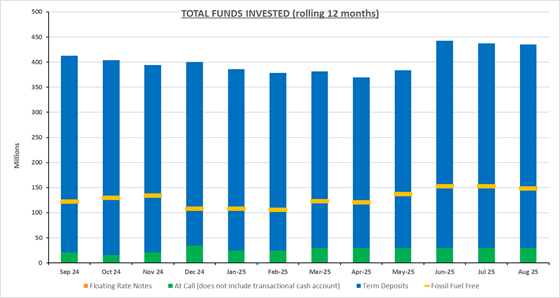
This chart shows the distribution and composition of Council’s investments, indicating a sharp increase in total term deposits in June 2025, aligned with replenishment of internal reserves via strategic borrowings.
Term Deposit Maturity Profile
This graphic illustrates that most term deposits mature between 2026 and 2028. Reinvestment at higher yields (4.45% to 4.53%) is expected to lift overall portfolio performance above the current average of 3.8%.
The maturity profile of investments (excluding the cash management account, which is on call), demonstrates a balanced distribution of maturities over the next 3 to 5 years, in line with Council’s Investment Policy and the timing of future reserve funding requirements for key projects.
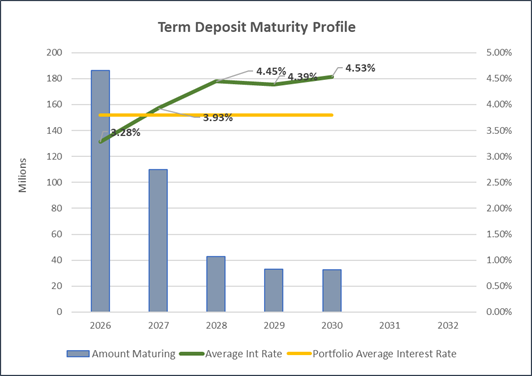
6. Conclusion
Council’s investment performance for August 2025 reflects prudent financial management underpinned by compliance, strategic reserve use, and alignment with long-term financial planning. The reinvestment of maturing funds at higher interest rates, alongside the restoration of internal reserves through structured borrowings, positions Council to maintain sound liquidity while supporting major infrastructure delivery in coming years.
Looking ahead, Council’s treasury strategy will continue to focus on maximising income, safeguarding capital, and ensuring alignment with the Long-Term Financial Plan. This approach reinforces Council’s financial sustainability and its capacity to respond effectively to emerging community priorities.
Key Considerations
7. Financial and Economic Implications
Council's investment income is ahead of budget, with a total of $3,145,841 earned year-to-date. Borrowing costs remain low, with interest expenses of $278,760 for August 2025. Council’s net interest position for the month was $1,421,877. Delayed borrowings and strategic fund timing have helped reduce reliance on internally restricted funds.
Domestic Economic Conditions
The Reserve Bank of Australia (RBA) reduced the official cash rate by 25 basis points in August, bringing it to 3.60%. This move was widely anticipated and underpinned by a continued decline in core inflation and a modest easing in labour market conditions. Importantly, the RBA’s August Statement on Monetary Policy did not alter its unemployment rate or inflation forecasts, though it did mark a shift in longer-term assumptions. The Bank has downgraded productivity expectations and now projects Australia’s trend GDP growth at around 2%, reflecting a more subdued outlook for the medium term.
Labour market data remained resilient. Employment increased by 24,500 in July, which helped nudge the unemployment rate down by 0.1 percentage points to 4.2%. Meanwhile, the Q2 Wage Price Index (WPI) printed in line with expectations, rising 0.8% quarter-on-quarter. On an annual basis, wage growth came in slightly stronger than consensus at 3.4% year-on-year, compared to 3.3% forecast.
Inflation indicators, however, presented some near-term surprises. The monthly CPI indicator accelerated to 2.8% in July from 1.9% in June, above market expectations. Similarly, the trimmed mean jumped to 2.7% from 2.1%. The unexpected strength was largely driven by the measurement of electricity subsidies and travel-related costs, which were always likely to dominate the July outcome.
In the regulatory space, APRA formalised a three-tiered prudential framework, categorising banks as ‘large’, ‘medium’, or ‘small’. This more granular approach is expected to provide regulatory relief for medium-sized banks by aligning oversight requirements more closely with institutional scale and risk profile.
In currency markets, the Australian dollar strengthened over the month, rising by approximately 1.07%. It ended August at US65.38 cents, up from US64.69 cents in July.
Global Economic Conditions
Global equity markets extended their rally through August, pushing to new highs despite persistent uncertainty around trade tariffs and geopolitical risks. Investor sentiment was buoyed by further central bank easing and expectations of additional rate cuts in the near term. While downside risks to global growth remain significant, the prospect of continued policy support, both monetary and fiscal has provided a buffer for medium-term growth expectations and valuations.
Across regional markets, performance was mixed. In the United States, the S&P 500 advanced 1.91%, while the NASDAQ rose 1.58%. European equities diverged: the UK’s FTSE posted a gain of 0.60%, whereas France’s CAC declined 0.88% and Germany’s DAX fell 0.68%.
In the US, the July FOMC minutes revealed that most officials continue to prioritise inflation control over concerns about labour market softness. Core CPI rose in line with expectations at 0.32% month-on-month, leaving the annual rate at 3.1%. Labour market data showed unemployment edging higher to 4.2% (from 4.1%), accompanied by a slight drop in the participation rate from 62.3% to 62.2%.
Canada’s July labour market report was weaker than anticipated, with employment falling sharply by 40,800. However, the unemployment rate was steady at 6.9%, cushioned by a 0.2 percentage point decline in participation to 65.2%.
In the UK, the Bank of England delivered a widely expected 25bp cut in early August, bringing the Bank Rate to 4.00%. This marked the fifth reduction in the current easing cycle, which began a year ago. Wage growth held steady, with private sector pay excluding bonuses rising 4.8% year-on-year, in line with consensus but just below the prior reading of 4.9%.
The Reserve Bank of New Zealand also cut rates by 25bp to 3.00%. The decision came with a notably dovish tone, as two members voted for a deeper 50bp cut. Markets now anticipate the terminal policy rate could settle at 2.50%, lower than previously expected.
In China, July data signalled ongoing weakness. CPI remained flat at 0.0%, avoiding a slip back into deflation but falling short of the prior 0.1% print. Producer price deflation persisted at -3.6%, the weakest level in two years. Activity data softened further: retail sales growth slowed to 3.7% year-on-year, industrial production eased to 5.7%, and new home prices dropped 0.31% month-on-month, the sharpest fall since October.
8. Legislative and Policy Implications
· Local Government Act 1993 (NSW)
· Local Government (General) Regulation 2021
· Ministerial Investment Order
· Council’s adopted Investment Policy
9. Strategic Context and Implications
This report aligns with the Integrated Planning and Reporting Framework (IP&R), supporting financial sustainability objectives outlined in the Long-Term Financial Plan and Resourcing Strategy (2025-2035).
10. Risk and Insurance Implications
Investment and borrowing decisions are managed within a comprehensive risk framework. Council maintains a diversified maturity profile and adheres to conservative credit exposure limits. Market volatility and rising interest rates are ongoing risks being actively monitored.
11. Engagement and Consultation
Council engages an independent investment advisor and routinely seeks market quotes across a diversified panel of institutions. Internal consultation includes finance, infrastructure, and strategic planning teams to align funding with project delivery.
12. Civic Leadership
Council is progressively aligning investments with ESG priorities. While current holdings include fossil fuel-exposed institutions, all new investments are assessed for ethical alignment where consistent with risk and return mandates.
Options
This is an information report only.
|
Attachments 1. 2.
|
Agenda Business and Performance
Subject: Draft Annual Financial Statements for the year ended 30 June 2025
Presented by: Business and Performance, Keith Hentschke
That Council:
1. Endorse the signing of the “Statement by Councillors and Management made pursuant to Section 413(2c) of the Local Government Act 1993” by the Responsible Accounting Officer, the Chief Executive Officer, the Mayor, and one Councillor.
2. Note that a further report will be presented to the November 2025 Ordinary Meeting of Council for consideration of the final Annual Financial Statements for the year ended 30 June 2025, together with the Auditor’s Report.
Executive Summary
Section 413(1) of the Local Government Act 1993 requires that “a council must prepare financial reports for each year and must refer them for audit as soon as practicable.” Council must also prepare a Statement by Councillors and Management stating their opinion on the general purpose and special purpose financial statements.
The draft Financial Statements for the year ended 30 June 2025 have been prepared. While the external audit is not yet complete, the draft statements must now be formally referred for audit in order to meet Council’s statutory obligations.
In accordance with Section 413, Council is required to resolve that the Statement by Councillors and Management be signed by the Responsible Accounting Officer, the Chief Executive Officer, the Mayor, and one Councillor. This step formally certifies that the financial statements are, in Council’s opinion, a true and fair reflection of Council’s financial position and performance.
The final audited Annual Financial Statements, together with the Auditor’s Report and a detailed analysis of results, will be reported back to the November 2025 Ordinary Meeting of Council for notation.
A copy of the draft Financial Statements is attached to this report.
Report
1. Background
Council is legislatively required to prepare and submit annual financial reports. Section 413 of the Local Government Act 1993 and the Local Government (General) Regulation 2021 prescribe both the content of these reports and the process by which they are certified, audited, and adopted.
The Audit, Risk and Improvement Committee (ARIC), in accordance with its forward responsibility schedule, reviewed the draft financial statements prior to submission to Council. Council is now required to:
· Approve the signing of the Statement by Councillors and Management; and
· Formally refer the draft statements to the external auditor for completion of the audit
2. Current Position
The draft Annual Financial Statements for the year ended 30 June 2025 have been completed and, together with the required supporting working papers, provided to the NSW Audit Office.
The draft statements were reviewed by the Audit, Risk and Improvement Committee (ARIC) at its meeting on 3 September 2025 and were also the subject of a Councillor briefing on 4 September 2025. These forums provided an opportunity for both oversight and early consideration of the financial results prior to formal referral for audit.
Council officers have continued to meet audit requirements by providing the draft reports and supporting documentation in line with the Engagement Information Request issued by the NSW Audit Office
3. Review of Draft Statements
The draft 2025 Financial Statements confirm that Council continues to maintain a strong balance sheet position, underpinned by significant infrastructure assets and adequate liquidity. However, the operating result before capital contributions reflects an underlying deficit, with expenditure growth outpacing revenue. While capital grants and contributions remain a critical source of funding, reliance on them continues to highlight structural financial sustainability challenges. Borrowings have more than doubled to support major infrastructure projects, and asset renewal and backlog indicators confirm the ongoing pressure on long-term asset management.
General Purpose Financial Statements (GPFS)
|
Financial Results |
2024–2025 000s |
2023–2024 000s |
% Change |
Note |
|
Rates and Annual Charges |
122,578 |
118,803 |
3.18% |
B2-1 |
|
User Charges & Other Revenues |
55,952 |
55,939 |
0.02% |
B2-2 / B2-3 |
|
Capital Grants & Contributions |
92,780 |
132,080 |
-29.8% |
B2-4 |
|
Operating Expenditure |
229,835 |
211,226 |
8.8% |
Income Statement |
|
Operating Result (incl. capital) |
77,394 |
129,163 |
-40.08% |
Income Statement |
|
Operating Result (excl. capital) |
-15,769 |
-2,917 |
-427% |
Income Statement |
|
Total Assets |
3,260,753 |
3,466,850 |
9.0% |
Financial Position |
|
Total Liabilities |
127,035 |
86,657 |
46.60% |
Financial Position |
|
Total Equity |
3,639,618 |
3,380,193 |
7.6% |
Financial Position |
|
Cash & Investments |
452,872 |
430,155 |
5.28% |
C1-3 |
|
Total Borrowings |
59,691 |
18,115 |
229.51% |
C3-3 |
Performance Measures - Note H1-1
|
KPI |
2024–2025 |
2023–2024 |
2022-2023 |
KPI |
|
Operating Performance Ratio |
–3.88% |
4.09% |
4.04% |
>0% |
|
Own Source Operating Revenue |
64.89% |
56.15% |
61.33% |
>60% |
|
Unrestricted Current Ratio |
2.20x |
1.67x |
1.32x |
>1.5x |
|
Debt Service Cover Ratio |
2.91x |
9.95x |
5.01x |
>2x |
|
Rates & Charges Outstanding |
7.46% |
6.91% |
5.57% |
<10% |
|
Cash Expense Cover Ratio (Months) |
27.00 |
28.05 |
32.92 |
>3 |
Notes on Key Variances
1. Operating Revenue (excluding capital) increased by $6.1m (2.9%) due to stronger rates, charges, user fees and investment income.
2. Capital Grants & Contributions (B2-4) fell by $39.3m (–29.8%) as large one-off project grants in 2024 were not repeated.
3. Operational Employee Benefits and On-Costs (B3-1) rose by $10.4 million compared with the 2023-2024 actual result. When measured against the 2024-2025 budget, however, the increase was more moderate at $3.1 million. This uplift is primarily attributable to an easing labour market, which enabled the successful recruitment of long-standing vacancies. In addition, higher on-costs such as Workers Compensation insurance premiums contributed significantly to the overall increase.
4. Expenditure on Materials and Services increased by $5.3 million above budget. A portion of this growth reflects the broader impact of global economic uncertainty, which has pushed up costs for raw materials and consumables. More notably, the May 2025 flood event had a significant influence, driving higher levels of asset maintenance activity. This response effort, centred on restoration rather than impairment, represents the most substantial factor behind the overall increase.
5. Assets increased by $269m (+9%) due to capitalisation of infrastructure projects and revaluation movements.
6. Borrowings increased by $41.6m reflecting new loans for major infrastructure works.
7. Cash and Investments rose slightly $22.7m though a large share is restricted for externally funded programs.
8. Key Ratios:
· Operating Performance has slipped below benchmark.
· Own Source Revenue has improved and is above benchmark.
· Liquidity ratios remain sound.
· Debt Service Cover has reduced but remains above benchmark.
Special Purpose Financial Statements (SPFS)
The Special Purpose Financial Statements report on Council’s declared business activities, including Water Supply, Sewerage Services, and Waste Management, in accordance with the requirements of the National Competition Policy. These activities are required to demonstrate financial sustainability, applying competitive neutrality principles by recognising taxation equivalents, subsidies, and return on capital employed.
For the year ended 30 June 2025, all three business activities reported results consistent with cost recovery expectations, with surpluses generated once competitive neutrality adjustments were applied. Net assets remain strong across all business activities, particularly in the Water and Sewer funds, reflecting the high level of investment in essential infrastructure. Restricted reserves within these funds are preserved for reinvestment in renewals, upgrades, and compliance-driven projects. The Waste Fund, while smaller in scale, continues to operate sustainably.
|
Business Activity |
Operating Result 000s |
Net Assets 000s |
Restricted Reserves |
|
Water Supply |
18,212 |
860.6 |
172.3 |
|
Sewerage Services |
11,586 |
573.4 |
57.6 |
|
Waste Management |
768 |
65.7 |
71.4 |
Analysis:
All business activities are financially stable and compliant with National Competition Policy requirements.
Water and Sewer results demonstrate effective cost recovery, with reserves ensuring capacity to deliver long-term infrastructure renewal.
Waste continues to operate on a sustainable basis, maintaining adequate reserves to meet future obligations.
The results confirm Council’s ability to deliver essential utility services without undue reliance on general fund revenues, while maintaining equity and reinvestment capacity in each business.
Key Considerations
4. Financial and Economic Implications
The draft Annual Financial Statements provide a preliminary view of Council’s financial performance for 2024–2025. While the audit process may result in adjustments, significant changes are not anticipated at this stage.
Key financial implications include:
· Ongoing pressure on operating performance ratios, reflecting structural challenges in aligning revenue with recurrent expenditure.
· The impact of major capital projects on cash reserves and liquidity, particularly in the water and wastewater portfolios.
· The need to incorporate the audited results into the Long-Term Financial Plan (LTFP) to ensure financial sustainability.
A more detailed financial and statistical analysis, including ratio commentary and trend data, will be provided to Council with the final audited statements in November 2025.
5. Legislative and Policy Implications
This report addresses Council’s statutory obligations under Section 413 of the Local Government Act 1993, which requires preparation of annual financial reports and their referral for audit.
Preparation and certification of the Statement by Councillors and Management is also a requirement of the Act.
The audited Annual Financial Statements form Part C of Council’s Annual Report, as required under the Integrated Planning and Reporting (IP&R) Framework.
No new or revised policies are proposed.
ESG factors – Transparent and compliant financial reporting supports good governance and public confidence in Council’s stewardship of resources.
6. Strategic Context and Implications
The financial statements directly support Council’s delivery of the Community Strategic Plan (CSP) and Delivery Program, particularly in demonstrating financial sustainability and accountability.
Alignment includes:
· Civic Leadership Theme – providing transparent financial information to the community.
· Resourcing Strategy (LTFP) – audited results will inform the forward budget and funding strategies for priority infrastructure and services
7. Risk and Insurance Implications
Key risks identified include:
· Financial Sustainability Risk – deterioration in key ratios could limit Council’s ability to fund services and infrastructure over the long term.
· Audit and Compliance Risk – failure to meet statutory deadlines or address audit findings could result in reputational and regulatory consequences.
· Resourcing Risk – ongoing challenges in financial services staffing may affect Council’s capacity to meet audit and reporting requirements.
Mitigation measures include strengthened internal controls, oversight by ARIC, and integration of audit findings into Council’s risk management framework.
8. Engagement and Consultation
· Internal consultation has occurred with the Financial Services Group, Executive Team, and the Audit, Risk and Improvement Committee.
· The draft statements were reviewed by ARIC on 3 September 2025 and discussed at a Councillor briefing on 4 September 2025.
· External consultation has occurred with the NSW Audit Office and contracted audit agents.
· Broader community engagement will occur through publication of the final audited statements as part of the Annual Report.
9. Civic Leadership
This report contributes to Council’s Civic Leadership responsibilities by:
· Ensuring compliance with statutory financial reporting obligations.
· Promoting transparency and accountability in the use of public resources.
· Embedding ESG considerations in governance practices through clear reporting of financial sustainability and stewardship.
Options
Council is required under Section 413(1) of the Local Government Act 1993 to prepare annual financial reports and refer them for audit. The process also requires the signing of the Statement by Councillors and Management prior to audit. Accordingly, there are limited options available to Council in considering this report:
Option 1 – Endorse the recommendation (Preferred Option)
· Council resolves to authorise the signing of the Statement by Councillors and Management by the Responsible Accounting Officer, the Chief Executive Officer, the Mayor, and one Councillor.
· Council notes that the final audited Financial Statements and Auditor’s Report will be tabled at the November 2025 Ordinary Meeting of Council for notation.
· This option ensures compliance with statutory obligations and enables the audit process to proceed without delay.
Option 2 – Do not endorse the signing of the Statement by Councillors and Management
· This option is not recommended as it would place Council in breach of its statutory obligations under the Local Government Act 1993 and prevent referral of the draft financial statements to the NSW Audit Office.
· Such a decision could result in delays to the audit timetable, reputational damage, and regulatory consequences for non-compliance.
|
Attachments 1.
|
Agenda Business and Performance
Subject: 2025-2026 Financial Assistance Grants
Presented by: Business and Performance, Keith Hentschke
That Council note the report and attached correspondence from the NSW Local Government Grants Commission regarding the 2025-26 Financial Assistance Grant allocation for Port Macquarie-Hastings Council.
Executive Summary
Port Macquarie-Hastings Council will receive $12,205,266 in Financial Assistance Grants (FAGs) for 2025–26. This comprises $8,176,871 for the General Purpose Component (GPC) and $4,028,395 for the Local Roads Component (LRC). These untied funds are allocated by the NSW Local Government Grants Commission under the Local Government (Financial Assistance) Act 1995 (Cth), with the distribution model designed to address relative disadvantage across councils.
For Port Macquarie-Hastings, the allocation reflects factors such as a higher Aboriginal and Torres Strait Islander population share, extensive road and bridge infrastructure, higher pensioner rebate levels, lower property values, and significant environmental land responsibilities.
A major challenge remains the timing and treatment of prepayments. In June 2025, the Commonwealth advanced circa 50% of the 2025-26 allocation, a lower share than the 85% prepaid in June 2024. This creates year-on-year volatility in reported income, as grants must be recognised in the year received, not the period intended. Combined with the late timing of detailed allocation advice (typically August), this uncertainty complicates cashflow, budget forecasting, and long-term planning.
Report
1. Background
The FAGs program provides untied financial assistance to local governments nationwide. Funding is distributed from a Commonwealth pool ($3.45 billion in 2025–26) to States and Territories, with NSW receiving $1.052 billion. Of this, $744 million supports the GPC and $307 million the LRC.
In NSW, the Local Government Grants Commission applies a methodology based on expenditure need, relative disadvantage, and local road requirements. The GPC is subject to annual adjustment caps (+6% / –4%) and a minimum per capita grant of $26.34.
For 2025–2026, the Australian Government prepaid around half of each council’s entitlement in June 2025, with the balance payable in four quarterly instalments between August 2025 and May 2026.
Structure of the Grants
• General Purpose Component (GPC): Based on service delivery needs and disadvantage factors such as population, Aboriginal and Torres Strait Islander share, road length, pensioner rebates, drainage/topography, environmental land, and relative revenue capacity.
• Local Roads Component (LRC): Distributed using local road length, bridge length, and population indicators.
2025–26 Allocation – Port Macquarie-Hastings Council
• General Purpose: $8,176,871
• Local Roads: $4,028,395
• Total Entitlement: $12,205,266
Council received a prepaid 2025-26 Financial Assistance Grant payment of $6,133,902 in June 2025. Quarterly payments of $1,517,091 will be received in August and November 2025, and February and May 2026
Relative Disadvantage Factors
Compared with state benchmarks, Port Macquarie-Hastings Council faces above-average disadvantage across several measures:
|
Indicator |
PMHC Measure |
NSW Standard |
Implication |
|
Population (persons) |
90,835 |
66,237 |
Larger population increases service demand. |
|
Aboriginal & Torres Strait Islander population (%) |
6.3% |
3.4% |
Above state average, increasing service needs. |
|
Road length (km) |
1,333 km |
1,184 km |
Higher than standard, increasing road maintenance costs. |
|
Rainfall, topography & drainage index |
188% |
161% |
More challenging terrain adds to infrastructure costs. |
|
Environmental land area (ha) |
95,642 ha |
57,330 ha |
Greater protected areas to manage and maintain. |
|
Pensioner rebates (% of residential properties) |
26.1% |
13.7% |
Higher pensioner share reduces rate revenue capacity. |
|
Property value (urban, average) |
$427,292 |
$764,243 |
Lower values reduce revenue capacity from rates. |
|
Property value (non-urban, average) |
$990,994 |
$1,637,417 |
Below state benchmark, limiting rural revenue base. |
These measures reinforce the Council’s reliance on FAGs to meet service delivery obligations.
Income Recognition and Prepayments
The advance payment arrangements continue to complicate financial reporting:
· Recognition Rule: Income must be recorded in the year received, regardless of the intended funding period.
· Prepayment Volatility: Prepayment proportions vary widely – 85% in 2024–25 vs 50% in 2025–26.
· Forecasting Difficulty: Detailed allocation advice is not received until August, when the budget year is already underway.
This misalignment creates swings in reported results and limits Council’s capacity to build reserves. For example, if the 2026–27 grant grows by 4% to $12.7m, and a 50% prepayment is received in June 2026, FAG receipts in 2025–26 would total $12.4m, about $0.2m short of the budgeted $12.6m.
Policy and Formula Developments
· The Commission has resumed the negative floor adjustment in 2025–26, ending the transition period that previously limited reductions.
· A formula review is scheduled during 2025–26, with consultation across the sector.
· Distribution continues to favour rural and regional councils: while 65% of NSW’s population lives in metropolitan areas, those councils receive only 25% of the FAG pool.
Prepayment Volatility and Cashflow Impacts
The following table illustrates the mismatch between annual FAG entitlements and actual cash receipts, driven by both the timing of payments and the inconsistent share of advance payments received each year. The proportion of prepayment has varied significantly, from as high as 85% in 2024–25 to just 50% in 2025–26, creating major uncertainty for cashflow management.
3. Conclusion
Financial Assistance Grants remain a cornerstone of Council’s funding framework, providing flexibility to address local priorities. However, the uncertainty created by advance payments and late allocation advice complicates budget forecasting and financial management. Council must remain cautious in its planning, recognising the volatility FAG receipts introduce to annual income reporting. Continued engagement with the NSW Local Government Grants Commission during its methodology review will be important to ensure the funding model reflects the challenges faced by Port Macquarie-Hastings and supports sustainable service delivery.
Key Considerations
4. Financial and Economic Implications
· 2025–2026 allocation: $12.205m (GPC $8.177m, LRC $4.028m).
· Key financial risk: income volatility due to prepayment timing.
· Prepayments: 85% prepaid in 2024–25 vs 50% in 2025–26.
· Budget sensitivity: A 50% prepayment of the 2026–27 grant equates to ~$6.3m receipted in 2025–26, potentially leaving a budget shortfall.
5. Legislative and Policy Implications
· Governed by the Local Government (Financial Assistance) Act 1995 (Cth).
· Administered in NSW by the Local Government Grants Commission.
· No immediate policy change for 2025–26, but methodology review underway.
6. Strategic Context and Implications
· FAGs provide flexible, untied revenue that underpins Council’s Delivery Program and Operational Plan.
· The allocation reflects structural challenges (roads, environment, demographics) that constrain local revenue.
· Financial volatility requires disciplined cashflow management and conservative planning assumptions.
7. Risk and Insurance Implications
· Main risk: prepayment uncertainty undermines reliable financial forecasting.
· Risk management: maintain prudent reserves, monitor announcements, and manage liquidity carefully.
· No direct insurance implications.
8. Engagement and Consultation
· Report is for information only; no engagement undertaken.
· Ongoing advocacy with the NSW Local Government Grants Commission will be important during the formula review.
9. Civic Leadership
FAGs support Council’s civic leadership by enabling continued service delivery aligned with the Community Strategic Plan. Transparent reporting of grant receipts, active participation in state-level consultations, and prudent management of volatile revenue streams demonstrate Council’s commitment to sustainability, equity, and accountability.
|
Attachments 1. 2. 3. 4. 5.
|
Agenda Business and Performance
Subject: Council Loan Funding - August 2025
Presented by: Business and Performance, Keith Hentschke
That Council note the Loan Funding report for August 2025.
Executive Summary
This report provides a detailed analysis of Port Macquarie-Hastings Council’s debt funding position as at 31 August 2025, with a focus on recent and planned borrowings to support major infrastructure delivery. In line with the 2025–2035 Long-Term Financial Plan (LTFP), Council’s borrowing strategy is designed to fund significant capital works while maintaining flexibility in the use of internal reserves.
Council’s loan program is now presented as a stand-alone report, reflecting its growing significance in financing critical projects. The use of borrowings is a key enabler for progressing major works such as the Cowarra Water Treatment Plant, Thrumster Sewerage Treatment Plant, and the Ocean Drive Upgrade.
In June 2025, Council undertook new borrowings totalling $50.71 million, directed toward priority infrastructure to meet future community needs and service demands. While these borrowings are essential for advancing long-term strategic objectives, they also increase Council’s debt servicing obligations, requiring ongoing monitoring to ensure fiscal sustainability.
The current debt profile highlights a strategic funding approach toward structured, project-specific financing as a core element of Council’s long-term financial management. Careful alignment of borrowing levels with the LTFP will be critical to balancing infrastructure investment ambitions with the prudent management of future repayment commitments.
Report
1. Loan Portfolio Overview by Fund (as at 31 August 2025)
The following table presents the loan balances, repayments and monthly interest expense as of 31 August 2025 for the 2025-2026 financial year.
|
Fund |
Amount Borrowed |
Outstanding Balance |
Weighted Average Interest Rate |
Accrued Interest for Month |
Remaining Repayments FYTD |
|
General |
65,385,170 |
57,396,876 |
5.50% |
268,569 |
6,064,382 |
|
Water |
- |
- |
- |
- |
- |
|
Sewer |
2,000,000 |
2,000,000 |
5.70% |
9,682 |
168,242 |
|
Waste |
1,500,000 |
174,074 |
3.44% |
509 |
178,582 |
|
Total |
68,885,170 |
59,570,950 |
|
278,760 |
6,411,206 |
2. Link to Long Term Financial Plan and 2025-2026 Proposed Borrowings
The Council’s Long-Term Financial Plan (LTFP) outlines a progressive drawdown of Water and Sewer Fund reserves through to 2035. Structured borrowings are incorporated within the plan to preserve internal liquidity and align debt financing with the delivery milestones of key infrastructure, including:
· Cowarra Water Treatment Plant
· Thrumster Sewerage Treatment Plant
This milestone-based borrowing strategy is intended to minimise interest expense, optimise cash flow timing, and maintain continuity in infrastructure delivery and essential services.
The following table, Proposed Borrowings by Fund – 2025–2026 to 2030–2031, presents Council’s planned loan funding as identified in the adopted 2025–2026 Operational Plan and the 2025–2035 Long-Term Financial Plan. The proposed borrowings are shown by fund and reflect Council’s forward funding strategy to deliver major infrastructure programs. No new borrowings are planned beyond the 2030–2031 financial year.
These borrowings are intended to support the delivery of strategic infrastructure; however, Council has not yet formally resolved to proceed with the debt arrangements. Borrowings attributed to the Water and Sewer Funds remain subject to further review, including completion of the exploratory phase of relevant procurement processes and a future formal recommendation to Council endorsing both a preferred supplier and a financing approach.
Proposed Borrowings by Fund and Financial Year (2025–2026 to 2030–2031)
|
Project |
2026-2027 |
2027-2028 |
2028-2029 |
2029-2030 |
2030-2031 |
|
General Fund |
|||||
|
Rehabilitation of Priority Bridges - Limeburner’s Creek Bridge |
1,600,000 |
||||
|
Hastings River Drive-Land Acquisition |
203,000 |
||||
|
Kindee Bridge - Critical Maintenance |
1,200,000 |
||||
|
Lake Road Duplication - Ocean-Chestnut-Design and Approval |
285,000 |
||||
|
West Port (Buller Street) Flood mitigation works |
1,600,000 |
||||
|
Ocean Drive-Matthew Flinders to Greenmeadows Construction |
14,000,000 |
||||
|
PMQ Airport - Biodiversity Certification |
2,600,000 |
||||
|
Sesqui and Lake Cathie Bridge-Complete maintenance |
900,000 |
||||
|
Settlement Shores Canal Replenishment-Reinstate to Base state |
3,500,000 |
||||
|
Port Macquarie/Wauchope Depot - Construction |
1,126,780 |
5,553,560 |
4,777,830 |
2,841,230 |
|
|
Beechwood Road Upgrade Stage 6 - High Priority Maintenance |
3,800,000 |
||||
|
|
22,388,000 |
8,426,780 |
5,553,560 |
4,777,830 |
2,841,230 |
|
Water Fund |
|||||
|
Cowarra Water Scheme-Construction |
8,200,000 |
23,000,000 |
28,800,000 |
||
|
|
- |
8,200,000 |
23,000,000 |
28,800,000 |
- |
|
Sewer Fund |
2026-2027 |
2027-2028 |
2028-2029 |
2029-2030 |
2030-2031 |
|
Thrumster WWTP Scheme-Construction |
6,200,000 |
48,300,000 |
33,000,000 |
33,000,000 |
|
|
|
6,200,000 |
48,300,000 |
33,000,000 |
33,000,000 |
- |
|
Grand Total |
28,588,000 |
64,926,780 |
61,553,560 |
66,577,830 |
2,841,230 |
3. Treasury Strategy and Risk Management
Council’s treasury strategy continues to reflect prudent risk management, including:
· Structuring of loans to smooth future repayment obligations.
· Use of fixed-rate instruments to mitigate interest rate volatility.
· Recognition that future borrowings may incur higher interest costs due to current and forecasted monetary conditions.
This approach supports a stable funding base and financial predictability over the long term.
The maturity profile of the current loans portfolio is shown below, providing details of when outstanding loan balances will be paid down, including the average interest rate payable.
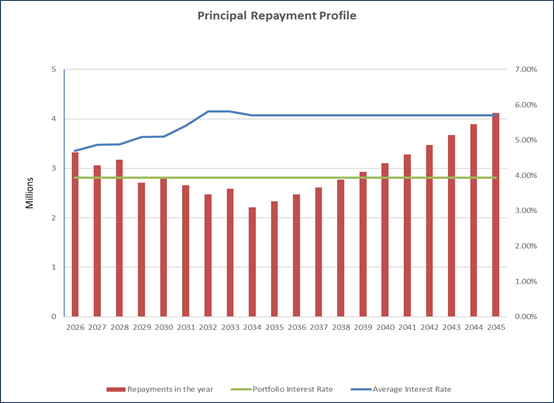
4. Net Financial Position
While Council’s net investment position remains positive, underlying trends point to emerging financial pressures. From 2026 to 2029, total borrowings are forecast to rise from $100 million to $275 million, while investment holdings are expected to contract from $371 million to $254 million. This structural shift highlights a growing reliance on debt financing, alongside a gradual erosion of investment reserves.
Over the same period, net interest income (the balance of interest earned on investments versus interest paid on borrowings) is projected to deteriorate. What is currently forecast as a revenue of $10.5 million in 2026 is expected to fall into deficit, reaching a shortfall of $4.6 million by 2029. The narrowing interest margin reflects two compounding dynamics: declining investment returns as cash reserves are drawn down and increasing interest expenses as new borrowings are progressively undertaken.
These trends unfold against a broader backdrop of sustained economic uncertainty, rising debt service obligations, and constrained revenue growth. Taken together, they point to tightening financial headroom and heightened exposure to external risks. To safeguard liquidity and maintain long-term fiscal sustainability, Council will need to closely monitor its financial strategy, reassess key assumptions, and adapt its approach to debt and investment management to ensure resilience in the years ahead.
|
Net Financial Position |
2026 |
2027 |
2028 |
2029 |
|
Total Investments |
371,325 |
270,136 |
228,685 |
254,047 |
|
Total Borrowings |
99,838 |
160,658 |
216,036 |
274,954 |
|
Net Investment Position |
271,487 |
109,478 |
12,649 |
-20,907 |
|
Interest Received |
(13,757) |
(13,086) |
(9,135) |
(8,018) |
|
Interest Paid |
3,254 |
6,573 |
9,762 |
12,664 |
|
Net Interest Income |
(10,503) |
(6,513) |
627 |
4,646 |
1.
5. Legislative and Policy Implications
• Local Government Act 1993 (NSW)
• Local Government (General) Regulation 2021
• Ministerial Investment Order
• Council’s adopted Investment Policy
6. Strategic Context and Implications
This report aligns with the Integrated Planning and Reporting Framework (IP&R), supporting financial sustainability objectives outlined in the Long-Term Financial Plan and Resourcing Strategy (2025-2035).
7. Risk and Insurance Implications
Borrowing decisions are undertaken within a comprehensive risk management framework designed to protect Council’s long-term financial position. The loan portfolio is structured with a diversified maturity profile to avoid concentration risk and to smooth repayment obligations over time. Council remains exposed to ongoing risks from interest rate volatility and broader market uncertainty, with rising borrowing costs being closely monitored. Conservative credit exposure limits and adherence to legislative and policy requirements form key safeguards within this framework.
8. Engagement and Consultation
Council engages with a broad panel of financial institutions to ensure competitive borrowing terms and market diversity. Multiple quotes are obtained for each loan facility in accordance with procurement and treasury management protocols. Internal consultation includes finance, infrastructure, and strategic planning teams to ensure that borrowing aligns with the timing and scope of approved capital projects, and that debt drawdowns are synchronised with project milestones.
9. Civic Leadership
Council’s borrowing strategy seeks to balance the delivery of essential infrastructure with responsible fiscal management. While debt funding is an important enabler of major projects, Council remains committed to ensuring that all financing arrangements are transparent, compliant, and consistent with long-term community and service delivery priorities.
Options
This is an information report only.
|
Attachments 1.
|
Agenda Business and Performance
Subject: Policy Review - Debt Recovery Policy
Presented by: Business and Performance, Keith Hentschke
That Council:
1. Note the outcomes of the public exhibition for the Draft Debt Recovery Policy.
2. Adopt the Debt Recovery Policy.
Executive Summary
The Debt Recovery Policy was publicly exhibited between 21 July 2025 and 18 August 2025 in accordance with legislative requirements and Council’s adopted engagement framework.
After the engagement period, the Executive endorsed the recommendation for adoption of this policy at the Strategic Meeting held on 26 August 2025.
The revised policy introduces clearer definitions, expanded procedural guidance, and strengthened hardship provisions.
The Policy introduces an early intervention strategy, enabling debtors to proactively manage obligations before they become unmanageable.
Council’s formal adoption of the Debt Recovery Policy is sought following public exhibition and community consultation.
Report
1. Background
Council adopted the current Debt Recovery Policy in May 2023. The policy outlines the framework for recovering outstanding debts including rates, water charges, and sundry debtor accounts. A review has been undertaken as part of the scheduled review cycle, ensuring alignment with legislative changes and best practice.
The revised policy introduces a more structured and detailed approach to debt recovery, including clearer definitions, expanded procedural guidance, and enhanced support for debtors experiencing financial hardship.
2. Discussion
The revised Debt Recovery Policy introduces a more structured and user-focused framework compared to the 2023 version. Key enhancements include a formal table of contents, clearly defined sections, and new additions such as Third Party Reporting, Support Services, and a Review of Decisions process. These changes reflect a more professional and empathetic approach to debt management, with stronger integration of hardship support and procedural fairness.
Operational updates include reducing the recovery threshold from $1,100 to $500 to allow earlier intervention and clearly outlining the legal action process. The policy also enforces stricter compliance timelines for clearing arrears and introduces consequences for defaults. Governance improvements include alignment with privacy legislation, standardized definitions, and clarified roles for internal and external stakeholders, all aimed at improving transparency and recovery outcomes.
3. Conclusion
The Policy reflects legislative compliance, internal process improvements, and a commitment to clarity and transparency for the community. As the public exhibition process has been completed and no submissions were received, it is recommended that Council now adopt the Debt Recovery Policy.
Key Considerations
4. Financial and Economic Implications
The 2025 Policy enhances long-term financial sustainability while maintaining ethical and socially responsible practices. By lowering the recovery threshold to $500, the policy enables earlier engagement with debtors, which may increase short-term administrative costs but is expected to reduce aged debts and future write-offs. Clearer payment timeframes and stricter compliance protocols improve cash flow predictability and reinforce disciplined revenue recovery.
Early intervention tactics, such as prompt reminder notices and structured payment plans, are designed to prevent debt escalation, reduce legal costs, and ease the burden on debtors—supporting broader community resilience. The policy also retains the non-write-off stance for land-secured debts, preserving Council’s financial leverage. Importantly, it incorporates ESG principles by promoting transparency and ethical treatment of debtors throughout the recovery process.
5. Legislative and Policy Implications
· Complies with the Local Government Act 1993 (NSW) and associated regulations.
· Aligns with Council’s Hardship Policy and Code of Conduct.
· This is a revised policy.
6. Strategic Context and Implications
This policy aligns with the Integrated Planning and Reporting Framework (IP&R), particularly the Lead Strategy for Financial Sustainability and Governance.
7. Risk and Insurance Implications
Should this policy not be adopted the risks include reputational impacts and financial loss due to unrecovered debts.
8. Engagement and Consultation
Public exhibition of the Draft Debt Recovery Policy occurred from 21 July 2025 to 18 August 2025 via Council’s Have Your Say platform. Visitor activity included:
· 28 informed visitors
· 0 submissions received
· 8 document downloads
Internal Consultation was conducted with:
· Executive
· Executive Lead - Finance and Commercial Operations
· Chief Financial Officer
· Manager Revenue Accounting
· Team Leader Rates
· Team Leader Water and Debtors
· Debt Recovery Specialist
It is noted that no submissions were received.
9. Civic Leadership
This policy supports Council’s civic leadership responsibilities by ensuring ethical, transparent, and accountable debt recovery practices.
Options
Council may adopt the Debt Recovery Policy, consistent with the recommendation in this report.
Council may request further amendments post public exhibition.
Council may retain the existing Debt Recovery Policy without amendment. This is not recommended, as the updated Policy contains important refinements for clarity, fairness, and alignment with Council’s current structure.
|
Attachments 1. 2.
|
Agenda Business and Performance
Subject: Policy Review - Hardship Policy
Presented by: Business and Performance, Keith Hentschke
That Council:
1. Note the outcomes of the public exhibition for the Draft Hardship Policy.
2. Adopt the Hardship Policy.
3. Rescind the Payment of Late Rate Instalment Due to Death of Ratepayers Spouse Policy.
Executive Summary
The draft Hardship Policy and Rescission Notice of the Payment of Late Rate Instalment Due to Death of Ratepayers Spouse Policy was publicly exhibited between 21 July 2025 and 18 August 2025 in accordance with legislative requirements and Council’s adopted engagement framework.
After the engagement period the Executive endorsed the recommendation for adoption of the Hardship policy and the Rescission of the Payment of Late Rate Instalment Due to Death of Ratepayers Spouse Policy at the Strategic Meeting held on 26 August 2025.
The revised Hardship Policy introduces a more contemporary, compassionate, and inclusive approach to supporting ratepayers experiencing genuine financial hardship. The Payment of Late Rate Instalment Due to Death of Ratepayers Spouse policy is recommended for rescission, as its provisions are now incorporated under Section 5.4 – Assistance Available of the Hardship Policy.
Council’s formal adoption of the Hardship Policy, and rescission of the superseded Payment of Late Rate Instalment Due to Death of Ratepayers Spouse policy, is now sought.
Report
1. Background
Council adopted the current Hardship Policy in April 2020. The policy has provided a framework for supporting ratepayers in financial distress, including during natural disasters and the COVID-19 pandemic. A review was initiated to modernise the policy, improve accessibility and effectiveness, and consolidate related policies for clarity and consistency.
2. Discussion
The Draft Hardship Policy reflects Council’s strengthened commitment to fairness, accessibility, and community support. It introduces a more structured and readable format, adopts plain English standards, and expands eligibility beyond concession card holders to include any residential ratepayer experiencing genuine financial hardship. The policy now recognises a broader range of hardship factors—such as illness, domestic violence, and natural disasters—and includes a formalised assessment process led by a multidisciplinary panel, along with a new appeals mechanism to ensure procedural fairness.
Support options have been broadened to include natural disaster relief and bereavement assistance, while the application process has been redesigned to be more inclusive and supportive, encouraging documentation and offering interview opportunities. The integration of external support services and the consolidation of previous related policies into a single framework further enhance the policy’s effectiveness. These updates aim to reduce barriers to access and ensure all applicants are treated with dignity and respect.
3. Conclusion
As a result of no submissions being received, no changes have been made to the draft policy after presentation to the July 2025 Council meeting.
The revised Hardship Policy reflects Council’s commitment to fairness, empathy, and responsible governance.
The rescission of the Payment of the Late Rate Instalment Due to Death of Ratepayers Spouse Policy reflects its incorporation into the updated Hardship Policy.
Key Considerations
4. Financial and Economic Implications
The revised policy maintains Council’s financial sustainability by continuing to require full repayment of rates and charges over time, while offering flexibility in payment arrangements and interest relief. The introduction of a formal assessment panel and clearer eligibility criteria is expected to improve administrative efficiency and reduce the risk of inconsistent decisions.
While there may be a short-term impact on cash flow due to deferred payments or waived interest, this is balanced by improved community trust and support for vulnerable ratepayers. The limited number of submissions and the nature of the feedback received indicate broad community support or acceptance of the draft policy.
5. Strategic Context and Implications
Supports Council’s strategic goals under the Integrated Planning and Reporting framework, particularly in financial sustainability and community wellbeing.
6. Risk and Insurance Implications
Financial risk mitigated through structured repayment plans.
Legal and reputational risks reduced by transparent and fair processes.
7. Engagement and Consultation
Public exhibition of the Draft Hardship Policy occurred from 21 July 2025 to 18 August 2025 via Council’s Have Your Say platform, supported by the July Have Your Say e-newsletter. Visitor activity included:
· 33 aware visitors
· 5 informed visitors
· 0 submissions received
· 5 document downloads of Hardship Policy
· 0 document downloads of the Payment of Late Rate Instalment Due to Death of Ratepayers spouse Policy
Internal Consultation was conducted with:
· Executive
· Executive Lead - Finance and Commercial Operations
· Chief Financial Officer
· Manager Revenue Accounting
· Team Leader Rates
· Team Leader Water and Debtors
· Debt Recovery Specialist
8. Civic Leadership
The revised policy enhances Council’s leadership in social responsibility and community support, aligning with ESG principles.
Options
Council may adopt the draft Hardship Policy, which aligns with the recommendation in this report.
Council may request further amendments post public exhibition.
Council may retain the existing Hardship Policy without amendment. This is not recommended, as the updated Policy includes important refinements for clarity and accurate references to Council’s current structure.
Council may resolve not to rescind the Payment of Late Rate Instalment Due to Death of Ratepayer’s Spouse Policy. This would, however, require amendments to the Hardship Policy as presented and would perpetuate duplication.
|
Attachments 1. 2. 3.
|
Agenda Business and Performance
Subject: Report of the Audit, Risk and Improvement Committee Meeting Held 3 September 2025
Presented by: Business and Performance, Keith Hentschke
That Council note the report of the Audit, Risk and Improvement Committee held 3 September 2025.
Executive Summary
In accordance with the Risk Management and Internal Audit for Local Government in NSW Guidelines, Council’s Audit, Risk and Improvement Committee is required to report to Council following each ordinary meeting on the items considered and outcomes of the meeting.
It is noted that due to the sensitive nature of some items considered at this meeting, some details may be excluded from this report.
Report
1. Background
Councils are required to have an Audit, Risk and Improvement Committee as required by the Local Government Act. This Committee meets on a quarterly basis and considers items as relevant under section 428A of the Local Government Act.
2. Discussion
In accordance with the Risk Management and Internal Audit for Local Government in NSW Guidelines, Council’s Audit, Risk and Improvement Committee is required to report to Council following each ordinary meeting on the items considered and outcomes of the meeting.
It is noted that due to the sensitive nature of some items considered at this meeting, some details may be excluded from this report.
Council’s Audit, Risk and Improvement Committee met on 3 September 2025 commencing at 12 noon with several in-camera sessions being held with Committee members, Council’s Legal Counsel and Council’s Acting Chief Executive Officer. The meeting was conducted on-line and attended by Chairperson Stephen Coates, Independent Members Mel Jacobs and Kerry Phillips and non-voting member Councillor Rachel Sheppard. The meeting was also attended by Council’s Acting Chief Executive Officer, Robert Fish and Acting Director Business and Performance, Anthea Gilmore together with other support staff from Governance, Project Delivery, Digital Technology and Financial Services. A representative of the Audit Office of NSW was also present for the duration of the meeting.
There were 14 items considered outside of housekeeping items such as previous minutes and disclosures of interest.
All Audit, Risk and Improvement Committee meetings commence with members being informally asked to indicate if they are aware of any emerging risks that Council may wish to consider. A number of risks were informally discussed with staff giving further consideration to the emerging risks discussed.
The Committee reviewed the recently developed list of outstanding actions and provided advice on how they wished to manage this list in the future.
Council’s Legal Counsel provided a verbal report that provided an update on legal and compliance matters currently being managed by Council.
The Committee noted a report from the Group Manager Project Delivery on the status of major projects currently underway by Council. These projects include:
· Ocean Drive Duplication
· Maria River Road
· Thrumster Wastewater Scheme
· Port Macquarie Bulk Water Treatment Plant at Cowarra (Cowarra Water Supply Scheme)
· Kew/Kendall Wastewater Scheme Diversion to Camden Haven
An Artificial Intelligence (AI) and Cybersecurity report was provided to the Committee by the Chief Information Officer. This report was well received and outlines Council’s current uses of and controls associated with the use of AI. The Committee has requested a report on Council’s AI strategy and policy to come to the December 2025 meeting of the Committee.
Council’s Executive Lead Finance and Commercial Operations, Chief Financial Officer and Financial and Statutory Accounting Manager attended to address several reports including:
· The Audit Office’s Interim Management Letter
· Improvement Plan 2022-2026 - General Fund Operating Performance
· Making of 2025-2026 Fees and Charges, Revenue Policy, and Rating Maps and Notation of Proposed Budget Adjustments
· Draft Financial Statements for Year Ended 30 June 2025
A representative of the Audit Office attended the meeting and discussed the contents of the Interim Management Letter for year ending 30 June 2025. The Committee requested that the findings of the management letter be included in Council’s Audit findings register and reporting on progress continue with the Committee. It was noted that the draft financial statements remain subject to external audit and may be subject to further adjustment.
The Group Manager Governance presented a number of reports to the Committee including:
· Major Non-Compliance Exceptions Report - this is a cyclic report that includes any major instances where Council needed to report a non-compliance with licence requirements to an external agency. It was noted that no such major non-compliance reports were required in this reporting period.
· Review into the Effectiveness of the Audit, Risk and Improvement Committee - Council resolved to undertake an external review into the Effectiveness of the Audit, Risk and Improvement Committee. This was undertaken and presented to ARIC with recommendations. The recommendations were accepted and will be included in the outstanding audit recommendations for monitoring and reporting.
· Business Continuity Plans - the Committee was presented the almost complete draft Business Continuity Plans for their review and comment prior to finalising. It is noted that additional information relating to crisis communications will be incorporated into the final drafts for adoption by Council.
· Risk Registers - this item provided a status update to the Committee of this transformation project together with updated risk registers for the Committee’s review. The Committee acknowledged that there has been significant work given to the risk management transformation project and updated risk registers and also provided some suggestions for further improvements. Aspects of these risk registers will continue to be reported to ARIC. The Committee also recommended that a formal review of Council’s Risk Appetite Statement be undertaken in the near future.
· Draft Ethical Framework - the Committee noted a draft ethical framework and recommended it include a flowchart to demonstrate relationships between the various documents listed in the framework.
Items of General Business included:
· A request for regular reporting of outstanding internal audit actions be prioritised noting the vacancy in the Internal Auditor position at the moment.
· A proposal to arrange site visits for Committee members to some of the major project sites during 2026
· The addition of a component of the post ARIC Committee Council report that includes a Chairperson’s Report.
· Request that Service Reviews are included on the agenda for the December 2025 ARIC meeting.
· Request that divisional representatives provide regular reports to ARIC detailing some of the aspects of their business that are a high risk, including financial implications.
The next meeting will be held on 16 December 2025.
Chairperson’s Report
This report highlights strategic issues for Council’s oversight, complementing Minutes and officer reports. The Committee focused on financial sustainability, risk maturity, major projects, cyber resilience, governance culture, and organisational change. While progress is evident, several material risks require councillor attention.
The “Councillor focus” notes in this report highlight the key oversight questions councillors should be asking of management. They are designed to direct attention to the most strategic risks and governance issues, rather than operational detail.
Emerging Risks
· There are ongoing economic pressures and flood recovery creating uncertainty and these are not fully reflected in the risk register.
· Swift adoption of new technology and AI introduce cyber, privacy, and ethics risks that may needing tighter controls.
· Financial sustainability pressures continue from rising costs and deferred works.
Councillor focus: How well are emerging risks integrated into planning and budgeting?
Major Projects
· Key projects such as Cowarra Water Supply and Thrumster Wastewater Scheme are rated Amber on scope, budget, and risk.
· Limited contingency exists if multiple projects slip.
· ARIC requested further details of projects reported to reflect more than just traffic light status, including phase/stage of project, spend against budget, timeframes, and more details of specific project risks to ascertain how risk management is being handled at a project/operational level.
Councillor focus: What recovery plans and funding contingencies are in place if slippage occurs in major projects simultaneously?
Cyber Security & AI
· Cyber maturity remains at Essential Eight levels 1–2, leaving unexplained residual exposure beyond that.
· Council’s AI rollout progressing well, but bias, privacy, and governance risks need attention.
· Funding gaps hinder uplift of critical controls (endpoint detection, privileged access) to manage risk.
Councillor focus: What is Council’s tolerance for cyber risk, and how should it be resourced?
Financial Statements & Audit
· Draft 2025 financial statements were tabled. These will be recirculated to the Committee out of session as multiple changes had occurred in drafts since the version the Committee was provided for review.
· Council has recorded consecutive operating deficits from operations over the past 2 years. While this does not give rise to a material uncertainty regarding Council’s ability to continue as a going concern, it does present a material risk to long-term financial sustainability.
· AONSW Interim Management Letter findings point to outstanding process and resourcing issues in the management of risk.
Councillor focus: Are material uncertainties and sustainability risks fully disclosed?
Governance & Integrity
· Council’s Risk Appetite alignment with risk register exposures is still developing.
· Risks outside Risk Appetite should be flagged in cover reports for councillors.
· ARIC requested further details in future reports of risks outside of appetite and encouraged Management to progress with appetite setting with Elected Officials and finalisation of an updated strategic risk register.
Councillor focus: Does Council have a governance culture that consistently translates frameworks into outcomes?
Business Continuity & Resilience
· Draft BCPs were presented, and extensive work has been done, but still require minor updates, then testing, training.
Councillor focus: Are resilience plans adequate to support community expectations in crises?
Action Tracking & Oversight
· A new ARIC Action Item List is now monitored each meeting for Committee accountability.
· Current ARIC reporting covers only “major” capital projects; broader project coverage is needed and will be followed up next meeting.
Considerations for Councillors
· Note heightened risks (economic, flood recovery, cyber, AI).
· Request clear recovery and funding plans for simultaneous, amber-rated projects.
· Prioritising cyber/data security uplift in FY26 budget.
· Encourage regular disaster-linked testing of BCPs.
End of Chairperson’s Report
Key Considerations
3. Financial and Economic Implications
There are no financial and economic implications in relation to this report.
4. Legislative and Policy Implications
Councils are required to have an Audit, Risk and Improvement Committee by the Local Government Act. This Committee meets on a quarterly basis and considers items as relevant under section 428A of the Local Government Act.
In accordance with the Risk Management and Internal Audit for Local Government in NSW Guidelines, Council’s Audit, Risk and Improvement Committee is required to report to Council following each ordinary meeting on the items considered and outcomes of the meeting.
It is noted that due to the sensitive nature of some items considered at this meeting, some details may be excluded from this report.
5. Strategic Context and Implications
There are no Strategic Context implications in relation to this report.
6. Risk and Insurance Implications
Failure to provide this report to Council as required risks Council not complying with its requirements under the Risk Management and Internal Audit for Local Government in NSW Guidelines. This report however is for information only so there are minimal risks associated with this report.
7. Engagement and Consultation
No engagement was required or has occurred regarding this report.
8. Civic Leadership
These quarterly reports provide details of items considered by the ARIC on a quarterly basis. This transparently advises the community the items being considered even though not all details can be made public through this report due to the sensitivity of some of the information.
Options
This report is for notation only.
|
Attachments Nil
|
Agenda Community Infrastructure
Subject: Integrated Transport Plan - Annual Update
Presented by: Community Infrastructure, Blayne West
That Council:
1. Note the progress update on the 2024-2025 Integrated Transport Plan.
2. Endorse the public release of the 2024-2025 Integrated Transport Plan Progress Update.
3. Continue to monitor implementation of the Integrated Transport Plan and receive future updates on a 12-monthly basis.
Executive Summary
Covering the period of 1 September 2024 to 31 August 2025, the report highlights the significant achievements across multiple transport modes, current priorities for ongoing delivery, and any challenges that impact implementation progress.
Working in partnership with Transport for NSW (TfNSW), this annual review demonstrates progress on our key transport priorities while providing transparency on implementation timelines and outcomes achieved to date.
The report demonstrates the progress of 57 actions that have been commenced within 2024-2025. Representing progress on 52% of the 110 actions outlined in the ITP.
Council is actively progressing actions within our direct control and available resources, with notable progress on several priority transport initiatives, including:
· Beach-to-Beach (Stages D3 and D5) delivering an 8.3 km continuous shared path from the North Haven break wall to Dunbogan Reserve
· Adoption of the Walking and Cycling Plan
· Near completion of the Ocean Road duplication
· Commencement of a traffic study to update the LGA traffic model and assess future needs
Council also continues to strongly advocate to the State Government for investment in the broader network improvements our community needs (i.e. Oxley Highway Corridor, Wrights Road and Lake Road intersections). This advocacy aligns with the Councillors’ four-year strategic priorities outlined in Council’s Delivery Program 2025–2029.
As a high-level strategic document addressing complex and large-scale transport infrastructure improvements, progress is incremental and measured over multiple years rather than annual completion targets. This means many actions are scheduled to commence in later years of the plan. The collaborative nature of this plan means sustained progress depends on ongoing partnership coordination, funding alignment, and the practical timeline required for major infrastructure planning and delivery. The 2024-2025 ITP Progress Update is included at Attachment 1.
Report
1. Background
The ITP was adopted at the Ordinary Council Meeting on 15 August 2024 as a strategic framework to guide investment and decision-making across the region’s transport network. Developed in partnership with TfNSW, the Plan establishes a clear vision for creating a safe, connected, and sustainable transport system that supports liveability, economic growth, and enhances environmental resilience throughout the local government area.
The Plan includes 110 specific actions across the breadth of transport modes and infrastructure, including active transport initiatives, public transport improvements, road safety enhancements, freight movement efficiency, and the integration of emerging technologies. These actions are strategically aligned with Council’s Regional Integrated Transport Strategy 2022–2042 and the NSW Future Transport Strategy.
Following adoption of the ITP, which identified key active transport corridors, Council developed the Walking and Cycling Plan (adopted May 2025) which now services as the operational sub-plan to the ITP. This Plan provides an evidence-based prioritisation framework, based on connectivity, equity, and safety deficiency criteria, to guide Council's funding applications and investment decisions.
The Walking and Cycling Plan now functions as Council's primary decision-making tool for active transport initiatives, translating the ITP’s strategic directions into actionable, prioritised delivery.
2. Discussion
Further to the adoption of the ITP in August 2024, at the Ordinary Council meeting on 20 March 2025, Council resolved as follows:
12.02 Notice of Motion - Integrated Transport Plan - Reporting
Request the Chief Executive Officer to update the Status of Reports from Council Resolutions for the April 2025 Ordinary Council Meeting to include a regular reporting frequency of once per year for the Port Macquarie-Hastings Integrated Transport Plan to be provided in September 2025, which includes but is not limited to, works completed and priority projects for Port Macquarie-Hastings Council and TfNSW for the next 2 years.
The attached 2024-2025 ITP Progress Update provides a comprehensive snapshot of progress against the Plan’s key focus areas, highlighting key achievements while acknowledging ongoing challenges and future priorities. The report shows substantial progress in the commencement of critical transport infrastructure projects, with notable active transport progress.
Overall progress
|
Overall progress is summarised below: |
|||
|
Indicative timing & priority |
# Totals Actions |
# Actions programmed for 2024-2025 |
Status 2024-2025 |
|
Total Actions |
110* |
57 |
|
|
Short Term |
60 |
38 |
|
|
Short Medium |
27 |
12 |
|
|
Medium Term |
23 |
7 |
|
*Total includes ITP actions and sub-actions
Key achievements
|
Key achievements during 2024-2025 are: |
|
|
|
Council adopted the Walking and Cycling Plan in May 2025, following extensive community consultation. As a sub-plan to the ITP, it will deliver a safer and more connected active transport network. It establishes a prioritised project list based on community need, safety deficiencies and connectivity gaps to guide Council investment decisions and strengthen advocacy for external funding to deliver identified improvements. |
|
|
The duplication of Ocean Drive between Matthew Flinders Drive and Greenmeadows Drive, designed to increase traffic capacity along this corridor, will be completed in the 2025-2026 financial year. This investment, which includes pedestrian and cycleway infrastructure is jointly funded through a NSW Government grant and Council. |
|
|
Walking and Cycling Plan 2025 Ocean Drive Duplication |
|
|
TfNSW have advised the draft Oxley Highway Business Case is in the final stages of quality assurance testing. A briefing will be provided to Council when completed. |
|
|
The NSW Government has committed $20 million for design and delivery of improvements to the Oxley Highway/Pacific Highway interchange at Port Macquarie: Stage 1 - Western side to Billabong Drive and Stage 2 - Eastern side to Service Centre (subject to funding) |
|
|
Council delivered Beach to Beach Stage D3 (from Tip Road to 22 The Boulevarde) and Stage D5 (a complex boardwalk suspended above the water between 28 and 33 The Boulevard). This $3.65 million investment provides a continuous 8.3 km shared path from the North Haven break wall to the Dunbogan Reserve, enhancing connectivity for pedestrians and cyclists. |
|
|
Completion of the $2.4 million upgrade of the intersection at Gordon and Horton Streets. The project supports the growing population by facilitating improved traffic flow into the CBD and pedestrian accessibility. It also includes upgraded infrastructure - new street lighting, additional stormwater drainage and new pedestrian crossings to enhance safety & efficiency. |
|
|
Beach to Beach Gordon Street Intersection |
|
|
Council completed traffic modelling in June 2025 to identify infrastructure needs resulting from forecast population growth and additional housing under the Thrumster Structure Plan and the Sancrox and Fernbank Creek Structure Plan. |
|
|
Council commenced the Area Wide Traffic Study to update the local government area (LGA) traffic model and evaluate future infrastructure and network improvements, considering different land use scenarios. |
|
|
Council is progressing the design and environmental approvals for the duplication of Lake Road between Ocean Drive and Chestnut Road. When constructed it will result in the full duplication of Lake Road delivering significant improvements in traffic flow, safety, and accessibility for all road users, including pedestrians and cyclists. |
|
|
Council received $443,296 to undertake a detailed design of a shared pathway between the Health and Education Precinct (HEP) and Port Macquarie Town Centre under the Get NSW Active grant program. |
|
|
Partnership and collaboration with Transport for NSW continues to strengthen. |
Several risks and challenges continue to affect implementation and require ongoing monitoring. Funding availability remains the primary constraint, with many strategic transport actions unfunded and reliant on future grant opportunities.
Current funding limitations are restricting Council’s ability to deliver planned active transport connections. Delivery of additional walking and cycling infrastructure is contingent on securing external financial resources.
Congestion hotspots along the Oxley Highway, Lake Road and Wrights Road require coordinated infrastructure responses and demand management strategies. Public transport uptake remains below targets and will require service improvements and demand management measures to support modal shift.
The Living and Place Strategy identifies a target of 40% infill development over the next 20 years. Concentrating growth within established urban areas supports more efficient public transport networks by increasing density near existing services, reducing travel distances, and improving the viability of frequent services.
Upcoming priorities 2025-2026
The key priority projects for 2025-2026 are:
|
|
Progressing a Council-led Area Wide Traffic Study to provide an updated LGA traffic model |
|
|
Lake Road Duplication, Ocean Drive to Chestnut Road detailed design |
|
|
Council led detailed design of HEP to Port Macquarie Town Centre Shared Pathway under Get NSW Active grant program |
|
|
Oxley Highway Corridor Business finalisation by TfNSW and presentation to Council |
|
|
Progressing Port Macquarie Parking Precinct Plan |
|
|
Continued advocacy to the State Government for investment in key projects including Wrights Road Roundabout, Lake Road and King Creek intersections, as well as the broader network improvements our community needs |
3. Options
Council has the following options available for consideration:
1. Adopt the recommendation as proposed in this report.
2. Council could seek additional information or amendments to the Progress Update prior to adoption.
Option 1 is the recommendation of this report.
4. Conclusion
In conclusion, it is recommended that Council note the progress update on the implementation of the ITP and acknowledge the key achievements during 2024-2025.
The collaborative nature of this plan means sustained progress depends on ongoing partnership coordination, funding alignment, and the practical timeline required for major infrastructure development.
Key Considerations
5. Financial and Economic Implications
The implementation of the ITP continues to face significant financial constraints that will impact delivery timing and scope. The 110 strategic actions identified are designed for delivery across short, short-medium and medium-term timeframes in partnership with TfNSW.
As a strategic document focused on complex transport infrastructure improvements, progress is incremental and measured over several years rather than through annual delivery targets.
Many strategic actions remain unfunded and dependent on grant funding, requiring ongoing advocacy and strategic positioning to secure necessary investment.
Council's successful grant applications during the reporting period, including the $443,296 Get NSW Active grant for the detailed design of a shared pathway between the Health and Education Precinct (HEP) and Port Macquarie Town Centre demonstrate the value of having well-prepared, strategic projects ready for funding opportunities.
The Plan serves as a crucial strategic tool for grant applications and advocacy efforts, positioning Council to respond quickly when funding opportunities arise.
6. Legislative and Policy Implications
The ITP aligns with existing legislative requirements and policy frameworks at both state and local levels. Implementation continues to comply with relevant planning instruments while supporting broader strategic objectives for sustainable transport development and community wellbeing.
7. Strategic Context and Implications
The ITP is aligned with Council’s Regional Integrated Transport Strategy 2022–2042 and supports achievement of NSW Future Transport Strategy objectives. The Plan contributes to Council’s Integrated Planning and Reporting documents that guide Council’s strategic direction and operational priorities as follows:
Community Strategic Plan Imagine 2050
· Outcome 1 - We have well connected places with reliable services and infrastructure that meets the changing needs of our growing community.
· Strategy 1.2 - Plan, maintain and improve our roads, bridges, footpaths and cycleways, air and water-based transport services, to enable safe and easy movement around our region.
Delivery Program 2025-2029 and annual Operational Plan
· Principal Activity/Service: Transport
· Relevant Strategy and Plan: Integrated Transport Strategy and Integrated Transport Plan
8. Risk and Insurance Implications
The delivery of transport infrastructure projects involves inherent risks, including construction safety, environmental impacts, and potential disruption to local communities. These risks are managed through established project management and governance frameworks that ensure compliance with relevant standards and mitigation strategies.
The ITP supports risk reduction by promoting coordinated planning and appropriately sequenced infrastructure delivery in partnership with TfNSW. As a strategic document addressing complex and large-scale transport improvements, implementation is incremental and is assessed over multiple years. Progress is heavily influenced by funding availability and broader planning priorities, as outlined earlier in the report.
9. Engagement and Consultation
The ITP Progress Update is specifically designed to be accessible to community members and stakeholders, providing clear information about progress and future priorities. Public release through Council's website and other engagement channels ensures transparency in reporting while supporting ongoing community awareness of transport infrastructure developments.
Regular reporting maintains accountability to the community while providing opportunities for feedback and input on implementation priorities. The annual reporting cycle balances the need for timely updates with practical considerations regarding project delivery timeframes and meaningful progress measurement.
10. Civic Leadership
Council's commitment to transparent reporting on ITP implementation demonstrates leadership in strategic transport planning and community accountability. The Plan positions Council as a proactive advocate for sustainable transport solutions while maintaining focus on practical delivery of infrastructure that supports community needs and economic development objectives.
The Plan contributes to environmental, social, and corporate governance (ESG) outcomes by promoting sustainable mobility, enhancing equitable access to transport options, and aligning infrastructure planning with responsible governance and long-term community wellbeing.
Options
Council has the following options available for consideration:
1. Adopt the recommendation as proposed.
2. Council could seek additional information or amendments to the ITP Progress Update prior to adoption.
Option 1 is the recommendation of this report.
|
Attachments 1. |
Agenda Community Infrastructure
Subject: Implementation of the 2025 Authorisation and Delegation Instrument from Transport for NSW
Presented by: Community Infrastructure, Blayne West
That Council:
1. Rescind the Local Traffic Committee (LTC) and formally thank all members and contributors for their service over the years.
2. Establish the Local Transport Forum (LTF) in accordance with the 2025 Authorisation and Delegation Instrument from Transport for NSW.
3. Appoint Mayor Roberts as Chairperson for the Local Transport Forum noting his previous appointment to chair the Local Traffic Committee.
4. In accordance with clause (d) of the Authorisation and Delegation Instrument (the Instrument), Sub-delegate all functions and powers under Schedule 1 of the Instrument to the General Manager (CEO), subject to the conditions and limitations set out in Schedule 4 of the Instrument.
5. Receive a report at the December 2025 Ordinary Council meeting to review the charter of the Local Transport Forum, ensuring clarity on its advisory role, membership, and attendance following consideration by the Local Transport Forum.
Executive Summary
Transport for NSW has issued a new Authorisation and Delegation Instrument effective 1 August 2025, replacing previous delegations from 2011 and 2023. The Instrument modernises council powers to regulate traffic and use prescribed traffic control devices, introduces the Local Transport Forum (LTF) as a replacement for the Local Traffic Committee (LTC), and allows councils to sub-delegate these powers internally.
This report recommends Council implement the Instrument by formally establishing the LTF, appointing a Chair, and sub-delegating powers to the General Manager.
Report
1. Background
Council’s powers to regulate roads and traffic have historically been provided via the 2011 Delegation to Councils (Attachment 5) and the 2023 Temporary Delegation (Attachment 4). These instruments defined the following:
TfNSW 2011 Delegation to Councils
This was a long-standing delegation that allowed NSW councils to regulate traffic using Transport for NSW’s powers under the Roads Act 1993 and Road Transport Act 2013. It enabled councils to:
· Use prescribed traffic control devices (e.g., signs, markings) enforceable under the Road Rules.
· Regulate traffic for purposes like roadworks, maintenance, and events (e.g., parades, markets).
· With the above delegation operating via specific referral requirements to the Local Traffic Committee (LTC), which reviewed, approved and advised on traffic proposals
TfNSW 2023 Temporary Delegation
This was a trial delegation aimed at streamlining council decision-making for low-risk pedestrian works and allowed councils to:
· Approve and implement selected pedestrian infrastructure without needing TfNSW or LTC approval.
· Design works like:
· Raised pedestrian crossings
· Kerb buildouts
· Continuous footpaths
· Alfresco dining zones
· Speed management treatments (e.g., humps, cushions)
The goal of the temporary delegation was to test whether localised decision-making could be more efficient and sustainable.
Each of these historic delegations required referral of traffic matters to the Local Traffic Committee (LTC), which functioned as a technical advisory group. The LTC included representatives from Transport for NSW (TfNSW), NSW Police, and local MPs, and operated with a voting structure.
A newly adopted Instrument (Attachment 1) revokes these prior delegations and replaces the LTC with the Local Transport Forum (LTF), which in difference to the LTC is advisory only in function and does not vote or approve proposals.
2. Discussion - the 2025 Authorisation and Delegation Instrument
On 23 July 2025, Transport for NSW wrote to Councils advising of the creation of a new delegation instrument for Council’s. The 2025 Authorisation and Delegation Instrument (Attachment 1) replaces both the 2011 and 2023 delegations.
The 2025 Instrument came into force on 1 August 2025.
In comparison to the prior delegations, the 2025 Instrument further extends the scope for Councils to independently manage local street and renames and re-scopes the Local Traffic Committee to become the ‘Local Transport Forum’ to reflect the need to focus on all transport modes, especially bus services.
A summary of key changes defined by the instrument are documented below. A copy of the instrument and TfNSW’s guideline for Councils on the use of the instrument is also attached to this report (Attachment 3).
Key changes include:
Establishment of the Local Transport Forum (LTF)
The LTF replaces the LTC and now functions as a technical advisory body only with no voting rights. Council remains the final decision-maker.
Referral Requirements to the Local Transport Forum (LTF)
Under the 2025 Authorisation and Delegation Instrument, councils are granted discretion in referring proposals to the Local Transport Forum (LTF). However, certain proposals must be referred, while others are optional and left to council’s discretion. Referral to the LTF is only required for proposals that restrict passage for more than 6 months or affect public transport for more than 24 hours.
In particular, the following proposals must be referred to the LTF for advice prior to implementation:
1. Traffic Regulation for More Than 6 Months:
· Proposals that restrict or prohibit passage along a road (e.g. road closures, turn bans).
· Proposals that compel or prevent a turn from one public road to another.
2. Impacts on Public Transport for More Than 24 Hours:
· Proposals that prevent, impede, or hinder the safe or efficient operation of a public passenger service.
· Proposals that prevent access to a public transport station, stop, wharf, or service.
· Proposals that remove or render less effective any bus priority measure.
In addition, the instrument introduces a new “Statement of Concern Process”, that formalises a process via which TfNSW can raise concern with Council’s management of roads within its delegations. In such instances, if TfNSW indicates it will issue a Statement of Concern during an LTF meeting, the proposal cannot proceed until Council has responded in writing and a further 7 days have passed.
The following types of proposals are Options, and Council may choose to refer these works to the LTF at Council’s discretion:
1. Proposals that:
· Are temporary (e.g. less than 6 months for traffic regulation or less than 24 hours for public transport impacts).
· Do not restrict or prohibit passage (e.g. speed cushions, roundabouts, parking changes).
· Affect road capacity or amenity but not access or movement.
· Are trials or pilot projects intended to test community response or network impact.
Sub-delegation
Councils may sub-delegate powers associated with the delegation instrument to the General Manager (CEO) or staff. This occurred with the prior 2011 and 2023 delegations, and again it is recommended that Council sub-delegate all functions and powers under the Instrument to the General Manager (CEO), as permitted under clause (d) of the Instrument as a means of ensuring the efficient and effective operation of Council functions as a Road Manager.
Councillor attendance
Councillors may attend LTF meetings in an observer capacity only where they are not Council’s representative, however it is noted that the LTF is not classified as a committee under the Local Government Act 1993.
Membership and Governance:
The following representatives must be invited to every LTF meeting:
· Council (the delegate) – Convenor and decision-maker.
· Transport for NSW – Provides advice on state-level interests, including public transport and road network safety.
· NSW Police Force – Advises on public safety, enforcement, and event management.
· Local Member(s) of NSW Parliament – Represents community interests.
· Public Passenger Service Operators – Must be invited when a proposal is likely to affect their operations (e.g. bus operators).
Meeting Quorum
Under the 2025 Authorisation and Delegation Instrument, a quorum for an LTF meeting is:
· One representative from Council, and
· One representative from Transport for NSW
In difference to the function of the LTC, there is no voting at the LTF, with the forum being an advisory body only.
Council is the sole decision-maker and must consider the advice provided but is not bound by it.
3. Action Required
In order to implement the 2025 Authorisation and Delegation Instrument, Council must undertake the following actions:
1. Rescind the Local Traffic Committee (LTC). As part of this process, it is recommended that Council write to all current LTC members and thank them for their contribution and advise of the change in delegations and meeting format.
2. Formally establish the Local Transport Forum (LTF) in accordance with the 2025 Authorisation and Delegation Instrument from Transport for NSW.
3. Appoint a Chairperson for the Local Transport Forum. In this regard, the Mayor of Port Macquarie - Hastings Council serves as the current chair of the LTC. The Council may elect to continue to support the appointment of the Mayor to Chair the LTF, or appoint another Councillor, the General Manager (CEO), or delegate to a Council officer.
4. Similarly to the 2011 and 2023 delegations, Council is requested to sub-delegate all functions and powers under the Instrument to the General Manager (CEO), as permitted under clause (d) of the Instrument as a means of ensuring the efficient and effective operation of Council functions as a Road Manager.
Subject to the above occurring, Council staff propose to include an item in the initial meeting of the LTF (tentatively scheduled for 24 September 2025) to present the delegation instrument and define a new LTF charter, ensuring clarity on its advisory role, membership, and attendance.
4. Conclusion
The 2025 Instrument modernises council traffic management powers and simplifies processes. Council should implement the Instrument by establishing the LTF, appointing a Chair, and sub-delegating powers to the General Manager.
Key Considerations
5. Financial and Economic Implications
There are no direct financial implications associated with implementing the Instrument. Existing resources and staff will support the transition. The increased flexibility may reduce administrative costs over time.
6. Legislative and Policy Implications
The Instrument is issued under the Transport Administration Act 1988, Roads Act 1993, and Road Transport Act 2013.
Council’s implementation complies with all legislative requirements.
This is not a new Council policy but a response to a revised delegation from Transport for NSW.
7. Strategic Context and Implications
The implementation aligns with Council’s Integrated Planning and Reporting (IP&R) framework, particularly strategies related to transport planning, community engagement, and governance.
8. Risk and Insurance Implications
Risks are minimal and primarily relate to procedural compliance. The Instrument includes safeguards such as the Statement of Concern process and mandatory referrals for high-impact proposals.
9. Engagement and Consultation
Consultation has occurred with Transport for NSW. Further engagement will occur through the LTF, which includes representatives from Transport, Police, public transport operators, and local MPs. Councillors may attend as observers.
10. Civic Leadership
The transition to the LTF reflects Council’s commitment to modern governance, collaboration, and community-focused decision-making.
|
Attachments 1. 2. 3. 4. 5.
|
Agenda Community Planning and Environment
Subject: City Heart Strategy and Master Plan
Presented by: Community, Planning and Environment, Melissa Watkins
That Council:
1. Note the report and the Community Engagement and Consultation outcomes on the City Heart Strategy and Masterplan development.
2. Endorse the City Heart Principles as identified in this report and derived from the Community Engagement and Consultation program.
3. Receive a further report to the November 2025 Ordinary Council Meeting on the City Heart Strategy and Master Plan seeking endorsement for public exhibition.
Executive Summary
The purpose of this report is to provide an update on the City Heart Strategy and Master Plan development and community engagement undertaken to date and advise on key principles to inform the project. The report also seeks Council’s endorsement of the City Heart principles derived from the engagement undertaken to date.
The City Heart Master Plan is a strategic planning outcome that is designed to provide a clear vision and approach to the future development of the Town Centre and Central area of Port Macquarie. The purpose of the City Heart Master Plan as identified in the community engagement and consultation program is to:
· Protect and revitalise existing open spaces.
· Improve walkability of streets with tree canopy
· Connect existing & create new active transport links.
· Capitalise on and celebrate natural features and existing heritage character.
· Create special precincts and sites to improve retail and entertainment experiences.
· Inform planning controls to help facilitate infill housing in the Port Macquarie City Heart
The City Heart Strategy and Master Plan will seek to inform appropriate planning controls and master planning to ensure Port Macquarie has sufficient housing and investment opportunities.
The City Heart Strategy and Master Plan documents, will be presented at the November 2025 Ordinary Council Meeting, for endorsement for public exhibition. This project supports a place-based approach to planning, including better integration of land use and regional development and or renewal.
The City Heart Strategy and Master Plan will strengthen Port Macquarie’s role as a vibrant, inclusive, and well-connected regional centre offering diverse housing options, fostering economic growth, and enhancing accessibility. It envisions a dynamic heart where residents, visitors, and workers come together to enjoy events, festivals, and cultural experiences, supported by a thriving mix of retail, hospitality, and commercial activity.
Report
1. Background
In 2020 Council Developed the Local Strategic Planning Statement ‘Shaping Our Future 2040’ which identified Planning Priority 13:
“Build the capacity of Port Macquarie as a regional city and develop the vitality of other economic centres and employment lands.”
Priority 13 identified the need to review the Development Control Plan (DCP) and Local Environmental Plan (LEP) controls in and around the Port Macquarie CBD.
The Port Macquarie Regional City Action Plan (RCAP) was developed in 2021 and identified the need for cohesive planning for the Port Macquarie City Heart. The Port Macquarie City Heart study area is shown below.
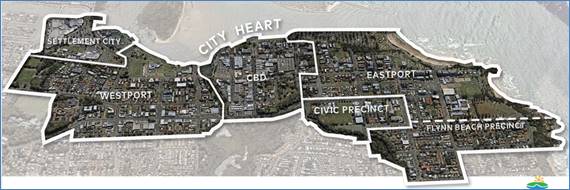
In 2024 Council developed its Local Housing Strategy Documents, including the Living and Place Strategy, the Housing Delivery Plan, and the Affordable Housing Plan. These documents identified the need to locate development in well planned growth precincts and infill areas. A key action to achieve this was to develop a City Heart Master Plan.
The City Heart Master Plan is designed to identify opportunities to deliver greater housing diversity in the City Heart, supporting Council’s Living and Place Strategy (Housing Strategy) and the broader objectives of the Living and Place Strategy. The City Heart Strategy that will support the Master Plan will also explore opportunities to strengthen the Central Business District’s (CBD) identity, encourage a night-time economy, promote investment, and integrate distinctive green and blue landscapes into the urban fabric.
Council has received input from a broad range of stakeholders regarding the City Heart Strategy and Master Plan both through the Regional City Action Plan (RCAP) engagement process and ongoing consultation focused on the CBD. Revitalising the Port Macquarie City Heart has consistently emerged as a key strategic priority in response to the RCAP, which emphasised the importance of strengthening the CBD as a vibrant regional centre. This includes promoting housing diversity, enhancing the public domain, and stimulating economic activity. These priorities were strongly reflected in community feedback during the RCAP engagement (Attachment 2) and continue to be reinforced through the most recent consultation on the City Heart Strategy and Master Plan (Attachment 1).
Council successfully secured funding through the Australian Government’s Housing Support Program – Stream 1 to enable the engagement of consultants AJC and GYDE Planning to support the background studies to the City Heart Strategy and Master Plan, which has ensured that the timelines of the grant funding can be met while Council staff ultimately produce the final City Heart Strategy and Masterplan.
2. Discussion
The Port Macquarie-Hastings community has provided a range of feedback to input into the development of a City Heart Master Plan, across a range of engagement activities.
While community and stakeholder views have a small variance in the desirable scale for future development, there is clear support for a range of new, diverse, and affordable housing options, medium and higher density residential and mixed-use development.
The community is generally supportive of ongoing activation and revitalisation across the City Heart, valuing improved night-time activity, diversity of activities, land uses and events.
The community identified a range of opportunities to:
• Prioritise excellent quality development.
• Improve existing public spaces for enjoyment.
• Enhance connection to the waterfront.
Development priorities identified will include the vacant sites and underdeveloped sites. These prioritised sites will be considered to offer great potential for connection to waterfront, as well as for cohesive east west connectivity.
Heritage is a key value among the wider community. Opportunities to conserve and highlight the Port Macquarie City Heart’s heritage were highlighted and will be considered for the potential to establish heritage focused destinations, support community and visitor-oriented endeavours; and celebrate heritage sites and experiences. Acknowledgment and meaningful representation of Aboriginal cultural heritage is also an important part of Port Macquarie-Hastings’ heritage journey.
In considering opportunities to provide much needed housing and housing diversity, improve local services and infrastructure, and support appropriate growth in Port Macquarie-Hastings, there will be a need to find a balance between varying perspectives and values, to ensure that development is realistic, achievable and feasible, and also hitting the right notes on local character, amenity, design quality and place experience.
City Heart Strategy and Master Plan Principles
To inform and define the City Heart Strategy and Master Plan the feedback received from the community and industry has been developed into the following principles:
Open Space and Natural Assets
· Celebrate foreshore and creeks - Encourage residential development adjacent to Port Macquarie City Heart’s foreshore and along Kooloonbung Creek, with careful consideration of flood risks. New development should reference the surrounding waterways through open streetscape design, improved visual connections, and a network of pedestrian linkages that improve public access to these key natural assets.
· Provide new parks and improved open space to accommodate future growth - Create additional public open spaces in Port Macquarie City Heart to support future population growth and address gaps in walkable access to green space, particularly in areas undergoing urban renewal or higher density development.
Streets and Connectivity
· Improve connectivity and encourage active transport - Prioritise pedestrians within Port Macquarie’s City Heart by introducing new streets and through-site links, and by increasing the number of safe crossing points and street connections to improve walkability and connectivity throughout the City Heart.
· Improve pedestrian safety and access - Prioritise street upgrades where needed to ensure pedestrian safety and access through the whole of the City Heart.
Urban Fabric
· Concentrate density around amenity and infrastructure - Encourage higher densities in the Port Macquarie City Centre by focusing mixed-use development around key amenities like open spaces, the foreshore, and cultural hubs where housing will be supported by social infrastructure and services.
· Strengthen identity through strategic consideration of key sites - Focus building height at key entry points and around major open spaces particularly in the north and west to enhance arrival experiences, support wayfinding, and strengthen the city centre’s identity and character.
· Reinforce character by protecting existing assets - Support Port Macquarie City Heart’s existing assets by retaining high quality medium and large-scale buildings where possible, while protecting the city’s heritage sites and built character.
City Life
· Invite people to stay in the city centre - Improve the Port Macquarie Town Centre by prioritising street upgrades in the City Heart and incentivising new small open spaces near the centre to enhance vibrancy and accessibility.
· Provide opportunities for positive urban experiences - Activate the Port Macquarie Town Centre by encouraging street art, feature lighting, and colourful paving to better define shared zones. Support more market days and events and reduce car access during these times to prioritise people and public life.
Should the City Heart Masterplan be ultimately adopted, a separate grant funded activity will commence for the implementation of the City Heart Strategy and Master Plan. This will involve a Planning Proposal to change planning controls in the City Heart Strategy and Masterplan area to facilitate its delivery. This will be separately reported to Council under the existing regime for Planning Proposals. Assuming adoption of the City Heart Strategy and Master Plan, following exhibition it is anticipated the first stage, a Scoping Proposal would be presented to Council in February 2026. The Planning Proposal is also Grant Funded under a different grant round but is also funded by the Federal Government Housing Support Program.
3. Conclusion
The draft City Heart Strategy and Master Plan will be shaped by the guiding principles outlined in this report, which have been informed by extensive and ongoing engagement with the community and industry stakeholders. These principles reflect a shared vision for a vibrant, inclusive, and economically resilient city centre. As Council moves forward with the development of the draft, it is essential to maintain alignment with community aspirations and strategic priorities identified through the Regional City Action Plan and recent consultation.
Key Considerations
4. Financial and Economic Implications
The preparation of the Port Macquarie City Heart Strategy and Master Plan is being funded primarily through the Australian Government’s Housing Support Program – Stream 1, following Council’s successful grant application. The Grant funding amount for this project is $275,000. Council will not be required to contribute to the City Heart Strategy and Masterplan Grant Funding. Council has received 70% of the Grant Funds to complete the work.
The City Heart strategy and Master Plan Grant Funding timing requirements are that Council must report on the City Heart Strategy and Master Plan by no later than the Ordinary Council Meeting of 20 November 2025, for the purposes of public exhibition. Following and assuming adoption as soon as possible, after the submissions are adequately considered and incorporated, Council staff will provide a Practical Completion report to the funding body. At this point Council will receive the balance of the Grant funds.
There is a further $200,000 for a Planning Proposal to amend the Planning Controls in the City Heart Area, under a separate Stream and Round 3 of the Federal Government Housing Support Program, should the City Heart Strategy and Masterplan be endorsed. Council will fund from existing approved budgets $30,000 to finalise the Planning Proposal under this Grant Fund.
The City Heart Strategy and Master Plan itself does not commit Council to future capital works expenditure. However, it will provide the strategic framework to guide future investment in public domain improvements, infrastructure upgrades, and housing supply initiatives within the City Heart. This framework will also strengthen Council’s position when seeking additional external funding opportunities.
5. Legislative and Policy Implications
The preparation of the Port Macquarie City Heart Strategy and Master Plan, responds directly to a range of existing strategic planning frameworks and policy directions.
At the regional and local level, the City Heart Strategy and Master Plan supports the North Coast Regional Plan 2041, the Port Macquarie Regional City Action Plan, the Local Strategic Planning Statement, the Living and Place Strategy, and the Port Macquarie-Hastings Urban Growth Management Strategy. Collectively, these strategies and plans emphasise the need for more diverse housing options, revitalised centres, and sustainable growth.
6. Strategic Context and Implications
The Draft City Heart Master Plan aligns with Council’s Integrated Planning and Reporting Framework (IP&R) and supports the following strategies:
|
IP&R Theme |
Strategic Alignment |
|
Liveable and well-connected places |
Facilitates diverse housing options in the City Heart; supports improved connectivity and movement networks. |
|
A thriving, inclusive economy |
Strengthens the CBD as a regional centre; encourages investment, business activity and job creation. |
|
Sustainable environments |
Embeds green and blue infrastructure; promotions sustainable urban design. |
|
Community voice and leadership |
Provides transparent, evidence-based planning that reflects community aspirations and supports Council’s role as regional leader. |
Figure 1: IP&R Framework
The City Heart Strategy and Master Plan will also advance outcomes identified in adopted strategies, including:
· Local Strategic Planning Statement - gives direct effect to planning priority 13.
· Living and Place Strategy – supports housing supply and diversity.
· Urban Growth Management Strategy – consolidates growth within the existing urban footprint.
· Regional City Action Plan 2036 (RCAP) – reinforces the CBD as the focal point for cultural, social, and economic activity.
7. Risk and Insurance Implications
A risk management strategy was included in the detailed project plan throughout the procurement process. The risk management strategy identified risks for the projects life cycle and included mitigation controls.
Several risks have been identified in relation to the City Heart Strategy and Masterplan, including potential community opposition to change, financial constraints, and disruption during construction, which could affect local businesses, traffic flow, and community amenity. There is also a risk that desired outcomes, such as increased vibrancy, activation, and economic uplift, may not be fully achieved, alongside environmental risks such as flooding. Heritage and cultural values may be affected if not adequately considered, and implementation risks, including delays in approvals or stakeholder coordination, could impact project delivery.
These risks are mitigated through ongoing community engagement, careful planning and staging of works, integration of climate resilience measures, alignment with heritage requirements, and clear governance and project management arrangements.
8. Engagement and Consultation
The engagement and consultation approach for the City Heart Strategy and Master Plan has been jointly undertaken by Council, and consultants AJC and Gyde, in alignment with the Port Macquarie-Hastings Council Community Participation Plan. The engagement was targeted on the wider Port Macquarie-Hastings community, local businesses, interest groups and stakeholders as well as with government agencies. The program was developed and guided by the following principles:
· Open - invite a broad range of people to participate and get involved.
· Meaningful - encourage participation and produce meaningful outcomes that will be directly reflected in the Port Macquarie City Heart Strategy and Master Plan.
· Timely - consult the community early and with plenty of time to respond, to inform the development of the City Heart Strategy and Master Plan
· Inclusive - ensure that everyone can provide their feedback through a range of forums.
· Clear - make complex, strategic information clear and easy to understand by a wide audience.
The following engagement activities were undertaken to inform the creation of the Draft Master Plan:
· Advertising - the Port Macquarie City Heart Master Plan and World Café session were advertised on Council’s Have Your Say page on its website. Physical postcards were sent out across the City Heart area, downloadable postcards were available on the website, with supporting mapping information. A QR code was included on the postcard directing recipients to the Have Your Say page.
· Community Enquiries - the community and interested stakeholders were able to contact Council for information about the City Heart Master Plan via survey or email.
· Project webpage - information about the City Heart Master Plan was available on Council’s Have Your Say page and website.
· Social media and Council collateral - the engagement was advertised on Council’s social media pages.
· Community Survey - a community survey was made available on Council’s website, advertised on the community postcard and the QR code was promoted at the World Café session.
· Stakeholder meetings and briefings - meetings were held with key stakeholders including the Town Centre Business and Property Owners, seeking feedback on the key priorities. Business Port Macquarie were briefed on the development of the City Heart Master Plan.
· World Café - a world café session was held on Thursday 12 June 2025, at the Westport Club. Members of the community and stakeholders were invited to give their input on their vision, values, and suggestions for the City Heart.
There were:
· 1,500 page visits to Council’s Have Your Say page.
· 364 downloaded documents
· 127 surveys were completed.
· The postcard was viewed or downloaded 174 times.
· Mapping was provided 114 times.
A total of 34 participants registered for and attended the World Café event. Participants were invited to comment on four (4) themes at a table discussion facilitated by a Council staff member. Outcomes from the engagement undertaken to date is included in Attachment 1 and 2. The four themes and a summary of the feedback is listed below.
· Theme 1: The City Centre - now and the future
o Enhance active transport and pedestrian-friendly streets with safe, visually appealing public spaces.
o Activate waterfront areas and public spaces with events, nightlife, and cultural activities.
o Support CBD’s role as the primary commercial and business hub.
o Improve east-west connections and create focal nodes for social interaction.
o Encourage local businesses, pop-ups, and cultural heritage initiatives.
· Theme 2: Public spaces and the waterfront
o Strengthen visual and physical connections to the waterfront.
o Increase dining and leisure options along waterfront areas.
o Improve parks and underutilised green spaces.
o Establish swimming areas and activate spaces near jetties.
· Theme 3: Businesses, attractions, events, and activities
o Promote Town Green for events and reduce barriers to public space activation.
o Host more local festivals, markets, and sporting events.
o Consider destination precincts like Fisherman’s Wharf with restaurants, bars, and microbreweries.
· Theme 4: Housing and liveability
o Increase CBD housing density, including affordable and senior housing.
o Encourage mixed-use developments and shop-top housing.
o Address parking, heritage, and economic feasibility challenges.
o Improve public transport, pedestrian safety, street furnishings, lighting, and connectivity.
o Use examples like Newcastle’s Honeysuckle precinct for inspiration on integrating residential and public spaces.
Key Priorities Across Themes:
· Activate streets, laneways, and public spaces.
· Enhance connectivity, safety, and amenity for all users.
· Preserve heritage while enabling higher-density development and economic feasibility.
· Create a vibrant, inclusive, and culturally rich city centre integrated with waterfront areas.
Councillors were provided a Councillor Briefing on 4 September 2025. The briefing covered the City Heart Strategy and Masterplan area, key considerations, input from the Community and the High Level Principles and Concepts that were identified in the community engagement program and included in this report.
9. Civic Leadership
In terms of Environmental, Social and Corporate Governance (ESG) factors, the City Heart Strategy and Master Plan is strongly aligned with Council’s ESG objectives:
· Environmental – the City Heart Strategy and Master Plan seeks to support more sustainable land use patterns, reduces pressure on greenfield development, and integrates green and blue landscapes within the CBD.
· Social – the City Heart Strategy and Master Plan seeks to promote diverse and affordable housing, improved public spaces, accessibility, and community wellbeing.
· Governance – this project is being developed through transparent processes, supported by grant funding under the Australian Government’s Housing Support Program – Stream 1, and will be subject to community consultation through public exhibition.
Options
Council has the following options available:
1. Note the information provided and endorse the principles as recommended or
2. Seek additional information or
3. Note the information and not endorse the identified principles.
|
Attachments 1. 2.
|
Agenda Community Planning and Environment
Subject: Homelessness in the Port Macquarie-Hastings Local Government Area
Presented by: Community, Planning and Environment, Melissa Watkins
That Council:
1. Note the data provided on homelessness and availability of social and affordable housing in the Port Macquarie-Hastings Local Government Area.
2. Note the data provided on Short-Term Rental Accommodation in the Port Macquarie-Hastings LGA.
3. Note the actions taken to date within Council’s control to address homelessness and affordable housing, and continue to support coordinated, cross-sector efforts to improve housing outcomes for the community.
4. Note that it will continue to play its role in advocating to State and Federal governments for increased investment in, and policy support, for social and affordable housing in the LGA.
Executive Summary
This report provides an update on the current state of homelessness and housing affordability in the Port Macquarie-Hastings Local Government Area (LGA). The data for this report comes from multiple sources, primarily the NSW Government and REMPLAN, and it is important to note that this is not Council data.
The report outlines key housing challenges in the community, including an increase in rough sleeping, limited availability of social and affordable housing, and a shortage of short-term rental accommodation (STRA). Additionally, it acknowledges the role of Council in addressing these issues through advocacy, policy initiatives, and collaboration with Community Housing Providers (CHPs) and other stakeholders, emphasising that the Council does not serve as a lead agency in this area.
Publicly available data indicates that approximately 278 people in the LGA are experiencing homelessness, with rough sleeping increasing by 30% from 2024 to 2025. The lack of alignment between social housing supply and demand remains significant, particularly for smaller dwellings. Council’s actions, such as waiving development contributions for social and affordable housing projects and securing grant funding for strategic planning, demonstrate commitment to improving housing outcomes.
This report recommends that Council note the current data on homelessness and the actions taken to date, and continue supporting coordinated, cross-sector efforts to address housing affordability and homelessness in the region. These efforts align with Council’s broader strategic plans and contribute to building a more inclusive and resilient community.
1. Background
At the Ordinary Council Meeting held on 17 July 2025, a Notice of Motion resolved that:
1. Current number of people experiencing homelessness in the Port Macquarie Hastings LGA
2. Current levels of Social Housing provision
3. Current levels of Affordable Housing
4. Short-term Rental Accommodation Statistics
5. Actions, including advocacy, that Port Macquarie-Hastings Council has taken to address homelessness since November 2022
6. Actions, including advocacy, that Port Macquarie-Hastings Council has taken to increase affordable housing and housing affordability since November 2022
This report addresses the issues outlined in the Notice of Motion by providing relevant data and updates. The data included in this report has been sourced from external entities, rather than from Council data. It covers a range of topics, including homelessness, affordable and social housing, and short-term rental accommodation. It is important to note that the Council has a limited role in these areas, and various economic factors and housing policies at the State and Federal Government levels are largely beyond Council's control.
2. Discussion
Like many regions in Australia, Port Macquarie-Hastings is confronted by escalating challenges regarding housing and homelessness. Affordable, secure and appropriate housing meets an essential human need for shelter and security. It also provides a foundation for people to engage with education, employment, their community and their families.
Although monitoring homelessness and housing issues is not primarily the responsibility of Council, it recognises the substantial impact these issues have on the community within the Local Government Area (LGA). Council understands that access to adequate housing is vital for the well-being of residents and identifies housing affordability as a challenge facing the LGA.
To respond to these issues, Council has developed a comprehensive suite of Housing Strategy documents. This includes:
1. The Living and Place Strategy, which focuses on creating vibrant, sustainable communities
2. The Local Housing Delivery Plan aimed at increasing the supply of quality housing, and
3. The Affordable Housing Plan designed to ensure that housing options remain accessible to low- and moderate-income families.
Collectively, these strategies provide a clear strategic framework for responding to the housing challenges faced by our community, promoting a balanced approach to development and ensuring that all residents can find affordable, suitable housing.
The Grattan Institute reported in March 2025, “of all the problems facing Australia today, few have worsened so rapidly in the past 25 years as housing affordability.” As identified in the November 2022 Ordinary Council Meeting report at item 12.05, Australia more broadly is experiencing:
· Declining housing affordability (both in home ownership and private rent)
· Decreasing levels of home ownership
· Increasing housing stress
· Significant increases in construction costs
· Increased inflationary pressure on cost of living
· A minimal and diminishing stock of public housing and
· Pockets of poverty and disadvantage in the private rental sector.
The combination of the above has exacerbated and led to a significant rise in homelessness across Australia, NSW and the LGA.
Homelessness
There is no single definition of homelessness. In Australia, homelessness is typically defined as the lack of one or more elements that represent ‘home’. This includes not having a permanent residence or living in accommodation that falls below minimum community standards. ‘Home’ includes elements that provide a sense of security, stability, privacy, safety and the ability to control living space.
The Australian Bureau of Statistics defines homelessness as relating to people who are:
· Without shelter
· In temporary accommodation
· Living in severely overcrowded dwellings
· Staying temporarily with others without tenure
· In dwellings that are unsafe, lack basic facilities or are not secure
These definitions recognise that homelessness is not just a lack of shelter, it includes housing that does not allow for the economic, social or emotional well-being of individuals or families.
Causes of Homelessness
The causes of homelessness are complex, encompassing a broad range of individual and structural factors. Many of the national drivers of homelessness are felt acutely in the Port Macquarie - Hastings LGA. Key local contributing factors include:
· Housing factors, including supply shortage of affordable and available housing
· Insufficient crisis and transitional housing
· Limited supply of supported accommodation or short-term crisis beds for rough sleepers and people exiting state care or prison
· Under-resourced support services, many homelessness support services are over capacity or underfunded, with long referral wait times.
Council's housing strategy documents aim to respond to these challenges by providing a clear plan to increase the supply and diversity of housing within our LGA.
More broadly, according to the Australian Institute of Health and Welfare (AIHW) and the Australian Bureau of Statistics, the most common causes of homelessness in Australia include:
· Housing affordability stress, when rent or mortgage payments consume a disproportionate share of income, typically over 30% of gross income
· Domestic and family violence
· Relationship breakdown
· Severe and persistent mental illness and psychological distress
· Financial crisis and low wage jobs
· Structural / systemic factors, long social housing waitlists, underinvestment in affordable housing and lack of tenancy protections are policy-level contributors
· Crime, violent crime rate, drug related offences
· Loss of home due to natural disaster (flooding, fire) and no (or inadequate) replacement insurance.
Homelessness in the Port Macquarie-Hastings region is understood to be driven by a combination of localised housing pressures and broader systemic issues, including high rental costs, low availability of suitable dwellings, and gaps in crisis accommodation and support services. Many of the individuals affected are experiencing compounding challenges such as domestic violence, mental illness, or economic insecurity, which are intensified by limited access to support in regional areas.
Extent of Homelessness
According to the Australian Homelessness Monitor 2024, rough sleeping has risen nationally by 22% over the three years to 2023-2024, with New South Wales up by 51% since 2020, this surge is largely driven by increases in regional communities. The bulk of growth in rough sleeping continues to occur in regional areas.
In the 2025 NSW street count, 2,192 people were counted as sleeping rough, an 8% increase compared to 2024. Of the 2,192 people, 69 people were counted sleeping rough in the Port Macquarie Hastings LGA. This reflects a 30% increase since 2024, when 53 people were counted sleeping rough. These state-level street counts and homelessness monitoring consistently indicate rapid rises outside metropolitan centres, reinforcing the acute vulnerability of regional communities.
Rough sleeping is only one component of homelessness; on the night of the 2021 census, 122,494 people were estimated to be experiencing homelessness Australia-wide. 55.9% of Australia’s homeless were male (1.6% increase from 2016), 44.1% were female (10.1% increase from 2016) (ABS 2021).
According to the 2025 Health Needs Assessment by Healthy North Coast, about 3 in 1,000 people were experiencing homelessness in the LGA. With a 2025 population forecast of 92,650 (REMPLAN), this equates to approximately 278 people. Around 25% are sleeping rough (without shelter such as in tents, cars, or on the street) (NSW Street Count). The remaining 75% are likely in other forms of homelessness, such as couch surfing, living in overcrowded housing, or staying in crisis accommodation.
In 2021, Homelessness NSW estimated there were 293 people experiencing homelessness and 904 people who have received services from Specialist Homelessness Services in the Port Macquarie-Hastings LGA (Homelessness NSW).
While the two datasets differ slightly in source and methodology, they are broadly consistent, suggesting a slight decline of around 15 people between 2021 and 2025. Both also highlight the difficulty of capturing the true scale of homelessness, much of which is hidden.
Market conditions have likely influenced the slight decline of around 15 people. In 2021, tight rental markets and surging rents, fuelled by net migration to Port Macquarie Hastings and constrained housing supply and increased financial instability for many households. Since then, rental vacancy rates have modestly lifted, offering some relief and potential exit pathways from homelessness. However, despite the slight increase in the availability of rentals, the vacancy rate remains well below historical levels, suggesting supply pressures are a factor.
Social Housing
Social housing in NSW refers to secure, subsidised housing provided to eligible people on low incomes who are unable to access or sustain suitable accommodation in the private rental market. There are three types of providers of social housing in NSW:
· Public Housing - managed by the NSW Government (Homes NSW)
· Community Housing - managed by not-for-profit Community Housing Providers (CHP) (such as Community Housing Limited)
· Aboriginal Housing - provided by the Aboriginal Housing Office (AHO) or Aboriginal Community Housing Providers.
Current levels of Social Housing
The latest Homes NSW Local Area Analysis identifies 1,200 social housing dwellings managed by the NSW Government’s Homes NSW, within the Port Macquarie-Hastings LGA, with approximately 150 dwellings grouped in a single suburb or estate and the remaining properties dispersed across the LGA.
There is an obvious lack of alignment between available stock and current demand, with 84% of priority waitlist applicants requiring one or two-bedroom dwellings, while only 31% of the existing social housing portfolio consists of one or two-bedroom units, with the majority being older three-bedroom single dwellings. This issue has also been reiterated by CHPs in discussions with Council staff, who note that the misalignment between stock and demand makes it difficult to find appropriate housing for tenants.
In the Port Macquarie - Hastings LGA, waiting ten or more years for social housing appears to be common, even for those with priority status. This reflects both very high demand and extremely limited supply, particularly for affordable 1–2-bedroom dwellings. As of 30 June 2024, there were 790 general applicants and 145 priority applicants on the waitlist in the Port Macquarie-Hastings LGA, this encompasses the Port Macquarie (NN22), Laurieton (NN38), and Wauchope (NN39) allocation zones. Priority status on the NSW Housing Register is granted only to applicants with urgent or complex housing needs.
Table 1: Applicants for Social Housing and current wait times as of 30 June 2024. Homes NSW
|
Allocation zone |
NN22 Port Macquarie |
NN38 Laurieton |
NN39 Wauchope |
TOTAL APPLICANTS |
|
No. of Priority applicants |
127 |
7 |
11 |
145 |
|
No. General applicants |
689 |
32 |
69 |
790 |
|
Total No. of applicants |
816 |
39 |
80 |
935 |
|
Wait times for studio / 1-bed property |
10+ years |
10+ years |
5 to 10 years |
|
|
Wait times for a 2-bed property |
10+ years |
10+ years |
5 to 10 years |
|
|
Wait times for a 3-bed property |
10+ years |
Up to 2 years |
5 to 10 years |
|
|
Wait times for a 4+ bed property |
10+ years |
No properties |
10+ years |
|
There has recently been confirmed, the approval by the State Government of a new development on the corner of Grant and Gordon streets, Port Macquarie comprising 94 apartments (28 social housing units and 66 affordable units, one- and two-bedroom dwellings), to address priority waitlist demand. Construction is understood to be scheduled to commence in October 2025 with expected completion in February 2027. This is complemented by the earlier delivery of 16 smaller social units in Port Macquarie at Edward and Gore streets, including several accessible units for older people and people with a disability.
In respect of the Grant and Gordon streets development, Council has previously resolved to waive the Section 7.11 contributions (developer contributions), aligning with policy intentions and to support critical supply of small-unit social and affordable housing in the LGA.
Affordable Housing
In New South Wales (NSW), affordable housing, in accordance with the State Environmental Planning Policy (Housing) 2021, is defined as housing for households with very low to moderate incomes. Specifically:
· Very low income: Less than 50% of the median income
· Low income: Between 50% and 80% of the median income
Generally, affordable housing is available at lower prices than usual market rent, allowing households to better manage other living costs and a common measure is that individuals should not spend more than 30% of their income on housing to avoid house stress.
Affordable housing is distinct from social housing, which is for very low-income households with complex needs and is typically managed by government agencies or Community Housing Providers (CHPs). Affordable housing and social housing, whilst both forms of subsided housing, are different in who they support, how they’re funded and who manages them. Social and affordable housing are often linked in policy discussions. Importantly, affordable housing supports working individuals and families who earn too much to qualify for social housing but not enough to afford private rent.
Current levels of Affordable Housing
Currently, there is limited publicly available data specifically quantifying the supply of affordable housing in the Port Macquarie-Hastings LGA as distinct from social housing.
Discussions between Council staff and local Community Housing Providers, including Community Housing Limited (CHL) and Many Rivers Aboriginal Housing has found:
· Community Housing Ltd: has been providing housing in the Port Macquarie Hastings LGA since 2009, providing 2,000 tenants accommodation. The Social Housing Management Transfer program in 2018-2019, transferred 1,324 public housing properties in the LGA to Community Housing Ltd.
· Many Rivers Aboriginal Housing: manage approximately 50 properties in the Port Macquarie-Hastings LGA on behalf of the Aboriginal Housing Office and Local Aboriginal Land Councils.
Statistics for affordable housing can be challenging to accurately locate as they are not always tracked in a single dataset like social housing is. The NSW Department of Communities and Justice does not directly publish the numbers of affordable housing. Publicly available statistics, such as many referenced in this report, pertain to social housing supply, not the broader affordable sector, which may include mixed-tenure developments, community housing, or market-based rentals priced below certain income thresholds.
Short-term Rental Accommodation Statistics
As at 2025, the Short Term Rental Accommodation (STRA) register (NSW Planning Portal) shows there are 296 active registered hosted Short-Term Rental Accommodation dwellings and 550 active registered non-hosted STRA dwellings in the Port Macquarie-Hastings LGA. This indicates that non-hosted STRA makes up a larger share of registered STRA activity in the area. The data provides context on the scale and type of STRA locally and may help inform consideration of housing supply dynamics in the Port Macquarie-Hastings LGA.
From review of the NSW STRA Register for the Port Macquarie-Hastings LGA it appears that STRA dwellings are concentrated in key coastal and urban localities. The table, map and figure below highlight the distribution of STRA dwellings across Statistical Area Level 2 (SA2) regions by dwelling type.
The largest concentration is in the Port Macquarie - East SA2, where there is 390 actively registered STRA dwellings, with a significant proportion being residential flat buildings (157) and dwelling houses (127). This reflects the high prevalence of holiday apartments and standalone houses in the coastal tourism precinct.
Laurieton - Bonny Hills also has a substantial share, with 146 dwellings houses and 33 residential flat buildings registered as STRA. Suggesting that holiday letting in this area is dominated by standalone homes and small apartment complexes catering to the visitor market.
Other SA2 areas, including Port Macquarie – South and Port Macquarie – West, show smaller but still notable concentrations, with most registered STRA properties in these areas being dwelling houses or multi-dwelling housing.
The data demonstrates that STRA in the Port Macquarie-Hastings LGA is not limited to one housing form, but is spread across attached dwellings, dual occupancies, secondary dwellings, and semi-detached homes. However, the dominance of residential flat buildings and detached houses indicates that STRA may be competing directly with the long-term rental supply in these dwelling categories.
There are an estimated 42,204 dwellings in the Port Macquarie-Hastings LGA in 2025 (REMPLAN). Of these, 550 are registered as non-hosted STRA, representing approximately 1.3% of the total housing stock. While this appears to be a relatively small proportion overall, the impact of STRA can be more significant at a local scale, particularly in high-demand coastal areas where concentrations of STRA may reduce the availability of long-term rental housing. It should be noted however that these figures only capture those registered on the NSW STRA Register and there may be more STRA properties that are not captured due to not being registered.
The total dwelling counts in the NSW Planning Portal STRA dataset differ from the SA2 location-based totals. This is because the original dataset records each dwelling individually (e.g., three units within a residential flat building are counted as three separate dwellings). In contrast, the SA2 location-based totals count the building as a single dwelling site, regardless of the number of units within it. This explains why the aggregated SA2 totals appear lower than the overall dwelling totals reported in the raw data.
Table 2: Registered STRA dwelling typologies per SA2 locations
|
Laurieton - Bonny Hills |
Port Macquarie - South |
Port Macquarie - East |
|||||
|
Dwelling type |
No. |
Dwelling Type |
No. |
Dwelling type |
No. |
||
|
Attached Dwelling |
14 |
Attached Dwelling |
10 |
Attached Dwelling |
22 |
||
|
Dual Occupancy |
6 |
Dual Occupancy |
1 |
Dual Occupancy |
24 |
||
|
Dwelling House |
147 |
Dwelling House |
73 |
Dwelling House |
127 |
||
|
Manor House |
0 |
Manor House |
0 |
Manor House |
1 |
||
|
Multi Dwelling Housing |
13 |
Multi Dwelling Housing |
1 |
Multi Dwelling Housing |
30 |
||
|
Multi Dwelling Housing (Terraces) |
0 |
Multi Dwelling Housing (Terraces) |
0 |
Multi Dwelling Housing (Terraces) |
5 |
||
|
Residential Flat Building |
33 |
Residential Flat Building |
5 |
Residential Flat Building |
157 |
||
|
Secondary Dwelling |
8 |
Secondary Dwelling |
5 |
Secondary Dwelling |
13 |
||
|
Semi-Detached Dwelling |
4 |
Semi-Detached Dwelling |
2 |
Semi-Detached Dwelling |
11 |
||
|
Shop Top Housing |
1 |
Shop Top Housing |
0 |
Shop Top Housing |
0 |
||
|
Total |
226 |
Total |
97 |
Total |
390 |
||
|
Port Macquarie - West |
Port Macquarie - Surrounds |
Wauchope |
|||||
|
Dwelling Type |
No. |
Dwelling Type |
No. |
Dwelling Type |
No. |
||
|
Attached Dwelling |
8 |
Attached Dwelling |
2 |
Attached Dwelling |
5 |
||
|
Dual Occupancy |
6 |
Dual Occupancy |
3 |
Dual Occupancy |
0 |
||
|
Dwelling House |
59 |
Dwelling House |
13 |
Dwelling House |
11 |
||
|
Manor House |
1 |
Manor House |
2 |
Manor House |
0 |
||
|
Multi Dwelling Housing |
16 |
Multi Dwelling Housing |
6 |
Multi Dwelling Housing |
0 |
||
|
Multi Dwelling Housing (Terraces) |
2 |
Multi Dwelling Housing (Terraces) |
0 |
Multi Dwelling Housing (Terraces) |
0 |
||
|
Residential Flat Building |
26 |
Residential Flat Building |
1 |
Residential Flat Building |
0 |
||
|
Secondary Dwelling |
4 |
Secondary Dwelling |
9 |
Secondary Dwelling |
8 |
||
|
Semi-Detached Dwelling |
3 |
Semi-Detached Dwelling |
0 |
Semi-Detached Dwelling |
0 |
||
|
Shop Top Housing |
0 |
Shop Top Housing |
0 |
Shop Top Housing |
1 |
||
|
Total |
125 |
Total |
36 |
Total |
25 |
||
 Figure 1: Active
Short-term Rental Accommodation registered in the NSW Planning Portal.
Figure 1: Active
Short-term Rental Accommodation registered in the NSW Planning Portal.
Again, it is important to note, obtaining accurate STRA statistics is challenging because although hosts are required to register their properties via the NSW Planning Portal and comply with safety and code of conduct standards, the system relies on self-registration rather than active enforcement. This means some STRA operators may fail to register or renew on time, especially if managing multiple properties or using non platform booking methods. Additionally, if hosts choose to block out dates for private use or under report bookings, the data can undercount actual STRA activity. As a result, figures reported in this report likely represent a conservative estimate of actual STRA use.
PMHC Response to Homelessness
Since November 2022, Port Macquarie-Hastings Council has undertaken numerous actions in response to homelessness in the Port Macquarie-Hastings LGA, spanning advocacy, service support, infrastructure planning and community engagement. Many of these actions have aligned with broader strategic actions outlined in the Community Strategic Plan 2050.
Councils’ primary role is as an information provider and an advocate, providing information to the public, engaging with the community sector and supporting other specialist agencies in their work to address homelessness and housing insecurity in the region.
Actions by Council to date include:
· Supporting Homelessness Week, by raising community awareness through its communication channels.
· Serving as a member of the Hastings Homelessness Committee, supporting interagency coordination and collective efforts.
· Publicly appealing to owners of short-term rental properties in late 2022, to consider making their properties available to long-term tenants, as part of efforts to ease the local housing shortage. This appeal was included within the printed material included with the quarterly rates notices.
· Promoting and supporting services, such as Link2Home, a statewide service for people in housing crisis.
· The provision of a list of local service agencies, in accordance with the NSW State Government’s Homelessness Protocol, for Council’s Rangers to provide to the homeless if they request assistance.
· Supporting Youth Homelessness Awareness Day on 17 April 2024, which was attended by 200 people at the Town Beach Amphitheatre.
· Community grant opportunities for local homeless, such as:
§ Shade and shelter for homeless for the “Our Place” program 2025.
§ Food Supplies 2024.
§ Generator for supporting people experiencing homelessness in Wauchope 2024.
· Recognising and celebrating individuals and community groups helping address homelessness in the LGA through:
§ Citizen of the Year Award 2024 - Erin Denham for her work with people experiencing homelessness
§ Community Spirit Award 2025 - Camden Haven Community @3 for providing meals to people experiencing homelessness in Camden Haven.
· Developing an internal regulatory procedure to provide clear guidelines for staff on regulatory activities in response to allegations of unlawful camping, vehicle or non-vehicle based. The procedure, once complete will create clear referral pathways so that, when individuals are assessed as genuinely homeless, Council’s response is coordinated with service providers such as New Horizons.
Council works closely with New Horizons, a key homelessness service provider in the LGA and follows the NSW Homelessness Protocols to guide its response to people found sleeping rough or engaging in unlawful camping. The NSW Homelessness Protocols provide a framework for government agencies and councils to respond to people sleeping rough with sensitivity and dignity, ensuring they are linked to appropriate support services rather than solely enforcement actions. Where Council staff receive customer service requests or encounter individuals in these circumstances, and those individuals are determined to be genuinely homeless, information is shared with New Horizons, via Council’s Liveable Communities team, to ensure appropriate support and referral pathways are offered.
PMHC Response to Affordable Housing
Since November 2022, Council has taken action to address affordable housing. Like the homelessness actions, these approaches have spanned across planning policy, financial incentives, strategic advocacy, community engagement, and evidence-based policy development.
Actions to date have included:
· Waiving s7.11 development contributions for the Grant and Gordon Street social and affordable housing development, reducing financial barriers to delivery.
· Waiving of s7.11 development contributions and s64 headworks charges (with the exception of water headworks charges for an additional water meter) for secondary dwellings under 60m2, further encouraging affordable and flexible housing forms.
· Adoption of the Living and Place Strategy, with the inclusion of an Affordable Housing Plan and Local Housing Delivery Plan in August 2024.
· Council staff engaging with local Community Housing Providers to better understand opportunities and barriers to delivering affordable housing in the Port Macquarie-Hastings LGA and discuss any collaboration and partnership opportunities with Council.
· Securing funding from the NSW Government to complete the City Heart Master Plan project, aimed at revitalising the CBD and enabling higher density, mixed-use development which could support more affordable and diverse housing and free up housing opportunities outside of the City Heart. The City Heart Master Plan will also look at height of building controls and floor space ratios to incentivise higher density.
· Continuous review and desktop analysis of other local, national or global affordable housing initiatives.
· Staff continuing to engage with the NSW Government on changes to the Housing SEPP and providing advice on local context for consideration. An amendment to the SEPP in June 2025 sought to increase the diversity of housing and allow greater flexibility for workers housing for example.
· Ongoing engagement between the NSW Government and Council Staff on affordable housing.
· Council’s planning staff seek to engage on an ongoing basis with Homes NSW (formerly LAHC) and other state government agencies where appropriate to facilitate additional affordable and social housing.
· A bi-annual housing forum with stakeholders, to understand and discuss key local issues and opportunities for action, will be formalised to commence in 2026.
· A Council-initiated Scoping Proposal for a housekeeping LEP Amendment, to prohibit dwelling houses and secondary dwellings in the R3 Medium Density Residential zone and R4 High Density Residential zone, which Council resolved at the Ordinary Council Meeting held in June 2025, to support a pre-lodgement meeting with DPHI.
· The Local Infrastructure Contributions Plan (LICP) which was adopted in June 2025 and incorporates provisions that enable social and community housing undertaken by a Community Housing Provider to be exempt from s7.11 development contributions. Consideration of affordable housing as being exempt from s7.11 development contributions will be considered as part of the first review of the LICP after adoption.
These actions, supported by stakeholder engagement and focused infrastructure incentives, underscore Council’s integrated response to local affordable housing challenges.
3. Conclusion
Housing affordability and homelessness remain pressing challenges for the Port Macquarie-Hastings LGA, driven by systemic and localised factors including rental stress and limited social and affordable housing. While Council does not directly provide or manage housing or specifically affordable or social housing, it has an important role to play as an advocate, supporter, and enabler of housing solutions. Since 2022, Council has taken a proactive, multi-faceted approach to addressing homelessness and affordable housing through strategic planning, advocacy, financial incentives, and ongoing engagement with key stakeholders.
Key Considerations
4. Financial and Economic Implications
Many of the initiatives undertaken by Council to address homelessness and housing affordability have been delivered within existing operational budgets or supported through external grant funding. For example, development of the City Heart Master Plan, which incorporates housing-related strategic outcomes, was enabled through funding received under the Federal Government’s Housing Support Program.
Waiving of development contributions for secondary dwellings and social housing developments has had a modest impact on revenue, however, this is offset by the long-term social and economic benefits associated with increased housing supply and diversity. These policy decisions reflect a targeted use of Council’s planning levers to enable more affordable housing outcomes. At the Ordinary Council Meeting held in February 2025, Council resolved to waive approximately $1,170,000 in Section 7.11 development contributions for the 94 unit infill social and affordable housing project at Grant and Gordon Streets. This waiver removed substantial costs for the housing provider, improving the financial viability of the project, accelerating the delivery of the 1-2-bedroom dwellings aligned with priority waitlist demand.
No new recurrent costs have been incurred to date, and advocacy efforts have largely been supported through staff time and existing strategic planning work. Future actions arising from the Affordable Housing Plan, including any implementation or partnership projects, may require further consideration of funding sources, including grant applications, state partnerships, or reallocation of Council resources.
5. Legislative and Policy Implications
The preparation of this report is in response to a resolution of a Notice of Motion at the Ordinary Council Meeting held on 17 July 2025. This report also supports the implementation of Council’s adopted Living and Place Strategy and Affordable Housing Plan, whilst also aligning with the NSW Government’s Housing 2041 Strategy.
6. Strategic Context and Implications
Under the Integrated Planning and Reporting (IP&R) Framework, the actions addressing housing affordability and homelessness align closely with Council’s Community Strategic Plan objectives, particularly in the areas of “A Thriving, Inclusive and Connected Community” and “A Liveable and Sustainable Built Environment.” These initiatives also support the Delivery Program and Operational Plan actions that focus on advocating for and facilitating increased supply of diverse housing options, promoting social inclusion, and fostering partnerships to address local housing needs. By integrating these actions within the broader strategic planning hierarchy, Council ensures that efforts to address housing challenges are not isolated projects but part of a coordinated, long-term approach to building a resilient, equitable, and sustainable community.
7. Risk and Insurance Implications
The key risks associated with addressing affordable housing and homelessness in the Port Macquarie-Hastings LGA relate primarily to factors outside of Council’s direct control, including fluctuations in the housing market, changes in state or federal government policy, and the availability of funding from external sources. There is a risk that despite Council’s advocacy and facilitation efforts, land availability, construction costs, and market forces may constrain the delivery of affordable housing. Failure to progress actions could lead to reputational risk, as community expectations for Council to contribute to housing issues are high.
While no direct insurance implications arise, the reputational and social risks underscore the importance of ongoing monitoring, partnerships, and advocacy to mitigate potential impacts.
8. Engagement and Consultation
The following internal teams were consulted in the preparation of this report:
· Community Activation Team - to gather information on homelessness-related activities and
· Environment and Regulatory Group - to obtain information on Council’s Homelessness response.
No direct external consultation was undertaken in the preparation of this report. However, community engagement has occurred indirectly through the initiatives detailed in the “Actions by Council to Address Affordable Housing” and “Actions by Council to Address Homelessness” sections, including public engagement on the Affordable Housing Plan, advocacy efforts, and stakeholder meetings with Community Housing Providers and other relevant organisations. These activities have provided valuable insights into community needs and priorities, which have informed the content and recommendations of this report.
9. Civic Leadership
Environmental, Social and Corporate Governance (ESG) factors:
· Environmental: Some initiatives (e.g., promoting higher-density infill near existing infrastructure via the City Heart Master Plan) can reduce urban sprawl, minimise car dependency, and lower carbon emissions.
· Social: Direct contribution waivers and policy levers are enabling the delivery of both social and affordable housing, reducing housing stress, and improving community wellbeing.
· Governance: Transparent reporting on Council’s role, funding contributions, and advocacy ensures accountability and strengthens partnerships with the State Government, Community Housing Providers, and the community sector.
Options
This report provides information for notation in response to Councils request for information.
|
Attachments Nil
|
Agenda Community Planning and Environment
Subject: Planning Proposal - LEP Housekeeping Amendments 2025
Presented by: Community, Planning and Environment, Melissa Watkins
That Council:
1. Endorse the Council-initiated Planning Proposal (Attachment 1), to enable Local Environmental Plan Housekeeping Amendments 2025 under section 3.33 of the Environmental Planning and Assessment Act 1979.
2. Note that the two (2) amendments as resolved by Council on 19 June 2025 proposed to permit detached dual occupancies and expanded secondary dwelling controls in rural zones have been withdrawn following advice from the NSW Department of Planning, Housing and Infrastructure.
3. Forward the draft Council-initiated Planning Proposal to the NSW Department of Planning, Housing and Infrastructure for a Gateway determination under Section 3.34 of the Environmental Planning and Assessment Act 1979.
4. Delegate authority to the Director Community, Planning and Environment to make any minor updates to the Planning Proposal prior to seeking a Gateway Determination, and / or as a result of the issue of Gateway Determination.
5. Receive a report following the public exhibition period on any submissions received.
Executive Summary
This report seeks Council's endorsement of a Council-initiated Planning Proposal for 20 proposed housekeeping amendments to the Port Macquarie-Hastings Local Environmental Plan 2011.
The proposed changes are minor, corrective revisions that ensures the Port Macquarie-Hastings Local Environmental Plan 2011 remains compliant with the Standard Instrument (Local Environmental Plans) Order 2006, reflects current land ownership and use, and aligns with Council’s strategic planning framework, including the Local Strategic Planning Statement, Living and Place Strategy, and Local Housing Delivery Plan.
The Scoping Proposal for this project was endorsed by Council on 19 June 2025 and referred to the NSW Department of Planning, Housing and Infrastructure for comment. On 22 July 2025, the Department provided advice that generally supported the Scoping Proposal’s progression, subject to demonstrating consistency with Local Planning Directions and strategic planning objectives. All issues raised by the Department have been addressed in the Planning Proposal.
The 20 amendments fall into 5 categories:
1. Land Use Table Updates (2 items): clarifying permissible uses to safeguard medium / high-density housing supply and align waterway uses with recreational objectives,
2. New or Updated Clauses (2 items): amending subdivision provisions to support affordable housing and introducing assessment criteria for visually sensitive land at Sancrox,
3. Boundary Realignments or Rezonings (15 items): correcting anomalies to reflect updated flood data, cadastral boundaries, conservation outcomes, subdivision approvals, road alignments, land swaps, and community facility dedications,
4. Mapping Updates (1 item): removing ambiguous features from statutory maps to restore intent and protect biodiversity assets.
5. Council resolution (Not included) from the 19 June 2025 Ordinary Council Meeting at Item 13.12 Scoping Proposal - LEP Housekeeping Amendments 2025.
The Council Resolution from the 19 June 2025 Ordinary Council Meeting at Item 13.12 Scoping Proposal - LEP Housekeeping Amendments 2025 was as follows:
That Council:
1. Endorse the Scoping Proposal (Attachment 1), to facilitate a pre-lodgement meeting with the Department of Planning, Housing and Industry subject to the following:
a) The addition of an amendment to the proposed parameters under Matter 4 of the report relating to secondary dwellings (Clause 2.5) in the Scoping Proposal – LEP Housekeeping Amendments 2025, to consider:
i. Increasing the maximum permissible distance of a secondary dwelling from the principal dwelling from 200 metres to 300 metres;
ii. Increasing the maximum floor area of a secondary dwelling from 120m² or 50% of the principal dwelling, to 120m² or 80% of the principal dwelling, whichever is greater;
b) The addition of a new Matter 18 - Dual Occupancy development to consider permitting dual occupancies (detached) in rural zones in the Scoping Proposal - LEP Housekeeping Amendments 2025
And request the Acting Chief Executive Officer include these alternative parameters and the additional matter within the scope of the review and assess their potential implications in terms of land use planning, infrastructure, and rural land management.
c) That the assessment information referred to above be reported to Council prior to any lodgement with the Department.
2. Endorse the preparation of a Council-initiated Planning Proposal for LEP Housekeeping Amendments 2025 under section 3.33 of the Environmental Planning and Assessment Act 1979 on the basis of Item 1.
The two amendments as resolved by Council in June 2025 proposed to permit detached dual occupancies and expanded secondary dwelling controls in rural zones as identified in point 5 above have now been withdrawn following advice and discussion with the Department. These items raise complex rural land use management issues, and it was determined that they cannot be treated as minor or administrative housekeeping amendments which is the purpose of this Planning Proposal.
The Department’s view is that these matters should instead be addressed through a comprehensive Rural Lands Review, rather than within a Planning Proposal. This approach provides a stronger evidence base for any future changes to rural controls and ensures alignment with higher order planning strategies, including the North Coast Regional Plan 2041 and Council’s Local Strategic Planning Statement.
A Rural Lands Review is a significant undertaking and is not currently included in the Strategic Planning team’s forward work program or the Operational Plan. As the project is not currently funded or programmed, it will require detailed scoping, identification of funding sources, and potential reprioritisation of existing work for Council staff to progress this project in the future.
The Department hold the view that Secondary Dwellings on rural properties is not considered a housekeeping amendment. It is considered a strategic study. While reviewing controls for secondary dwellings in rural areas can appear minor, when considered as a single application, the risks created by cumulative impacts need to be well understood by Council in terms of infrastructure, services and safety, right to farm and land use conflicts, governance, compliance and financial implications.
Given the volume of work to study Secondary Dwellings on rural properties, it would be prudent to review the outcomes of the Select Committee report, prior to considering reprioritisation of staff resources and funding for the Rural Lands Review. It is possible the outcome of the Select Committee will address the issue being considered, or provide clarity on consistent and risk mitigated outcomes, as indicated in the Terms of Reference for the Select Committee.
Collectively, the remaining 20 housekeeping amendments are minor, corrective, and administrative in nature. These amendments maintain the existing strategic intent of the Port Macquarie-Hastings LEP 2011 while improving its reliability, legal defensibility, and alignment with Council’s strategic planning framework.
Report
1. Background
The amendments considered in this Planning Proposal were identified throughout the cycle of routine planning activities, engagement with all internal teams across Council and requests received from Council and State agencies highlighting discrepancies and updates required to the Port Macquarie-Hastings LEP 2011 (Council LEP).
At its Ordinary Council meeting held on 19 June 2025, Council endorsed the Scoping Proposal to facilitate a pre-lodgement meeting with the Department of Planning, Housing and Infrastructure (the Department) and include two additional amendments (1 (a) and 1 (b)) as follows:
“That Council:
1. Endorse the Scoping Proposal (Attachment 1), to facilitate a pre-lodgement meeting with the Department of Planning, Housing and Industry subject to the following:
a) The addition of an amendment to the proposed parameters under Matter 4 of the report relating to secondary dwellings (Clause 2.5) in the Scoping Proposal – LEP Housekeeping Amendments 2025, to consider:
i. Increasing the maximum permissible distance of a secondary dwelling from the principal dwelling from 200 metres to 300 metres;
ii. Increasing the maximum floor area of a secondary dwelling from 120m² or 50% of the principal dwelling, to 120m² or 80% of the principal dwelling, whichever is greater;
b) The addition of a new Matter 18 - Dual Occupancy development to consider permitting dual occupancies (detached) in rural zones in the Scoping Proposal - LEP Housekeeping Amendments 2025 And request the Acting Chief Executive Officer include these alternative parameters and the additional matter within the scope of the review and assess their potential implications in terms of land use planning, infrastructure, and rural land management.
c) That the assessment information referred to above be reported to Council prior to any lodgement with the Department.
2. Endorse the preparation of a Council-initiated Planning Proposal for LEP Housekeeping Amendments 2025 under section 3.33 of the Environmental Planning and Assessment Act 1979 on the basis of Item 1. “
Three (3) additional amendments relating to discrepancies in mapping were also identified by Council’s GIS team and Transport for NSW. The Scoping Proposal was updated to include these items.
On 22 July 2025, the Department issued their formal advice (Attachment 2), focusing on the need for Council to demonstrate consistency with the NSW strategic planning framework, including relevant Local Planning Directions, as well as identifying potential constraints, consultation requirements with State agencies, and item-specific matters for consideration. Overall, the Department generally supports the progression of the housekeeping amendments, and all matters raised by the Department have now been addressed in the Planning Proposal.
2. Discussion
The Planning Proposal applies to multiple sites across the Port Macquarie-Hastings Local Government Area (LGA), including land in King Creek, Beechwood, Thrumster, Port Macquarie, Bonny Hills, Limeburners Creek, and Sancrox. It encompasses both site-specific and LGA-wide amendments, refer to Figure 1.
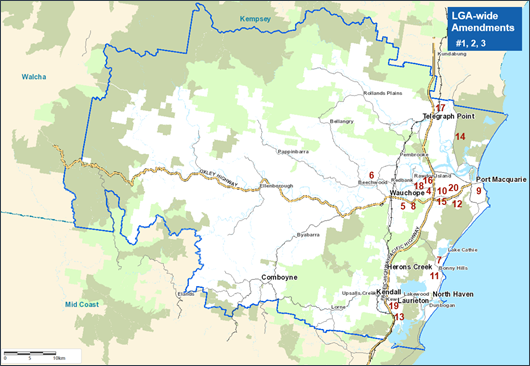
Figure 1: Location of Proposed Amendments
Housekeeping Amendments
A total of 20 housekeeping amendments are proposed to go forward. The amendments are divided into 4 categories:
1. Land Use Table Updates - 2 items
2. New or Updated Clauses - 2 items
3. Boundary Realignment or Rezoning - 15 items
4. Mapping Updates - 1 item
5. Council resolution 19 June 2025 - 2 Items (not progressing)
Each recommended amendment is minor in nature, administrative or corrective in intent, and does not materially alter the strategic direction of Council’s LEP. Collectively, they maintain statutory accuracy, improve usability, and ensure Council’s LEP remains current.
A summarised list of each proposed amendment is provided and grouped by theme. For a detailed explanation of each proposed amendment, refer to Attachment 1 - Planning Proposal.
Land Use Table Updates
|
Proposed Amendment 1: Amend the Land Use Tables for the R3 Medium Density Residential zone and R4 High Density Residential zone to prohibit dwelling houses and secondary dwellings. |
Rationale: Action 2b of Council’s Local Housing Delivery Plan requires Council to prohibit low density land including dwelling houses, dual occupancies and secondary dwellings in R3 Medium Density Residential and R4 High Density Residential zones. This amendment prevents underutilisation of medium and high-density zones by excluding detached and secondary dwellings, ensuring land is reserved for higher-yield housing. It aligns with Council’s Local Housing Delivery Plan by safeguarding strategic housing supply in well-serviced precincts. |
|
Item 2 - Permit ‘water recreation structures’ in the W1 Natural Waterways zone to support sustainable recreational fishing |
|
|
Proposed Amendment 2: Amend the Land Use Table for the W1 Natural Waterways zone to permit with consent a water recreation structure land use. |
Rationale: The W1 zones objectives include supporting sustainable recreational fishing, yet current controls prohibit essential supporting infrastructure. Allowing “water recreation structures” aligns permissible uses with zone objectives and removes inconsistency. This ensures safe and legal provision of facilities such as boat ramps and piers while protecting waterways through consent-based assessment. The change also harmonises Council’s controls with neighbouring LGAs, supporting regional consistency. |
Update or New Clauses
|
Item 3 - Amend Clause 4.1A - Exceptions to minimum lot sizes for certain residential development, to clarify the intent, allow subdivision with existing dwellings, and exclude the application of this clause in the R3 Medium Density Residential and R4 High Density Residential zones |
|
|
Proposed Amendment 3: Amend Clause 4.1A to explicitly support affordable housing, allow subdivision with existing dwellings, and exclude the R3 Medium Density Residential zone and R4 High Density Residential zone from its application. |
Rationale: The current wording of Clause 4.1A causes confusion with applicants and restricts practical application, limiting opportunities for affordable and diverse housing on smaller lots. Clarification will enable subdivision with existing dwellings while excluding R3 and R4 zones, reinforcing their higher-density function. |
|
Proposed Amendment 4: Insert Clause 5.26 - Visually sensitive land, to protect scenic quality, minimise visual impact, and ensure development is compatible with the surrounding landscape. |
Rationale: Visually sensitive land at Sancrox is mapped but lacks statutory assessment criteria, creating uncertainty for both applicants and assessors. Introducing Clause 5.26 provides clear objectives and controls to ensure new development minimises visual impacts, protects scenic corridors, and complements the surrounding landscape. |
Boundary Realignment or Rezoning
|
Item 5 - Realign zoning boundaries at 32 King Ridge, King Creek to match updated flood mapping and remove dual zoning through existing dwelling |
|
|
Proposed Amendment 5: Amend the Land Zoning Map - Sheet LZN_013B to realign the R5 Large Lot Residential zone boundary in accordance with updated Hastings River Flood Study Extension 2024 mapping and rezone affected land accordingly and amend the Lot Size Map - Sheet LSZ_013B to apply a 1.2ha minimum lot size to the R5-zoned portion of the site. |
Rationale: The current zoning boundary cuts through an existing dwelling and does not reflect the latest Hastings River Flood Study Extension 2024 flood data. Realignment ensures zoning aligns with evidence-based flood risk data, protecting flood-prone land while unlocking appropriate residential development. Applying a consistent 1.2ha minimum lot size standardises subdivision potential with surrounding R5 land. This correction improves planning certainty for the landowner and reduces risk associated with outdated mapping. |
|
Item 6 - Correct zoning anomalies in Beechwood by realigning zone boundaries with cadastral boundaries |
|
|
Proposed Amendment 6: Amend the Land Zoning Map - Sheet LZN_010A to align zoning boundaries with the updated cadastre boundaries and correct mapping discrepancies in Beechwood and update the NSW Spatial Viewer accordingly. |
Rationale: Multiple discrepancies exist in Beechwood where outdated mapping misaligns zones with cadastre, roads, and subdivision approvals. These include split-zoned lots, boundaries cutting through private land, and inappropriate conservation zoning over residential areas. Correcting the mapping ensures consistency between statutory instruments and actual land use. |
|
Item 7 - Correct zoning for 18 Summer Circuit, Lake Cathie from R3 Medium Density Residential to R1 General Residential |
|
|
Proposed Amendment 7: Amend the NSW Spatial Viewer to allocate Lot 1 DP1226839 as R1 General Residential zone. |
Rationale: A mismatch exists between Council’s statutory PDF zoning maps and the NSW Spatial Viewer, with Lot 1 incorrectly shown as R3 Medium Density Residential instead of R1 General Residential. This creates confusion for both landowners and developers about permissible uses. Updating the NSW Spatial Viewer restores accuracy and consistency across datasets. This correction ensures confidence in Council’s LEP as the definitive environmental planning instrument. |
|
Item 8 - Correct the RE1 Public Recreation zoning boundary at Sarahs Crescent, King Creek to align with actual lot boundary and recreation use |
|
|
Proposed Amendment 8: Amend the NSW Spatial Viewer to allocate the correct zone boundaries for Lot 93 DP0810033 as RE1 Public Recreation zone |
Rationale: The current zoning of Lot 93 incorrectly applies RE1 Public Recreation to adjoining land outside its actual boundaries. This misrepresentation risks confusion for landowners and undermines planning accuracy. Realigning the zoning to the true cadastral boundary ensures the area accurately reflects its intended recreation use. This amendment strengthens the integrity of statutory mapping and avoids unintended planning disputes. |
|
Item 9 - Rezone and include an additional permitted use at 154 Lord Street, Port Macquarie to enable the expansion of the Koala Hospital |
|
|
Proposed Amendment 9: Amend the Land Zoning Map - Sheet LZN_013G to rezone Lot 21 on DP1172308 from C1 National Parks and Nature Reserves zone to C2 Environmental Conservation zone and amend Schedule 1 - Additional Permitted Uses and Additional Permitted Uses Map - Sheet APU_013G to permit a veterinary hospital. |
Rationale: The Koala Hospital site was historically managed under a lease from NSW National Parks and Wildlife Service (NPWS) but is now subject to a land swap agreement transferring ownership to the Koala Conservation Australia Limited (KCAL). Rezoning from C1 National Parks and Nature Reserves zone to C2 Environmental Conservation zone with an Additional Permitted Use for a veterinary hospital facilitates the hospital’s ongoing function and future expansion. This approach balances environmental protection with delivery of critical wildlife care services. |
|
Item 10 - Rezone proposed Lot 92 and ancillary roads in Thrumster to match approved subdivision layout and satisfy DA2022/774 condition |
|
|
Proposed Amendment 10: Amend the Land Zoning Map - Sheet LZN_013D to rezone Lot 92 DP1292179 and ancillary roads from SP2 Infrastructure zone to IN1 General Industrial zone. |
Rationale: The SP2 Infrastructure zone zoning of a water quality basin at Thrumster extends unnecessarily over land intended for industrial use. This creates a conflict with the approved industrial subdivision layout and prevents registration of the final plan. Rezoning to IN1 General Industrial zone satisfies DA consent conditions, ensuring zoning matches the as-built stormwater infrastructure footprint. This enables orderly development and supports industrial land supply in the precinct. |
|
Item 11 - Rezone part of 49 Panorama Drive, Bonny Hills to implement a private Koala Plan of Management |
|
|
Proposed Amendment 11: Amend the Land Zoning Map - Sheet LZN_014B to rezone part of Lot 2 DP1050649 from RU1 Primary Production zone and R1 General Residential zone to C2 Environmental Conservation zone. |
Rationale: A Private Koala Plan of Management for the site identifies the western portion of the site as critical koala habitat requiring conservation. Rezoning this area to C2 Environmental Conservation zone ensures long-term habitat protection, consistent with State biodiversity policy. The eastern residential portion remains unaffected, allowing housing delivery while safeguarding ecological values. This outcome balances environmental and urban development objectives in accordance with a negotiated management plan. |
|
Item 12 - Rezone Lot 11 The Ruins Way, Port Macquarie for conservation purposes |
|
|
Proposed Amendment 12: Amend the Land Zoning Maps - Sheet LZN_013, Sheet LZN_013D and Sheet LZN_013G to rezone Lot 11 DP1284516 from C2 Environmental Conservation zone, R1 General Residential zone and RU1 Primary Production zone to C1 National Parks and Nature Reserves zone |
Rationale: NPWS purchased Lot 11 for conservation, but the land remains inconsistently zoned across three categories (R1 General Residential zone, C2 Environmental Conservation zone, RU1 Primary Production zone). This amendment rezones the site wholly to C1 National Parks and Nature Reserves, aligning statutory controls with land ownership and purpose. It eliminates conflicting zone objectives and ensures appropriate long-term management under NPWS. The correction resolves ambiguity and strengthens ecological protection. |
|
Item 13 - Swap zoning between TfNSW and NPWS parcels at Pacific Highway, Middle Brother to reflect ownership and intended use |
|
|
Proposed Amendment 13: Amend the Land Zoning Map - Sheet LZN_011 to rezone NPWS land to C1 National Parks and Nature Reserves zone and TfNSW land to SP2 Infrastructure zone. |
Rationale: A land swap between state agencies has not been completed leaving TfNSW road reserve land zoned C1 National Parks and Nature Reserves and NPWS land zoned SP2 Infrastructure zone. Rezoning these parcels ensures the sites have the appropriate zoning to fulfil their intended purpose. This correction addresses an administrative oversight and provides legal clarity for both TfNSW and NPWS. It also ensures conservation land is formally recognised and protected. |
|
Item 14 - Rezone multiple lots on Maria River Road, Limeburners Creek to facilitate planned road upgrades |
|
|
Proposed Amendment 14: Amend the Land Zoning Maps - Sheets LZN_012 and LZN_013C to rezone identified lots from C1 National Parks and Nature Reserves zone to RU1 Primary Production zone. |
Rationale: 28 small parcels within a road corridor remain zoned C1 National Parks and Nature Reserves, despite their intended use for future road upgrades. Retaining C1 zoning imposes unnecessary conservation restrictions that hinder infrastructure delivery. Rezoning to RU1 Primary Production corrects the oversight and enables roadworks without additional statutory hurdles. This amendment supports efficient project delivery and aligns zoning with long-term land function. |
|
Item 15 - Rezone part of Lot 3 on College Road, Thrumster to develop a district-level sporting facility |
|
|
Proposed Amendment 15: Amend the Land Zoning Map - Sheet LZN_013D to rezone part of Lot 3 DP1293093 from R1 General Residential zone to RE1 Public Recreation zone. |
Rationale: Under a Voluntary Planning Agreement negotiated by Council, an 8.3ha site is to be dedicated to Council for a district sporting facility, but the land is still zoned R1 General Residential. Rezoning to RE1 Public Recreation formally secures the land for recreation and ensures future development reflects its community purpose. This strengthens provision of public open space and social infrastructure in a fast-growing precinct. It also guarantees long-term public access and use of the facility. |
|
Item 16 - Rezone surplus TfNSW land at Pacific Highway, Sancrox for rural land use |
|
|
Proposed Amendment 16: Amend the Land Zoning Map - Sheet LZN_013C to rezone Lot 2 DP226821 from SP2 Infrastructure zone to RU1 Primary Production zone. |
Rationale: TfNSW has identified Lot 2 as surplus to infrastructure needs, but the land remains zoned SP2 Infrastructure zone. Rezoning to RU1 Primary Production ensures compatibility with adjoining rural lands and reflects its new long-term purpose. This amendment prevents unnecessary planning restrictions associated with infrastructure zoning. It allows the land to be managed productively while maintaining strategic consistency. |
|
Item 17 - Rezone surplus TfNSW land at Pacific Highway, Telegraph Point for rural land use |
|
|
Proposed Amendment 17: Amend the Land Zoning Map - Sheets LZN_012 and LZN_012A to rezone Lots 10 and 11 DP1300295 from SP2 Infrastructure zone to RU1 Primary Production zone. |
Rationale: 2 surplus lots at Telegraph Point are no longer required for transport infrastructure but remain zoned SP2 Infrastructure. Rezoning to RU1 Primary Production removes the redundant classification and returns the land to rural use. This correction supports orderly land management and eliminates regulatory constraints. It aligns statutory controls with the site’s intended long-term function. |
|
Item 18 - Rezone surplus TfNSW land at Glen Ewan Road, Sancrox for rural land use |
|
|
Proposed Amendment 18: Amend the Land Zoning Map - Sheet LZN_013C to rezone Lot 6 DP1300632 from SP2 Infrastructure zone to RU1 Primary Production zone. |
Rationale: This TfNSW site at Sancrox is surplus to needs but is still zoned SP2 Infrastructure. Rezoning to RU1 Primary Production ensures alignment with surrounding land and prevents inappropriate statutory restrictions. This change improves planning consistency and supports sustainable rural use. It also resolves an unnecessary anomaly in the zoning map. |
|
Item 19 - Realign zoning at Ocean Drive, Kew to match final design of reservoir access road |
|
|
Proposed Amendment 19: Amend the Land Zoning Map - Sheet LZN_011B to rezone part of Lot 100 DP1130726 from C2 Environmental Conservation zone to C3 Environmental Management zone, aligning the zoning boundary with the final design of the reservoir access road. |
Rationale: The zoning for the Kew reservoir access road reflects an outdated concept design. The final alignment falls partly within C2 Environmental Conservation zoning, creating inconsistency between intended land use and statutory mapping. Rezoning to C3 Environmental Management ensures the access corridor is properly recognised, consistent with its infrastructure function. This correction supports delivery of the reservoir while protecting surrounding conservation land. |
Mapping Updates
|
Item 20 - Remove erroneously mapped trees from the Additional Permitted Uses Map at Port Macquarie Airport |
|
|
Proposed Amendment 20: Amend the Additional Permitted Uses Map - Sheet APU_013D to remove individual marked trees to ensure mapping accuracy and protect environmentally sensitive land |
Rationale: Individual trees were mistakenly included in the Additional Permitted Uses Map, creating the impression that sewerage development could occur on ecologically significant land. Removing these features restores the original intent of the map, which was to apply only to infrastructure areas. This correction prevents misinterpretation and protects biodiversity assets near the airport. It ensures statutory mapping accuracy and reduces risk of unintended impacts. |
Withdrawn Amendments from the Scoping Proposal
The two amendments that Council resolved to be included in the Scoping Proposal at the Ordinary Council meeting held on 19 June 2025 relating to detached dual occupancies and secondary dwellings, have been withdrawn, following advice and discussions with the Department. These two amendments are as follows:
|
Permit detached Dual Occupancies in all rural zones (RU1, RU2, RU3, RU5, RU6), |
|
|
Item B - |
Amend Clause 5.5 (secondary dwellings in rural zones), including: · doubling the maximum floor area from 60m² to 120m², · increasing the ratio from 33% of the principal dwelling to 80%, and · extending the separation distance from 100m to 300m. |
On 22 July 2025, the Department issued formal advice to Council on each of the proposed amendments. Their advice for Items A and B is summarised below:
|
Item A - |
The Department’s position is that progressing this amendment is best dealt with after Council undertakes a Rural Lands Review, given the broad-reaching nature of the change. If Council chooses to proceed without a review, consultation with DPI - Agriculture is required prior to lodgement of any planning proposal. |
|
Item B - |
The Department confirmed that the proposed increase in floor area, ratio, and separation distance represents a substantial policy change. Given the scale of the amendment and its likely impacts on rural land supply, land use patterns, and servicing demands, the Department recommended this matter also be dealt with through a Rural Lands Review. If pursued without a review, consultation with DPI - Agriculture is required prior to lodgement of any planning proposal. |
Both amendments are substantive in nature and cannot be treated as housekeeping amendments, as the issues extend well beyond agricultural productivity and require a broader strategic approach. While DPI - Agriculture can provide advice on farming impacts such as productivity, land fragmentation, and biosecurity, their remit is limited to impacts to agriculture. A Planning Proposal must address a wider range of considerations including biodiversity, bushfire, flooding, coastal management, contamination, servicing, heritage, and transport and involve multiple specialist agencies. The Department’s advice therefore recommended that Items A and B be dealt with through a comprehensive Rural Lands Review, which can assess these broader land use, environmental, and infrastructure implications in an integrated way.
A Rural Lands Review enables a holistic assessment of rural land, considering infrastructure capacity, biodiversity, natural hazards, rural character, and settlement patterns. It provides a comprehensive evidence base through technical studies, mapping, and consultation, ensuring that any changes to Council’s LEP are robust, defensible, and able to withstand scrutiny at Gateway determination stage, during community consultation, and in potential legal challenges.
The Rural Lands Review would also ensure alignment with higher order strategic planning documents and environmental planning instruments such as the North Coast Regional Plan 2041, the Local Strategic Planning Statement (LSPS), Living and Place Strategy, and relevant State Environmental Planning Policies (SEPPs). This strategic consistency improves the likelihood of Departmental support, which cannot be guaranteed through agency-specific advice alone.
Importantly, rural dwelling provisions are politically sensitive and benefit from transparent, inclusive engagement. A Rural Lands Review provides a structured process for consultation with landowners, farming groups, and the broader community, building confidence that outcomes are fair, evidence-based, and locally informed.
While the Rural Lands Review involves higher upfront costs, it delivers long-term value by establishing a clear framework for rural land management over the next decade and beyond. This avoids the inefficiency and risks associated with piecemeal amendments and positions Council to manage rural land issues strategically and consistently into the future. A single, integrated review is ultimately more cost-effective and ensures that future decisions are consistent, strategically justified, and defensible.
The Department’s advice is acknowledged, and both amendments have been withdrawn to allow for suitable for progression of the housekeeping Planning Proposal. Council recognises that these matters raise complex questions of rural land management, including the balance between enabling multi-generational living and protecting the agricultural, environmental, and scenic values of rural land. Deferring these amendments to a comprehensive Rural Lands Review will ensure that any future changes are properly justified, strategically aligned, and capable of withstanding statutory and community scrutiny.
Rural Lands Review
A Rural Lands Review is not a single legislated process but rather a strategic planning exercise undertaken by Councils (sometimes in partnership with the Department) to take a holistic look at how rural land is zoned, managed, and planned for. It typically arises when incremental or ad hoc LEP amendments are considered insufficient, because rural land issues are complex and interrelated.
A Rural Lands Review needs to:
· assess existing rural zones and land uses to determine if they remain appropriate,
· balance competing objectives including agricultural productivity, environmental protection, settlement patterns, rural character, biodiversity, and hazard management,
· establish an evidence base through technical studies (e.g. biodiversity mapping, bushfire, flooding, infrastructure servicing, agricultural land capability, scenic values),
· resolve cumulative issues including fragmentation of rural land, right-to-farm conflicts, rural housing pressure, and the spread of lifestyle subdivision,
· align with higher-order planning policies, particularly the North Coast Regional Plan 2041, relevant Section 9.1 Local Planning Directions, and SEPPs.
While there is no defined legislative process for a Rural Lands Review, it typically involves:
1. A Scoping study - setting objectives, work program, project schedule and funding / resource requirements,
2. Technical investigations - land capability, hazards, biodiversity, servicing,
3. Stakeholder engagement - with State agencies, landowners, industry and the community,
4. Draft recommendations - zoning and LEP / Development Control Plan amendments, policy changes,
5. Integration - with Council’s strategic planning framework such as the LSPS,
6. Statutory outcomes - a Planning Proposal to amend Council’s LEP, supported by the review’s evidence base.
1. Technical studies and mapping:
· agricultural land capability and productivity assessments,
· biodiversity corridor mapping, threatened species surveys,
· bushfire and flood hazard modelling,
· infrastructure and servicing capacity studies,
· scenic landscape / character assessments.
These can each cost $50,000 - $150,000 depending on detail and scale.
2. Consultants and project management:
· Councils generally lack the specialised expertise and resources required to undertake this work internally, and therefore engage external planning consultancies to lead the review.
A large-scale rural lands review for a regional LGA may cost $250,000 - $500,000+ in consultant fees.
3. Community and stakeholder engagement:
· Workshops, surveys, meetings with State agencies and landowners.
Typically, $20,000 - $50,000, more if extensive consultation is required.
4. Internal resourcing:
· strategic planning staff time, GIS / mapping support, internal workshops,
Costs are often absorbed into existing budgets but still a significant workload.
A Rural Lands Review is a major undertaking, typically requiring $300,000 -$600,000 (ex GST) to complete. Costs are driven by specialist technical studies (agricultural land capability, biodiversity mapping, bushfire and flood hazard modelling, and infrastructure servicing), consultant fees, and extensive engagement with landowners, agencies, and the community. The project will also require dedicated Council resourcing and budget allocation.
This project is of significant scale and is not currently included in the Strategic Planning team’s forward work program due to limited resourcing. As the project is not currently funded or programmed, it will require detailed scoping, identification of funding sources, and potential reprioritisation of existing work should Council wish to progress this project in the future.
As detailed above, there has been a NSW Parliament Select Committee on Rural Housing and Secondary Dwelling Reform established. The terms of reference of the Select Committee were updated on the 27 August 2025 and they do reflect the key strategic considerations for Port Macquarie Hastings Council. The Terms of Reference for the committee report indicates at Item 2 that the committee report by the 13 February 2026.
Given the volume of work to study Secondary Dwellings on rural properties, it is considered prudent to review the outcomes of the Select Committee report, prior to considering reprioritisation of staff resources and funding for the Rural Lands Review. It is possible the outcome of the Select Committee will address the issue being considered or provide clarity or guidance on consistent and risk mitigated outcomes, as indicated in the Terms of Reference for the Select Committee.
3. Conclusion
The Planning Proposal provides a package of minor, corrective amendments to the Port Macquarie-Hastings LEP 2011. The changes are administrative in nature and seek to improve statutory accuracy, remove mapping anomalies, clarify land use controls, and ensure consistency with Council’s strategic planning framework.
Two proposed amendments have been withdrawn on the advice of the Department, with these matters to be more appropriately addressed through a future Rural Lands Review. This approach ensures that complex and strategically significant rural land issues are managed comprehensively, supported by technical studies and community consultation.
The Planning Proposal has been prepared in response to Council’s strategic planning responsibilities and has addressed all matters raised by the Department. It is consistent with legislative requirements and maintains the integrity of the Port Macquarie-Hastings LEP 2011 as the primary environmental planning instrument for the local government area.
It is recommended that Council endorse the Planning Proposal and forward it to the Department for Gateway determination, with a further report to be provided to Council following the statutory exhibition period.
Key Considerations
4. Financial and Economic Implications
The proposed amendments are administrative in nature and can be managed within existing Strategic Planning team’s operational budget. No direct financial contributions or fees are required from Council to progress the Planning Proposal through Gateway determination, public exhibition, and finalisation stages.
The amendments provide broader economic benefits by improving the statutory accuracy of Council’s LEP, reducing uncertainty for landowners and developers, and supporting delivery of housing, infrastructure, recreation, and environmental outcomes in line with Council’s strategic objectives.
The withdrawal of amendments relating to rural detached dual occupancies and secondary dwellings may result in future costs associated with undertaking a Rural Lands Review. Based on comparable reviews by other regional councils, this is estimated at $300,000 - $600,000 (ex GST), subject to scope and external consultancy requirements. This project is not currently funded or programmed.
5. Legislative and Policy Implications
The proposed amendments are consistent with the legislative requirements under the Environmental Planning and Assessment Act 1979 (EP&A Act), which governs the preparation and amendment of LEPs. The Planning Proposal represents the formal mechanism for progressing the housekeeping amendments in accordance with the Department’s LEP Making Guidelines (August 2023), including the requirement to obtain a Gateway determination and undertake public exhibition.
All proposed amendments have been developed to ensure consistency with relevant SEPPs and to address land use anomalies in a manner consistent with broader State and regional policy directions, including the North Coast Regional Plan 2041. The refinements, such as updated subdivision provisions, clarified housing controls, and the introduction of assessment criteria for visually sensitive land, strengthen the operational effectiveness of Council’s LEP and support Council’s capacity to deliver sustainable growth, housing diversity, and environmental protection.
6. Strategic Context and Implications
Planning Proposals are assessed in accordance with the strategic planning framework of NSW which includes both State and local legislative requirements, strategies and planning controls.
This strategic planning framework establishes the vision for NSW into the future with alignment between planning priorities identified at a state, regional or district level with finer-grained placed-based planning at the local level.
The framework sets out the principles and outcomes for meeting the needs of communities and the environment now and plans for the needs of the future. It enables communities to assess the broader implications and consequences of identifying locations for growth and change.
Alignment across state and local strategic planning sets up a streamlined process for amending LEPs by having planning matters resolved early and setting a clear sequence, and greater confidence for all parties, for how communities will grow and change over time.
7. Risk and Insurance Implications
The proposed housekeeping amendments are administrative in nature and carry low risk to Council. The amendments correct anomalies, clarify provisions, and align mapping with current land use, thereby reducing the likelihood of misinterpretation, planning disputes, or legal challenge. Endorsement of the Planning Proposal ensures statutory compliance with the EP&A Act and strengthens the defensibility of Council’s LEP.
The greater risk lies in not progressing the amendments. Failure to address known discrepancies may undermine confidence in Council’s strategic planning framework, create uncertainty for landowners and developers, and expose Council to reputational and legal risks if decisions are made based on inaccurate or outdated statutory mapping.
Two proposed amendments relating to rural land have been withdrawn on the advice of the Department and should instead be considered through a comprehensive Rural Lands Review. This approach mitigates the risk of progressing changes that are beyond the scope of a housekeeping amendment and ensures that any future policy shifts are supported by a robust evidence base and community engagement.
8. Engagement and Consultation
The proposed amendments have been informed by engagement with internal stakeholders, including Council’s Development Assessment, GIS and Project Delivery teams, to ensure operational issues and implementation challenges within the current Council LEP were identified and addressed. Input was also sought from landowners, State agencies, and through formal resolutions of Council.
As part of the Scoping Proposal process, Council referred the draft amendments to the Department for advice. The Department’s feedback, issued on 22 July 2025 (Attachment 2), supported progression of the amendments, subject to demonstrating consistency with Local Planning Directions, addressing potential constraints, and ensuring targeted consultation with relevant State agencies. All matters raised have been incorporated into the Planning Proposal.
Should Council endorse the Planning Proposal, the next stage will involve referral to the Department for Gateway determination, followed by a period of public exhibition in accordance with the EP&A Act. During exhibition, landowners, State agencies, and the broader community will be invited to make submissions. A further report will then be presented to Council summarising feedback received and recommending any changes prior to finalisation.
9. Civic Leadership
From an Environmental, Social, and Corporate Governance (ESG) perspective, the amendments support improved housing diversity, protection of ecological values, more efficient infrastructure planning, and better alignment of land use with strategic outcomes. Collectively, the Planning Proposal strengthens the integrity of Council’s strategic planning framework and supports sustainable, place-based development outcomes.
Options
Council may choose to:
1. Endorse the Council-initiated Planning Proposal as recommended or
2. Seek further information or amendments to the draft Planning Proposal prior to referral to the NSW Department of Planning, Housing and Infrastructure or
3. Not endorse the Council-initiated Planning Proposal.
|
Attachments 1. 2. |
Agenda Community Planning and Environment
Subject: Draft Community Inclusion Plan and Disability Inclusion Action Plan 2025-2029
Presented by: Community, Planning and Environment, Melissa Watkins
That Council:
1. Endorse the draft Port Macquarie-Hastings Community Inclusion Plan and Disability Inclusion Action Plan 2025-2029 for public exhibition for a period of at least 28 days.
2. Note that a further report will be presented to Council for consideration following conclusion of the public exhibition.
Executive Summary
The draft Community Inclusion Plan (CIP) 2025–2029 (Attachment 1), builds on the 2022–2025 Plan (which is available on Council’s website) and provides a strategic framework for growing a more welcoming, accessible, inclusive, and resilient region.
The draft Plan embeds the legislatively required Disability Inclusion Action Plan (DIAP), incorporates new actions on Domestic, Family and Sexual Violence (DFSV) in line with Council’s resolution of 15 May 2025 (Ordinary Council Meeting, Item 11.01), and reflects themes and needs identified through extensive community engagement. It sets out clear focus areas and measurable actions, aligned with Council’s Community Strategic Plan and Delivery Program.
Building an inclusive community is a shared responsibility, with Council playing a vital role. Beyond being a legislative requirement, it is a strategic priority that delivers better services, stronger communities, and more effective civic participation. This draft Plan reflects national and state priorities, together with community aspirations, and shows how local government can lead meaningful change.
This report recommends that Council endorse the draft Plan for the purpose of public exhibition and note that a further report will be presented to Council for consideration following the exhibition period.
Report
1. Background
Council’s previous Community Inclusion Plan 2022–2025 which is available on Council’s website, provided a framework to build a region that is welcoming, accessible, inclusive, and resilient. It delivered outcomes such as community events and grants, partnerships with Birpai and Bunyah Local Aboriginal Land councils and other local networks, accessibility upgrades, disaster preparedness programs, and internal initiatives to embed inclusion across Council.
The new draft CIP builds on these foundations while responding to emerging needs identified through extensive community engagement, legislative requirements, and past Council resolutions.
Specifically, at the Ordinary Council Meeting on 15 May 2025 (Item 11.01), Council resolved to:
1. Note the petition lodged by Leonie McGuire on behalf of the community.
2. Include within the draft Community Inclusion Plan a section on how Council can better support prevention and response to domestic and family violence.
3. Request the Acting Chief Executive Officer to develop a draft Domestic Violence Policy to be presented to Council at the August 2025 Ordinary Council Meeting.
4. Respond to the organiser of the petition with the outcome of Council’s consideration in this matter.
5. Request the Acting Chief Executive Officer to allocate funding from the COVID-19 relief measures reserve to fund this policy development.
The draft CIP responds to item 2 of this resolution by embedding actions addressing primary prevention of domestic and family violence (referenced in this report as domestic, family and sexual violence, to align with current sector terminology) across Council’s roles as an employer, service provider, community leader, and partner. Item 3 is being progressed separately through a draft Domestic, Family and Sexual Violence (DFSV) Policy that is presented separately to Council.
Further, at the Ordinary Council Meeting on 19 June 2025 (Item 13.04), Council resolved:
That Council endorse the themes outlined in the report to be incorporated into the development of the new Cultural and Community Inclusion Plans.
The draft CIP also responds to this resolution by incorporating the endorsed engagement themes, ensuring inclusion is shaped by lived experience and reflects the voices of under-represented groups across our community.
The draft CIP also continues to embed Council’s Disability Inclusion Action Plan (DIAP), as required under the NSW Disability Inclusion Act 2014, and has been developed in line with guidelines issued by the NSW Department of Communities and Justice.
1. Discussion
Community inclusion is central to creating a liveable, sustainable, and innovative region where everyone can take part, feel safe, and belong. Inclusion is everyone’s responsibility, shared by individuals, families, organisations and all levels of government. Council, as the level of government closest to everyday life, has a critical role in shaping how community members access public spaces and services, and how they participate in decisions that affect them.
The draft Plan reflects Council’s commitment to:
· Embedding inclusion across policies, planning, services, and infrastructure.
· Meeting legislative requirements under the NSW Disability Inclusion Act 2014 and obligations under the Local Government Act 1993.
· Incorporating new actions on the primary prevention of DFSV, as directed by Council’s resolution.
· Embedding community voice through ongoing consultation and collaboration.
Together, these elements ensure the draft CIP supports the Community Strategic Plan, particularly Outcome 2: ‘We are a safe, inclusive and vibrant region, with an active, healthy and connected community.’
How the draft CIP is structured
The draft Plan has been shaped around clear design principles and structured to provide accountability and measurable outcomes as follows:
· Guiding model – defined through community consultation, reflecting the importance of safety, belonging, and wellbeing.
· Underlying principles – grounded in equity, access, participation, and rights; ensuring barriers are removed, the right to self-determination is acknowledged, intersectionality is considered, lived experience is centred, community strengths are built, and continuous improvement is visible.
· Focus Areas – five key areas that translate the model and principles into clear goals and objectives, with approaches included to guide action.
· Action Plan – concrete steps for delivery, linked to roles, timeframes, measures, and community partners. It aligns with the Plan’s objectives and Council’s Delivery Program and is reviewed annually to track accountability and progress.
Focus Areas
The draft Plan identifies five Focus Areas, each with a clear goal as follows:
1. Welcoming and Affirming – Ensure people feel safe, respected, included, and able to be themselves in community life.
2. Accessible and Liveable – Promote environments that are accessible, usable and enhance everyday safety, participation, and wellbeing.
3. Resilient and Prepared – Work alongside communities to strengthen their ability to prepare for, respond to and recover from disruption and adversity.
4. Visible and Represented – Ensure the diversity of our community is visible, heard and reflected in leadership, civic life, decision-making, and employment.
5. Evaluating and Evolving – Use insights, evidence and reflection to strengthen what we do and how we do it.
Each Focus Area is in turn supported by a goal, objectives, approaches and success measures.
Meeting DIAP requirements
The draft CIP embeds Council’s DIAP, required under the NSW Disability Inclusion Act 2014, with each Focus Area linked to DIAP outcome areas. Progress is reported annually to the Department of Communities and Justice to meet legislative requirements and demonstrate Council’s accountability.
Council’s role in DFSV
The draft CIP positions safety as central to inclusion and, in line with Council’s resolution, embeds actions including primary prevention of DFSV. Delivery on actions will align with Council’s proposed draft DFSV Policy, guiding safe, and ethical practices. The proposed draft DFSV Policy is the subject of a separate report on the September 2025 Council meeting agenda.
2. Conclusion
The draft Community Inclusion Plan (CIP) provides Council with a clear and practical framework to strengthen inclusion, connection, and belonging across the Port Macquarie-Hastings region. Grounded in community insights and lived experience, the Plan embeds Council’s legislative obligations, including those under the Disability Inclusion Action Plan (DIAP), and aligns with the Community Strategic Plan and the Delivery Program.
It incorporates new and important actions, such as the primary prevention of domestic, family and sexual violence, while also addressing broader priorities that support dignity, respect, and wellbeing for all. Through measurable actions, partnerships, and annual reporting, the draft CIP sets out how Council will contribute in practical ways to building a safe, inclusive, and vibrant community where people feel actively connected and engaged.
Beyond meeting legislative requirements, the CIP positions inclusion as a priority that delivers better services, stronger communities, and more effective civic participation. It reflects national and state priorities alongside local aspirations and demonstrates how local government can play a leading role in creating meaningful, positive change.
Council’s community outcomes remain clear: We are a safe, inclusive and vibrant region, with an active, healthy and connected community.
Key Considerations
3. Financial and Economic Implications
If, following public exhibition, the Community Inclusion Plan (CIP) is adopted, Council will consider resources to support implementation through future annual budget/Operational Plan process.
The CIP does not have a dedicated budget allocation. Delivery will rely primarily on existing staff time and capacity to integrate actions into current programs and services. Many actions are designed to strengthen inclusion within Council’s existing responsibilities and can be progressed through staff-led initiatives, reporting, and partnership development.
Due to funding limitations, for the past 16 months, delivery of actions has been largely dependent on external grant funding. While this has enabled some outcomes, reliance on grants alone is not sustainable and presents risks to consistency.
Where new or expanded initiatives are proposed, Council will need to prioritise these through the annual budget process or continue to seek external funding. In the short term, staff capacity will ensure the Plan is coordinated and monitored, but dedicated funding would strengthen Council’s ability to deliver outcomes in a consistent and impactful way.
4. Legislative and Policy Implications
The draft Community Inclusion Plan (CIP) 2025–2029 embeds Council’s Disability Inclusion Action Plan (DIAP), which is a legislative requirement under the NSW Disability Inclusion Act 2014. Progress against DIAP outcomes must be reported annually to the NSW Department of Communities and Justice, ensuring compliance with statutory obligations.
Actions relating to Domestic, Family and Sexual Violence (DFSV) are informed by Council’s May 2025 resolution and are contingent on the adoption of the separate draft DFSV Policy, which is also being considered at the September Ordinary Council Meeting. Embedding these actions in the draft Plan provides alignment with the NSW Pathways to Prevention Framework and reinforces Council’s role in primary prevention, while maintaining legislative and policy consistency.
The draft CIP also aligns with Council’s Community Strategic Plan and broader policy framework, ensuring a coordinated approach across inclusion, equity, and community wellbeing priorities.
5. Strategic Context and Implications
Actions under the draft Community Inclusion Plan (CIP) 2025–2029 are mapped directly to key deliverables within Council’s Delivery Program 2025–2029, as outlined in the Action Plan section of the document. This ensures the Plan is embedded in Council’s broader Integrated Planning and Reporting (IP&R) framework and directly contributes to achieving the outcomes of the Community Strategic Plan.
The CIP also strengthens alignment with other key strategies and policies, including the Disability Inclusion Action Plan, the draft Domestic, Family and Sexual Violence Policy, and Council’s broader engagement, recreation, cultural, and social strategies. In doing so, the CIP acts as a unifying framework that connects inclusion outcomes with Council’s operational and strategic priorities.
By positioning inclusion as a theme across Council’s service delivery, the draft Plan ensures that actions are not siloed, but instead contribute to organisational priorities in practical ways such as liveability, wellbeing, and equity. This alignment maximises the impact of limited resources and reinforces Council’s role as a leader in building a safe, inclusive, and connected community.
6. Risk and Insurance Implications
If the draft Community Inclusion Plan 2025–2029 is not adopted, Council can continue to deliver inclusion initiatives, but without a strategic framework the work would be less coordinated, harder to measure, and less transparent. This creates several organisational risks:
· Legislative compliance: Reduced ability to demonstrate compliance with the NSW Disability Inclusion Act 2014.
· Governance and accountability: Weaker transparency for both Council and the community around inclusion outcomes.
· Reputational: Failing to progress actions developed through extensive engagement and endorsed community themes could erode trust in Council’s leadership and commitment to inclusion.
· Safety and wellbeing: Some actions, including those relating to prevention initiatives, require clear frameworks to ensure they are delivered safely, responsibly, and in line with best practice.
The adoption of the draft Plan helps mitigate these risks by providing a clear, consistent, and accountable framework for Council’s inclusion work.
7. Engagement and Consultation
A comprehensive engagement program was conducted from January- May 2025 and includes data from a creatives sector survey from May-June 2024. Specifically, the engagement program included:
· A total of over 250 respondents across all community engagement surveys
· High representation from Aboriginal and Torres Strait Islander peoples (11%)
· 81 young people completed the youth survey
· 47 creatives completed the Mapping the creative landscape survey
· 35 seniors responded to a seniors’ survey during Seniors Week
· nearly 30% of respondents identified as coming from a culturally diverse background
A full engagement report is available in Attachment 2.
Additionally, the following stakeholders were consulted with in the development of this Plan:
· Internal teams including People, Safety and Performance, Libraries, the Glasshouse, Spaces and Places
· Dementia Friendly Community Alliance
· Liberty Domestic and Family Violence Specialist Services
· LGNSW - DFSV Project Manager
Council staff also completed LGNSW’s “Domestic Violence - Councils are a part of the solution” online training.
If the draft Plan is adopted, it will be the subject of further engagement during the public exhibition period. Any feedback received with be considered and where appropriate amendments to the Plan will be made for Council’s further consideration.
8. Civic Leadership
Community inclusion is a cornerstone of Council’s civic leadership, reflecting its responsibility to represent and serve the full diversity of its population. By embedding inclusion into policies, planning, and decision-making, Council demonstrates leadership that is fair, transparent, and accountable.
Strong civic leadership in this space builds trust, strengthens community cohesion, and supports better outcomes in health, wellbeing, and participation. It also positions Council as a role model for equity and respect, showing that local government can actively shape a region where all residents feel welcomed, valued, and empowered to contribute.
The adoption of the Community Inclusion Plan confirms Council’s commitment to lead with fairness and integrity, and to champion a vision of Port Macquarie-Hastings as a safe, inclusive, and vibrant community for all.
Options
Council may choose to:
1. Endorse the draft Community Inclusion Plan 2025-2029 for public exhibition as recommended or
2. Seek additional information or amendments to the draft Plan prior to public exhibition or
3. Not endorse the draft Plan
|
Attachments 1. 2.
|
Agenda Community Planning and Environment
Subject: Draft Community Engagement Policy - Post Public Exhibition
Presented by: Community, Planning and Environment, Melissa Watkins
That Council:
1. Note the outcomes of the public exhibition of the draft Community Engagement Policy.
2. Adopt the Community Engagement Policy
3. Thank people who made submissions and advise of the outcome of Council’s consideration.
Executive Summary
A draft Community Engagement Policy was presented to the June Ordinary Council Meeting (Item 13.02) and Council resolved as follows:
That Council:
1. Note the information contained within this report relating to the review of the Community Engagement Policy.
2. Endorse the updated Community Engagement Policy for public exhibition for a period of not less than 28 days.
3. Note that Council will receive a further report at future Ordinary Council meeting outlining community feedback received during the public exhibition period.
The draft Community Engagement Policy (Attachment 1) was publicly exhibited between 18 July and 18 August 2025 as part of a suite of documents including the draft Community Engagement Strategy and the Committee Fact Sheet, this was called “Have your say on Community Engagement”.
No changes were required to be made as a direct result of engagement feedback. One amendment has been made since exhibition to improve alignment with legislative requirements, namely the addition of a reference to the New South Wales (NSW) Government Integrated Planning and Reporting Guidelines (2021) as part of the External Related Documents section.
This report now recommends that the Community Engagement Policy (Attachment 2) be adopted.
Report
1. Background
The current Community Engagement Policy (available on Council’s website), adopted by Council in 2022, has provided the framework for how Council engages with its community over the past three years. This Policy guided practice and decision-making, ensuring that Council’s engagement activities meet legislative requirements and support transparency, accountability, and meaningful participation.
Since that time, Council has progressed the development of an overarching draft Community Engagement Strategy, which provides a more comprehensive and contemporary framework for engagement. The draft Community Engagement Strategy is the subject of a separate report on the September Council meeting agenda.
The draft Strategy has been designed to align with all relevant legislative obligations, including those set out under the Integrated Planning and Reporting (IP&R) Framework and the Environmental Planning and Assessment (EP&A) Act, while also reflecting best practice principles and feedback from both Councillors and the community.
To ensure consistency, a review of the 2022 Community Engagement Policy has now been undertaken alongside development of the new comprehensive Community Engagement Strategy. This review ensures that the Policy:
· Aligns with the strategic direction and intent of the Draft Community Engagement Strategy.
· Provides a clear policy foundation for the organisation’s engagement activities.
· Removes duplication or ambiguity in roles, responsibilities, and processes.
The revised Policy therefore meets a legislative requirement and provides an opportunity to strengthen Council’s overall engagement approach, supporting the delivery of high-quality, consistent, and coordinated engagement across all areas of Council activity.
2. Discussion
The review of the Community Engagement Policy provided an opportunity to refine and clarify the roles, responsibilities, and expectations of Council in undertaking effective and inclusive community engagement.
The updated Policy is designed to:
· Reinforce Council’s commitment to engagement that is transparent, inclusive, and consistent with both statutory obligations and best practice.
· Strengthen alignment with the draft Community Engagement Strategy, ensuring that Council’s day-to-day engagement practices support the broader strategic direction.
· Provide clarity and confidence to staff, Councillors, and the community about how engagement will be planned, delivered, and reported.
· Support accountability, by clearly defining the standards and principles against which engagement activities can be measured and evaluated.
The draft Policy was placed on public exhibition during 18 July–18 August 2025. The engagement included:
· A dedicated Have Your Say (HYS) page, which received 392 visitors, 33 downloads of the draft Policy, and 11 submissions specifically relating to the Policy.
· Five community pop-ups, including targeted sessions with youth and seniors.
· Online and written submissions, with all feedback captured in the Community Engagement Report (Attachment 3).
There were 10 submissions received through the engagement period. No changes were required to be made as a direct result of engagement feedback. One amendment has been made since exhibition to improve alignment with legislative requirements, namely the addition of a reference to the New South Wales (NSW) Government Integrated Planning and Reporting Guidelines (2021) as part of the External Related Documents section.
By updating the Policy alongside the Strategy, Council can ensure that its approach is cohesive, consistent, and fit-for-purpose, reducing the risk of duplication, confusion, or misalignment across different areas of the organisation. This will ultimately improve the quality of engagement, support better decision-making, and strengthen trust between Council and the community.
3. Conclusion
The updated Community Engagement Policy strengthens Council’s commitment to transparent, inclusive, and consistent engagement. By aligning with the draft Strategy and statutory requirements, the Policy provides clear guidance for staff, Councillors, and the community, ensuring that engagement is purposeful, coordinated, and trusted.
Key Considerations
4. Financial and Economic Implications
There are no financial or economic implications arising from this report
5. Legislative and Policy Implications
This revised Policy, if adopted, would replace Council’s 2022 Community Engagement Policy. It has been updated to ensure alignment with Council’s legislative obligations under the Integrated Planning and Reporting (IPR) Framework and the Environmental Planning and Assessment (EP&A) Act. The Policy also reflects the draft Community Engagement Strategy and incorporates reference to the NSW Government Integrated Planning and Reporting Guidelines (2021) as an external related document.
6. Strategic Context and Implications
Council is committed to delivering consistent, transparent, and effective community engagement that builds trust and supports informed decision-making. The Community Engagement Policy underpins this commitment by providing a clear framework for how engagement is planned and delivered.
The Policy aligns with the strategic objectives outlined in the draft Community Engagement Strategy and supports the broader goals of Council’s Integrated Planning and Reporting framework. It ensures that community engagement remains a central element in shaping Council’s policies, projects, and services, and reinforces Council’s commitment to being open, accountable, and connected with the community.
7. Risk and Insurance Implications
Without a current and clearly defined Policy, there is a risk of inconsistent engagement practices across the organisation, which may result in reduced community trust, misaligned expectations, or non-compliance with legislative requirements.
The revised Policy mitigates this risk by providing a clear, consistent, and organisation-wide framework that supports compliance, strengthens transparency, and ensures a uniform standard of engagement. This approach reduces reputational, governance, and operational risks while reinforcing Council’s commitment to best practice.
8. Engagement and Consultation
Community engagement on the Policy was undertaken as part of a broader consultation package titled “Have Your Say on Community Engagement”, which combined the draft Community Engagement Policy and the draft Community Engagement Strategy.
As outlined above, the engagement included:
· A dedicated Have Your Say (HYS) page, which received 392 visitors, 33 downloads of the draft Policy, and 11 submissions specifically relating to the Policy.
· Five community pop-ups, including targeted sessions with youth and seniors.
· Online and written submissions, with all feedback captured in the Community Engagement Report (Attachment 3).
There were 10 submissions received the engagement period. Community feedback on the Draft Community Engagement Policy was largely positive, with many acknowledging it as an important step in strengthening Council’s connection with the community. Respondents welcomed the recognition of families as a stakeholder group and encouraged Council to adopt structured, ongoing engagement processes that move beyond ad-hoc consultation. There was strong support for broadening engagement in areas such as environment, biodiversity, climate change, and transport, with calls to draw more actively on local expertise and community groups.
Suggestions to strengthen the Policy included improving communication channels, particularly through social media and approaches tailored to different age groups, as well as enhancing transparency and two-way communication. Overall, the feedback shows clear support for the direction of the Policy, with constructive recommendations to ensure it is implemented in a meaningful, consistent, and inclusive way.
The feedback received did not result in substantive changes to the Policy, except for including reference to the NSW Government Integrated Planning and Reporting Guidelines (2021) under external related documents.
9. Civic Leadership
Reviewing and updating the Community Engagement Policy demonstrates Council’s commitment to strong civic leadership and accountable governance. The revised Policy ensures that engagement practices remain contemporary, transparent, and inclusive. Importantly, it reinforces Council’s role in enabling the community to have a meaningful voice in decision-making, building trust and confidence in how Council delivers for its community.
Options
Council has the following options available:
1. Adopt the Community Engagement Policy as recommended or
2. Seek additional information about the Community Engagement Policy or
3. Not adopt the Policy.
|
Attachments 1. 2. 3.
|
Agenda Community Planning and Environment
Subject: Draft Community Engagement Strategy - Post Public Exhibition
Presented by: Community, Planning and Environment, Melissa Watkins
That Council:
1. Note the outcomes of the public exhibition of the draft Community Engagement Strategy.
2. Adopt the Community Engagement Strategy.
3. Formally thank those who made submissions and advise them of Council’s decision on this matter.
Executive Summary
Council is committed to fostering a culture of meaningful engagement that delivers sustainable and inclusive outcomes for the community.
The draft Community Engagement Strategy (CES) has been revised following extensive consultation with both community members and Councillors. The updated CES provides a clear and practical framework to engage with a wide range of voices, including all residents, businesses, and stakeholders, in a consistent, meaningful, and measurable way.
If adopted the Strategy will guide how Council designs and delivers engagement activities, making it easier for the community to have a say on issues that matter most. It sets out the principles, processes, and tools required to embed best-practice engagement across the organisation, in line with legislative requirements.
Under Section 420A of the NSW Local Government Act 1993, councils are required to establish and implement a Community Engagement Strategy to guide the development of all plans, policies, and strategies.
This report recommends that Council adopt the Community Engagement Strategy (Attachment 3).
Report
1. Background
The draft Community Engagement Strategy was first presented to Councillors at a briefing on 5 December 2024. At that session, it was proposed that an interim Integrated Planning and Reporting (IP&R) Engagement Strategy be developed to support the upcoming IP&R public exhibition and help inform the final draft Strategy.
The draft Community Engagement Strategy and Engagement Plan were then presented to the Ordinary Council Meeting of 20 March 2025 (Item 11.06), where Council resolved as follows:
“That Council:
1. Note the draft Community Engagement Strategy and the proposed Engagement Plan to support the public exhibition of the draft Community Engagement Strategy.
2. Request the Chief Executive officer review the proposed Engagement Plan for the specific proposed public exhibition, to provide greater detail about the specific targeted engagement activities planned for groups that have been identified as underrepresented in past Council Engagements.
3. Request that the revised engagement plan in point 2 also include a document to be exhibited alongside the draft Community Engagement Strategy, which lists the underrepresented stakeholders, and a more comprehensive range of example target methods that are used or maybe used in future engagement plans to engage each of those groups.
4. Request that Councillors receive a briefing before the Engagement Plan is finalised and the draft Community Engagement Strategy is presented to Council.
5. Receive a further report to the May 2025 Ordinary Meeting of Council”.
Following this resolution, additional work was undertaken to meet these requirements, and Councillors were briefed again in May 2025.
An updated draft Community Engagement Strategy (Attachment 1) was then presented to the June 2025 Ordinary Meeting of Council (Item 13.01), where Council resolved as follows:
“That Council:
1. Endorse the draft Community Engagement Strategy (Attachment 1) for the purpose of public exhibition.
2. Endorse the proposed Engagement Plan to support the public exhibition of the draft Strategy as included as Attachment 3 subject to the following: a) The inclusion of an additional key message on "How do you want Council to engage with you?" b) The inclusion of a specific question seeking community views on the use of committees as a means of consulting and collaborating on important planning, policy and strategic matters of Council. c) The preparation and inclusion in the exhibition material, of a Fact Sheet to assist with informing responses to the question identified in b), based on the information contained in Item 11.11 Review of Disbanded Council Committees from the June 2025 Ordinary Council meeting agenda.
3. Place the Community Engagement Strategy on public exhibition for a period of not less than 28 days.
2. Discussion
Councils across NSW are required to maintain a robust Community Engagement Strategy (CES) to ensure transparency, inclusivity, and meaningful community participation in decision-making. Port Macquarie-Hastings Council’s current Engagement Strategy, adopted in 2022, has guided our approach to date. The new CES was developed to align with all legislative obligations, including the Integrated Planning and Reporting (IP&R) Framework and the Environmental Planning and Assessment (EPA) Act, while also incorporating insights gained through engagement activities over the past three years. If adopted, it will replace both the interim IP&R Engagement Strategy and the existing 2022 Strategy, providing a more structured and community-focused approach across all areas of Council.
The CES outlines a clear and consistent framework for how Council engages with the community, businesses, and stakeholders. It reinforces Council’s commitment to genuine and meaningful engagement that builds trust, fosters collaboration, and ensures our community has a voice in shaping the region’s future. The Draft Engagement Strategy (Attachment 1) was exhibited between the 18 July and the 18 August.
Engagement
Outcomes
Community engagement on the draft CES
was undertaken between July and August 2025, alongside the Community Engagement
Policy.
· The Have Your Say page received 392 visitors, with 109 downloads of the draft CES.
· 22 surveys were completed and 4 formal submissions were received by email.
· The Fact Sheet on the use of committees was downloaded 56 times, with 16 community members providing supportive feedback on the questions raised.
· In addition, five community pop-ups were undertaken during this period, including targeted sessions with youth and seniors.
For additional information the full engagement reports is provided as Attachment 2.
As Council has been consistently engaging with the community over the past three years, there was limited new feedback that required changes to the draft CES. The minimal changes that were made include:
· Grammatical improvements.
· Changing the term “consultation” to “engagement.”
· Updating “equal” to “equitable.”
· Adding context on the interface between Engagement, Communications, and Education activities.
· Adding further context on the Integrated Planning and Reporting Framework.
· Including “Stakeholders” in the Roles and Responsibilities section.
The updated CES incorporates these refinements and provides practical guidance on how Council will deliver accessible, inclusive, and transparent engagement into the future.
3. Conclusion
The Community Engagement Strategy (Attachment 3) provides Council with a clear, practical, and legislatively compliant framework to guide engagement. It reflects both community and Councillor feedback, with minimal changes required following consultation, and reinforces Council’s commitment to inclusive, transparent, and equitable engagement. Adoption of the Strategy will strengthen trust, ensure consistency, and support more meaningful participation in Council decision-making.
Key Considerations
4. Financial and Economic Implications
The implementation of the Community Engagement Strategy if adopted will be managed within Council’s existing operational budgets. The focus will be on maximising current resources and improving efficiency to strengthen engagement outcomes.
This includes:
· Continuing to use existing platforms such as Have Your Say (HYS) and reviewing options for future growth as part of ongoing service improvement.
· Prioritising staff training and internal capability building to embed best practice engagement across the organisation.
· Leveraging existing communication channels, events, and networks to extend reach without significant additional expenditure.
· Embedding engagement planning into project budgets to ensure appropriate costs are identified and resourced at the project level.
By focusing on smarter use of current resources and embedding engagement into project planning, Council can deliver stronger community outcomes without requiring additional organisational funds. Importantly, these efforts also help deliver long-term benefits by strengthening trust, reducing project delays caused by dissatisfaction, and ensuring that Council’s decisions better align with community expectations and priorities.
5. Legislative and Policy Implications
Should Council adopt the Community Engagement Strategy, the existing Community Participation Plan will be replaced, as its requirements are incorporated into the Strategy. This approach is consistent with the resolution of Council in March 2025 and ensures compliance with the Integrated Planning and Reporting (IP&R) Framework and the Environmental Planning and Assessment Act.
6. Strategic Context and Implications
The Community Engagement Strategy (CES) is a core strategic document that underpins how Council connects with the community and delivers on its broader objectives. It directly supports the implementation of the Integrated Planning and Reporting (IP&R) Framework by embedding consistent and transparent engagement practices into the development of all Council plans, policies, and strategies.
The CES also aligns with Council’s adopted Community Strategic Plan, Imagine2050, by ensuring that engagement processes reflect the community’s aspirations for an inclusive, connected, and resilient region. By formalising how Council engages, the Strategy strengthens trust and accountability, ensures diverse voices are heard, and supports evidence-based decision-making.
In addition, the CES provides a foundation for continuous improvement in engagement, guiding Council’s approach to projects, service delivery, and place-based planning in a way that is consistent, equitable, and responsive to community needs.
7. Risk and Insurance Implications
Without a clear and consistent Community Engagement Strategy, there is a risk of inconsistent practices, low levels of public participation, and potential reputational damage to Council. This could result in community dissatisfaction, reduced trust, and challenges in progressing projects if stakeholders feel they have not been adequately engaged.
The new Community Engagement Strategy mitigates these risks by setting out clear principles, methods, and responsibilities for engagement. By embedding transparent, inclusive, and consistent practices across the organisation, the Strategy strengthens Council’s ability to manage stakeholder expectations, reduce conflict, and demonstrate accountability.
8. Engagement and Consultation
External Consultation
Community engagement on the draft Community Engagement Strategy (CES) was
undertaken as part of the broader “Have Your Say on Community
Engagement” campaign. This included both the draft CES and the draft
Community Engagement Policy, exhibited together for 28 days between 18 July and
18 August 2025.
In line with the June 2025 Council resolution, a dedicated fact sheet and survey question were included, seeking community views on the potential role of committees as a way to consult and collaborate on key planning, policy, and strategic matters.
Key engagement outcomes included:
· 392 visitors to the Have Your Say page.
· 109 downloads of the draft CES.
· 22 survey completions and 4 emailed submissions.
· 56 downloads of the Committee Fact Sheet, with 16 community members strongly supportive of Council using committees as an engagement mechanism.
Five community pop-ups, including targeted sessions with youth and seniors.
Internal Consultation
Internal engagement was also undertaken. A total of 21 staff participated in
Political Acumen Training where the Community Engagement & Communications
Coordinator presented on the draft CES, with particular focus on the levels of
engagement and influence (pages 17–18 of the Strategy).
Outcome
Feedback received through the consultation period was generally supportive. Given Council’s ongoing conversations with the community, feedback did not result in substantial changes to the draft CES. Minor refinements made include:
· Grammatical adjustments.
· Replacing the term “consultation” with “engagement.”
· Updating “equal” to “equitable.”
· Adding context on the interface between engagement, communications, and education activities.
· Adding context on the Integrated Planning and Reporting (IP&R) Framework.
· Adding “Stakeholders” to the Roles and Responsibilities section.
A full Community Engagement Report is provided as Attachment 2.
9. Civic Leadership
The adoption of the Community Engagement Strategy demonstrates Council’s ongoing commitment to strong civic leadership and responsive governance. It reinforces the principle that community voices are central to Council’s decision-making, ensuring transparency, accountability, and inclusivity.
By embedding a structured and consistent approach to engagement, the Strategy helps position Council as a leader in participatory governance. This not only strengthens trust between Council and the community but also models best practice for how local government can work collaboratively with its residents, businesses, and stakeholders.
Options
Council has the following options available:
1. Adopt the Community Engagement Strategy as recommended or
2. Seek additional information about the Draft Community Engagement Strategy or
3. Not adopt the Community Engagement Strategy noting it is a legal requirement for Council to have an endorsed Community Engagement Strategy.
|
Attachments 1. 2. 3. |
Agenda Community Planning and Environment
Subject: Draft Domestic, Family and Sexual Violence Policy
Presented by: Community, Planning and Environment, Melissa Watkins
That Council:
1. Endorse the draft Domestic, Family and Sexual Violence Policy for the purposes of public exhibition for a period of not less than 28 days.
2. Note that a further report will be presented to Council for consideration following the conclusion of the public exhibition period.
Executive Summary
This report presents the draft Domestic, Family and Sexual Violence (DFSV) Policy (Attachment 1) for Council's consideration. The Policy responds to a community petition containing 557 signatures and a Council resolution from the Ordinary Council Meeting on 15 May 2025 (Item 11.01).
The draft Policy uses the term, Domestic, Family and Sexual Violence (DFSV), to align with current NSW Government terminology; particularly the NSW Pathways to Prevention Strategy 2024-2028. This broader term recognises that these forms of violence often overlap within domestic and family settings.
The draft Policy establishes Council's commitment to primary prevention of DFSV by addressing the key drivers of gender-based violence through its existing roles and community influence, consistent with the NSW Pathways to Prevention Strategy. While Council is not a frontline response agency, it recognises its important role in prevention and will actively consider DFSV prevention in its functions as a community leader, employer, and service provider.
This report recommends that the draft Policy, as included in Attachment 1, be endorsed for the purpose of public exhibition.
Report
1. Background
In early 2025, a petition containing 557 signatures was lodged with Council, requesting the development of a Domestic Violence Policy by Council. The petition highlighted strong community concern about the prevalence and impacts of domestic violence in the Port Macquarie-Hastings area.
At the Ordinary Council Meeting held on 15 May 2025 (Item 11.01), Council resolved as follows:
That Council:
1. Note the petition lodged by Leonie McGuire on behalf of the community.
2. Include within the update draft Community Inclusion Plan a section on how Council can better support prevention and response to domestic and family violence.
3. Request the Acting Chief Executive Officer to develop a draft Domestic Violence Policy to be presented to Council at the August 2025 Ordinary Council Meeting.
4. Respond to the organiser of the petition with the outcome of Council’s consideration in this matter.
5. Request the Acting Chief Executive Officer to allocate funding from the COVID-19 relief measures reserve to fund this policy development.
The draft Policy responds to item 3 of the resolution, noting that it was essential that staff seek input from the relevant agencies and services to develop this new draft Policy and this required additional time to do so. Item 2 is addressed separately on this Council agenda, via the draft Community Inclusion Plan 2025 - 2029 report, being tabled at the Ordinary Council Meeting on 18 September 2025.
Council currently does not have a standalone public DFSV Policy. It does however address its responsibilities as an employer through existing internal policies and programs.
2. Discussion
Policy Purpose
The new draft Policy establishes a framework for Council for responding to DFSV within our local government area (LGA), providing clarity on Council's role and responsibilities. The Policy is community-facing and outlines Council’s role as a community service provider and separately as a workplace, complementing existing internal workplace policies and procedures. It sets clear parameters to ensure Council operates within its capability and responsibility, while respecting the expertise and statutory responsibilities of specialist agencies.
Council's Role in DFSV Prevention
The NSW Government's approach to addressing DFSV uses a public health model that positions prevention and response across four pillars: primary prevention, early intervention, response, and recovery. This model, outlined in the NSW Pathways to Prevention Strategy, identifies where different agencies, service providers, and levels of government should focus their efforts.
While the responsibility for DFSV response and recovery sits predominantly with specialist services and State agencies (such as NSW Health, Police, and Department of Communities and Justice), the Pathways to Prevention Strategy identifies local government’s role in primary prevention and community education. This involves whole-of-community initiatives that challenge harmful attitudes, promote gender equality, and foster respectful relationships. Primary prevention aligns naturally with Council's existing functions as a workplace and in community development, service delivery, and civic leadership. This role may include activities such as:
· raising awareness.
· supporting partnerships, programs and public engagement.
· providing funding support for community initiatives through the Community Grants program.
· embedding prevention considerations into Council’s services, programs and planning.
The draft Policy reflects this positioning by:
· limiting scope to prevention activities within Council's existing service delivery scope.
· defining Council’s domains of influence as an employer, service provider, community leader and connector in addressing DFSV.
· excluding crisis response, law enforcement, and specialist support services from its scope.
· acknowledging that community members may disclose violence to Council staff during community-facing work, in which case staff will provide safe referral to appropriate specialist services in line with current workplace procedures.
Policy Principles
The draft Policy adopts six guiding principles, adapted from the NSW Pathways to Prevention Strategy, aligned with state-wide approaches:
· Gender Equality: recognising it as a core driver of DFSV.
· Evidence Informed: focusing on established research and proven approaches.
· Aboriginal Self-Determination: respecting Aboriginal and Torres Strait Islander peoples' right to lead their own solutions and ensuring cultural knowledge informs prevention actions.
· Inclusive and Intersectional: acknowledging that people may experience multiple forms of discrimination and ensuring prevention approaches respond to diverse community needs.
· Partnership Approach: working collaboratively with government, community organisations and local leaders to deliver coordinated prevention efforts.
· Strengths Based: building on existing community resilience and capacity.
These principles provide a consistent framework that connects Council's efforts with local community and broader state initiatives, ensuring prevention work reinforces rather than duplicates or contradicts other government and community sector efforts.
3. Conclusion
The draft Policy provides Council with a clear framework for contributing to DFSV prevention within its remit, guided by state frameworks and a safe, responsible approach to implementation. Endorsing the Policy would signal Council’s commitment to evidence-based prevention while ensuring its role remains clear and within capacity.
Key Considerations
4. Financial and Economic Implications
There is no specific budget allocation in the current Operational Plan in relation to DFSV.
Following Council’s resolution of 15 May 2025 (Item 11.01), $12,000 from the COVID-19 Relief Measures Reserve was allocated to support the development of the draft Policy.
5. Legislative and Policy Implications
The draft Policy has been developed to ensure Council’s approach is consistent with its statutory roles and responsibilities and within key State government frameworks guiding domestic, family and sexual violence (DFSV) prevention. It provides a clear local framework that supports and complements broader government strategies.
Specifically, the Policy aligns with Council’s obligations under:
· Local Government Act 1993 (NSW)
· Work Health and Safety Act 2011 (NSW)
· NSW Pathways to Prevention Strategy 2024–2028
· NSW Domestic and Family Violence Plan 2022–2027
6. Strategic Context and Implications
The draft Policy is both a response to community expectations and a reflection of Council’s leadership role within its sphere of influence. While Council is not a frontline service provider, local government authorities in NSW have an important enabling role in prevention, community education, and workplace leadership.
This Policy directly responds to:
· A community petition of 557 signatures demonstrating strong local demand for Council action.
· Council’s resolution of 15 May 2025 directing the development of a dedicated DFSV Policy.
The draft Policy complements existing Council documents such as the Code of Conduct, the Resourcing Strategy, and the draft Community Inclusion Plan 2025–2029 (addressed separately on this agenda, being tabled at the Ordinary Council Meeting on 18 September 2025), and other existing internal operational staff policies where it is embedded as a key action to support broader inclusion outcomes.
Strategically, endorsement of the draft Policy positions Council as:
· A responsible partner – working alongside specialist services, state agencies, and community organisations to reinforce a whole-of-community approach to DFSV prevention.
· An accountable employer – ensuring staff in community-facing roles are supported, safe, and aware of procedures relating to DFSV
· A community leader – using Council’s unique reach, visibility, and role in civic life to model best practice and demonstrate commitment to safety, dignity, and respect.
This approach acknowledges the shared community responsibility for addressing DFSV across prevention, intervention, response and recovery, and positions Council to contribute where its influence as a local government is most appropriate, effective, and in alignment with State-based strategies and plans.
7. Risk and Insurance Implications
Adopting and implementing a DFSV Policy carries both opportunities and risks for Council.
· Reputational risk: The community has expressed a strong expectation for Council to act through the recent petition and Council’s resolution. Failure to progress this policy could result in diminished trust and confidence in Council’s responsiveness and leadership.
· Governance and compliance risk: Without a clear framework, Council risks being less able to demonstrate alignment with State strategies and its own resolution.
· Staff and community safety: Any work to address DFSV, including in the prevention space, may result in disclosures of violence.
· Delivery risk: Without appropriate resourcing, there is a risk that expectations raised by the introduction of a DFSV policy may not be met.
8. Engagement and Consultation
Development of the draft Policy has been informed by both internal and external engagement.
· Internal engagement
o Discussions with the Liveable Communities and People, Safety and Performance teams to ensure alignment with organisational processes and staff support.
o Staff attendance in Local Government NSW’s “Domestic Violence – Councils are part of the solution” course for capacity building.
· External consultation
o Input from the Primary Prevention of DFSV Project Manager, providing specialist advice on prevention approaches suitable for local government.
o Consultation with Liberty Domestic and Family Violence Specialist Services to assist in understanding the local service landscape and identify appropriate referral pathways.
9. Civic Leadership
The Policy demonstrates Council’s commitment to a significant community issue, responding directly to a petition and Council resolution.
It positions Council as a partner in prevention and support, consistent with State and National expectations of local government.
Council demonstrates leadership as part of a whole-of-community responsibility, contributing to prevention while recognising that specialist agencies hold primary responsibility for response and recovery.
Options
Council may elect to:
1. Endorse the draft Policy for public exhibition as recommended or
2. Not endorse the draft Policy and take no further action or
3. Request amendments to the Policy or additional information, noting this would delay public exhibition
|
Attachments 1.
|
Agenda Community Planning and Environment
Subject: Draft Cultural Plan 2025 - 2029
Presented by: Community, Planning and Environment, Melissa Watkins
That Council:
1. Endorse the draft Port Macquarie Hastings Council Cultural Plan 2025-2029 for public exhibition for a period of at least 28 days.
2. Note that a further report will be presented to Council for consideration following the conclusion of the public exhibition.
Executive Summary
Council’s draft Cultural Plan 2025-2029 (Attachment 1) sets out a bold and creative vision for a culturally rich and connected community with a strong and shared sense of place.
This Plan is shaped by the voices of our community. We heard from artists, young people, older residents, Aboriginal Elders, people living with disabilities, multicultural communities, and LGBTQIA+ individuals. Across all groups, there was a clear and consistent message: people want to be seen, respected, and given more opportunities to express and connect through culture.
Pre engagement direct community feedback and best practice supported the development of five guiding principles that provide the strategic framework of the draft Cultural Plan. The Plan outlines Council-support across key areas of focus, including partnerships, programs and infrastructure to ensure cultural enrichment continues to thrive in our growing region.
Ultimately, the draft Cultural Plan is a strategic document that commits Council actions into shaping a more vibrant region with a strong cultural economy, through material support that includes funding for programs, place-making and cultural infrastructure.
This report recommends Council endorse the draft Cultural Plan (Attachment 1) for exhibition and receive a further report on the outcomes of the public exhibition period.
Report
1. Background
The previous Cultural Plan (2021-2025), available on Council’s website, covered a period of dramatic change for regional Australia. The creative industries and regional communities experienced significant setbacks, including COVID and natural disasters. Despite these challenges, our region bounced back with vibrance, and energy and our creative industries remain strong. As a community, we continue to have positive shared aspirations for our future.
The 2021-2025 period transformed the creative landscape, with many notable cultural achievements for our area. Examples include the building of cultural infrastructure (Town Beach amphitheatre), placemaking activities (Phillips Lane murals), arts festivals and events (ArtWalk 2021-2025), public art commissions (steel and hardwood pole installation - Bain Park, Heard at Sea sculpture - Town Beach, large scale mural -Kendall skate park. The depth and breadth of exhibitions, performances, and events across our leading cultural assets, the Glasshouse and Port Macquarie library, further developed our cultural sector. Other venues and spaces were activated through community creative programs, funded via Council’s community grants program.
The development of the draft 2025-2029 Cultural Plan (Attachment 1) builds on the successes of the 2021-2025 Plan and is based on a tailored engagement program that ensured a diverse range of residents had the opportunity to contribute.
The themes from pre-engagement were presented to the Ordinary Council meeting on 19 June 2025 (Item 13.04), where Council resolved:
That Council endorse the themes outlined in the report to be incorporated into the development of the new Cultural and Community Inclusion plans.
The themes that directed the development of the draft Plan included:
· Recognition and celebration of Aboriginal culture and heritage through visibility, dual naming and partnerships
· Support for local creatives and cultural practitioners from diverse backgrounds
· Equity in access - making cultural spaces and programs accessible
· Cultural infrastructure and programming that reflect universal design principles
· Focus on public art, through commissions, partnerships and community-led initiatives
2. Discussion
The draft Cultural Plan 2025-2029 is a whole-of-Council commitment that puts the community’s voice at its centre, ensuring culture is not just something we observe but something we live, grow, and shape together.
The Plan strengthens Council’s role in creating a region where people feel proud of their cultural identity, communities are more connected and resilient, creative industries thrive, and diversity is respected and celebrated.
A tailored engagement program that reached many diverse sectors and voices helped shape five guiding principles for the plan: Being, Expression, Connectedness, Belonging and Mattering. These principles reflect what matters most to people: feeling seen, heard, valued and contributing to shaping cultural life. A model was then developed to underpin and identify key areas of focus.
A summary of these principles and supporting goals follows.
1. BEING
Deepen cultural engagement as a path to individual and collective resilience
2. EXPRESSION
Celebrate our region’s diversity by supporting inclusive storytelling, public art, and creative opportunities that reflect who we are.
3. CONNECTEDNESS
Use arts and culture to bring people together, build trust, and strengthen community ties through shared experiences.
4. BELONGING
Ensure all communities see themselves reflected in the region’s cultural landscape
5. MATTERING
Empower people to lead, participate, and shape cultural life by recognising their voices, skills, and contributions.
Each principle has specific goals, actions, and indicators to track progress and impact. Associated actions are delivered through a mix of programs, partnerships, cultural infrastructure and communications, with outcomes measured across relevant domains.
The draft plan was also informed by the Cultural Development Network (CDN) framework, which ensures measurable outcomes across cultural, social, economic, environmental, and governance domains. This guarantees that cultural activities actively contribute to liveability, community pride, local economy, and sustainable growth. Importantly, the draft Plan aligns with Council, State and federal creative arts frameworks and plans.
In Australia, cultural planning and development is a shared responsibility across all levels of government. At the local level, councils can play a vital role as custodians, convenors and catalysts for cultural life. In the Port Macquarie Hastings Local Government Area, Council manages cultural sites including our flagship cultural institution, the Glasshouse, libraries, several community halls and public spaces. We also deliver events and programs that reflect and celebrate community identity.
3. Conclusion
A culturally vibrant community is one where local creatives, people, groups, and leaders are supported and empowered to shape and lead their own events, initiatives, and spaces. Council’s role, through this draft Plan, is to create the conditions for cultural expression to thrive—through infrastructure, access, partnerships, and support.
Key Considerations
4. Financial and Economic Implications
If the Plan is adopted, Council will need to consider resources to lead the Cultural Plan implementation and undertake any specific actions in which Council is involved, as part of its annual budget/Operational Plan considerations.
Implementation of the Plan will require a continuation of existing resource levels plus resourcing for the delivery of the ArtWalk, beyond 2026.
Adoption of the draft Cultural Plan will maintain focused and coordinated management of our cultural development and broader collaboration between Council, community, creative industries and other stakeholders engaged in our cultural economy. The economic impact of the Plan's implementation is difficult to forecast, however, performance measurement will form a key part of the Plan’s implementation.
5. Legislative and Policy Implications
There are no direct legislative obligations arising from this draft Plan. The Cultural Plan aligns with relevant state and national policy directions that emphasise the importance of arts, culture, and creative industries in building resilient, inclusive, and connected communities.
The draft Plan also complements Council’s existing policy framework, including the Community Strategic Plan, Delivery Program and the draft Community Engagement Strategy, by strengthening cultural participation and ensuring that cultural development is embedded across Council’s broader planning and service delivery.
6. Strategic Context and Implications
The draft Cultural Plan 2025–2029 is a key strategic document that will guide Council’s cultural priorities and actions over the next four years. It sets the vision and direction for how arts, culture, and heritage will contribute to the liveability, identity, and vibrancy of the Port Macquarie-Hastings region.
Actions under the Plan are identified as key deliverables in Council’s Operational Plans and Delivery Program, ensuring cultural development is not a standalone activity but an integrated part of Council’s service delivery and strategic outcomes. This alignment strengthens Council’s ability to deliver measurable outcomes, track progress, and ensure accountability.
The Plan also supports broader strategic goals outlined in the Community Strategic Plan, particularly in advancing liveability, inclusion, and economic development through cultural participation. By embedding culture into Council’s planning framework, the Plan ensures that arts, culture, and heritage are recognised as core drivers of community wellbeing, creativity, and place identity.
7. Risk and Insurance Implications
The successful delivery of the Cultural Plan relies on Council’s ability to resource its activities within available budgets. Over the past 16 months, delivery has been heavily reliant on external grant funding to supplement a reduced operational budget (2024-2025). While grants have enabled some strong outcomes, this approach is not sustainable in the long term and creates uncertainty in program delivery.
If activities, events, and programs identified in the Cultural Plan cannot be resourced from within existing or future operational allocations, there is a risk of reduced delivery and misalignment with community expectations. This in turn poses reputational risks to Council, as the community has been engaged in shaping the Plan and will expect implementation.
By clearly linking delivery priorities to current operational funding and seeking efficiencies wherever possible, Council can manage this risk. However, longer-term financial sustainability for the Cultural Plan will need to be considered through the annual budget/Operational Plan process to avoid over-reliance on unpredictable grant funding.
8. Engagement and Consultation
An engagement program was conducted from January-May 2025 and included data from a creatives sector survey from May-June 2024. Specifically, the engagement program included:
· A total of over 250 respondents across all community engagement surveys
· High representation from Aboriginal and Torres Strait Islander peoples (11%)
· 81 young people completed the youth survey
· 47 creatives completed the Mapping the creative landscape survey
· 35 seniors responded to a seniors’ survey during Seniors Week
· nearly 30% of respondents identified as coming from a culturally diverse background
The engagement report can be viewed at Attachment 2.
9. Civic Leadership
A Cultural Plan is important to civic leadership as it positions arts and culture as a core driver of the cultural economy, community belonging, identity, and progress. Factors supporting delivery of a Cultural Plan include:
A Cultural Plan ensures that the diverse voices, histories, and aspirations of a community are reflected in policy, planning, and service delivery. It strengthens civic leadership by making space for inclusion, creativity, and identity in decision-making.
A well-developed Cultural Plan helps leaders foster a sense of place, pride, and mutual respect across different generations, cultures, and communities reducing isolation and social fragmentation.
A Cultural Plan encourages community-led initiatives and recognises grassroots cultural leadership. It opens pathways for diverse voices including youth, Aboriginal and Torres Strait Islanders, and under-represented groups to participate in shaping civic life.
By investing in creative industries, events, and public art, civic leaders support job creation, local businesses, and vibrant public spaces, reinforcing the region’s liveability and growth.
Options
Council may choose to:
1. Endorse the draft Cultural Plan 2025-2029 for public exhibition as recommended or
2. Seek further information or amendments to the draft Plan prior to public exhibition
|
Attachments 1. 2.
|
Subject: Lake Cathie Natural Resource Management Monthly Update Report
Presented by: Community, Planning and Environment, Melissa Watkins
That Council note the progress of natural resource management projects/initiatives within the Lake Cathie, Lake Innes and Cathie Creek Waterways and the progress of the Coastal Management Program.
Executive Summary
Council is currently involved in several projects relating to the management of the Lake Cathie/Lake Innes/Cathie Creek waterway (referred herein as Lake Cathie) and surrounds.
This report provides an update on the Lake Cathie waterway natural resource management projects/initiatives and the progression of the Coastal Management Program (CMP) that have occurred since the previous report was presented to the August 2025 Ordinary Council Meeting. Works currently being undertaken and outlined in this report include:
a. CMP Stage 2 - Water Quality Improvement Strategy,
b. CMP Stage 2 - Review of the Lake Cathie Entrance Management Strategy,
c. CMP Stages 3 & 4,
d. CMP status summary, and
e. Other Coast and Estuary projects.
Report
1. Discussion
a. CMP Stage 2 - Water Quality Improvement Strategies
Rhelm is developing Water Quality Improvement Strategies for the Hastings River Estuary, Camden Haven River Estuary, and Lake Cathie/Bonny Hills catchments. These strategies aim to identify existing and potential water quality impacts and recommend targeted management actions.
In August 2025, Rhelm facilitated a staff workshop to discuss key findings and explore potential water quality management options for inclusion in the CMP. The project is scheduled for completion in December 2025.
b. CMP Stage 2 - Review of the Lake Cathie Entrance Management Strategy
Royal Haskoning DHV is progressing with the review of the Lake Cathie Entrance Management Strategy. Drawing on recent investigations and current guidelines, they are developing short-, medium-, and long-term management options. Current activities include:
· Conducting additional modelling to refine entrance management scenarios, and
· Finalising a dashboard that uses Council’s weather data and rainfall forecasts to predict lake levels.
This dashboard will help guide decisions about when to open the lake entrance and is expected to represent best available science at this time. The project is scheduled for completion in December 2025.
c. Coastal Management Program - Stages 3 and 4
Council has secured $196,667 through the
NSW Coastal and Estuary Grant Program to advance Stages 3 and 4 of the CMP.
These stages involve:
· Evaluating management options,
· Developing a business case, and
· Drafting the CMP with extensive community engagement.
In parallel, Council is preparing a Planning Proposal to introduce a Coastal Vulnerability Area (CVA) map into the State Environmental Planning Policy (Resilience and Hazards) 2021 which will help ensure future development considers coastal hazard risks. A consultant tender for this work ran from 29 May to 19 June 2025, with three submissions received. At the time of reporting, a preferred consultant has been identified, and Council staff are finalising the procurement process.
d. Coastal Management Program - status summary
The development of CMPs follows a structured
five-stage process being:
1. Stage 1 – Define the scope of the CMP,
2. Stage 2 – Assess risks, vulnerabilities, and opportunities,
· Includes detailed studies such as the Water Quality Improvement Strategy, Entrance Management Strategy, and Coastal Hazards and Vulnerability Assessment
3. Stage 3 – Identify and evaluate management options,
4. Stage 4 – Prepare, exhibit, finalise, certify, and adopt the CMP, and
5. Stage 5 – Implement, monitor, evaluate, and report
Stage 2 is currently underway across four geographic chapters. It involves comprehensive technical studies to assess risks and inform future planning. This stage is the most time-intensive but is critical to ensuring robust and effective outcomes as Council staff progress Stages 3-5. The final Stage 2 projects being the Water Quality Improvement Strategies and the Lake Cathie Entrance Management Strategy, are due for completion by the end of 2025. To accelerate progress, Stages 3 and 4 are being advanced in parallel.
 Table 1: Indicative
CMP Timeframe
Table 1: Indicative
CMP Timeframe
e. Other Coast and Estuary projects
Lake Cathie Water Quality Buoy
Council, in partnership with NSW National Parks and Wildlife Service (NPWS), NSW Department of Primary Industries and Regional Development – Fisheries (DPIRD Fisheries), and the Department of Climate Change, Energy, Environment & Water (DCCEEW), engaged Manly Hydraulics Laboratory (MHL) to install and maintain a long-term water quality monitoring station in Lake Innes.
The water quality monitoring station was successfully installed on 13 August 2025. The water quality monitoring station provides autonomous, continuous, and quality-controlled water quality data, accessible via a web-based platform in near real-time for both Council and the public. Council staff are currently working with MHL to finalise the web-based platform with the data generated by the water quality monitoring station being publicly available in the next month.
Invasive Weed Management
Council has carried out weed inspections and control in the bushland reserve west of Lakeside Way, focusing on Lantana removal. Extensive weed control has also been undertaken in the reserve behind Lake Cathie Bowling Club, targeting invasive species including Yellow Bells, Green Cestrum, and Madeira Vine.
Follow-up treatment for priority weeds being Green Cestrum and Leaf Cactus, has been completed, with ongoing monitoring planned to support long-term management.
Emergency Erosion Works
· Lake Cathie Reserve
Bluecoast Consulting Engineers have developed a concept design for a medium-term sandbag structure to stabilise erosion-affected areas of Lake Cathie Reserve, damaged during storms in January and flooding in May.
Temporary rock bags have been installed to limit further erosion. Council staff plan to backfill behind these bags using sand sourced from the adjacent berm at the lake entrance. If cost assessments are favourable, construction of the sandbag structure will proceed as a priority.
· Illaroo Road
Council has acquired 96 additional 4-tonne rock bags, adding to the 120 already stored at the Koala Street depot. These bags provide flexible protection for coastal and estuarine infrastructure. In 2023, rock bags and sand were placed along the southern end of Illaroo Road to protect stormwater assets. While recent swells have eroded much of the sand, the upper dune remains stable.
Environmental approvals are nearing completion to extend rock bag protection in the area. Installation will be managed by Council’s Infrastructure Delivery team, with Bluecoast Consulting Engineers preparing a detailed design to safeguard the most vulnerable sections. These measures will offer short- to medium-term protection while the CMP is being developed. Council staff are working with DCCEEW to confirm the appropriate planning pathway, with works to commence once approvals are in place.
· Riverbank Restoration Works
Stage
1 – Hastings River Hybrid Shorelines
Rock-It Science has
completed the design for a 200m foreshore restoration at North Shore,
incorporating a prototype oyster reef hybrid fillet as part of a University of
Melbourne Australian Research Council research project. A Development
Application will be prepared in the coming months, with on-ground works
expected to begin in 2026.
Limeburner’s Creek
DPIRD is funding repairs to a failing 180m rock revetment wall upstream of Shoreline Drive Bridge, North Shore. The project aims to reduce erosion and improve water quality for oyster growers. The design is complete. Actions to obtain the required approvals and licensing are underway, and construction, previously delayed by weather, is now expected to begin in September 2025.
North Haven Foreshore
DPIRD is supporting restoration of the Riverview Reserve foreshore at North Haven. Rhelm has completed the detailed design, which integrates living shoreline elements and public access. The NSW Soil Conservation Services (SCS) is reviewing the design to provide detailed cost estimates and construction is subject to funding confirmation.
Little Rawdon Island – Bank Stabilisation & Mangrove Offsets
Staff have selected Little Rawdon Island as the preferred location for a 500m² mangrove offset site for the Beach-to-Beach project. The SCS has prepared Council with a draft detailed design and cost estimate for the works. The final design is expected by October 2025.
Sea Country
Council continues to work closely with Birpai Elders, Local Aboriginal Land Councils, and the DPIRD to develop a Sea Country Action Plan for inclusion in the CMP. Council staff recently presented progress on this initiative at the Coastal Practitioners Roundtable, hosted by DCCEEW. An Expression of Interest (EOI) to create an artistic identity for the CMP has closed, and a successful submission has been selected by the assessment panel.
Further consultation on the draft Sea Country Action Plan is scheduled for September with the Aboriginal Education Consultative Group.
This report is provided for information purposes only.
Key Considerations
3. Financial and Economic Implications
There are no direct financial or economic implications arising from this report. All project funding allocations and expenditures remain within adopted budgets. An updated financial status for current natural resource management and CMP-related projects is provided below for reference and transparency.
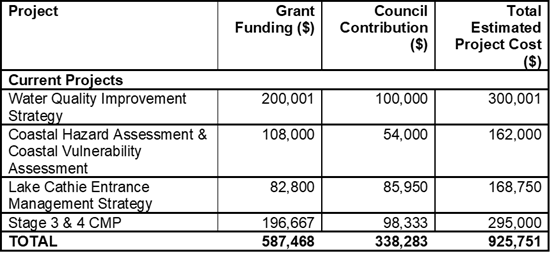
4. Legislative and Policy Implications
There
are no new or immediate legislative or policy implications resulting from this
update. All actions outlined are in accordance with existing state and local
planning instruments, including alignment with the NSW Coastal Management
Framework and associated guidelines.
5. Strategic Context and Implications
The projects and initiatives outlined in this report align with Council's adopted strategies and objectives for sustainable natural resource management. They support long-term coastal and estuarine resilience, ecosystem health, and informed planning in line with Council’s Strategic Planning objectives.
6. Risk and Insurance Implications
There are no new or elevated risk or insurance concerns raised by this report. Risk assessments have been incorporated into individual project designs and planning phases, particularly in relation to coastal hazards and infrastructure vulnerability.
7. Engagement and Consultation
There are no new engagement or consultation activities proposed as part of this report. Existing projects continue to incorporate stakeholder engagement in accordance with funding requirements and best practice community involvement standards.
8. Civic Leadership
This report demonstrates Council’s ongoing commitment to responsible environmental stewardship and transparent project delivery. The initiatives presented contribute to evidence-based decision-making and uphold community expectations for sustainable coastal and waterway management.
Options
This report is provided for information purposes only.
|
Attachments Nil
|
Agenda Community Planning and Environment
Subject: ArtWalk Report and Future Strategy
Presented by: Community, Planning and Environment, Melissa Watkins
That Council:
1. Note the details in the report providing an overview of ArtWalk 2025.
2. Endorse the future three-year strategy for ArtWalk from 2027-2029 subject to funding being confirmed.
3. Proceed to incorporate funding to support strategy delivery in the development of the draft 2026-2027 Operational Plan and Long-Term Financial Plan for future funding for Council’s consideration.
Executive Summary
ArtWalk is Port Macquarie’s premier annual creative arts festival and has become a cornerstone of the region’s cultural identity since its inception in 2016. Now heading into its tenth year, the event consistently attracts tens of thousands of attendees, transforming the CBD and surrounding precincts into a vibrant canvas of light, performance, music, digital installations, and storytelling. ArtWalk provides an accessible, family-friendly platform that celebrates local and regional artists while drawing visitors from across the Mid North Coast, significantly contributing to tourism, the night-time economy, and community pride.
The festival’s importance extends beyond entertainment. ArtWalk strengthens community connection, fosters cultural inclusion, and stimulates the local creative economy by supporting emerging and established artists. It enhances Port Macquarie-Hastings’ reputation as a liveable, innovative, and culturally dynamic region, aligning strongly with Council’s Community Strategic Plan, Cultural Plan and Community Inclusion Plan objectives.
To maintain this momentum and grow its impact, identified budget allocations are critical beyond 2026. Rising costs of production, compliance, and infrastructure, combined with audience demand for new immersive experiences, mean that current funding levels will not sustain ArtWalk’s scale or quality beyond 2026. Strategic investment will allow ArtWalk to continue to:
· Expand precinct activations and creative programming.
· Support more local artists.
· Attract major sponsorships and state/national funding through leveraged Council investment.
· Deliver safe, accessible, and innovative event experiences for a growing audience.
ArtWalk funding is secured for 2026 but not beyond. This report showcases the impressive achievements of Artwalk 2025, outlines a future strategy for Artwalk and proposes an increased and sustained budget commitment to ensure ArtWalk continues to deliver significant cultural, social, and economic returns for the Port Macquarie-Hastings community for 2027-2029.
Report
1. Background
ArtWalk began in 2016 as an experimental evening activation in Port Macquarie’s CBD, designed to bring creativity into public spaces and connect local artists with the community. From its first year it captured imaginations by transforming streets, laneways, and shopfronts into vibrant, temporary galleries and installations.
Over the years, ArtWalk has grown into Port Macquarie Hastings Council’s flagship arts and cultural festival, attracting tens of thousands of visitors annually. The event has consistently showcased local, regional, and Aboriginal and Torres Strait Islander artists, blending visual arts, performances, digital projections, live music, and interactive installations.
Each year, the event shines a light on creativity, from celebrating visual and performing arts to exploring storytelling, nature, and interactive art installations. The festival has also expanded beyond the Port Macquarie CBD, activating multiple precincts including Town Green West, Lady Nelson Wharf, Phillips Lane, Hay Street, and the Port Macquarie Observatory, drawing together diverse communities across the region.
Celebrating its 10th year in 2026, ArtWalk has become more than a one night event, it has become a cultural institution that strengthens community connection, boosts the local creative economy, and reinforces Port Macquarie-Hastings reputation as a vibrant cultural destination.
2. Discussion
ArtWalk as a Signature Event
ArtWalk has grown into the region’s premier arts and cultural activation, drawing together artists, businesses, community groups, and thousands of residents and visitors into the heart of Port Macquarie. It showcases the vibrancy of the local creative sector, while also delivering substantial economic and social benefits to the community.
Historical Growth and Impact
Since its establishment in 2016, ArtWalk has seen extraordinary growth in both scale and outcomes. The inaugural event attracted approximately 3,500 attendees, 9 participating businesses, and 18 artists. By comparison, in 2025 the event attracted 29,658 attendees (based on independent data from ActiveExchange), with 26 businesses and 270 artists directly involved.
This growth reflects the community’s support for Artwalk and its appetite for arts and cultural experiences, and aligns with Council’s objectives of supporting local creatives, activating the CBD, and boosting the night-time economy.
A key milestone was reported to Council at the Ordinary Meeting of 20 June 2018, when ArtWalk attracted an estimated 11,500 people—representing a 300% increase from its establishment. The ongoing growth and success demonstrates the power of arts and culture in drawing residents and visitors into the CBD and delivering significant benefits for the hospitality and retail sectors.
Return on Investment
As detailed below, over the past nine years, Council’s investment in ArtWalk has translated into a strong return on investment for the community, measured not only through economic uplift for local businesses, but also through community pride, inclusivity, and cultural participation.
|
YEAR |
THEME |
BUDGET |
ARTISTS |
BUSINESSES |
ATTENDANCE |
|
2025 |
Out of This World: -(event date moved to Friday 4 July due to the May flood event) |
$190.000.00 incl $50,000 from Ec Dev budget, and sponsorship $10,000 Optus |
300 |
40 |
29,658*
|
|
2024 |
Coastal Nights: art installations, interactive exhibits and live performances |
$246,053.00 Including $110,000 youth grant
|
100 |
30 |
25,936* |
|
2023 |
Up in Lights: focus on multi-site activations, |
$139,240.19 |
80 |
23 |
20,000 |
|
2022 |
A return to full activation with live music, street art and artist markets. |
$217,655 incl successful grant $110,793 and covid funding |
288 |
40 |
20,000 |
|
2021 |
Covid impacted |
|
|
|
|
|
2020 |
Covid impacted - COVID-Safe Longest Footpath Art Gallery |
$92,877 |
236 |
40 |
20,000 over a number of days |
|
2019 |
Artwalk yr 4 |
$43,909 |
114 |
45 |
13,500 |
|
2018 |
Artwalk yr 3 |
$25,000 |
71 |
42 |
11.500 |
|
2017 |
Artwalk yr 2 |
$15,000 |
45 |
26 |
8,500 |
|
2016 |
ArtWalk Port Macquarie 2016 pilot program |
$10,000 |
18 |
9 |
3,500 |
The scale of growth in artist involvement also highlights the event’s role in creating a platform for local creatives and strengthening the region’s identity as an arts and cultural destination.
2025 Wrap Up
The 2025 “Out of This World” theme transformed the CBD with interactive installations, live performances, pop-up exhibitions, and immersive experiences that highlighted the extraordinary talent of our local creatives. This year also marked the first time corporate sponsorship was secured for the event, with Optus providing $10,000 in support.
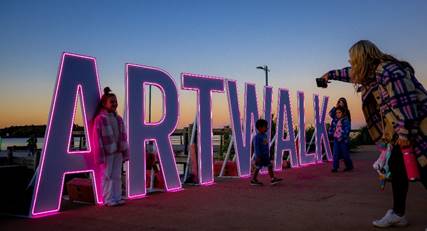
The total cost for this year’s event (2024-2025) was $170,000 which comprised an Operating budget of $110,000, an allocation from the Economic Development budget of $50,000 and Sponsorship of $10,000.
Resilience and Community Spirit
The May 2025 severe weather event significantly impacted the Port Macquarie
CBD, including businesses and spaces intended to host ArtWalk. As a result, the
event was rescheduled from 5 June to 4 July. Despite these challenges, the
community, businesses, and artists rallied together to ensure the event’s
success. Nearly all participants adapted to the new date, and the revised
timing allowed emergency services to be included, providing an opportunity to
acknowledge and showcase their vital role in the community. This adaptability
demonstrated the resilience of both the event and the local community,
reinforcing ArtWalk’s place as a unifying and celebratory occasion.
Event Scale and Participation
ArtWalk 2025 once
again reinforced its role as a driver for economic activity, cultural tourism,
and community connection. Key outcomes included:
· Attendance: Over 29,658 attendees on the night (ActiveExchange data).
· Artists and performers: 270 involved.
· Business collaborations: 40 artists partnered with local businesses.
· Markets and food vendors: 14 food stalls and 26 artisan market stalls.
· Satellite locations:
o St Thomas Church and St Agnes’ Church, Hay Street
o Little Turkey, Park Street
o Port Macquarie Observatory, Stewart Street
· Extended program: Following public feedback in 2024, activities were extended across the weekend, including keeping key installations onsite, continued live performances on Saturday, and the Hastings Art Trail across the weekend.
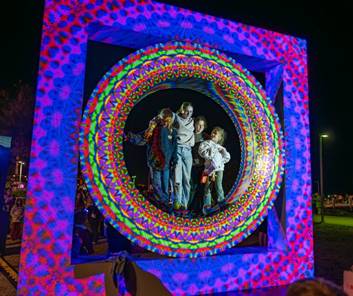
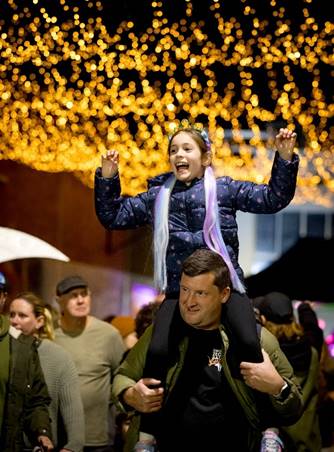
Economic Impact and Reach
Economic development
data indicate a combined spend by locals and visitors of $17.47 million over
the ArtWalk weekend. This equates to a return on investment of approximately
$97 for every $1 spent, highlighting the event’s strong contribution to the
local economy.
Partnerships also played an important role in expanding ArtWalk’s reach. Port Central was a key partner in providing parking and access to the Youth Precinct in Phillips Lane, recording more than 14,000 visitors between 3pm and 9pm—the highest foot traffic in the centre’s history.
The Glasshouse recorded 2,578 visitors on the night, compared with 3,080 in 2024, continuing to demonstrate strong audience interest in ArtWalk activations.
Online engagement was equally significant, with over 194,000 views across ArtWalk’s Facebook and Instagram channels between the media launch on 10 April and one week post-event (11 July).
Community and Partner Feedback
Engagement with audiences on the night and following the event generated 122 survey responses, highlighting:
· Strengths: Variety and quality of performances, welcoming atmosphere, and strong sense of community pride.
· Suggestions: Extending event hours and expanding the footprint.
· Visitor profile:
o 74 respondents (61%) travelled specifically for ArtWalk.
o 48 respondents (39%) identified as locals.
o Out-of-town visitors stayed an average of 2.3 nights, with some staying up to five nights, boosting the local visitor economy.
Attendee’s points of origin:
|
Port Macquarie LGA |
38.0% |
|
Coffs Harbour LGA |
4.0% |
|
Kempsey LGA |
2.0% |
|
Mid Coast LGA |
3.0% |
|
Other NSW areas |
43.0% |
|
Interstate |
10.0% |
Respondents frequently described the event as “magical” and “the best night of the year” for Port Macquarie, affirming ArtWalk’s reputation as a flagship cultural event for the region.
Participating organisations, schools, and community groups expressed strong support for ArtWalk, highlighting both its cultural value and economic impact. Feedback received included:
· “We’re incredibly proud that students from Years 7 to 12 at Hastings Secondary College have contributed artworks to ArtWalk for the past three years. It’s a highlight of our creative calendar, and our students are always excited to be involved in such a vibrant community event.” – Hastings Secondary College
· “The vibe was amazing, loads of happy people everywhere, good things to see and do. We had hundreds of people through the gallery, as well; so not only was it a fun and community-enriching event, it was great for business.” – Luminance Art Gallery
· “We had a great night; we were busy right from the start and continued until we finished. I felt that people knew what we had to offer this year. We had hundreds of people come through and had plenty of positive feedback.” – Blue Sky Community Services
· “Thank you so much for inviting us to sing at ArtWalk. It was an amazing event enjoyed by all. Well done on organising such a brilliant event.” – Girrwaa Duguula Choir
· “Congratulations on another fantastic ArtWalk! It looked like the whole thing was a huge success, and we love being part of it. We would love to continue our Clarence St activation into next year and beyond, if you'll have us.” – Tortuga Circus Performers
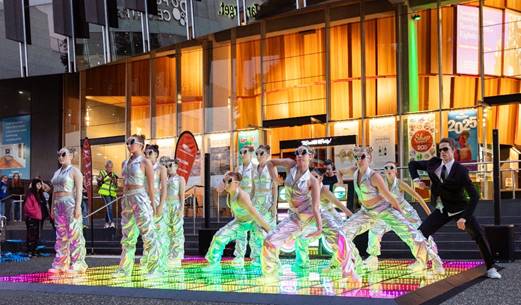
Future Three-Year Strategy
To build on the success of previous years and ensure ArtWalk remains a vibrant, sustainable, and high-impact event, a clear and forward-thinking strategy is essential. The following proposed three-year plan provides a roadmap to guide ArtWalk’s continued evolution—balancing creativity with financial sustainability, deepening community and artist engagement, and positioning the event as a signature cultural experience for the region.
This strategy outlines a vision for growth, innovation, and long-term value, ensuring ArtWalk continues to reflect the unique identity of Port Macquarie-Hastings while delivering measurable cultural, social, and economic outcomes.
Vision
and Purpose
ArtWalk has grown to become Port Macquarie-Hastings’ premier creative
event, attracting thousands of visitors and showcasing the region’s
talent. To ensure it continues to thrive, attract investment, and reflect the best
of our place and people, a three-year strategic plan is proposed. This plan
aims to:
· Future-proof ArtWalk by making it sustainable and innovative.
· Position ArtWalk as a whole-of-Council showcase event.
· Deliver stronger cultural, community, and economic outcomes year on year.
Strategic
Priorities (2027–2029)
Over the next three years, ArtWalk
will focus on four core priorities:
1. Artist Engagement – deepen partnerships with local and regional artists, ensuring their work is central.
2. Business and Economic Growth – strengthen partnerships with local businesses, create stronger economic opportunities, and encourage private sector investment.
3. Innovation and Fresh Experiences – introduce new creative themes annually, featuring interactive and visual activations to maintain public interest and drive repeat visitation.
4. Diversified Funding – grow sponsorship, grants, philanthropy, merchandise, and tourism partnerships to ensure sustainability.
Year-by-Year Focus
· 2027 – Foundation & Sponsorship Expansion
o Secure at least three new corporate sponsors and one state/federal grant.
o Launch tiered sponsorship packages and explore philanthropic opportunities.
o Embed ArtWalk in Council’s Integrated Planning & Reporting (IP&R) suite.
· 2028 – Diversification & Audience Monetisation
o Introduce branded merchandise and explore licensing opportunities.
o Formalise precinct/business partnerships and package ArtWalk with tourism.
o Secure at least one multi-year funding agreement.
· 2029 – Growth & Legacy Building
o Position ArtWalk as a Mid North Coast flagship cultural tourism event.
o Secure long-term anchor sponsorships (3–5 years).
o Launch a “Friends of ArtWalk” program and explore targeted ticketed experiences.
Targets and Measures of Success
· Year 1 (2027): 20% increase in non-Council funding.
· Year 2 (2028): Merchandise and sponsorship income established, one multi-year agreement in place.
· Year 3 (2029): Achieve balanced funding mix – 40% Council base, 30% sponsorship, 20% grants, 10% earned income/philanthropy.
Proposed Budget Investment
2027–2029: Proposal for allocation of $150,000 per annum as an annual operating budget allocation (not currently included in the Long-Term Financial Plan).
3. Conclusion
ArtWalk has firmly established itself as Port Macquarie-Hastings’ premier creative festival, delivering cultural, social, and economic benefits to the community for nearly a decade. The 2025 event again demonstrated its ability to attract large audiences, showcase local and Aboriginal artists, stimulate the night-time economy, and strengthen our profile as a vibrant cultural destination.
To sustain this momentum and meet growing community expectations, Council’s endorsement of a three-year strategy for ArtWalk 2027–2029 is essential. With a balanced approach to future planning and funding—including Council investment, sponsorship, grants, and new revenue streams—ArtWalk can continue to evolve, deliver outstanding experiences, and generate strong returns for the Port Macquarie-Hastings community well into the future.
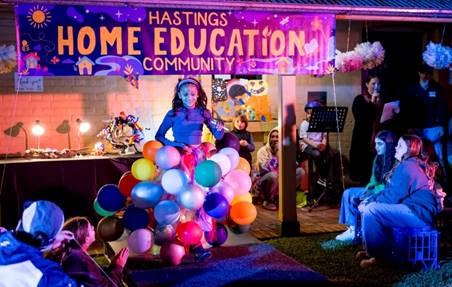
Key Considerations
4. Financial and Economic Implications
ArtWalk is recognised as a significant income generator for the local community, with a return on investment of approximately 97:1. Beyond the cultural and social value, the event directly benefits the local economy by driving visitation, spend, and business activity.
Currently, no Council budget has been allocated for ArtWalk beyond the 2026 event. Without additional funding, the future of this flagship event remains uncertain. Securing multi-year funding is therefore critical to safeguard ArtWalk’s sustainability and to provide certainty to artists, businesses, volunteers, and community groups who contribute to its ongoing success.
A sustained budget commitment will:
· Demonstrate Council’s genuine commitment to the community and confidence in the value of arts and culture.
· Enable longer-term planning and improved delivery of the event.
· Strengthen Council’s ability to leverage sponsorships and external grants.
· Provide stability that allows ArtWalk to consistently exceed community expectations.
Based on past year costs and budget allocations it is considered that an operational budget allocation of $150,000 per annum would be adequate to deliver Artwalk for the period 2027–2029. To achieve this it is recommended that funding to support strategy delivery be incorporated into the development of the draft 2026-2027 Operational Plan and Long-Term Financial Plan for future funding for Council’s consideration
By embedding this investment into future budgets, Council would reaffirm its role as a cultural leader and positions ArtWalk not just as an annual festival, but as an enduring contributor to the social, economic, and creative future of the Port Macquarie-Hastings region.
5. Legislative and Policy Implications
There are no direct legislative implications arising from this report. However, the proposed three-year strategy for ArtWalk aligns with Council’s existing policy commitments to cultural development, economic growth, and community engagement, as set out in the Community Strategic Plan and associated Delivery Program. Adoption of the strategy would reinforce Council’s broader policy objectives of supporting liveability, place activation, and cultural tourism.
6. Strategic Context and Implications
ArtWalk is directly aligned with Council’s broader strategic objectives around cultural vitality, economic growth, and community connection. The event supports key priorities in the Community Strategic Plan, particularly around liveability, creativity, and regional identity.
Depending on Council’s response to the proposed future strategy and funding request, ArtWalk will need to be formally integrated into Council’s Integrated Planning and Reporting (IP&R) framework for 2027 and beyond. This will ensure the event is embedded in long-term planning documents, with clear objectives, performance measures, and resourcing pathways.
Positioning ArtWalk within the IP&R suite will also enable stronger alignment across business units, ensuring the event is not only sustainable but also leveraged as a whole-of-Council opportunity to showcase our place, engage our community, and strengthen the local night-time economy.
7. Risk and Insurance Implications
ArtWalk is firmly established as Port Macquarie-Hastings’ signature cultural event, recognised by the community, businesses, artists, and visitors as a highlight of the creative calendar.
There are a few risks associated with Artwalk, namely:
· Economic conditions – Flexible sponsorship tiers to suit business capacity.
· Event saturation – Distinctive creative themes (light, digital, First Nations storytelling).
· Volunteer fatigue – Stronger partnerships with schools, TAFE, and community groups.
· Weather risk – Insurance coverage and increased use of indoor/covered activations.
If Council were to discontinue or fail to deliver ArtWalk, there are several key risks:
Community Trust and Expectations:
· ArtWalk is seen as a visible commitment to creativity, inclusion, and liveability. Cancelling or reducing the event risks damaging community trust and undermining Council’s reputation for delivering on its vision and commitments.
Perception of Leadership and Innovation:
· ArtWalk positions Council as a leader in cultural innovation and placemaking. Discontinuing the event would weaken this perception and potentially see Port Macquarie fall behind other regional LGAs investing in cultural tourism.
Stakeholder and Partner Relationships:
· The event relies on long-standing partnerships with artists, Aboriginal and Torres Strait Islander groups, schools, businesses, volunteers, and sponsors. Failing to deliver would risk damaging these relationships, eroding goodwill, and making future collaboration and sponsorship harder to secure.
Tourism and Economic Perception:
· With its demonstrated economic impact and visitor draw, ArtWalk contributes to the region’s night-time economy and tourism brand. Cancelling would reduce competitiveness as a cultural destination and undermine Council’s efforts to promote the region as vibrant and creative.
Political and Media Scrutiny:
· Given its profile, the absence of ArtWalk would attract negative attention from community, media, and potentially state-level forums. Questions could be raised about Council’s priorities, transparency, and support for cultural life, leading to reputational risk.
8. Engagement and Consultation
Community and stakeholder feedback was collected through a post-event survey and economic development data. A total of 122 survey responses were received, providing valuable insights into audience experiences and expectations.
Key Themes:
· Strong appreciation for the variety and quality of performances.
· Calls to extend event hours to allow more time to enjoy activities.
· Suggestions to expand the footprint further across the CBD.
· Consistent feedback about the welcoming atmosphere and community vibe, with many describing the event as inclusive and family-friendly.
Overall Sentiment:
Survey respondents overwhelmingly expressed appreciation for ArtWalk, with many describing it as “magical” and the “best night of the year” for Port Macquarie.
Stakeholder Feedback:
· “It’s a highlight of our creative calendar, and our students are always excited to be involved in such a vibrant community event.” — Hastings Secondary College
· “The vibe was amazing, loads of happy people everywhere, good things to see and do.” — Luminance Art Gallery
· “We had a great night; we were busy right from the start and continued until we finished.” — Blue Sky Community Services
This feedback highlights the strong community support for ArtWalk, the value of the event for local organisations, and its role in creating a vibrant cultural atmosphere for both residents and visitors.
9. Civic Leadership
ArtWalk is a clear demonstration of Council’s civic leadership in action. By curating and delivering Port Macquarie’s flagship arts and cultural event, Council actively shapes the region’s identity, sets a benchmark for inclusivity, and models innovation in placemaking and community connection.
Through ArtWalk, Council leads by example in several ways:
· Regional Identity: Positions Port Macquarie-Hastings as a progressive, creative, and liveable region, enhancing the LGA’s reputation and helping attract visitors, new residents, and investment.
· Economic and Cultural Growth: Leverages Council’s investment to generate significant economic return (over $17 million in 2025), while supporting the sustainability of local artists and businesses. This balance of cultural enrichment and financial impact exemplifies effective civic governance.
· Equity and Inclusion: Ensures cultural experiences are free, accessible, and welcoming to people of all ages, abilities, and backgrounds. ArtWalk directly aligns with Council’s Community Inclusion Plan and Disability Inclusion Action Plan, demonstrating leadership in embedding equity into public life.
· Connection and Cohesion: Brings together artists, businesses, schools, Aboriginal and Torres Strait Islander groups, volunteers, and visitors—showcasing Council’s role as a convener and connector that fosters pride, belonging, and social cohesion.
Increasing funding for ArtWalk is more than an investment in an event it signals to the community and external partners that Council values creativity, champions inclusivity, and is committed to shaping a thriving and connected future for the region.
|
Attachments Nil
|
Agenda Community Planning and Environment
Subject: Recommended Items from the July 2025 Meeting of the Port Macquarie-Hastings Sporting Fund
Presented by: Community, Planning and Environment, Melissa Watkins
That Council endorse the Port Macquarie-Hastings Sporting Fund Sub-Committee recommendations as follows:
1. Payment of $500.00 to Stephanie Dun to compete at the Australian Schools Orienteering Championships in Queensland between the 27 September and 5 October 2025.
2. Payment of $500.00 Jessica Dun to compete at the Australian Schools Orienteering Championships in Queensland between 27 September and 5 October 2025.
3. Payment of $750.00 to Lily Moseley to compete at the 2025 Australian Secondary Schools Rugby League Championships between the 28 June and 5 July 2025. Noting the application was received prior to the event commencement date.
Discussion
The Port Macquarie-Hastings Sporting Fund Committee met on 24 July 2025 and considered grant applications. The submission from Stephanie Dun, Jessica Dun, and Lily Moseley were determined to have met the funding criteria. Accordingly, the Sub-Committee recommends to Council the following payment from the fund:
· Stephanie Dun - $500.00 grant to compete at the Australian Schools Orienteering Championships in Queensland between the 27 September and 5 October 2025.
· Jessica Dun - $500.00 grant to compete at the Australian Schools Orienteering Championships in Queensland between 27 September and 5 October 2025.
· Lily Moseley - $750.00 grant to compete at the 2025 Australian Secondary Schools Rugby League Championships between the 28 June and 5 July 2025. Noting the application was received prior to the event commencement date.
The amounts recommended are consistent with the amount payable for participation at the relevant sporting levels nominated under the Port Macquarie-Hastings Sporting Fund Charter and guidelines.
|
Attachments Nil |
Agenda Notice of Motion
Subject: Notice of Motion - Annual Reports Special Schedule
Councillor Edwards has given notice of an intention to move the following motion:
Recommendation
That Council:
1. Include in future Annual Reports a summary of service-level financial data consistent with the Net Cost of Services previously reported under Special Schedule 1 of the former Local Government Code of Accounting Practice and Financial Reporting, using data sourced from Council’s Financial Data Return (FDR) to the Office of Local Government.
2. Present this information in a clear and accessible format for the community, incorporating both tabular and graphical summaries where appropriate.
3. Ensure the data is published alongside Council’s audited financial statements within the Annual Report, with appropriate disclaimers noting its unaudited status and any limitations in alignment with Council’s Integrated Planning and Reporting (IP&R) framework services categories.
Comments by Councillor Edwards:
The former Special Schedule 1 – Net Cost of Services was a mandatory part of NSW councils’ Special Purpose Financial Statements until the 2023-2024 reporting changes. This schedule provided a transparent breakdown of the net cost of individual council services, identifying how much was funded by user charges, grants and rates.
While no longer a statutory requirement, retaining this level of disclosure would:
a. Improve community understanding of how Council funds its services
b. Support evidence-based decision-making by elected members; and
c. Maintain transparency and comparability over time.
By incorporating this information into PMHC’s Annual Report, council can demonstrate its commitment to open, accountable governance, and ensures residents continue to have access to detailed service cost information.
Comments by Chief Executive Officer
With regard to Special Schedule 1, Net Cost of Services (NCOS) was a mandatory and audited disclosure detailing the net cost of delivering each council service which the Office of Local Government removed in the 2020 Code update as similar data was collected via the Financial Data Return (FDR).
We could provide similar data to the previous Schedule 1, however it would initially need to be a re-presentation of data we already have available from our FDR return.
However, inclusion of this data, whilst improving transparency of service NCOS to the community, would have the following caveats:
· Unaudited status: FDR service level data is not externally audited, unlike the former Special Schedule, and therefore should not be included in the same section of the Annual Report as the audited Financial Statements
· Framework misalignment: FDR service categories do not align with Council’s IP&R framework, preventing integration and/or comparison with strategic planning and performance reporting service classifications
· Data quality caveats: Service-level NCOS data will be subject to refinement over time through improvement plan initiatives, supported by system improvements such as a chart of accounts restructure. Ultimately the aim would be to provide services categories that align with the IP&R. We would need to scope out the effort, timeline and resources required to achieve this.
Resourcing Implications
There are minimal resourcing implications arising from this motion and should this be successful it can be achieved within business as usual activities within financial reporting resources.
Financial Implications
There are no financial implications arising from this motion.
Policy Implications
There are no policy implications arising from this motion.
|
Attachments Nil
|
Agenda Notice of Motion
Subject: Notice of Motion - Proposed Local Government NSW Annual Conference Motion - Biodiversity and Conservation SEPP 2021
Councillor Edwards has given notice of an intention to move the following motion:
Recommendation
That Council submit the following motion to the 2025 Local Government NSW Annual Conference for consideration:
That Local Government NSW advocates to the NSW Government for improved biodiversity protection and calls on the NSW Government to amend the Biodiversity and Conservation SEPP 2021 to apply the Koala Tree Species Schedule contained in Chapter 4 to all land use zones across NSW to ensure consistent protection of koala habitat regardless of land use zoning.
Comments by Councillor Edwards
The Biodiversity and Conservation SEPP 2021 currently includes a Koala Tree Species Schedule (Chapter 4) listing both primary and secondary food and habitat trees known to be critical to the survival of koalas across different Koala Management Areas in NSW. However, Chapter 4 does not currently apply to all land use zones and means that koala habitat assessments are not occurring via logical and adequate definition and process.
Expanding the application of the Koala Tree Species Schedule to all land use zones would ensure:
a. Consistency in how koala habitat is identified and assessed across NSW
b. Stronger protection for isolated or remnant habitat
c. Alignment with the NSW Koala Strategy’s objectives to halt population decline by 2050
This simple legislative amendment could ensure the Schedule in Chapter 4 of the SEPP is applied uniformly across all land use zones so that the habitat that koalas rely upon, and as an umbrella species, therefore that biodiversity more broadly relies upon can be better protected.
Comments by Chief Executive Officer
There are no concerns with the proposed Notice of Motion to suggest a motion for consideration at the 2025 Local Government NSW Annual Conference.
Resourcing Implications
The proposed motion does not have direct resourcing implications for Council at this stage.
Financial Implications
There are no immediate financial implications associated with submitting this motion.
Policy Implications
There are no immediate policy implications associated with submitting this motion.
|
Attachments Nil
|
Agenda Notice of Motion
Subject: Notice of Motion - Proposed Local Government NSW Annual Conference Motion - Constitutional Referendums
Councillor Lipovac has given notice of an intention to move the following motion:
Recommendation
That Council submit the following motion to the 2025 Local Government NSW Annual Conference for consideration:
That Local Government NSW calls on the NSW Government to amend section
20(1) of the Local Government Act 1993 to require that the question at a council
constitutional referendum is carried if it is supported by at least a 60% majority
of the votes cast.
Comments by Councillor Lipovac
In order to offset and combat the increasing amount of donkey votes, informal votes and a significant number of people making a decision without fully understanding the reasons behind the referendum question being asked and the repercussions of their vote, a 60% pass mark would ensure that the final vote count will in fact be a true representation of whether or not the majority of voters accept the change being presented to them.
Comments by Chief Executive Officer
The proposed motion is inconsistent with referendums for other levels of government and may also be a source of confusion for the public. 60% may not be a figure that the public readily associate with, and the basis with which it is proposed requires consideration. 50% is based on a majority which reflects how decision making typically occurs across our political system. The proposal to change the majority to 60% rather than the current 50% could confuse a process that is currently relatively easy to understand.
The proposed motion should be considered in the broader local government context across NSW given that is the forum it will be discussed in.
Resourcing Implications
There are no resourcing implications arising from this motion.
Financial Implications
There are no financial implications arising from this motion.
Policy Implications
There are no policy implications arising from this motion.
|
Attachments Nil
|
Agenda Notice of Motion
Subject: Notice of Motion - Proposed Local Government NSW Annual Conference Motion - Determine Method of Electing Mayor
Councillor Lipovac has given notice of an intention to move the following motion:
That Council submit the following motion to the 2025 Local Government NSW Annual Conference for consideration:
That Local Government NSW calls on the NSW Government to:
1. Remove section 16(b) of the Local Government Act 1993 that requires that a constitutional referendum be conducted to change the basis on which the mayor attains office (that is, by election by the councillors or by election by the electors)
2. Amend the Local Government Act 1993 Chapter 9, Part 2, Division 2 - The Mayor, whereby Council must resolve at least 12 months prior to each ordinary election to determine the method of electing the Mayor for the following term, that is, by election by the councillors or by election by the electors.
Comments by Councillor Lipovac
This will prevent current Councillors, many of whom may not be re-elected, from determining the need for a referendum 4 years in advance, which is a binding decision that impacts the new term of Councillors and those seeking to run for Mayor. Allowing Councillors to determine 12 months out from an Ordinary Election the method of selecting a Mayor (by Councillors or by Electors) is a far more reasonable proposition and allows elected representatives to discuss the preferred method with the community much closer to the next Election. This system will better manage the expectations of Councillors and the Community moving forward and provide greater flexibility especially in the instance where the Mayor no longer has overwhelming support.
Comments by Chief Executive Officer
The proposed motion to the 2025 Local Government NSW Annual Conference for the Council to determine the method of election of the Mayor, could be a source of confusion for communities. Across NSW there may be the scenario where the method of election of the Mayor will vary between election cycles. This may also raise the question as to why it should be Council determining the method of election, rather than the community via the current legislated process. With that could come trust and confidence concerns from communities in elected bodies, and it may similarly become a politicised issue each term pending the political environment at any given Council at the time.
Resourcing Implications
There are no resourcing implications arising from this motion.
Financial Implications
There are no financial implications arising from this motion.
Policy Implications
There are no policy implications arising from this motion.
|
Attachments Nil
|
Agenda Notice of Motion
Subject: Notice of Motion - Proposed Local Government NSW Annual Conference Motion - Environmental Monitoring, Planning and Decision Making
Councillor Edwards has given notice of an intention to move the following motion:
Recommendation
That Council submit the following motion to the 2025 Local Government NSW Annual Conference for consideration:
That Local Government NSW advocates for the improved usefulness of environmental reporting and calls on the NSW Government to amend the Protection of the Environment Administration Act 1991 to require the NSW EPA to provide for State of the Environment Reporting that includes the ability to observe LGA-scale breakdown to enable more targeted and locally relevant environmental monitoring, planning and decision making.
Comments by Councillor Edwards
The NSW State of the Environment (SoE) report is a critical tool for tracking the condition, pressures and trends affecting our natural environment. While the current reporting framework provides valuable state-wide insights, there is a growing need for this information to be more granular, localised and actionable at the Local Government Area level. Local Government is on the frontline of environmental management and land use planning. Councils are required to monitor, protect and enhance their local environments, yet are often working without consistent access to up-to-date LGA-specific environmental datasets.
By enhancing the NSW SoE reporting framework to include LGA-scale breakdowns of key environmental indicators, the reporting would support stronger local decision-making, more effective monitoring and greater transparency to local communities.
Comments by Chief Executive Officer
There are no concerns with the proposed Notice of Motion to suggest a motion for consideration at the 2025 Local Government NSW Annual Conference.
Resourcing Implications
The proposed motion does not have direct resourcing implications for Council at this stage.
Financial Implications
There are no immediate financial implications associated with submitting this motion
Policy Implications
The motion aligns with Council’s strategic objectives in environmental sustainability, evidence-based planning, and transparency.
|
Attachments Nil
|
Agenda Notice of Motion
Subject: Notice of Motion - Proposed Local Government NSW Annual Conference Motion - Funding to Support Monitoring and Enforcement of Development Consent Conditions
Councillor Edwards has given notice of an intention to move the following motion:
Recommendation
That Council submit the following motion to the 2025 Local Government NSW Annual Conference for consideration:
That Local Government NSW advocates to the NSW Government for dedicated and ongoing funding to support Councils in the monitoring and enforcement of development consent conditions, including staffing, training, and digital compliance tools. This funding should reflect the increasing complexity and volume of development activity and be administered through the Department of Planning, Housing and Infrastructure as part of a broader strategy to uphold planning integrity and community trust.
Comments by Councillor Edwards
Councils across NSW are the primary consent authority for most forms of development. While councils approve Development Applications, their statutory responsibilities extend to monitoring and enforcing compliance with consent conditions including conditions relating to environmental protection, vegetation management and infrastructure delivery.
Currently, many councils face significant challenges in carrying out this compliance role due to:
a. Inadequate or non-existent funding support from the NSW Government
b. Limited statutory fees or cost-recovery mechanisms to cover the cost of compliance monitoring; and
c. Increasingly complex development conditions (e.g. biodiversity offsets, environmental management plans, vegetation management plans, stormwater and infrastructure delivery requirements).
Without appropriate resourcing, compliance obligations can be undermined, with risks to community trust in the planning system, environmental outcomes and the equitable treatment of developers.
LGNSW has previously raised compliance resourcing issues through submissions to inquiries and regulatory reforms however, this advocacy has not yet been captured in the LGNSW Policy Platform. To provide clarity and strengthen LGNSW’s mandate, this motion seeks to make it explicit that the NSW Government should adequately resource councils to fulfill their compliance functions.
Comments by Chief Executive Officer
There are no concerns with the proposed Notice of Motion to suggest a motion for consideration at the 2025 Local Government NSW Annual Conference.
Resourcing Implications
The proposed motion does not have direct resourcing implications for Council at this stage.
Financial Implications
There are no immediate financial implications associated with submitting this motion.
Policy Implications
There are no immediate policy implications associated with submitting this motion.
|
Attachments Nil
|
Agenda Notice of Motion
Subject: Notice of Motion - Proposed Local Government NSW Annual Conference Motion - Stormwater Management Services
Councillor Edwards has given notice of an intention to move the following motion:
Recommendation
That Council submit the following motion to the 2025 Local Government NSW Annual Conference for consideration:
That Local Government NSW advocates for the financial sustainability of Local Government and calls on the NSW Government to amend section 125AA of the Local Government (General) Regulation 2021 regarding stormwater management services, to provide indexation of revenue raised from a stormwater levy in line with the rate peg.
Comments by Councillor Edwards
The maximum levy cap hasn’t changed since it was introduced in 2006 but real costs for maintenance, infrastructure upgrades and stormwater mitigation have increased with inflation and therefore councils need to be able to collect a higher amount to:
a. Maintain the purchasing power of levy funds
b. Ensure ongoing investment in urban stormwater infrastructure; and
c. Reduce reliance on general rates or grants for water management
A similar motion was debated and supported at the 2018 LGNSW conference which was then included in the LGNSW Policy Platform but is not currently explicitly listed within the LGNSW 2025 Policy Platform however should be.
Comments by Chief Executive Officer
The stormwater management service charge was introduced in the 2006/07 financial year as a fixed-rate levy per eligible lot. Since its inception, the charge has remained static, only increasing when new lots are subdivided, generating an additional $25 per residential lot (other rates apply to strata, business and industrial lots). However, this mechanism fails to account for inflation and rising construction costs, meaning the real value of the levy has steadily declined and councils are effectively able to do less each year with the same nominal revenue.
The function of the charge is to fund additional stormwater management services, including infrastructure upgrades, maintenance, and mitigation works. Without indexation, councils are increasingly constrained in their ability to deliver these services and are therefore increasingly reliant on general rates or external grants to support stormwater works.
Resourcing Implications
There are no resourcing implications.
Financial Implications
Additional funding provided by an increase to the levy via an amendment to the Local Government (General) Regulation 2021 would be used to support ongoing works outlined in the Stormwater Asset Management Plans.
Policy Implications
There are no policy implications.
|
Attachments Nil
|
Agenda Notice of Motion
Subject: Notice of Motion - Southern Breakwall Upgrade Project
Councillor Lipovac has given notice of an intention to move the following motion:
That Council:
1. Request the Acting Chief Executive Officer to write to the Member for Port Macquarie Rob Dwyer requesting a written update on the progress of the Port Macquarie Southern Breakwall Upgrade Project.
2. A copy of the request be provided to all Councillors
3. That any response received be tabled at the next available Ordinary Meeting of Council
Comments by Councillor
Nil
Comments by Chief Executive Officer
Staff have no concerns with writing to the Member for Port Macquarie Rob Dwyer requesting a written update on the progress of the Port Macquarie Southern Breakwall Upgrade Project.
For Council’s information, enquiry was made with Transport for NSW in August 2025 with respect to the status of the Port Macquarie southern breakwall project. The following advice was received at that time.
“The project team responsible for this project have advised as follows:
Transport for NSW is currently reviewing the next steps for the Port Macquarie Southern Breakwall, informed by recent technical assessments.
We remain committed to ensuring public safety and will continue to keep the community and stakeholders updated as the situation progresses.”
This update was provided to Councillors verbally by the Acting Chief Executive Officer on 14 August 2025.
Resourcing Implications
The motion does not have direct resourcing implications for Council.
Financial Implications
There are no significant financial implications associated with the request.
Policy Implications
There are no policy implications associated with the motion.
|
Attachments Nil
|
Agenda
|
RECOMMENDATION 1. That pursuant to Section 10A Subsections 2 & 3 and 10B of the Local Government Act 1993 (as amended), the press and public be excluded from the proceedings of the Council in Confidential Committee of the Whole on the basis that the items to be considered are of a confidential nature. 2. That Council move into Confidential Committee of the Whole to receive and consider the following items: Item 16.01 Land Acquisition - 24 Beechwood Road Wauchope This item is considered confidential under Section 10A(2)(d(ii)) of the Local Government Act 1993, as it contains commercial information of a confidential nature that would, if disclosed, confer a commercial advantage on a competitor of the Council. Item 16.02 Land Acquisition - Corner Lake Road and Ocean Drive Port Macquarie This item is considered confidential under Section 10A(2)(h) of the Local Government Act 1993, as it contains information concerning the nature and location of a place or an item of Aboriginal significance on community land. Item 16.03 Approval to Negotiate Settlement - Port Macquarie-Hastings Council v Willis This item is considered confidential under Section 10A(2)(e) of the Local Government Act 1993, as it contains information that would, if disclosed, prejudice the maintenance of law. 3. That the resolutions made by Council in Confidential Session be made public as soon as practicable after the conclusion of the Confidential Session and such resolutions be recorded in the Minutes of the Council Meeting.
|








